Tajikistan Managed Mobility Services Market Size & Growth Rate (2026-2032)
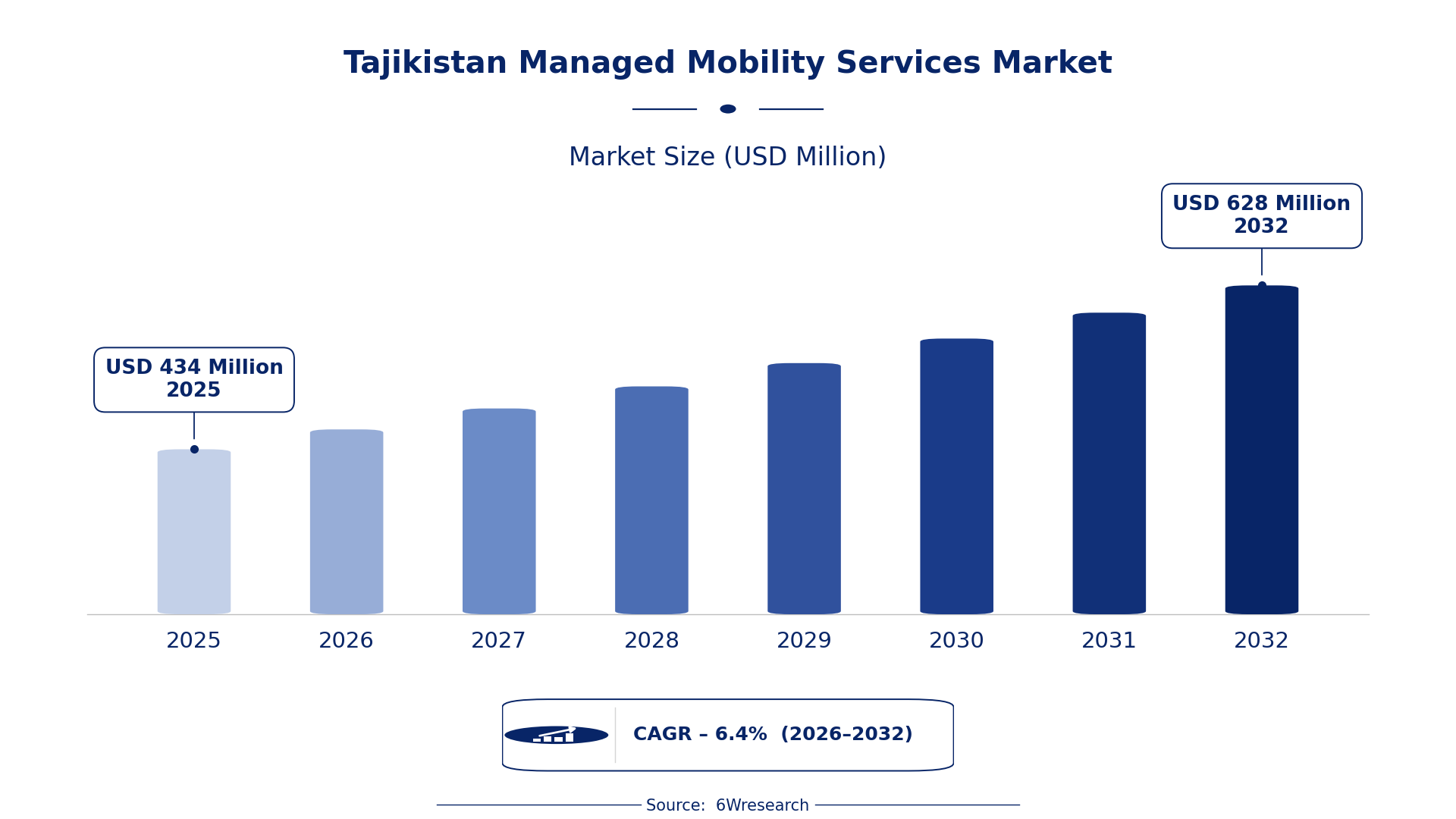
The Tajikistan Managed Mobility Services Market was estimated at USD 434 Million in 2025 and is projected to reach USD 628 Million by 2032, growing at a CAGR of 6.4% from 2026 to 2032.
Tajikistan Managed Mobility Services Market Synopsis
The Tajikistan Managed Mobility Services market is at a pivotal moment, propelled by the surging adoption of mobile devices and an increasing need for streamlined management of mobile assets. As businesses grapple with the complexities of mobile technology, they are turning to managed services to enhance operational efficiency and security.
Looking ahead, the market is set to expand further, driven by remote work trends and heightened data security demands. Telecom operators and managed service providers are stepping up their offerings, responding to the evolving needs of enterprises seeking to maintain competitiveness in a digital-first world.
Tajikistan Managed Mobility Services Market Year-wise Growth Rate and Key Drivers
This graph illustrates the annual growth rates of the Tajikistan Managed Mobility Services Market from 2021 to 2032, highlighting a steady upward trajectory and projected expansion over the forecast period.
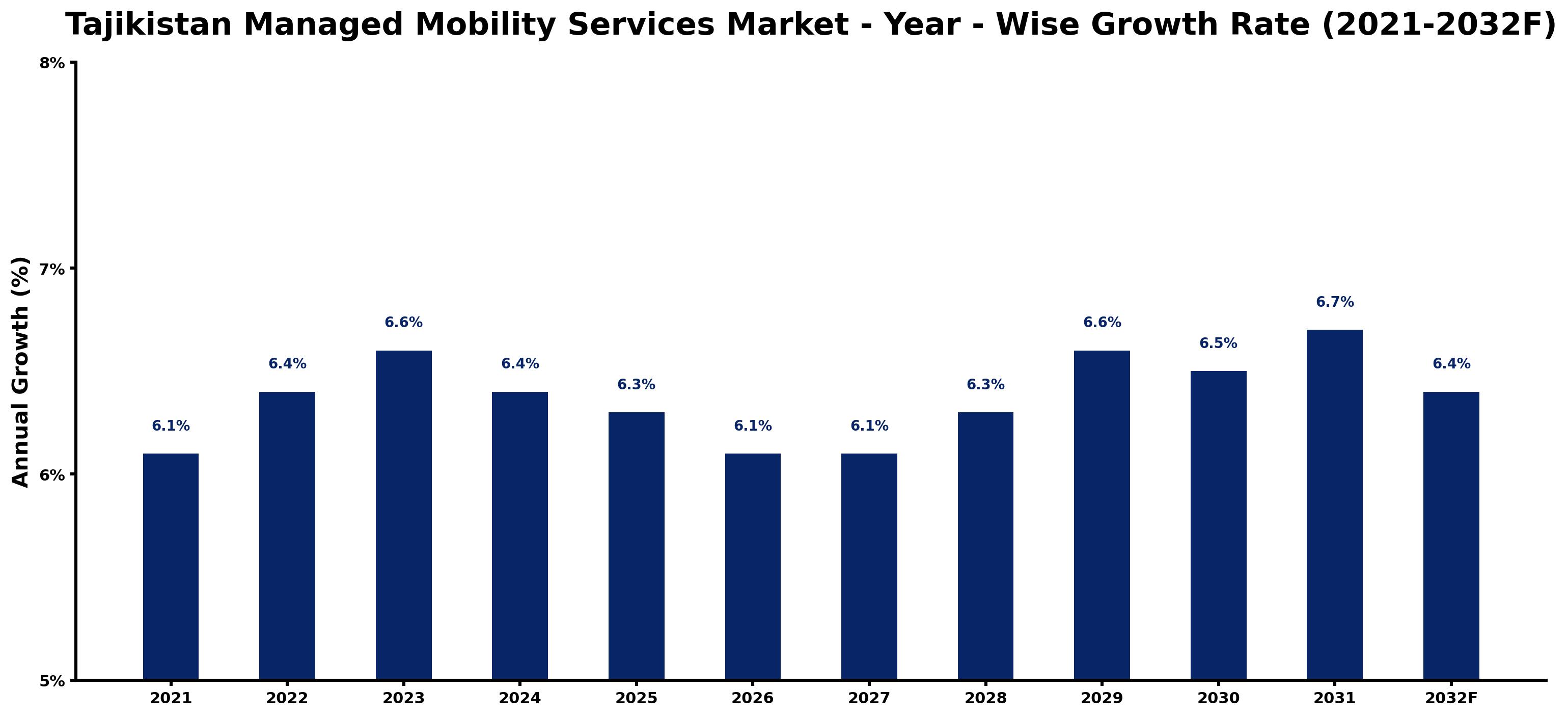
The table below presents the year‑wise growth rates along with the key drivers influencing the market
| Year | Growth Rate | Major Drivers |
| 2021 | 6.1% | Launch of Tajikistan's National Digital Economy Strategy. |
| 2022 | 6.4% | Increased focus on mobile health services post-pandemic. |
| 2023 | 6.6% | Government incentives for IT skill development programs. |
| 2024 | 6.4% | Growing partnerships between local startups and telecom providers. |
| 2025 | 6.3% | Introduction of mobile identity verification regulations. |
| 2026 | 6.1% | Increased foreign investments in telecommunications infrastructure. |
| 2027 | 6.1% | Rising popularity of mobile-based agricultural apps. |
| 2028 | 6.3% | Government support for e-government mobile applications. |
| 2029 | 6.6% | Surge in demand for mobile logistics solutions. |
| 2030 | 6.5% | Growing awareness of mobile cybersecurity standards. |
| 2031 | 6.7% | Adoption of 5G technology enhancing mobile service efficiency. |
| 2032 | 6.4% | Increasing reliance on mobile solutions for education access. |
Note: Market size estimations and growth projections presented in this report are based on 6Wresearch's proprietary forecasting methodology, utilizing the latest available industry data, government publications, and primary research inputs.
Tajikistan Managed Mobility Services Market Key Takeaways
Below are some of the specific key takeaways from the market, including:
- Increasing mobile workforce drives demand for managed mobility solutions.
- Cloud-based services are gaining traction among businesses for scalability.
- Enhanced data analytics are becoming integral for informed decision-making.
- Concerns over cybersecurity are propelling demand for robust security measures.
- Outsourcing to specialized service providers is on the rise, enabling efficiency.
Evaluation of Restraints in Tajikistan Managed Mobility Services Market
Despite the favorable growth trajectory, the Tajikistan Managed Mobility Services market faces notable constraints. One of the most pressing issues is the shortage of skilled IT professionals equipped to manage and implement mobility solutions effectively. This skill gap can obstruct companies from fully utilizing managed mobility services. Furthermore, infrastructural challenges, particularly in internet connectivity, hamper the seamless operation of these services, limiting their potential impact. Compliance with local data security regulations also adds complexity, requiring businesses to tread carefully as they adopt new technologies.
Tajikistan Managed Mobility Services Market Trends
Several trends are shaping the Managed Mobility Services landscape in Tajikistan. A significant shift toward cloud-based mobility solutions is evident, as businesses seek flexibility and scalability. Advanced data analytics are increasingly being integrated to drive operational insights and enhance decision-making processes. Additionally, the spotlight on cybersecurity has intensified, prompting organizations to invest in solutions that can safeguard sensitive data. Outsourcing managed mobility services to specialized providers is becoming common, allowing companies to focus on core competencies while benefiting from expert management.
Tajikistan Managed Mobility Services Market Opportunities
Investment opportunities in the Tajikistan Managed Mobility Services market are plentiful, especially in areas like mobile device management and enterprise mobility solutions. The continuing adoption of mobile technologies across various sectors, particularly finance, healthcare, and logistics, creates a pressing need for comprehensive managed services that address security and operational challenges. Investors have the chance to develop tailored solutions that align with the specific needs of Tajikistani businesses, leveraging the government's push for digital transformation and improved infrastructure.
Government Initiatives in the Tajikistan Managed Mobility Services Market
Government policy in Tajikistan is playing a crucial role in shaping the Managed Mobility Services market. Recent efforts focus on enhancing competition and ensuring data protection. By setting clear operational guidelines for service providers, the government seeks to foster a trustworthy environment that prioritizes consumer rights while promoting innovation within the industry.
- A national digital infrastructure upgrade programme launched in 2023 aims to improve connectivity and service delivery.
- Ongoing regulations focused on data protection standards are enhancing the operational framework for Managed Mobility Services.
- A planned public-private partnership expected to commence in 2026 is set to improve mobile service accessibility across rural areas.
- A recently completed initiative in 2024 established a licensing framework for Managed Mobility Services, aimed at boosting market transparency.
- Current discussions involve potential new policies to incentivize investment in cybersecurity measures for mobile services.
Future Insights of the Tajikistan Managed Mobility Services Market
The Tajikistan Managed Mobility Services market is on an upward trajectory toward 2032, driven by technological advancements and a growing mobile workforce. As businesses increasingly prioritize digital transformation, the demand for reliable managed services will intensify. Key factors such as the expansion of internet infrastructure, heightened security concerns, and governmental initiatives supporting digital advancements will collectively drive growth. The evolving landscape presents a compelling opportunity for service providers who can adapt to the shifting needs of Tajikistani organizations.
Tajikistan Managed Mobility Services Market Latest Developments
Recent activity within the Tajikistan Managed Mobility Services market indicates a proactive approach to enhancing service offerings. Over the last year, providers have been focused on expanding their capabilities to meet growing demand. Companies are investing in innovative solutions to address security and operational efficiency challenges faced by businesses.
- A major technology vendor unveiled a new mobile security solution in late 2024, designed specifically for local businesses.
- An ongoing initiative launched in early 2025 aims to integrate advanced analytics into existing mobility solutions to enhance user experience.
- A leading regional operator is expected to roll out enhanced mobile device management services in the first quarter of 2026.
- By mid-2025, a partnership is anticipated to be announced, aimed at developing tailored mobility solutions for the healthcare sector.
- A program introduced in early 2025 focusing on training IT personnel in mobility management is currently underway.
Tajikistan Managed Mobility Services Market - Key Attractiveness of the Report
- 10 Years of Market Numbers
- Historical Data Starting from 2022 to 2025
- Base Year: 2025
- Forecast Data until 2032
- Key Performance Indicators Impacting the Market
- Major Upcoming Developments and Projects
Key Highlights of the Report:
- Tajikistan Managed Mobility Services Market Outlook
- Market Size of Tajikistan Managed Mobility Services Market, 2025
- Forecast of Tajikistan Managed Mobility Services Market, 2032
- Historical Data and Forecast of Tajikistan Managed Mobility Services Revenues & Volume for the Period 2022-2032F
- Tajikistan Managed Mobility Services Market Trend Evolution
- Tajikistan Managed Mobility Services Market Drivers and Challenges
- Tajikistan Managed Mobility Services Price Trends
- Tajikistan Managed Mobility Services Porter's Five Forces
- Tajikistan Managed Mobility Services Industry Life Cycle
- Historical Data and Forecast of Tajikistan Managed Mobility Services Market Revenues & Volume By Function for the Period 2022-2032F
- Historical Data and Forecast of Tajikistan Managed Mobility Services Market Revenues & Volume By Device Management for the Period 2022-2032F
- Historical Data and Forecast of Tajikistan Managed Mobility Services Market Revenues & Volume By Application Management for the Period 2022-2032F
- Historical Data and Forecast of Tajikistan Managed Mobility Services Market Revenues & Volume By Security Management for the Period 2022-2032F
- Historical Data and Forecast of Tajikistan Managed Mobility Services Market Revenues & Volume By Maintenance & Support for the Period 2022-2032F
- Historical Data and Forecast of Tajikistan Managed Mobility Services Market Revenues & Volume By Organization Size for the Period 2022-2032F
- Historical Data and Forecast of Tajikistan Managed Mobility Services Market Revenues & Volume By SMEs for the Period 2022-2032F
- Historical Data and Forecast of Tajikistan Managed Mobility Services Market Revenues & Volume By Large Enterprises for the Period 2022-2032F
- Historical Data and Forecast of Tajikistan Managed Mobility Services Market Revenues & Volume By Industry Vertical for the Period 2022-2032F
- Historical Data and Forecast of Tajikistan Managed Mobility Services Market Revenues & Volume By Healthcare for the Period 2022-2032F
- Historical Data and Forecast of Tajikistan Managed Mobility Services Market Revenues & Volume By Manufacturing for the Period 2022-2032F
- Historical Data and Forecast of Tajikistan Managed Mobility Services Market Revenues & Volume By Logistics and Transportation for the Period 2022-2032F
- Historical Data and Forecast of Tajikistan Managed Mobility Services Market Revenues & Volume By Retail for the Period 2022-2032F
- Historical Data and Forecast of Tajikistan Managed Mobility Services Market Revenues & Volume By Financial Services for the Period 2022-2032F
- Historical Data and Forecast of Tajikistan Managed Mobility Services Market Revenues & Volume By Telecom and IT for the Period 2022-2032F
- Historical Data and Forecast of Tajikistan Managed Mobility Services Market Revenues & Volume By Media and Entertainment for the Period 2022-2032F
- Historical Data and Forecast of Tajikistan Managed Mobility Services Market Revenues & Volume By Travel and Hospitality for the Period 2022-2032F
- Tajikistan Managed Mobility Services Import Export Trade Statistics
- Market Opportunity Assessment By Function
- Market Opportunity Assessment By Organization Size
- Market Opportunity Assessment By Industry Vertical
- Tajikistan Managed Mobility Services Top Companies Market Share
- Tajikistan Managed Mobility Services Competitive Benchmarking By Technical and Operational Parameters
- Tajikistan Managed Mobility Services Company Profiles
- Tajikistan Managed Mobility Services Key Strategic Recommendations






































