Tajikistan Meat Packaging Market Summary
The tajikistan meat packaging market was estimated at USD 165 Million in 2025 and is projected to reach USD 228 Million by 2032, growing at a CAGR of 5.8% from 2026 to 2032.
Tajikistan Meat Packaging Market Year-wise Growth Rate and Key Drivers
This graph highlights how the Tajikistan Meat Packaging Market has steadily grown over the past five years, supported by major growth factors.
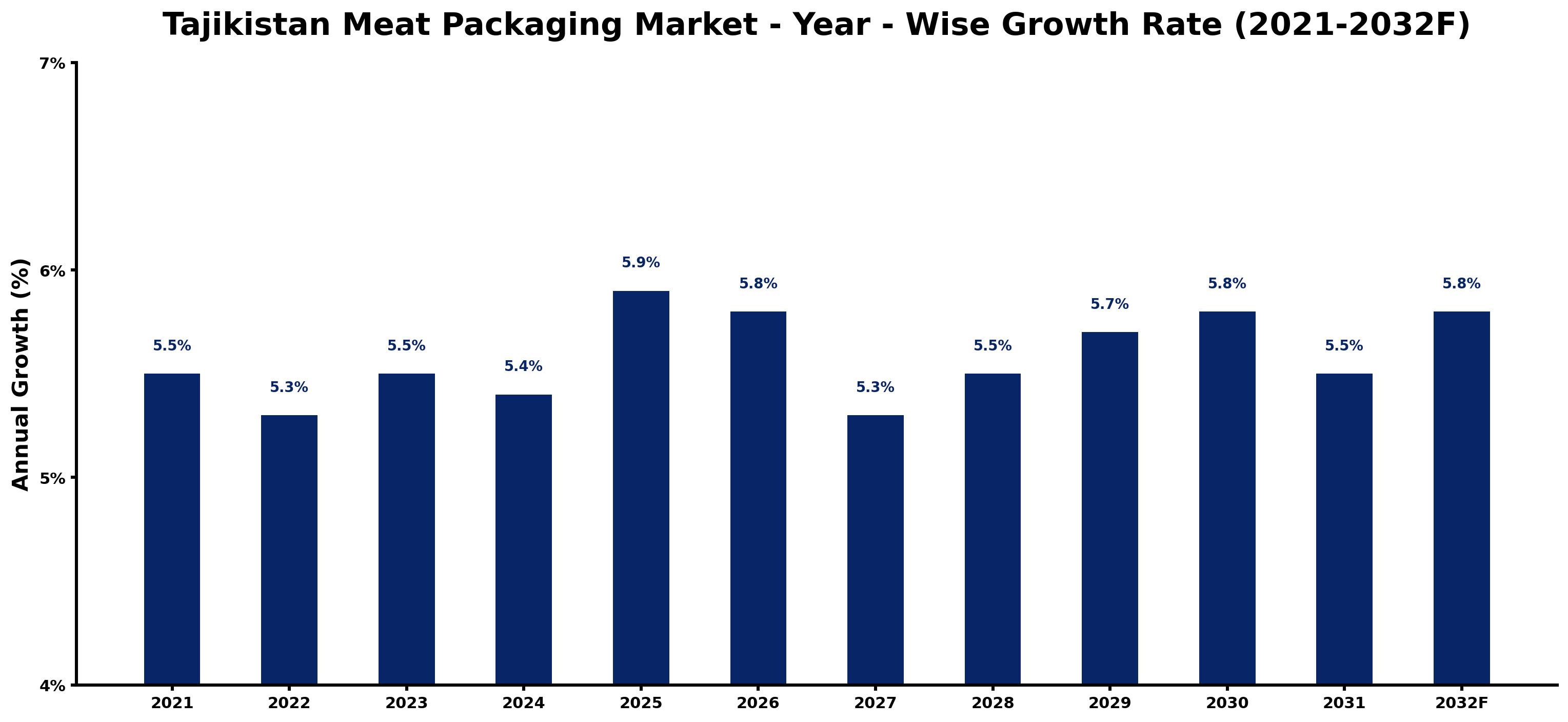
The table below presents the year wise growth rates along with the key drivers influencing the market
| Year | Growth Rate | Major Drivers |
| 2021 | 5.5% | A surge in poultry consumption highlighted the need for modern meat packaging solutions. |
| 2022 | 5.3% | Emerging local brands focused on quality are reshaping consumer expectations in Tajikistan. |
| 2023 | 5.5% | International investments are pouring into the meat sector, enhancing packaging technology availability. |
| 2024 | 5.4% | Changing lifestyles among urban populations create opportunities for convenient packaged meat products. |
| 2025 | 5.9% | Sustainability concerns are leading to a demand for eco-friendly meat packaging materials. |
| 2026 | 5.8% | Increased cross-border trade agreements facilitate access to advanced meat packaging machinery. |
| 2027 | 5.3% | Consumer awareness about food safety drives interest in vacuum and modified atmosphere packaging. |
| 2028 | 5.5% | Local regulations begin to favor industries adopting modern sanitation and packaging standards. |
| 2029 | 5.7% | E-commerce growth creates a necessity for efficient and durable meat packaging solutions. |
| 2030 | 5.8% | Partnerships with global suppliers introduce innovative packaging techniques to the local market. |
| 2031 | 5.5% | Rising disposable incomes empower consumers to choose premium packaged meat products. |
| 2032 | 5.8% | Technological advancements in automation streamline meat processing and packaging efficiencies. |
Note - Market size estimations and growth projections presented in this report are based on 6Wresearch's advanced forecasting approach, validated with industry datasets as of June 2026.
Tajikistan Meat Packaging Market Synopsis
The Tajikistan Meat Packaging Market is projected to reach 5.8% and witness significant growth during the forecast period (2026-2032). The burgeoning demand for packaged meat products, spurred by shifting consumer preferences and a heightened focus on convenience, underpins the market's expansion. As consumers increasingly prioritize food safety and quality, the meat packaging sector in Tajikistan is evolving, characterized by innovation in packaging technologies and materials.
Tajikistan Meat Packaging Market Growth Drivers
Several factors are propelling the growth of the Tajikistan Meat Packaging Market. Firstly, urbanization is leading to a shift in dietary habits, with more consumers turning to packaged meat for its convenience. Secondly, increasing disposable incomes are enabling consumers to spend more on quality meat products. Thirdly, a growing awareness regarding food safety and hygiene is pushing both consumers and producers towards adopting packaged solutions. Additionally, advancements in packaging technology are improving the shelf life of meat products, thereby attracting more customers. Lastly, the rising trend of e-commerce is facilitating wider distribution of packaged meat products, further driving market growth.
Tajikistan Meat Packaging Market Trends and Opportunities
The Tajikistan Meat Packaging Market is witnessing several notable trends. A significant shift towards sustainable and eco-friendly packaging materials is being observed, as consumers express concerns over the environmental impact of traditional packaging solutions. Moreover, there is a rising demand for portion-controlled packaging formats that cater to busy lifestyles and help manage food waste. Furthermore, innovation in packaging designs is enhancing product visibility and freshness, improving the overall consumer experience. Opportunities for investment are ripe in this sector, particularly in developing modern packaging facilities and adopting specialized packaging technologies tailored to local consumer preferences.
Tajikistan Meat Packaging Market Challenges and Restraints
Despite its positive outlook, the Tajikistan Meat Packaging Market faces several challenges. One major issue is the inadequacy of infrastructure for cold storage and transportation, which can compromise product quality and lead to spoilage. Furthermore, limited access to advanced packaging technologies hampers the efficiency and competitiveness of the market. The absence of standardized regulations and quality control measures also poses risks to food safety, especially concerning exports. Additionally, fluctuating prices of raw materials and instability in currency exchange rates can significantly affect production costs and profit margins for businesses. Addressing these challenges through strategic investments is vital for the market's sustainable growth.
Tajikistan Meat Packaging Market Investment Opportunities
The growing demand for packaged meat products presents several investment opportunities within the Tajikistan Meat Packaging Market. As consumer preferences evolve, there is a pressing need for modern and efficient meat packaging facilities. Investment in state-of-the-art packaging technologies can cater to the rising demand for hygienic solutions. Collaborating with local meat producers can enhance supply chain efficiency and ensure adherence to quality standards. Furthermore, the exploration of innovative packaging solutions, such as eco-friendly materials and portion-controlled formats, can provide a competitive edge. Overall, investing in this market offers substantial growth potential as the sector prepares for further development.
Tajikistan Meat Packaging Market Government Investment and Initiatives
The government of Tajikistan is actively implementing policies to regulate and support the meat packaging market. These policies include stringent quality control measures to ensure that packaged meat products comply with safety and hygiene standards. The government is also focused on enforcing proper labeling of meat products, thereby providing consumers with critical information regarding product content and origin. Additionally, incentives and subsidies are being introduced to bolster local meat packaging businesses, promoting competitiveness within the sector. Such initiatives aim not only to safeguard public health but also to foster a robust and sustainable meat packaging industry in Tajikistan.
Tajikistan Meat Packaging Market Latest Developments (May 2025 - June 2026)
In the recent period from May 2025 to June 2026, the Tajikistan Meat Packaging Market has witnessed noteworthy developments. There has been a strong emphasis on adopting environmentally friendly packaging materials, aligning with global sustainability trends. Additionally, advancements in packaging technology have enabled better preservation of meat products, enhancing their appeal to consumers. Market participants are increasingly exploring innovative designs that not only boost product visibility but also cater to consumer demands for convenience. Furthermore, collaborative efforts between the government and local producers have been initiated to improve supply chain dynamics and ensure the safety and quality of packaged meat products.
Tajikistan Meat Packaging Market - Key Attractiveness of the Report
- 10 Years of Market Numbers
- Historical Data Starting from 2022 to 2025
- Base Year: 2025
- Forecast Data until 2032
- Key Performance Indicators Impacting the Market
- Major Upcoming Developments and Projects
Key Highlights of the Report:
- Tajikistan Meat Packaging Market Outlook
- Market Size of Tajikistan Meat Packaging Market, 2025
- Forecast of Tajikistan Meat Packaging Market, 2032F
- Historical Data and Forecast of Tajikistan Meat Packaging Revenues & Volume for the Period 2022-2032F
- Tajikistan Meat Packaging Market Trend Evolution
- Tajikistan Meat Packaging Market Drivers and Challenges
- Tajikistan Meat Packaging Price Trends
- Tajikistan Meat Packaging Porter's Five Forces
- Tajikistan Meat Packaging Industry Life Cycle
- Historical Data and Forecast of Tajikistan Meat Packaging Market Revenues & Volume By Material Type for the Period 2022-2032F
- Historical Data and Forecast of Tajikistan Meat Packaging Market Revenues & Volume By Plastic for the Period 2022-2032F
- Historical Data and Forecast of Tajikistan Meat Packaging Market Revenues & Volume By Rigid? for the Period 2022-2032F
- Historical Data and Forecast of Tajikistan Meat Packaging Market Revenues & Volume By Metal for the Period 2022-2032F
- Historical Data and Forecast of Tajikistan Meat Packaging Market Revenues & Volume By Meat Type for the Period 2022-2032F
- Historical Data and Forecast of Tajikistan Meat Packaging Market Revenues & Volume By Fresh and Frozen for the Period 2022-2032F
- Historical Data and Forecast of Tajikistan Meat Packaging Market Revenues & Volume By Processed for the Period 2022-2032F
- Historical Data and Forecast of Tajikistan Meat Packaging Market Revenues & Volume By Ready to Eat for the Period 2022-2032F
- Tajikistan Meat Packaging Import Export Trade Statistics
- Market Opportunity Assessment By Material Type
- Market Opportunity Assessment By Meat Type
- Tajikistan Meat Packaging Top Companies Market Share
- Tajikistan Meat Packaging Competitive Benchmarking By Technical and Operational Parameters
- Tajikistan Meat Packaging Company Profiles
- Tajikistan Meat Packaging Key Strategic Recommendations






































