Tajikistan Medium Density Fiberboard Market Size, Share & Growth Rate
The Tajikistan Medium Density Fiberboard Market was estimated at USD 312 Million in 2025 and is projected to reach USD 441 Million by 2032, growing at a CAGR of 5.1% from 2026 to 2032. This growth is primarily driven by a surge in construction activities alongside rising urbanization, creating robust demand for MDF in furniture and interior design applications. Additionally, the trend towards modern, sustainable materials is further propelling the adoption of MDF products across various sectors.
Tajikistan Medium Density Fiberboard Market Year-wise Growth Rate and Key Drivers
This graph highlights how the Tajikistan Medium Density Fiberboard Market has steadily grown over the years, supported by major growth factors.
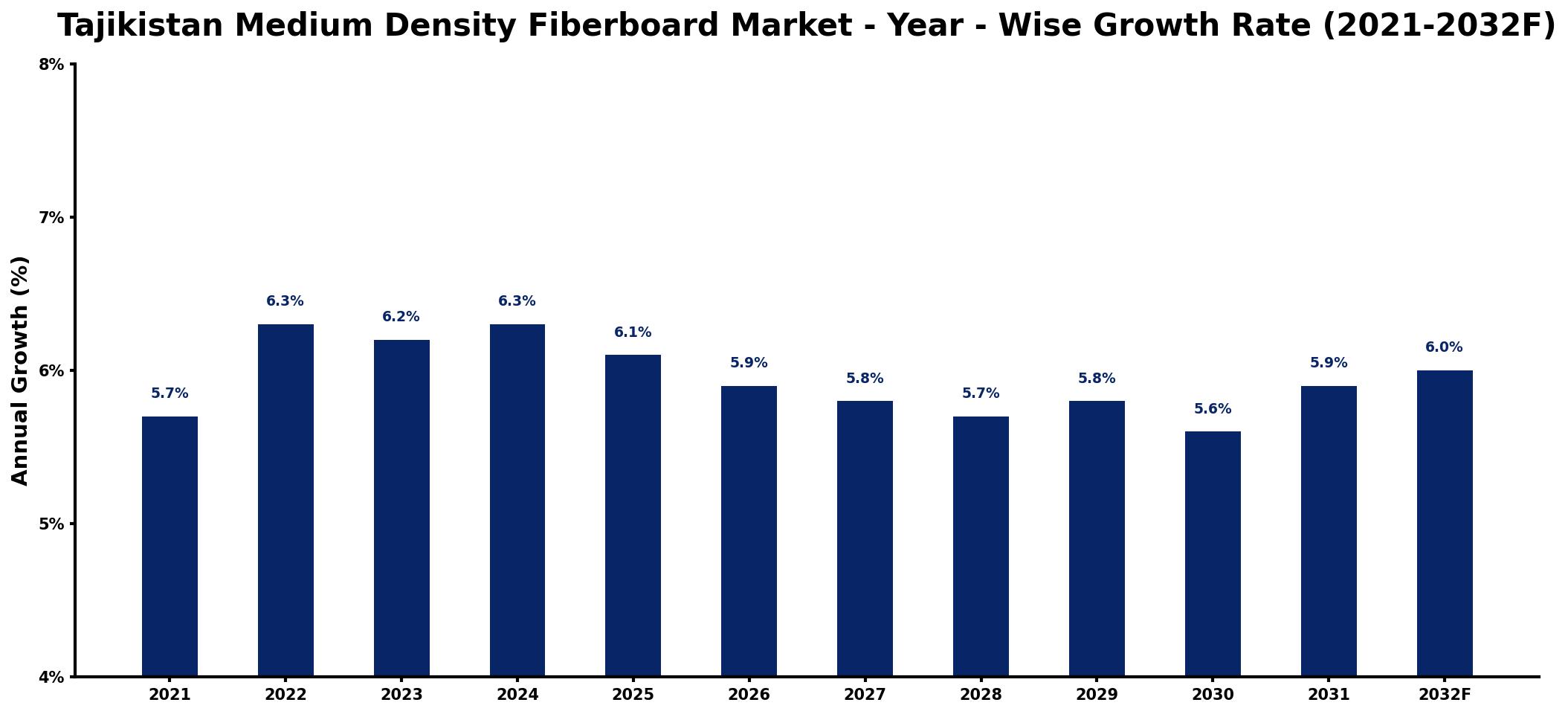
The table below presents the year‑wise growth rates along with the key drivers influencing the market
| Year | Growth Rate | Major Drivers |
| 2021 | 5.7% | Rising construction activity nationwide |
| 2022 | 6.3% | Increased consumer spending power |
| 2023 | 6.2% | Growing demand for eco-friendly products |
| 2024 | 6.3% | Expansion of furniture manufacturing sector |
| 2025 | 6.1% | Investment in local production facilities |
| 2026 | 5.9% | Surge in housing market growth |
| 2027 | 5.8% | Higher exports to neighboring countries |
| 2028 | 5.7% | Emerging trends in interior design |
| 2029 | 5.8% | Technological advancements in production |
| 2030 | 5.6% | Strengthening of local supply chains |
| 2031 | 5.9% | Increased government infrastructure projects |
| 2032 | 6.0% | Sustained demand from construction industry |
Note: Market size estimations and growth projections presented in this report are based on 6Wresearch's proprietary forecasting methodology, utilizing the latest available industry data, government publications, and primary research inputs.
Tajikistan Medium Density Fiberboard Market Synopsis
The demand for medium density fiberboard (MDF) in Tajikistan is significantly influenced by the ongoing infrastructure development projects. As new residential and commercial spaces emerge, the need for high-quality building materials, particularly for interior finishes, continues to rise. Furthermore, the expansion of the furniture market in the region is bolstering MDF usage, as manufacturers increasingly favor its versatility and cost-effectiveness over traditional timber.
On the supply side, local production capacities are gradually being enhanced to keep pace with burgeoning demand. This is coupled with a strategic reliance on imports to supplement the local market, especially for premium-grade MDF products that meet the evolving consumer preferences for quality and design. Consequently, Tajikistan's MDF market exhibits a dynamic blend of domestic manufacturing and international sourcing.
Tajikistan Medium Density Fiberboard Market Key Takeaways
- The Tajikistan MDF market is on a growth trajectory driven by construction and furniture industry demands.
- Urbanization and modernization trends are catalyzing increased MDF usage for interior applications.
- Domestic production is expanding, but imports remain crucial for high-quality MDF supply.
- Government support and investment in sustainable practices are expected to enhance market competitiveness.
- Opportunities exist for investment in both production and raw material sourcing to bolster the industry.
Evaluation of Restraints in Tajikistan Medium Density Fiberboard Market
Despite the positive outlook, the Tajikistan MDF market faces several constraints that can hinder its growth potential. One of the significant challenges is the limited availability of raw materials, particularly the reliance on imported wood fibers, making the sector vulnerable to global market fluctuations. This dependence leads to variable production costs that could affect pricing strategies. Furthermore, local manufacturers grapple with outdated technology and inefficiencies, which impact product quality and production scalability. Additionally, competition from lower-priced imported MDF products creates a challenging landscape for domestic players seeking to maintain market share.
Tajikistan Medium Density Fiberboard Market Trends
Several key trends are shaping the Tajikistan MDF market landscape. The shift towards eco-friendly construction materials is notable, as consumers become more aware of environmental sustainability. This increasing preference positions MDF favorably against solid wood due to its cost-effectiveness and reduced environmental footprint. Moreover, innovations in product design and manufacturing techniques are enabling the production of customized MDF solutions that cater to specific consumer tastes and market needs. Enhanced distribution networks are also emerging, facilitating better access to high-quality MDF products across various regions.
Tajikistan Medium Density Fiberboard Market Opportunities
The Tajikistan MDF market offers a myriad of investment opportunities, particularly in manufacturing and sustainable resource management. Establishing production facilities or collaborating with existing manufacturers presents lucrative prospects to tap into the growing demand for MDF products. There is also room for vertical integration through investments in sustainable forestry practices, ensuring a consistent and eco-friendly supply of raw materials. Furthermore, as urbanization accelerates, there is a critical need for innovative MDF solutions tailored to modern design requirements, marking fertile ground for investors and entrepreneurs alike.
Government Initiatives in the Tajikistan Medium Density Fiberboard Market
The Tajikistan government is actively promoting the growth of the MDF market through various supportive policies. These initiatives aim to enhance domestic production capabilities while reducing import dependency. Financial incentives and subsidies are being offered to manufacturers, encouraging investments in modern technologies and quality improvements. Additionally, the government is advocating for sustainable forestry practices, which not only aim to secure raw material supply but also enhance the environmental credentials of the domestic MDF production sector. Partnerships with industry stakeholders are fostering innovation and skills development, critical for long-term market viability.
Future Insights of the Tajikistan Medium Density Fiberboard Market
Looking ahead to 2026-2032, the Tajikistan MDF market is anticipated to witness substantial growth propelled by rising disposable incomes and a continued emphasis on infrastructure development. The demand for MDF is likely to surge, particularly in the furniture and construction sectors, as urbanization continues to reshape the living landscape. Technological advancements in production processes are expected to enhance the quality and appeal of MDF products, further driving market expansion. However, market participants must remain vigilant regarding the fluctuating costs of raw materials and the competitive pressures posed by imported goods.
Tajikistan Medium Density Fiberboard Market Latest Developments (2025 - 2026)
Recently, the Tajikistan MDF market has seen a shift towards greater innovation and quality enhancement. Manufacturers are increasingly investing in advanced machinery to improve production efficiency and product quality. Additionally, there has been a noticeable uptick in collaborative efforts among industry players to explore sustainable sourcing options and expand distribution channels. Furthermore, local initiatives aimed at raising consumer awareness about the benefits of MDF are helping to drive demand in both residential and commercial applications.
Tajikistan Medium Density Fiberboard Market - Key Attractiveness of the Report
- 10 Years of Market Numbers
- Historical Data Starting from 2022 to 2025
- Base Year: 2025
- Forecast Data until 2032
- Key Performance Indicators Impacting the Market
- Major Upcoming Developments and Projects
Key Highlights of the Report:
- Tajikistan Medium Density Fiberboard Market Outlook
- Market Size of Tajikistan Medium Density Fiberboard Market, 2025
- Forecast of Tajikistan Medium Density Fiberboard Market, 2032
- Historical Data and Forecast of Tajikistan Medium Density Fiberboard Revenues & Volume for the Period 2022-2032F
- Tajikistan Medium Density Fiberboard Market Trend Evolution
- Tajikistan Medium Density Fiberboard Market Drivers and Challenges
- Tajikistan Medium Density Fiberboard Price Trends
- Tajikistan Medium Density Fiberboard Porter's Five Forces
- Tajikistan Medium Density Fiberboard Industry Life Cycle
- Historical Data and Forecast of Tajikistan Medium Density Fiberboard Market Revenues & Volume By Type for the Period 2022-2032F
- Historical Data and Forecast of Tajikistan Medium Density Fiberboard Market Revenues & Volume By Standard for the Period 2022-2032F
- Historical Data and Forecast of Tajikistan Medium Density Fiberboard Market Revenues & Volume By Moisture Resistant for the Period 2022-2032F
- Historical Data and Forecast of Tajikistan Medium Density Fiberboard Market Revenues & Volume By Fire-Rated for the Period 2022-2032F
- Historical Data and Forecast of Tajikistan Medium Density Fiberboard Market Revenues & Volume By Application for the Period 2022-2032F
- Historical Data and Forecast of Tajikistan Medium Density Fiberboard Market Revenues & Volume By Furniture for the Period 2022-2032F
- Historical Data and Forecast of Tajikistan Medium Density Fiberboard Market Revenues & Volume By Construction & Flooring for the Period 2022-2032F
- Historical Data and Forecast of Tajikistan Medium Density Fiberboard Market Revenues & Volume By Interior Designing for the Period 2022-2032F
- Historical Data and Forecast of Tajikistan Medium Density Fiberboard Market Revenues & Volume By Packaging Systems for the Period 2022-2032F
- Historical Data and Forecast of Tajikistan Medium Density Fiberboard Market Revenues & Volume By Others for the Period 2022-2032F
- Tajikistan Medium Density Fiberboard Import Export Trade Statistics
- Market Opportunity Assessment By Type
- Market Opportunity Assessment By Application
- Tajikistan Medium Density Fiberboard Top Companies Market Share
- Tajikistan Medium Density Fiberboard Competitive Benchmarking By Technical and Operational Parameters
- Tajikistan Medium Density Fiberboard Company Profiles
- Tajikistan Medium Density Fiberboard Key Strategic Recommendations






































