Tajikistan Metal Recycling Market Size, Share & Growth Rate
The Tajikistan Metal Recycling Market was estimated at USD 291 Million in 2025 and is projected to reach USD 384 Million by 2032, growing at a CAGR of 4.0% from 2026 to 2032. This upward trajectory is driven by an increasing emphasis on environmental sustainability, coupled with a growing industrial base that generates substantial metal waste. The supportive government initiatives aimed at promoting recycling practices are further expected to fuel demand for efficient metal recycling solutions across various sectors in Tajikistan.
Tajikistan Metal Recycling Market Year-wise Growth Rate and Key Drivers
This graph highlights how the Tajikistan Metal Recycling Market has steadily grown over the years, supported by major growth factors.
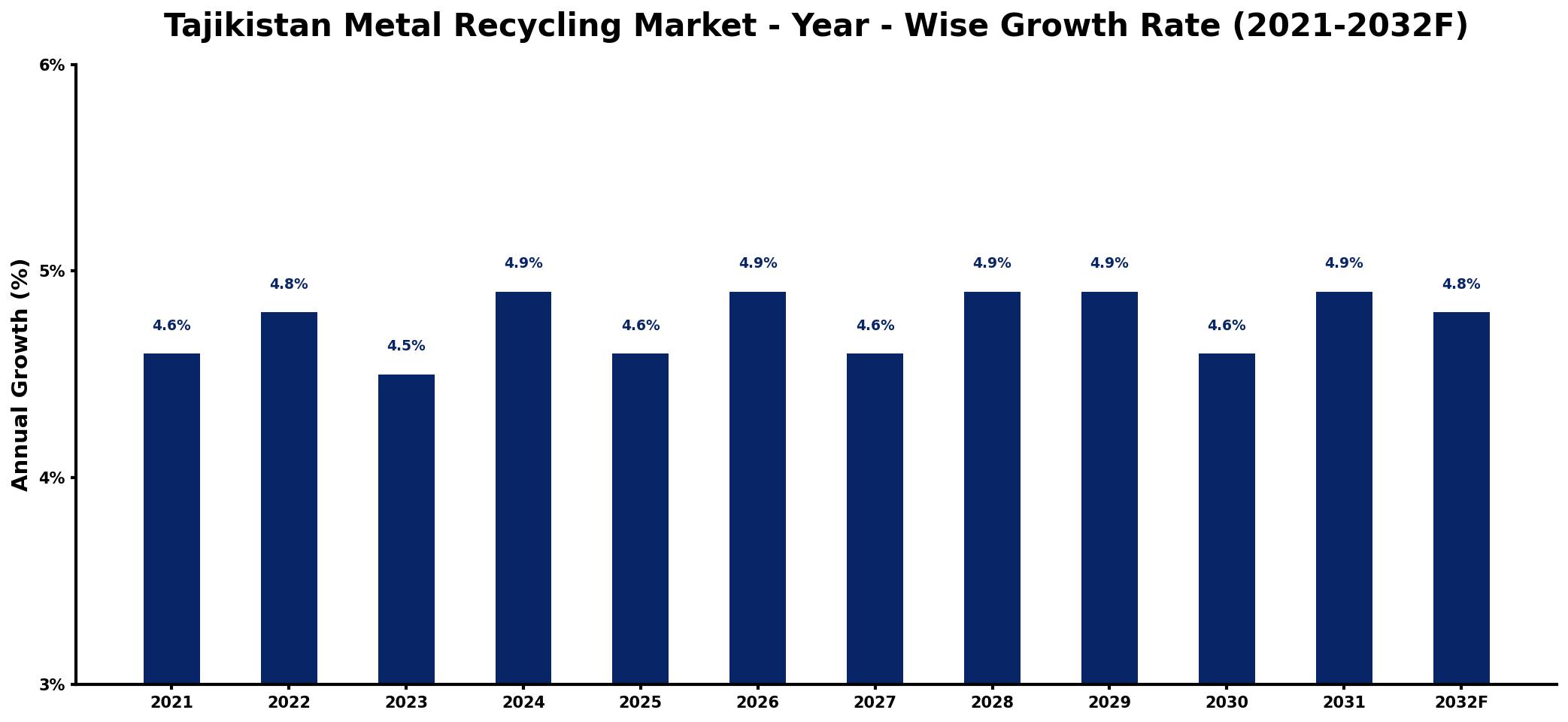
The table below presents the year‑wise growth rates along with the key drivers influencing the market
| Year | Growth Rate | Major Drivers |
| 2021 | 4.6% | Rising demand for raw materials |
| 2022 | 4.8% | Increased infrastructure development projects |
| 2023 | 4.5% | Growing consumer electronics market |
| 2024 | 4.9% | Expansion of renewable energy initiatives |
| 2025 | 4.6% | Boost in automotive manufacturing sector |
| 2026 | 4.9% | Higher construction activity levels |
| 2027 | 4.6% | Surge in urbanization trends |
| 2028 | 4.9% | Investment in technology advancements |
| 2029 | 4.9% | Focus on sustainability practices |
| 2030 | 4.6% | Enhanced waste management regulations |
| 2031 | 4.9% | Strengthening international trade agreements |
| 2032 | 4.8% | Emerging circular economy initiatives |
Note: Market size estimations and growth projections presented in this report are based on 6Wresearch's proprietary forecasting methodology, utilizing the latest available industry data, government publications, and primary research inputs.
Tajikistan Metal Recycling Market Synopsis
Tajikistan's metal recycling market is currently in a formative phase, marked by a growing awareness of the importance of recycling for environmental sustainability. Despite the challenges posed by limited infrastructure, the sector is gradually evolving, creating a conducive environment for investment and innovation.
The market dynamics reflect a rising interest among both local and international stakeholders, motivated by economic benefits and a commitment to sustainable practices. As the country embraces a circular economy, there exists a clear pathway for enhancing recycling capabilities and technologies, vital for the sectors long-term growth.
Tajikistan Metal Recycling Market Key Takeaways
- The market is expected to grow steadily, supported by increasing industrial metal waste and sustainability awareness.
- Government initiatives are significantly shaping the landscape, promoting recycling and environmental conservation.
- Investment opportunities are abundant, particularly in advanced recycling technologies and facility establishment.
- The ongoing transformation in consumer behavior reflects a demand shift towards sustainable practices in various industries.
- Collaboration among stakeholders, including businesses and government bodies, is crucial for the sectors development.
Evaluation of Restraints in Tajikistan Metal Recycling Market
The Tajikistan Metal Recycling Market faces notable restraints that hinder its potential. A significant barrier is the lack of adequate infrastructure to support the efficient collection and processing of scrap metal. Moreover, the population's limited awareness about recycling benefits hampers participation rates. The market is also fragmented, dominated by a few players, which stifles competition and innovation. Economic instability and the continued reliance on traditional metal extraction methods further complicate progress in the recycling sector. Regulatory barriers and inconsistent enforcement of environmental standards exacerbate these issues, necessitating comprehensive reforms and strategic investments to foster a sustainable recycling ecosystem.
Tajikistan Metal Recycling Market Trends
Several trends are shaping the metal recycling market in Tajikistan. There is a marked increase in technological advancements that enhance processing efficiency and the quality of recycled metals. Additionally, industries such as construction, automotive, and electronics are increasingly sourcing recycled materials, boosting demand. Collaborative efforts between government agencies and recycling companies are also gaining traction, further solidifying a supportive framework for the market. The movement towards a circular economy has stimulated interest in sustainable practices, inspiring innovative solutions across the recycling value chain.
Tajikistan Metal Recycling Market Opportunities
Investment opportunities within the Tajikistan Metal Recycling Market are becoming increasingly attractive. Given the substantial amount of metal waste generated from growing industrial activities, there is a compelling need for efficient recycling solutions that can recover valuable materials while minimizing environmental impact. Investors are encouraged to explore options for establishing recycling facilities equipped with state-of-the-art sorting and processing technologies. Partnerships with local industries to develop sustainable recycling solutions also present significant potential for long-term growth and profitability. The governments incentives and favorable regulations further enhance the appeal of this burgeoning market.
Government Initiatives in the Tajikistan Metal Recycling Market
The government of Tajikistan is actively fostering the growth of the metal recycling sector through various policies and initiatives. Recognizing the importance of recycling for resource conservation and environmental protection, authorities have introduced incentives, including tax breaks and subsidies, to encourage businesses and individuals to engage in recycling activities. Additionally, regulatory measures are in place to ensure the proper disposal of metal waste and oversee recycling operations to meet environmental standards. These initiatives are integral to the government's broader strategy to enhance sustainability and reduce reliance on imported raw materials.
Future Insights of the Tajikistan Metal Recycling Market
Looking ahead to 2026-2032, the Tajikistan Metal Recycling Market is poised for gradual growth fueled by the confluence of environmental initiatives and rising industrial demand for recycled materials. Government efforts to reduce waste generation and promote recycling are expected to catalyze this development. Nevertheless, the market must navigate the challenges of infrastructure development and technological advancement to fully realize its potential. As stakeholders embrace sustainability and circular economy principles, the outlook remains optimistic, with significant opportunities for expansion and investment on the horizon.
Tajikistan Metal Recycling Market Latest Developments (2025 - 2026)
In recent months, the Tajikistan Metal Recycling Market has seen notable momentum in terms of technology adoption and stakeholder engagement. There has been an increase in discussions around collaborative frameworks that can enhance recycling efficiency and market outreach. Local entities are beginning to explore partnerships with international technology providers to upgrade processing capabilities. The government is also stepping up its promotional activities aimed at raising public awareness about the benefits of recycling, creating an increasingly favorable environment for market growth.
Tajikistan Metal Recycling Market - Key Attractiveness of the Report
- 10 Years of Market Numbers
- Historical Data Starting from 2022 to 2025
- Base Year: 2025
- Forecast Data until 2032
- Key Performance Indicators Impacting the Market
- Major Upcoming Developments and Projects
Key Highlights of the Report:
- Tajikistan Metal Recycling Market Outlook
- Market Size of Tajikistan Metal Recycling Market, 2025
- Forecast of Tajikistan Metal Recycling Market, 2032
- Historical Data and Forecast of Tajikistan Metal Recycling Revenues & Volume for the Period 2022-2032F
- Tajikistan Metal Recycling Market Trend Evolution
- Tajikistan Metal Recycling Market Drivers and Challenges
- Tajikistan Metal Recycling Price Trends
- Tajikistan Metal Recycling Porter's Five Forces
- Tajikistan Metal Recycling Industry Life Cycle
- Historical Data and Forecast of Tajikistan Metal Recycling Market Revenues & Volume By Scrap Type for the Period 2022-2032F
- Historical Data and Forecast of Tajikistan Metal Recycling Market Revenues & Volume By Old Scrap for the Period 2022-2032F
- Historical Data and Forecast of Tajikistan Metal Recycling Market Revenues & Volume By New Scrap for the Period 2022-2032F
- Historical Data and Forecast of Tajikistan Metal Recycling Market Revenues & Volume By Type for the Period 2022-2032F
- Historical Data and Forecast of Tajikistan Metal Recycling Market Revenues & Volume By Ferrous for the Period 2022-2032F
- Historical Data and Forecast of Tajikistan Metal Recycling Market Revenues & Volume By Non-Ferrous for the Period 2022-2032F
- Historical Data and Forecast of Tajikistan Metal Recycling Market Revenues & Volume By Equipment for the Period 2022-2032F
- Historical Data and Forecast of Tajikistan Metal Recycling Market Revenues & Volume By Shredders for the Period 2022-2032F
- Historical Data and Forecast of Tajikistan Metal Recycling Market Revenues & Volume By Shears for the Period 2022-2032F
- Historical Data and Forecast of Tajikistan Metal Recycling Market Revenues & Volume By Granulating Machines for the Period 2022-2032F
- Historical Data and Forecast of Tajikistan Metal Recycling Market Revenues & Volume By Briquetting Machines for the Period 2022-2032F
- Historical Data and Forecast of Tajikistan Metal Recycling Market Revenues & Volume By End-use Sector for the Period 2022-2032F
- Historical Data and Forecast of Tajikistan Metal Recycling Market Revenues & Volume By Building & Construction for the Period 2022-2032F
- Historical Data and Forecast of Tajikistan Metal Recycling Market Revenues & Volume By Automotive for the Period 2022-2032F
- Historical Data and Forecast of Tajikistan Metal Recycling Market Revenues & Volume By Equipment Manufacturing for the Period 2022-2032F
- Historical Data and Forecast of Tajikistan Metal Recycling Market Revenues & Volume By Shipbuilding for the Period 2022-2032F
- Historical Data and Forecast of Tajikistan Metal Recycling Market Revenues & Volume By Packaging for the Period 2022-2032F
- Historical Data and Forecast of Tajikistan Metal Recycling Market Revenues & Volume By Consumer Appliances for the Period 2022-2032F
- Historical Data and Forecast of Tajikistan Metal Recycling Market Revenues & Volume By Others for the Period 2022-2032F
- Tajikistan Metal Recycling Import Export Trade Statistics
- Market Opportunity Assessment By Scrap Type
- Market Opportunity Assessment By Type
- Market Opportunity Assessment By Equipment
- Market Opportunity Assessment By End-use Sector
- Tajikistan Metal Recycling Top Companies Market Share
- Tajikistan Metal Recycling Competitive Benchmarking By Technical and Operational Parameters
- Tajikistan Metal Recycling Company Profiles
- Tajikistan Metal Recycling Key Strategic Recommendations






































