Tajikistan Molded Pulp Packaging Market Size, Share & Growth Rate
The Tajikistan Molded Pulp Packaging Market was estimated at USD 203 Million in 2025 and is projected to reach USD 279 Million by 2032, growing at a CAGR of 4.6% from 2026 to 2032. This growth trajectory is propelled by an increasing consumer shift towards sustainable packaging solutions, particularly within the food and beverage sector. As businesses recognize the financial and ecological benefits of biodegradable packaging, the demand for molded pulp options is expected to rise significantly.
Tajikistan Molded Pulp Packaging Market Year-wise Growth Rate and Key Drivers
This graph highlights how the Tajikistan Molded Pulp Packaging Market has steadily grown over the years, supported by major growth factors.
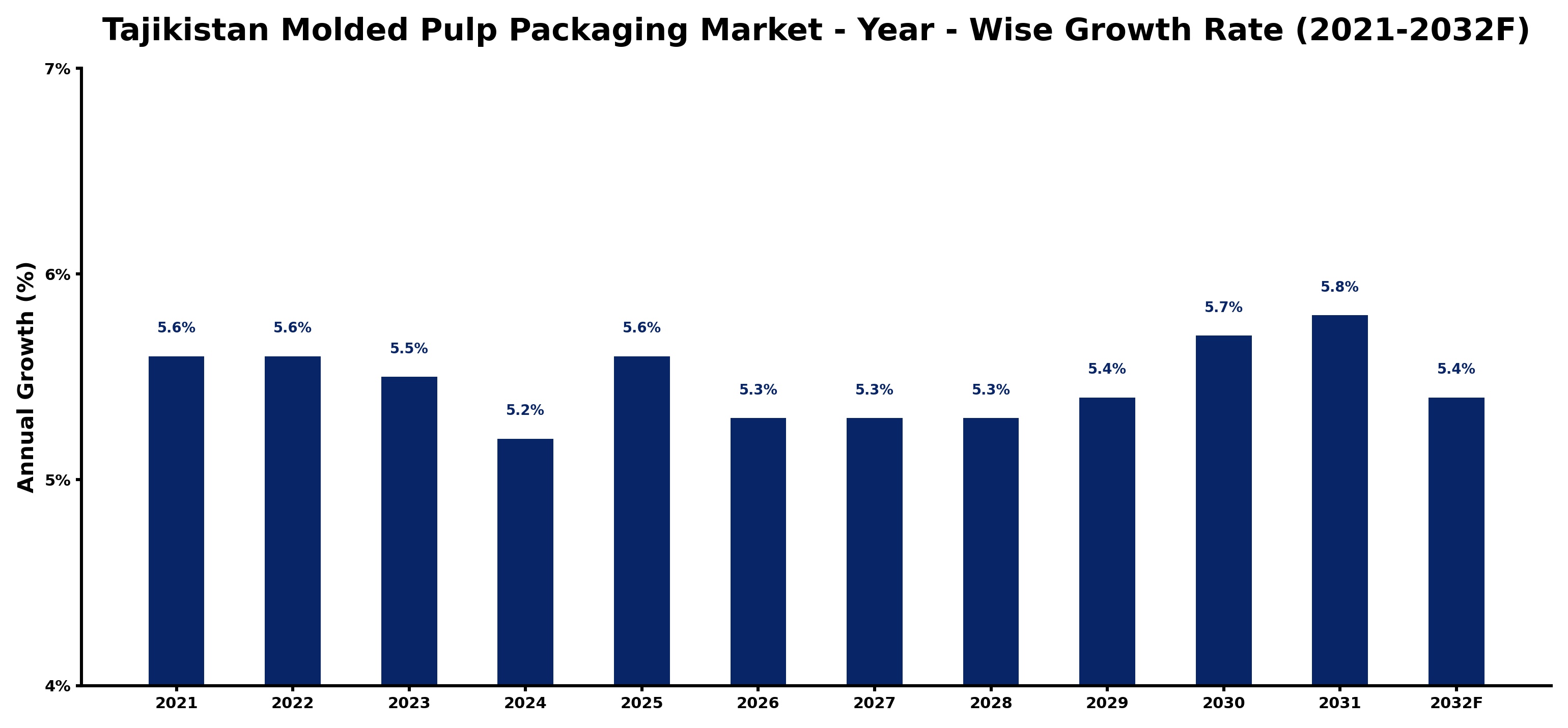
The table below presents the year‑wise growth rates along with the key drivers influencing the market
| Year | Growth Rate | Major Drivers |
| 2021 | 5.6% | Government infrastructure modernization initiatives |
| 2022 | 5.6% | Increasing adoption of advanced technologies |
| 2023 | 5.5% | Increasing smart city development projects |
| 2024 | 5.2% | Expansion of transportation and logistics networks |
| 2025 | 5.6% | Government infrastructure modernization initiatives |
| 2026 | 5.3% | Increasing industrial infrastructure investments |
| 2027 | 5.3% | Increasing industrial infrastructure investments |
| 2028 | 5.3% | Increasing adoption of advanced technologies |
| 2029 | 5.4% | Increasing industrial automation investments |
| 2030 | 5.7% | Increasing industrial automation investments |
| 2031 | 5.8% | Increasing smart city development projects |
| 2032 | 5.4% | Increasing industrial automation investments |
Note - Market size estimations and growth projections presented in this report are based on 6Wresearch's advanced forecasting approach, validated with industry datasets as of June 2026.
Tajikistan Molded Pulp Packaging Market Synopsis
A notable surge in the adoption of molded pulp packaging has been observed, particularly for applications like egg cartons and fruit trays. This trend is indicative of a broader commitment within the Tajikistan market to align with global sustainability practices and consumer preferences for eco-friendly products.
The market is also seeing engagement from a diverse range of sectors, including healthcare and cosmetics, which are increasingly recognizing the importance of sustainable packaging. As these industries evolve, the demand for molded pulp materials continues to expand, signaling a promising future for this segment.
Tajikistan Molded Pulp Packaging Market Key Takeaways
- The molded pulp packaging sector is primarily driven by the food and beverage industry.
- Growing consumer awareness of sustainable practices is influencing purchasing decisions.
- Investment in technology is enhancing product quality and design in molded pulp packaging.
- Government initiatives are fostering a favorable environment for sustainable packaging growth.
- Challenges related to production infrastructure are being addressed through strategic investments.
Evaluation of Restraints in Tajikistan Molded Pulp Packaging Market
Despite the promising outlook, the Tajikistan Molded Pulp Packaging Market faces several restraints. Limited awareness among local businesses regarding the benefits of molded pulp is a significant barrier to wider adoption. Furthermore, the lack of sufficient manufacturing infrastructure and high initial investment costs pose challenges for prospective entrants. Additionally, competition from traditional packaging materials like plastic—widely used and readily available—creates further hurdles for molded pulp adoption. Addressing these constraints requires concerted efforts in education, infrastructure improvement, and government support.
Tajikistan Molded Pulp Packaging Market Trends
A prominent trend in the Tajikistan Molded Pulp Packaging Market is the heightened consumer preference for environmentally friendly packaging options. As awareness of ecological issues rises, businesses are increasingly opting for biodegradable solutions. Furthermore, technological advancements are leading to innovative designs and improved quality of molded pulp products, aligning them more closely with consumer expectations. This shift towards sustainability is not just a trend but a transformation in how businesses approach packaging.
Tajikistan Molded Pulp Packaging Market Opportunities
Investment opportunities in the Tajikistan Molded Pulp Packaging Market are abundant, driven by the growing demand for sustainable solutions. Setting up local manufacturing facilities presents a viable pathway for investors looking to tap into both the domestic market and potential exports to neighboring regions. Collaborations with local enterprises or government initiatives aimed at promoting eco-friendly packaging can further enhance market entry strategies. This alignment with global sustainability trends positions investors for long-term growth in this emerging market.
Government Initiatives in the Tajikistan Molded Pulp Packaging Market
The government of Tajikistan is actively promoting molded pulp packaging through policies designed to encourage eco-friendly practices. Initiatives include incentives for companies investing in sustainable packaging technologies and regulations aimed at reducing environmental impact. Moreover, efforts to raise consumer awareness regarding the advantages of biodegradable materials play a vital role in supporting the market. These government measures are pivotal in shaping a robust framework for the molded pulp packaging industry.
Future Insights of the Tajikistan Molded Pulp Packaging Market
Looking ahead to 2026-2032, the Tajikistan Molded Pulp Packaging Market is poised for steady growth driven by a cultural shift towards sustainability. Increased adoption of biodegradable materials across various sectors, coupled with e-commerce growth, will continue to amplify demand for molded pulp packaging. Government support and community awareness initiatives will bolster this trend, ultimately establishing molded pulp packaging as a standard in Tajikistan's packaging landscape.
Tajikistan Molded Pulp Packaging Market Latest Developments (May 2025 - June 2026)
Recent developments in the Tajikistan Molded Pulp Packaging Market indicate a strong push towards innovation and technology integration. Manufacturers are exploring advanced production methods to enhance the quality of molded pulp products. Additionally, there is an observable increase in partnerships between local firms and international players, aiming to leverage expertise in sustainable packaging. This collaborative approach is expected to accelerate market growth and establish a more competitive landscape.
Tajikistan Molded Pulp Packaging Market - Key Attractiveness of the Report
- 10 Years of Market Numbers
- Historical Data Starting from 2022 to 2025
- Base Year: 2025
- Forecast Data until 2032
- Key Performance Indicators Impacting the Market
- Major Upcoming Developments and Projects
Key Highlights of the Report:
- Tajikistan Molded Pulp Packaging Market Outlook
- Market Size of Tajikistan Molded Pulp Packaging Market, 2025
- Forecast of Tajikistan Molded Pulp Packaging Market, 2032
- Historical Data and Forecast of Tajikistan Molded Pulp Packaging Revenues & Volume for the Period 2022-2032F
- Tajikistan Molded Pulp Packaging Market Trend Evolution
- Tajikistan Molded Pulp Packaging Market Drivers and Challenges
- Tajikistan Molded Pulp Packaging Price Trends
- Tajikistan Molded Pulp Packaging Porter's Five Forces
- Tajikistan Molded Pulp Packaging Industry Life Cycle
- Historical Data and Forecast of Tajikistan Molded Pulp Packaging Market Revenues & Volume By Source for the Period 2022-2032F
- Historical Data and Forecast of Tajikistan Molded Pulp Packaging Market Revenues & Volume By Wood Pulp for the Period 2022-2032F
- Historical Data and Forecast of Tajikistan Molded Pulp Packaging Market Revenues & Volume By Non-wood Pulp for the Period 2022-2032F
- Historical Data and Forecast of Tajikistan Molded Pulp Packaging Market Revenues & Volume By Molded Type for the Period 2022-2032F
- Historical Data and Forecast of Tajikistan Molded Pulp Packaging Market Revenues & Volume By Thick Wall for the Period 2022-2032F
- Historical Data and Forecast of Tajikistan Molded Pulp Packaging Market Revenues & Volume By Transfer for the Period 2022-2032F
- Historical Data and Forecast of Tajikistan Molded Pulp Packaging Market Revenues & Volume By Thermoformed for the Period 2022-2032F
- Historical Data and Forecast of Tajikistan Molded Pulp Packaging Market Revenues & Volume By Processed for the Period 2022-2032F
- Historical Data and Forecast of Tajikistan Molded Pulp Packaging Market Revenues & Volume By Product for the Period 2022-2032F
- Historical Data and Forecast of Tajikistan Molded Pulp Packaging Market Revenues & Volume By Trays for the Period 2022-2032F
- Historical Data and Forecast of Tajikistan Molded Pulp Packaging Market Revenues & Volume By End Caps for the Period 2022-2032F
- Historical Data and Forecast of Tajikistan Molded Pulp Packaging Market Revenues & Volume By Bowls & Cups for the Period 2022-2032F
- Historical Data and Forecast of Tajikistan Molded Pulp Packaging Market Revenues & Volume By Clamshells for the Period 2022-2032F
- Historical Data and Forecast of Tajikistan Molded Pulp Packaging Market Revenues & Volume By Plates for the Period 2022-2032F
- Historical Data and Forecast of Tajikistan Molded Pulp Packaging Market Revenues & Volume By Others for the Period 2022-2032F
- Tajikistan Molded Pulp Packaging Import Export Trade Statistics
- Market Opportunity Assessment By Source
- Market Opportunity Assessment By Molded Type
- Market Opportunity Assessment By Product
- Tajikistan Molded Pulp Packaging Top Companies Market Share
- Tajikistan Molded Pulp Packaging Competitive Benchmarking By Technical and Operational Parameters
- Tajikistan Molded Pulp Packaging Company Profiles
- Tajikistan Molded Pulp Packaging Key Strategic Recommendations






































