Tajikistan Nail Gun Market Size, Share & Growth Rate
The Tajikistan Nail Gun Market was estimated at USD 722 Million in 2025 and is projected to reach USD 1251 Million by 2032, growing at a CAGR of 8.2% from 2026 to 2032. This growth trajectory is primarily driven by an increase in construction activities, spurred by both residential and commercial projects across the nation. The modernization of infrastructure, alongside a rising trend among DIY enthusiasts for efficient tools, is further propelling the demand for nail guns.
Tajikistan Nail Gun Market Year-wise Growth Rate and Key Drivers
This graph highlights how the Tajikistan Nail Gun Market has steadily grown over the years, supported by major growth factors.
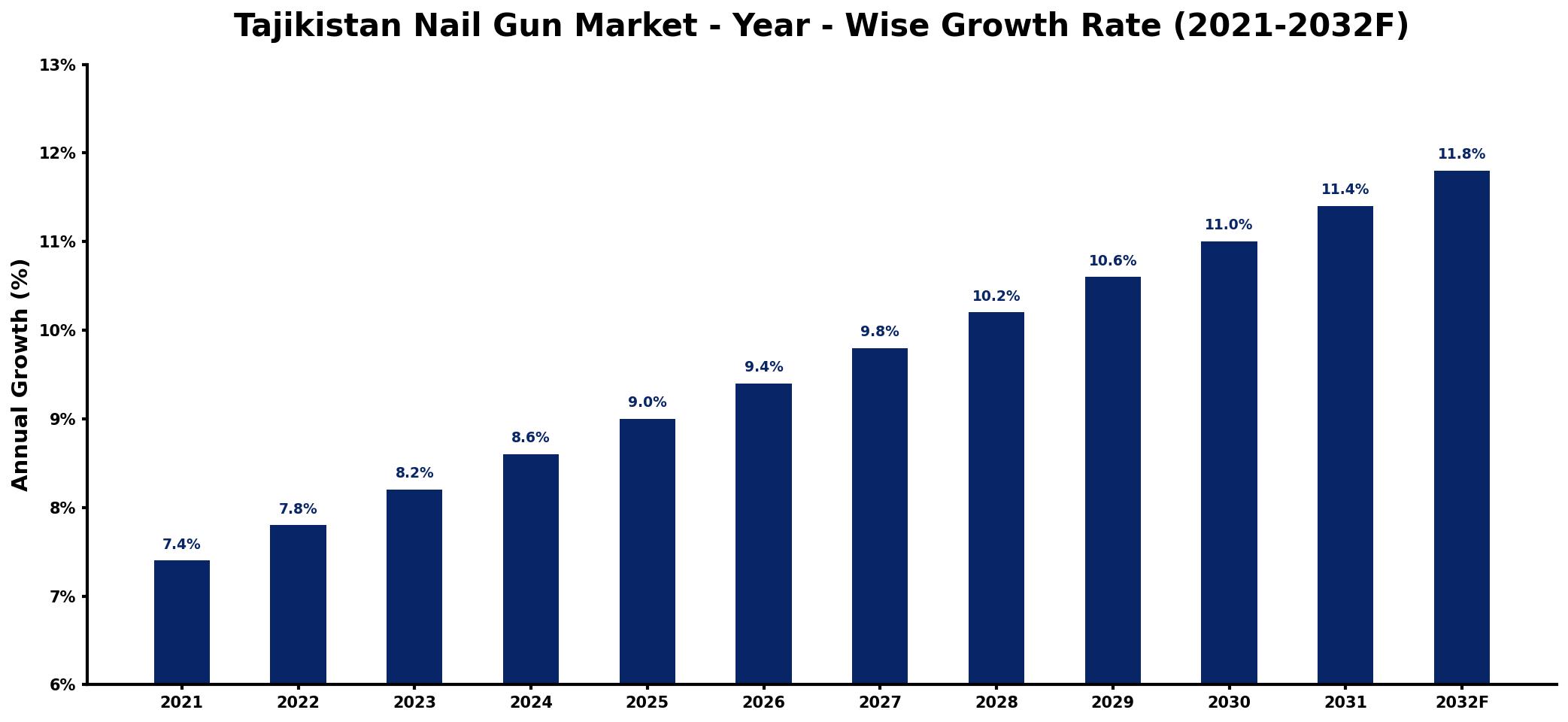
The table below presents the year‑wise growth rates along with the key drivers influencing the market
| Year | Growth Rate | Major Drivers |
| 2021 | 7.4% | Construction sector shows resilience |
| 2022 | 7.8% | Residential projects drive demand |
| 2023 | 8.2% | Infrastructure investments increase significantly |
| 2024 | 8.6% | Renovation projects gain momentum |
| 2025 | 9.0% | Commercial developments expand rapidly |
| 2026 | 9.4% | Technological advancements attract interest |
| 2027 | 9.8% | Skilled labor availability improves |
| 2028 | 10.2% | Sustainability trends influence purchases |
| 2029 | 10.6% | Export opportunities enhance market |
| 2030 | 11.0% | Government initiatives support construction |
| 2031 | 11.4% | Urbanization trends drive growth |
| 2032 | 11.8% | Consumer preferences shift positively |
Note: Market size estimations and growth projections presented in this report are based on 6Wresearch's proprietary forecasting methodology, utilizing the latest available industry data, government publications, and primary research inputs.
Tajikistan Nail Gun Market Synopsis
The nail gun market in Tajikistan is currently at a pivotal juncture, benefiting from the booming construction and woodworking sectors. Professionals and DIY enthusiasts alike are increasingly turning to nail guns as essential tools that significantly enhance efficiency and productivity in their projects.
Amid a backdrop of traditional construction methods, the market is witnessing a slow but steady shift toward modern tool adoption. With a growing awareness of the advantages of nail guns, combined with significant infrastructure investments, the market outlook remains optimistic as companies strive to innovate and meet evolving customer demands.
Tajikistan Nail Gun Market Key Takeaways
- The nail gun market in Tajikistan is experiencing robust growth, fueled by increasing construction projects and infrastructure investments.
- Professional craftsmen and DIY enthusiasts are favoring nail guns for their efficiency and time-saving capabilities.
- Innovation in design and technology, such as ergonomic features and safety enhancements, is becoming increasingly important.
- The rise of cordless nail guns is transforming user experiences, particularly in remote and complex job sites.
- Government policies aimed at improving product standards are expected to enhance market credibility and safety.
Evaluation of Restraints in Tajikistan Nail Gun Market
Despite its growth potential, the Tajikistan nail gun market faces significant constraints. A notable challenge is the limited awareness and understanding of nail guns' benefits among construction professionals and the general public. Traditional methods continue to dominate due to entrenched practices, making the transition to modern tools slower than anticipated. Moreover, issues regarding counterfeit products may undermine consumer confidence, further complicating market dynamics. Enhanced education and strategic marketing initiatives are essential to address these concerns effectively.
Tajikistan Nail Gun Market Trends
Emerging trends in the Tajikistan nail gun market are prominently featuring a shift towards cordless nail guns, which offer unparalleled convenience and mobility, especially on job sites with limited power access. Additionally, the design philosophy is increasingly leaning towards lightweight and ergonomic models that improve user comfort and reduce fatigue during prolonged use. Safety mechanisms, such as adjustable depth settings, are also gaining attention as professionals seek tools that prioritize efficiency without compromising safety.
Tajikistan Nail Gun Market Opportunities
The burgeoning construction sector in Tajikistan presents substantial investment opportunities for the nail gun market. Companies aiming to capitalize on this growth should consider forming partnerships with local distributors to facilitate market entry and expand their reach. Offering training and after-sales services can also create a competitive advantage and foster customer loyalty. With infrastructure development initiatives on the rise, the demand for reliable, high-performance nail guns will likely increase, making it a lucrative segment for potential investors.
Government Initiatives in the Tajikistan Nail Gun Market
Government initiatives play a crucial role in shaping the Tajikistan nail gun market. Regulatory bodies such as the State Committee for Standardization, Metrology, and Certification ensure that products meet safety and quality standards, thereby enhancing consumer trust. Additionally, policies promoting the local production of tools may create a more favorable environment for domestic manufacturers while also potentially imposing tariffs on imports to protect local industries. Such measures are vital for creating a balanced market ecosystem.
Future Insights of the Tajikistan Nail Gun Market
Looking ahead, the future of the Tajikistan nail gun market appears bright, primarily due to anticipated growth in construction activities driven by urbanization and government-backed development programs. As the market evolves, the integration of more automated and technologically advanced tools will likely resonate with professionals seeking to enhance productivity. However, the market must navigate challenges such as fluctuating raw material costs and competition from traditional hand tools. Overall, the outlook remains positive with a steady growth trajectory expected through 2032.
Tajikistan Nail Gun Market Latest Developments (2025 - 2026)
Recent developments in the Tajikistan nail gun market are indicative of a growing recognition of advanced tools in construction. New collaborations between international manufacturers and local distributors are emerging, paving the way for improved product accessibility. Additionally, there has been a notable increase in educational initiatives aimed at training professionals on the benefits and safe usage of nail guns. These efforts are expected to bolster demand and enhance market penetration in the upcoming years.
Tajikistan Nail Gun Market - Key Attractiveness of the Report
- 10 Years of Market Numbers
- Historical Data Starting from 2022 to 2025
- Base Year: 2025
- Forecast Data until 2032
- Key Performance Indicators Impacting the Market
- Major Upcoming Developments and Projects
Key Highlights of the Report:
- Tajikistan Nail Gun Market Outlook
- Market Size of Tajikistan Nail Gun Market, 2025
- Forecast of Tajikistan Nail Gun Market, 2032
- Historical Data and Forecast of Tajikistan Nail Gun Revenues & Volume for the Period 2022-2032F
- Tajikistan Nail Gun Market Trend Evolution
- Tajikistan Nail Gun Market Drivers and Challenges
- Tajikistan Nail Gun Price Trends
- Tajikistan Nail Gun Porter's Five Forces
- Tajikistan Nail Gun Industry Life Cycle
- Historical Data and Forecast of Tajikistan Nail Gun Market Revenues & Volume By Product Type for the Period 2022-2032F
- Historical Data and Forecast of Tajikistan Nail Gun Market Revenues & Volume By Pneumatic Nail Gun for the Period 2022-2032F
- Historical Data and Forecast of Tajikistan Nail Gun Market Revenues & Volume By Combustion Powered Nail Gun for the Period 2022-2032F
- Historical Data and Forecast of Tajikistan Nail Gun Market Revenues & Volume By Electric Nail Gun for the Period 2022-2032F
- Historical Data and Forecast of Tajikistan Nail Gun Market Revenues & Volume By others for the Period 2022-2032F
- Historical Data and Forecast of Tajikistan Nail Gun Market Revenues & Volume By Application for the Period 2022-2032F
- Historical Data and Forecast of Tajikistan Nail Gun Market Revenues & Volume By Construction Engineering for the Period 2022-2032F
- Historical Data and Forecast of Tajikistan Nail Gun Market Revenues & Volume By Residential Decoration for the Period 2022-2032F
- Tajikistan Nail Gun Import Export Trade Statistics
- Market Opportunity Assessment By Product Type
- Market Opportunity Assessment By Application
- Tajikistan Nail Gun Top Companies Market Share
- Tajikistan Nail Gun Competitive Benchmarking By Technical and Operational Parameters
- Tajikistan Nail Gun Company Profiles
- Tajikistan Nail Gun Key Strategic Recommendations






































