Tajikistan Network Slicing Market Size, Share & Growth Rate
The Tajikistan Network Slicing Market was estimated at USD 188 Million in 2025 and is projected to reach USD 263 Million by 2032, growing at a CAGR of 4.9% from 2026 to 2032. This trajectory is primarily driven by the ongoing deployment of 5G networks, which enhances the capability of operators to deliver specialized services across diverse sectors. The increasing demand for tailored network solutions, particularly in industries such as IoT and augmented reality, further fuels this growth in Tajikistan.
Tajikistan Network Slicing Market Year-wise Growth Rate and Key Drivers
This graph highlights how the Tajikistan Network Slicing Market has steadily grown over the years, supported by major growth factors.
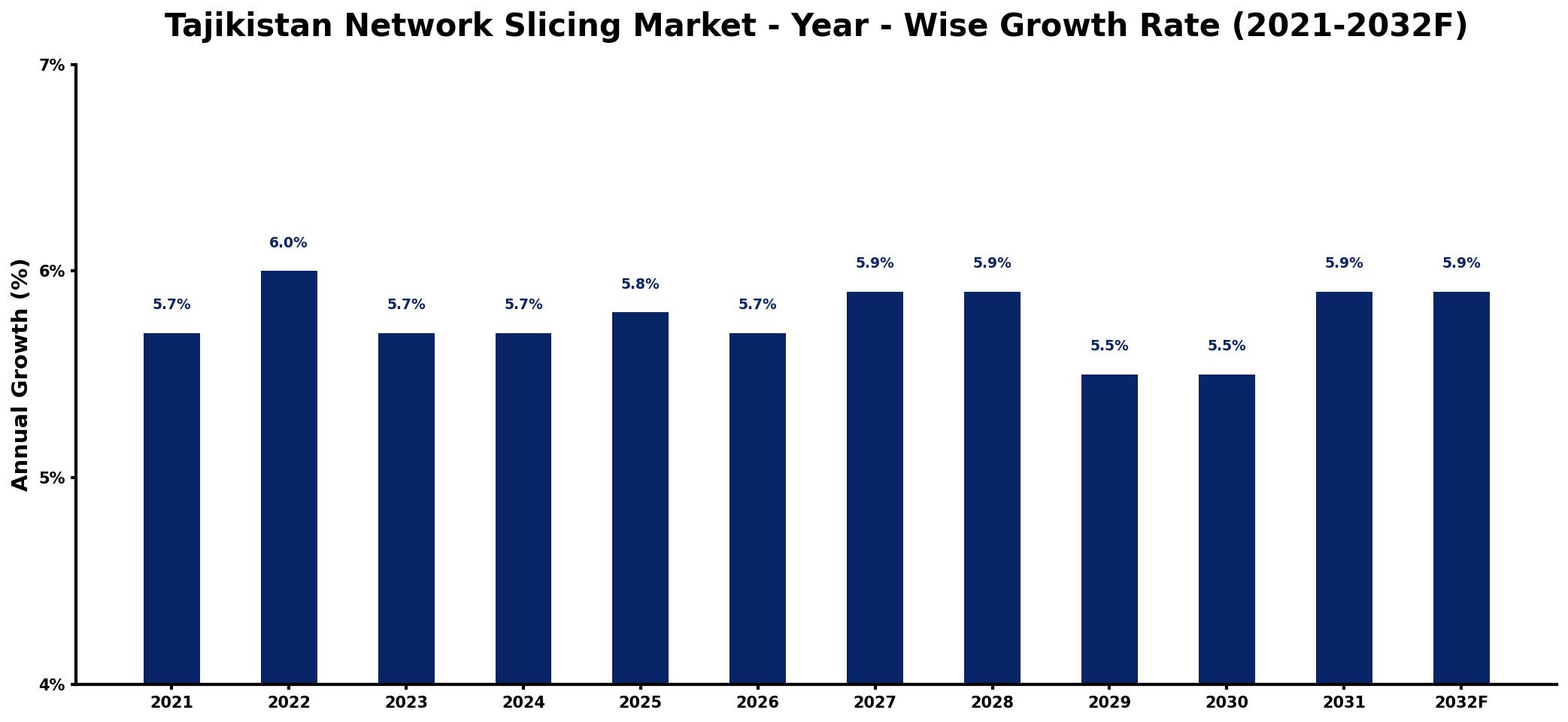
The table below presents the year‑wise growth rates along with the key drivers influencing the market
| Year | Growth Rate | Major Drivers |
| 2021 | 5.7% | increased investment in telecom infrastructure |
| 2022 | 6.0% | growing demand for mobile connectivity |
| 2023 | 5.7% | expansion of 5G technology adoption |
| 2024 | 5.7% | rising need for customized solutions |
| 2025 | 5.8% | enhanced focus on IoT applications |
| 2026 | 5.7% | growing enterprise digital transformation initiatives |
| 2027 | 5.9% | increased government support for innovation |
| 2028 | 5.9% | higher consumer expectations for services |
| 2029 | 5.5% | development of new business models |
| 2030 | 5.5% | increased competition among service providers |
| 2031 | 5.9% | growing partnerships with tech firms |
| 2032 | 5.9% | improved raw material availability |
Note: Market size estimations and growth projections presented in this report are based on 6Wresearch's proprietary forecasting methodology, utilizing the latest available industry data, government publications, and primary research inputs.
Tajikistan Network Slicing Market Synopsis
As the telecommunications landscape in Tajikistan evolves, the demand for network slicing technology is becoming more pronounced. This technology allows telecom operators to create virtual networks that cater to specific customer needs, optimizing resource utilization and enhancing service delivery. Such capability is essential for supporting the burgeoning Internet of Things (IoT) market within the country.
Moreover, network slicing paves the way for improved performance across various applications, enabling faster response times and reduced latency. The integration of such advanced technologies is vital as Tajikistan strives to modernize its telecom infrastructure and support a growing digital economy, making the network slicing market a focal point for innovation and investment.
Tajikistan Network Slicing Market Key Takeaways
- The market is driven by the increasing demand for customized network solutions.
- 5G deployment is a significant catalyst for the growth of network slicing capabilities.
- Operators are actively seeking partnerships to enhance technological offerings in this space.
- Investment opportunities are emerging in network infrastructure modernization.
- The evolving regulatory environment may soon support network slicing adoption.
Evaluation of Restraints in Tajikistan Network Slicing Market
Despite the promising outlook for the Tajikistan Network Slicing Market, several challenges could impede its growth. A significant hurdle is the existing limitations in telecommunications infrastructure and technological readiness for effective network slicing implementation. Many operators face a resource crunch, requiring substantial investments to upgrade their current systems to support advanced functionalities. Additionally, the regulatory environment may not yet be fully equipped to foster the level of innovation and collaboration needed among operators. This lag could result in a slower-than-expected adoption rate, stunting the overall market potential.
Tajikistan Network Slicing Market Trends
Several trends are shaping the Tajikistan Network Slicing Market. One notable trend is the increasing focus on the Internet of Things (IoT), where network slicing facilitates tailored connectivity for smart devices and applications. Another emerging trend is the emphasis on augmented reality (AR) and ultra-reliable low-latency communication (URLLC), which require precise network management to deliver high-quality user experiences. As operators continue to explore the potential of network slicing, the trend towards flexible, adaptive networks is likely to become a cornerstone of their service offerings.
Tajikistan Network Slicing Market Opportunities
The Tajikistan Network Slicing Market presents numerous opportunities for investment and growth. Telecom operators can unlock significant value by modernizing their infrastructure to integrate network slicing capabilities, particularly as demand surges for applications like autonomous vehicles and smart cities. Investors can capitalize on partnerships with local telecom companies to deliver innovative solutions or participate in infrastructure enhancement initiatives. As Tajikistan continues its journey towards digital transformation, the potential for growth in network slicing technology offers a competitive advantage for forward-thinking stakeholders.
Government Initiatives in the Tajikistan Network Slicing Market
While there are currently no specific government policies targeting the network slicing market, Tajikistan's government has expressed a commitment to improving digital infrastructure and promoting digital transformation across the telecommunications sector. Such initiatives could eventually create a conducive environment for the adoption of network slicing technologies, allowing operators to enhance their services and performance. As the digital economy grows, we may anticipate regulatory developments that support innovation and investment in network slicing.
Future Insights of the Tajikistan Network Slicing Market
Looking ahead to 2026-2032, the Tajikistan Network Slicing Market is set for substantial growth driven by the increasing demand for sophisticated network services. As telecom operators enhance their capabilities through 5G networks, we expect to see a more rapid adoption of network slicing technologies. These developments will facilitate differentiated service offerings and optimize resource allocation, leading to higher customer satisfaction. Overall, the focus on digital transformation will continue to propel the market forward, solidifying Tajikistan as an important player in the network slicing domain.
Tajikistan Network Slicing Market Latest Developments (2025 - 2026)
In recent months, the telecommunications sector in Tajikistan has shown signs of momentum, with increased discussions around partnerships for network slicing technology. Operators are exploring innovative solutions to enhance service delivery in response to emerging customer needs. Furthermore, there have been initiatives focusing on infrastructure upgrades that are crucial for enabling network slicing capabilities. These movements reflect a growing recognition of the technology's potential to drive efficiency and revenue generation in the local market.
Tajikistan Network Slicing Market - Key Attractiveness of the Report
- 10 Years of Market Numbers
- Historical Data Starting from 2022 to 2025
- Base Year: 2025
- Forecast Data until 2032
- Key Performance Indicators Impacting the Market
- Major Upcoming Developments and Projects
Key Highlights of the Report:
- Tajikistan Network Slicing Market Outlook
- Market Size of Tajikistan Network Slicing Market, 2025
- Forecast of Tajikistan Network Slicing Market, 2032
- Historical Data and Forecast of Tajikistan Network Slicing Revenues & Volume for the Period 2022-2032F
- Tajikistan Network Slicing Market Trend Evolution
- Tajikistan Network Slicing Market Drivers and Challenges
- Tajikistan Network Slicing Price Trends
- Tajikistan Network Slicing Porter's Five Forces
- Tajikistan Network Slicing Industry Life Cycle
- Historical Data and Forecast of Tajikistan Network Slicing Market Revenues & Volume By Component for the Period 2022-2032F
- Historical Data and Forecast of Tajikistan Network Slicing Market Revenues & Volume By Solution for the Period 2022-2032F
- Historical Data and Forecast of Tajikistan Network Slicing Market Revenues & Volume By Services (Professional & Managed) for the Period 2022-2032F
- Historical Data and Forecast of Tajikistan Network Slicing Market Revenues & Volume By End User for the Period 2022-2032F
- Historical Data and Forecast of Tajikistan Network Slicing Market Revenues & Volume By Telecom Operators for the Period 2022-2032F
- Historical Data and Forecast of Tajikistan Network Slicing Market Revenues & Volume By Enterprises for the Period 2022-2032F
- Historical Data and Forecast of Tajikistan Network Slicing Market Revenues & Volume By Application for the Period 2022-2032F
- Historical Data and Forecast of Tajikistan Network Slicing Market Revenues & Volume By Manufacturing for the Period 2022-2032F
- Historical Data and Forecast of Tajikistan Network Slicing Market Revenues & Volume By Government for the Period 2022-2032F
- Historical Data and Forecast of Tajikistan Network Slicing Market Revenues & Volume By Automotive for the Period 2022-2032F
- Historical Data and Forecast of Tajikistan Network Slicing Market Revenues & Volume By Media and Entertainment for the Period 2022-2032F
- Tajikistan Network Slicing Import Export Trade Statistics
- Market Opportunity Assessment By Component
- Market Opportunity Assessment By End User
- Market Opportunity Assessment By Application
- Tajikistan Network Slicing Top Companies Market Share
- Tajikistan Network Slicing Competitive Benchmarking By Technical and Operational Parameters
- Tajikistan Network Slicing Company Profiles
- Tajikistan Network Slicing Key Strategic Recommendations






































