Tajikistan Oil and Gas Cloud Applications Market Size & Growth Rate (2026-2032)
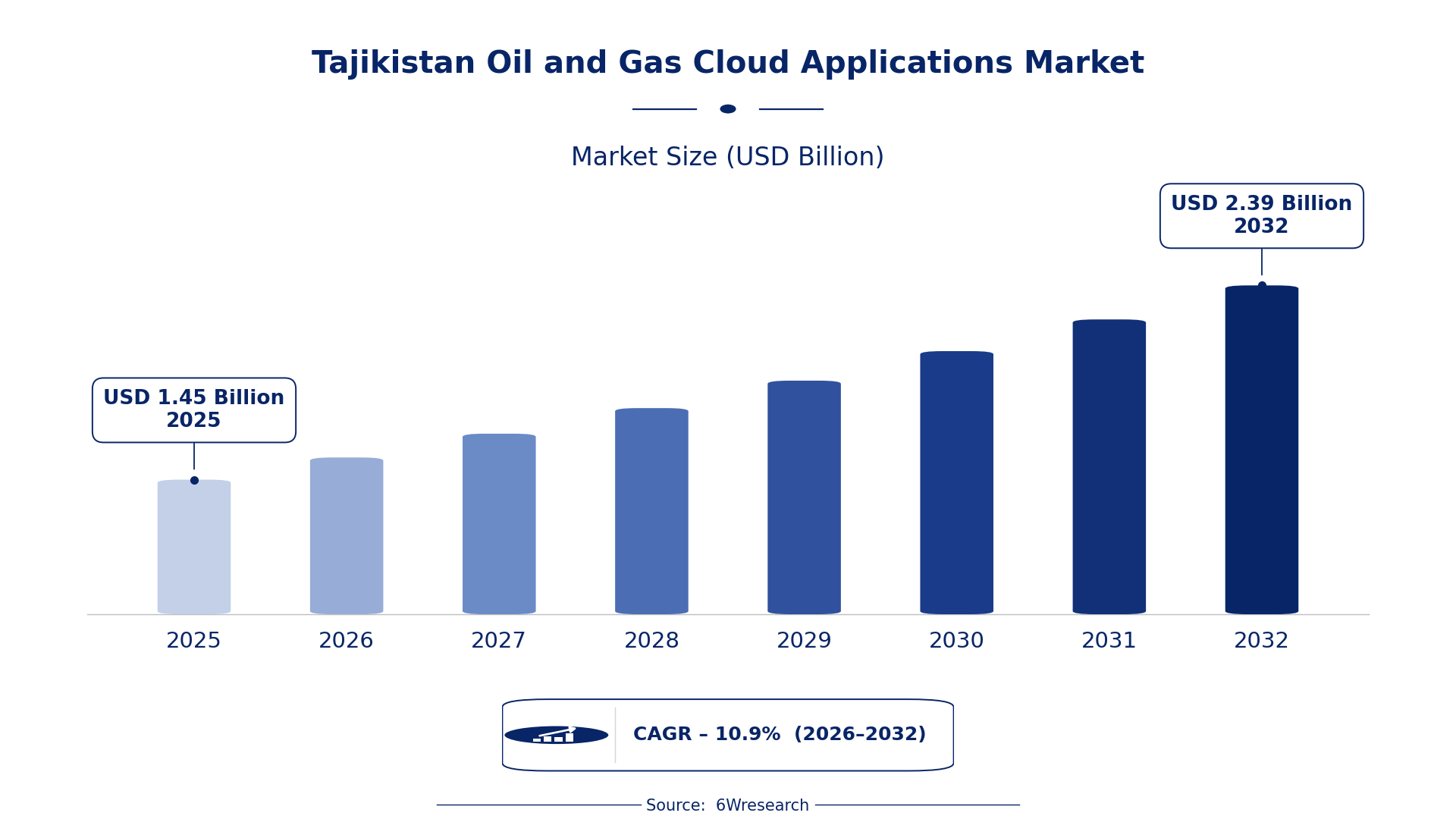
The Tajikistan Oil and Gas Cloud Applications Market was estimated at USD 1449 Million in 2025 and is projected to reach USD 2390 Million by 2032, growing at a CAGR of 10.9% from 2026 to 2032.
Tajikistan Oil and Gas Cloud Applications Market Synopsis
The primary force shaping the Tajikistan Oil and Gas Cloud Applications market is the increasing push for digital transformation within the industry. Companies are recognizing that adopting cloud technologies is no longer optional but essential for staying competitive.
As oil and gas firms in Tajikistan strive for greater operational efficiency, they are turning to cloud solutions that provide real-time data access and advanced analytics. This shift not only boosts collaboration but also enhances data security, making it a critical component of their business strategy.
Tajikistan Oil and Gas Cloud Applications Market Year-wise Growth Rate and Key Drivers
This graph illustrates the annual growth rates of the Tajikistan Oil and Gas Cloud Applications Market from 2021 to 2032, highlighting a steady upward trajectory and projected expansion over the forecast period.
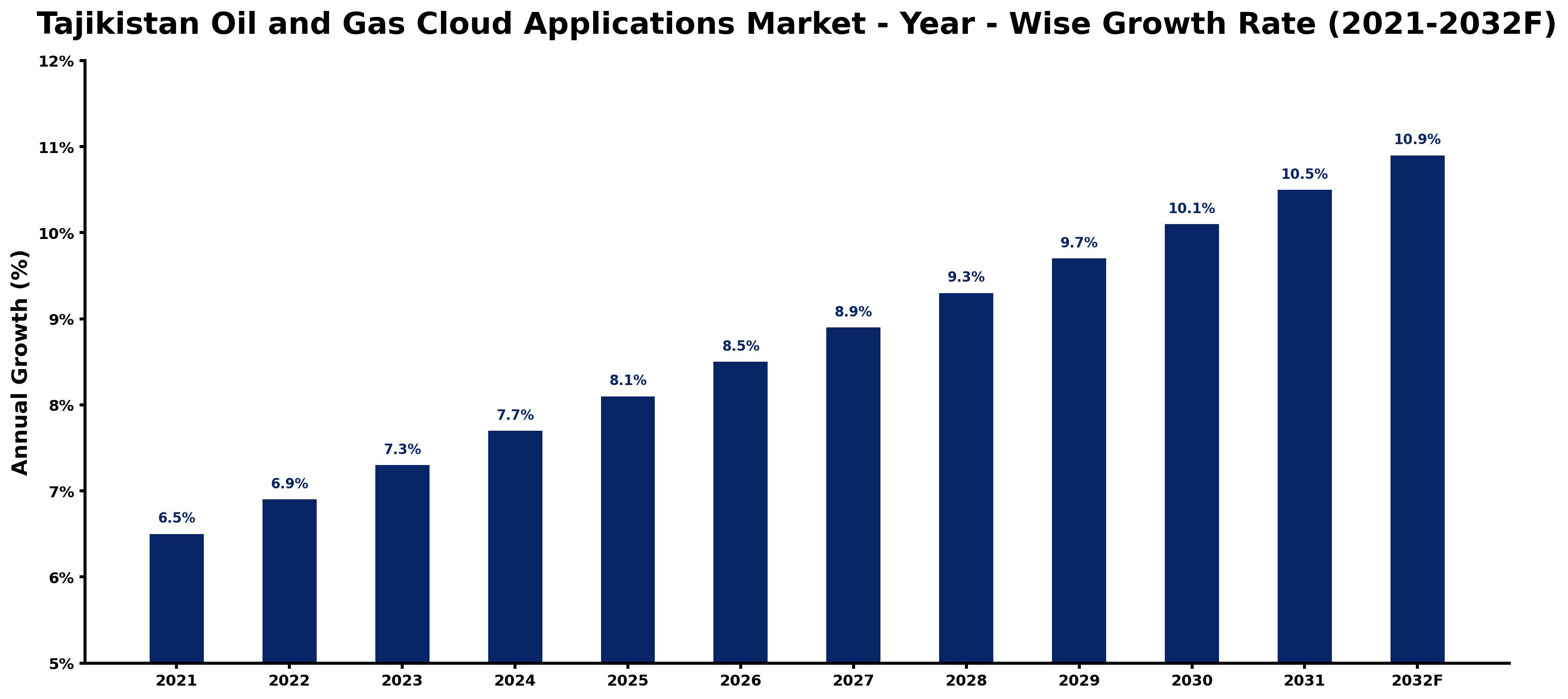
The table below presents the year‑wise growth rates along with the key drivers influencing the market
| Year | Growth Rate | Major Drivers |
| 2021 | 6.5% | Government push for digitalizing oil and gas operations |
| 2022 | 6.9% | Increased partnership with international cloud service providers |
| 2023 | 7.3% | Growing local workforce skilled in cloud technologies |
| 2024 | 7.7% | Implementation of data-driven decision-making initiatives |
| 2025 | 8.1% | Increased investor interest in Tajikistan's energy sector |
| 2026 | 8.5% | National strategy promoting sustainable oil and gas practices |
| 2027 | 8.9% | Rising crude oil prices boosting exploration investments |
| 2028 | 9.3% | Adoption of IoT for remote monitoring in fields |
| 2029 | 9.7% | Government incentives for adopting advanced cloud solutions |
| 2030 | 10.1% | Increased local production capacity and operational efficiency |
| 2031 | 10.5% | Strengthening regional cooperation in energy technology sharing |
| 2032 | 10.9% | Growing cybersecurity regulations fostering cloud application trust |
Note: Market size estimations and growth projections presented in this report are based on 6Wresearch's proprietary forecasting methodology, utilizing the latest available industry data, government publications, and primary research inputs.
Tajikistan Oil and Gas Cloud Applications Market Key Takeaways
Below are some of the specific key takeaways from the market, including:
- The market is driven by the need for operational efficiency and cost reduction.
- Cloud applications are critical for real-time monitoring and decision-making.
- Government initiatives are aimed at promoting digitalization in the sector.
- Challenges remain, particularly related to infrastructure and data security.
- Predictive maintenance and IoT integration are emerging trends in the market.
Evaluation of Restraints in Tajikistan Oil and Gas Cloud Applications Market
Limited infrastructure and connectivity are significant restraints in the Tajikistan Oil and Gas Cloud Applications market. Poor internet access hinders the effective implementation of cloud solutions, impacting operational efficiency. on top of that, concerns about data security and privacy remain prevalent, given the inadequate cybersecurity measures in the region. Companies face added pressure to comply with regulatory standards while navigating an evolving technological landscape. These challenges necessitate substantial investments in infrastructure and training to fully harness the potential of cloud applications.
Tajikistan Oil and Gas Cloud Applications Market Trends
The trend toward digitalization and automation is reshaping the Tajikistan Oil and Gas Cloud Applications market. Companies are increasingly adopting cloud-based solutions to streamline operations, with a notable shift toward advanced analytics for predictive maintenance. Remote monitoring of assets is becoming standard practice, enabled by the integration of IoT technologies. These developments are driving demand for specialized cloud applications that cater specifically to the oil and gas sector.
Tajikistan Oil and Gas Cloud Applications Market Opportunities
The market presents a wealth of opportunities for cloud service providers focused on the oil and gas industry. As companies seek to optimize production processes and reduce downtime, there is increasing demand for tailored solutions that offer real-time data analytics, asset management tools, and collaborative platforms for workforce engagement. With the ongoing digital transformation, the potential for innovation in cloud applications is vast, opening doors for investment and growth.
Government Initiatives in the Tajikistan Oil and Gas Cloud Applications Market
Government policy is actively shaping the Tajikistan Oil and Gas Cloud Applications market through initiatives aimed at fostering technological advancements and digitalization. With a focus on enhancing operational efficiency, the government is implementing regulations to ensure data security while encouraging collaboration among industry stakeholders. This supportive regulatory framework is crucial for integrating cloud applications into the oil and gas sector.
- A national digital infrastructure upgrade programme launched in 2023 aims to improve connectivity in remote areas.
- Currently ongoing initiatives include partnerships between government agencies and technology providers to enhance data management capabilities.
- Upcoming plans feature a public-private initiative expected to streamline regulatory compliance processes by 2026.
- In 2024, a framework mandating cybersecurity protocols for cloud services was introduced to safeguard data privacy.
- The government is also promoting training programmes for personnel to adapt to new technologies in the oil and gas sector.
Future Insights of the Tajikistan Oil and Gas Cloud Applications Market
Looking ahead to 2026-2032, the Tajikistan Oil and Gas Cloud Applications market is positioned for substantial expansion. With digital technologies becoming increasingly integral to operations, companies will seek scalable and cost-effective cloud solutions to enhance efficiency and ensure data security. The government's commitment to improving infrastructure and attracting foreign investments will further fuel the adoption of advanced cloud applications, driving innovation and competitiveness across the industry.
Tajikistan Oil and Gas Cloud Applications Market Latest Developments
In the past year, the Tajikistan Oil and Gas Cloud Applications market has seen notable developments as companies actively embrace digital transformation. The trend toward cloud adoption is accelerating, with various initiatives aimed at integrating advanced technologies into operations.
- A major technology vendor initiated a cloud service rollout in early 2023, focusing on data analytics for oil production.
- An ongoing partnership between local oil companies and international cloud providers aims to enhance asset management capabilities, starting in mid-2023.
- A rollout of IoT-integrated cloud solutions is expected to begin in Q3 2025, targeting real-time monitoring of production assets.
- In late 2023, a pilot project was completed, demonstrating the effectiveness of cloud applications in predictive maintenance.
- Upcoming plans include a series of workshops in early 2024 to educate industry professionals on leveraging cloud technologies.
Tajikistan Oil and Gas Cloud Applications Market - Key Attractiveness of the Report
- 10 Years of Market Numbers
- Historical Data Starting from 2022 to 2025
- Base Year: 2025
- Forecast Data until 2032
- Key Performance Indicators Impacting the Market
- Major Upcoming Developments and Projects
Key Highlights of the Report:
- Tajikistan Oil and Gas Cloud Applications Market Outlook
- Market Size of Tajikistan Oil and Gas Cloud Applications Market, 2025
- Forecast of Tajikistan Oil and Gas Cloud Applications Market, 2032
- Historical Data and Forecast of Tajikistan Oil and Gas Cloud Applications Revenues & Volume for the Period 2022-2032F
- Tajikistan Oil and Gas Cloud Applications Market Trend Evolution
- Tajikistan Oil and Gas Cloud Applications Market Drivers and Challenges
- Tajikistan Oil and Gas Cloud Applications Price Trends
- Tajikistan Oil and Gas Cloud Applications Porter's Five Forces
- Tajikistan Oil and Gas Cloud Applications Industry Life Cycle
- Historical Data and Forecast of Tajikistan Oil and Gas Cloud Applications Market Revenues & Volume By Component for the Period 2022-2032F
- Historical Data and Forecast of Tajikistan Oil and Gas Cloud Applications Market Revenues & Volume By Solution for the Period 2022-2032F
- Historical Data and Forecast of Tajikistan Oil and Gas Cloud Applications Market Revenues & Volume By Services for the Period 2022-2032F
- Historical Data and Forecast of Tajikistan Oil and Gas Cloud Applications Market Revenues & Volume By Deployment Type for the Period 2022-2032F
- Historical Data and Forecast of Tajikistan Oil and Gas Cloud Applications Market Revenues & Volume By Private for the Period 2022-2032F
- Historical Data and Forecast of Tajikistan Oil and Gas Cloud Applications Market Revenues & Volume By Public Cloud for the Period 2022-2032F
- Historical Data and Forecast of Tajikistan Oil and Gas Cloud Applications Market Revenues & Volume By Operation for the Period 2022-2032F
- Historical Data and Forecast of Tajikistan Oil and Gas Cloud Applications Market Revenues & Volume By Upstream for the Period 2022-2032F
- Historical Data and Forecast of Tajikistan Oil and Gas Cloud Applications Market Revenues & Volume By Midstream for the Period 2022-2032F
- Historical Data and Forecast of Tajikistan Oil and Gas Cloud Applications Market Revenues & Volume By Downstream for the Period 2022-2032F
- Tajikistan Oil and Gas Cloud Applications Import Export Trade Statistics
- Market Opportunity Assessment By Component
- Market Opportunity Assessment By Deployment Type
- Market Opportunity Assessment By Operation
- Tajikistan Oil and Gas Cloud Applications Top Companies Market Share
- Tajikistan Oil and Gas Cloud Applications Competitive Benchmarking By Technical and Operational Parameters
- Tajikistan Oil and Gas Cloud Applications Company Profiles
- Tajikistan Oil and Gas Cloud Applications Key Strategic Recommendations






































