Tajikistan Oilfield Air Drilling Market Size, Share & Growth Rate
The Tajikistan Oilfield Air Drilling Market was estimated at USD 661 Million in 2025 and is projected to reach USD 1102 Million by 2032, growing at a CAGR of 7.6% from 2026 to 2032. This growth is largely attributed to the increasing efficiency and cost-effectiveness of air drilling techniques, which are becoming crucial for operators looking to maximize production in challenging geological environments. As investments in technology and infrastructure grow, the sector stands poised for robust expansion.
Tajikistan Oilfield Air Drilling Market Year-wise Growth Rate and Key Drivers
This graph highlights how the Tajikistan Oilfield Air Drilling Market has steadily grown over the years, supported by major growth factors.
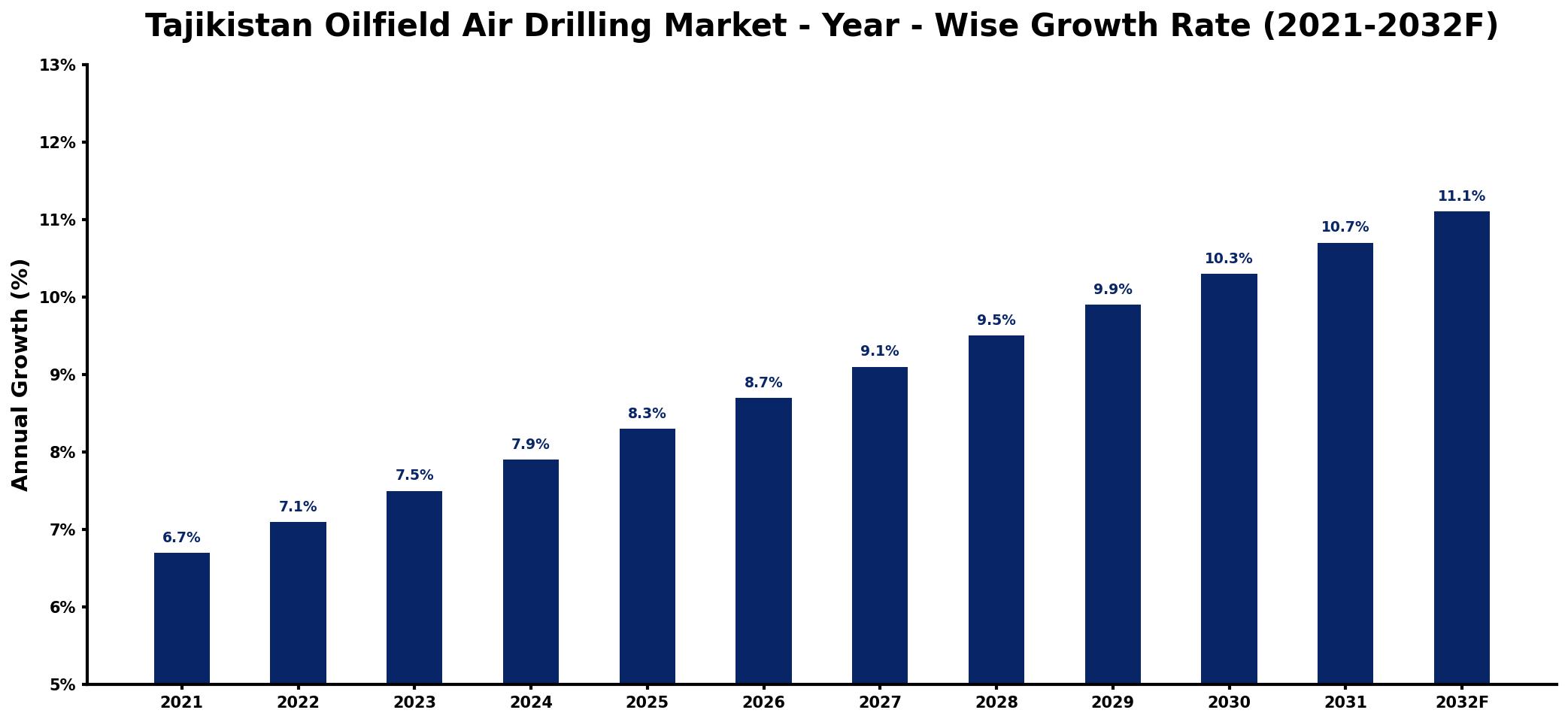
The table below presents the year‑wise growth rates along with the key drivers influencing the market
| Year | Growth Rate | Major Drivers |
| 2021 | 6.7% | rising energy sector investments |
| 2022 | 7.1% | growing exploration activities globally |
| 2023 | 7.5% | increased infrastructure development projects |
| 2024 | 7.9% | enhanced regulatory support initiatives |
| 2025 | 8.3% | expansion of renewable energy sources |
| 2026 | 8.7% | surge in foreign direct investments |
| 2027 | 9.1% | growing demand for energy security |
| 2028 | 9.5% | technological advancements in extraction |
| 2029 | 9.9% | increased focus on sustainability practices |
| 2030 | 10.3% | expanding manufacturing base activity |
| 2031 | 10.7% | growing interest in unconventional resources |
| 2032 | 11.1% | rising demand for energy innovations |
Note: Market size estimations and growth projections presented in this report are based on 6Wresearch's proprietary forecasting methodology, utilizing the latest available industry data, government publications, and primary research inputs.
Tajikistan Oilfield Air Drilling Market Synopsis
The adoption of air drilling technology is rapidly transforming the operational landscape of Tajikistan's oil and gas industry. This innovative approach offers several key advantages, including accelerated drilling rates and diminished formation damage, crucial for operators navigating the region's complex geology.
Moreover, as the demand for sustainable and environmentally friendly practices grows, air drilling has emerged as a preferred option over traditional methods. This shift not only enhances productivity but also aligns with global standards for environmental stewardship, further driving the market's evolution.
Tajikistan Oilfield Air Drilling Market Key Takeaways
- The market is expected to benefit from rising investments in advanced air drilling technologies.
- Government incentives are actively encouraging foreign investments in the oil and gas sector.
- Environmental concerns are driving a shift towards more sustainable drilling practices.
- Operators are increasingly focused on maximizing oil and gas recovery in challenging terrains.
- Strategic partnerships are emerging as companies seek to enhance their technological capabilities.
Evaluation of Restraints in Tajikistan Oilfield Air Drilling Market
Despite the promising growth trajectory, the Tajikistan Oilfield Air Drilling Market faces significant challenges that could impede its progress. Limited infrastructure development remains a critical concern, as insufficient transport and operational facilities can lead to increased operational costs and delays in project timelines. Moreover, the prevailing political instability and regulatory uncertainty can deter potential investments, thereby slowing the market's expansion. Furthermore, the reliance on foreign expertise due to a lack of local technological skills adds to operational costs, necessitating a robust focus on building domestic capabilities and ensuring stable operating conditions.
Tajikistan Oilfield Air Drilling Market Trends
The current trend in the Tajikistan Oilfield Air Drilling Market highlights an increasing preference for advanced drilling technologies that enhance operational efficiency. This includes the integration of automated systems and real-time data analytics to optimize drilling processes. Additionally, there is a noticeable push towards environmentally friendly drilling practices, with air drilling being recognized for its lower environmental impact. As operators seek to improve penetration rates and reduce costs, the demand for air drilling services is expected to grow significantly, reflecting a broader industry shift toward innovation and sustainability.
Tajikistan Oilfield Air Drilling Market Opportunities
Investment opportunities within the Tajikistan Oilfield Air Drilling Market are abundant, particularly given the nations vast untapped oil and gas reserves. The growing global demand for energy resources makes this an attractive region for investors willing to leverage advanced air drilling technologies to enhance efficiency. Furthermore, the Tajik governments openness to foreign investment provides a favorable regulatory environment that encourages entry and expansion into this burgeoning market. By focusing on innovative solutions and sustainable practices, investors can play a crucial role in shaping the future of oilfield exploration and production in Tajikistan.
Government Initiatives in the Tajikistan Oilfield Air Drilling Market
Government initiatives are pivotal in fostering the growth of the oilfield air drilling market in Tajikistan. The government has instituted policies aimed at promoting the development of the oil and gas sector, with specific regulations designed to encourage adherence to environmental standards. Incentives such as tax breaks and subsidies are being offered to attract foreign investment, fostering a favorable climate for technological advancement in the sector. Overall, the governments strategic approach is focused on balancing economic growth with environmental sustainability, essential for long-term development in the region.
Future Insights of the Tajikistan Oilfield Air Drilling Market
Looking ahead to 2026-2032, the Tajikistan Oilfield Air Drilling Market is set to witness substantial growth driven by advancements in drilling technologies and increased exploration activities. As operators seek to optimize production and mitigate environmental impact, air drilling techniques are likely to become even more prevalent. The ongoing governmental support and regulatory frameworks aimed at attracting foreign capital further bolster the market's potential. By aligning with global energy trends and focusing on sustainable practices, the sector stands ready to capitalize on emerging opportunities and fulfill the evolving demands of the oil and gas industry.
Tajikistan Oilfield Air Drilling Market Latest Developments (2025 - 2026)
Recent developments in the Tajikistan Oilfield Air Drilling Market indicate a growing shift towards technological innovation and increased investments in infrastructure. Companies are exploring partnerships to enhance technological capabilities and improve drilling efficiency. Additionally, government policies continue to evolve, providing more favorable conditions for foreign investments and encouraging sustainable practices. As the market progresses, the focus remains on overcoming infrastructural challenges and leveraging advanced drilling techniques to maximize resource extraction.
Tajikistan Oilfield Air Drilling Market - Key Attractiveness of the Report
- 10 Years of Market Numbers
- Historical Data Starting from 2022 to 2025
- Base Year: 2025
- Forecast Data until 2032
- Key Performance Indicators Impacting the Market
- Major Upcoming Developments and Projects
Key Highlights of the Report:
- Tajikistan Oilfield Air Drilling Market Outlook
- Market Size of Tajikistan Oilfield Air Drilling Market, 2025
- Forecast of Tajikistan Oilfield Air Drilling Market, 2032
- Historical Data and Forecast of Tajikistan Oilfield Air Drilling Revenues & Volume for the Period 2022-2032F
- Tajikistan Oilfield Air Drilling Market Trend Evolution
- Tajikistan Oilfield Air Drilling Market Drivers and Challenges
- Tajikistan Oilfield Air Drilling Price Trends
- Tajikistan Oilfield Air Drilling Porter's Five Forces
- Tajikistan Oilfield Air Drilling Industry Life Cycle
- Historical Data and Forecast of Tajikistan Oilfield Air Drilling Market Revenues & Volume By Type for the Period 2022-2032F
- Historical Data and Forecast of Tajikistan Oilfield Air Drilling Market Revenues & Volume By Dust for the Period 2022-2032F
- Historical Data and Forecast of Tajikistan Oilfield Air Drilling Market Revenues & Volume By Aerated fluid for the Period 2022-2032F
- Historical Data and Forecast of Tajikistan Oilfield Air Drilling Market Revenues & Volume By Foam for the Period 2022-2032F
- Historical Data and Forecast of Tajikistan Oilfield Air Drilling Market Revenues & Volume By Mist for the Period 2022-2032F
- Historical Data and Forecast of Tajikistan Oilfield Air Drilling Market Revenues & Volume By Nitrogen membrane for the Period 2022-2032F
- Tajikistan Oilfield Air Drilling Import Export Trade Statistics
- Market Opportunity Assessment By Type
- Tajikistan Oilfield Air Drilling Top Companies Market Share
- Tajikistan Oilfield Air Drilling Competitive Benchmarking By Technical and Operational Parameters
- Tajikistan Oilfield Air Drilling Company Profiles
- Tajikistan Oilfield Air Drilling Key Strategic Recommendations






































