Tajikistan Ornamental Fish Market Size, Share & Growth Rate
The Tajikistan Ornamental Fish Market was estimated at USD 282 Million in 2025 and is projected to reach USD 384 Million by 2032, growing at a CAGR of 4.5% from 2026 to 2032. This growth trajectory is driven by an increasing disposable income among urban residents, coupled with a rising interest in aquarium keeping as a leisure activity. Additionally, the emergence of online retail platforms is providing greater access to exotic fish species, further fueling demand in this niche market.
Tajikistan Ornamental Fish Market Year-wise Growth Rate and Key Drivers
This graph highlights how the Tajikistan Ornamental Fish Market has steadily grown over the years, supported by major growth factors.
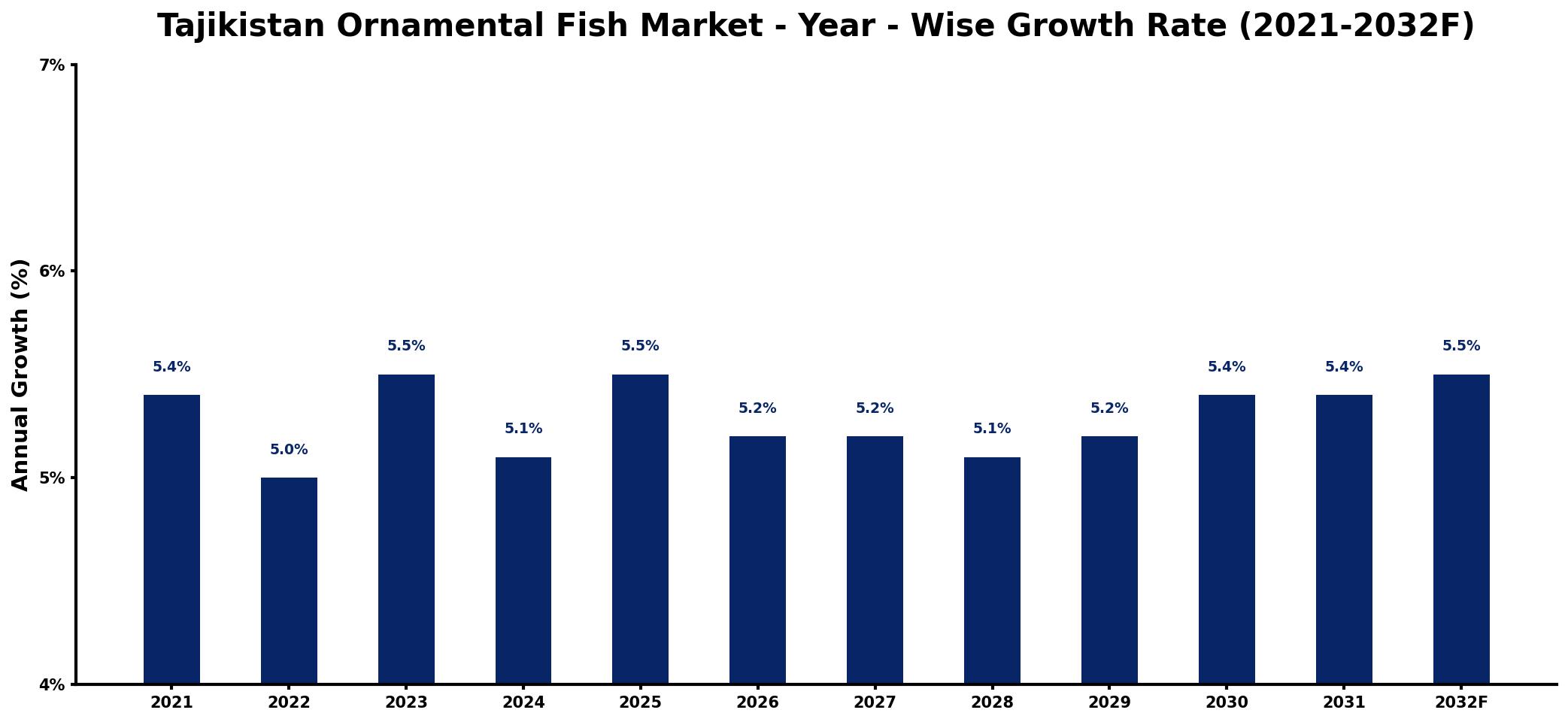
The table below presents the year‑wise growth rates along with the key drivers influencing the market
| Year | Growth Rate | Major Drivers |
| 2021 | 5.4% | Rising interest in home aquariums |
| 2022 | 5.0% | Increase in disposable income levels |
| 2023 | 5.5% | Growth in online pet sales |
| 2024 | 5.1% | Expansion of local pet shops |
| 2025 | 5.5% | Surge in aquarium hobbyists community |
| 2026 | 5.2% | Higher demand for aquatic decor |
| 2027 | 5.2% | Increased popularity of aquascaping |
| 2028 | 5.1% | Investment in sustainable breeding practices |
| 2029 | 5.2% | Wider availability of aquatic supplies |
| 2030 | 5.4% | Enhanced consumer education programs |
| 2031 | 5.4% | Broader marketing outreach strategies |
| 2032 | 5.5% | Growing trend of eco-friendly aquariums |
Note: Market size estimations and growth projections presented in this report are based on 6Wresearch's proprietary forecasting methodology, utilizing the latest available industry data, government publications, and primary research inputs.
Tajikistan Ornamental Fish Market Synopsis
The strongest force shaping the Tajikistan Ornamental Fish Market right now is the burgeoning interest among hobbyists for unique and exotic fish species. Urban centers, where affluent consumers are concentrated, are seeing a rise in aquarium shops and online retailers catering to this demand, leading to an expanding marketplace.
While the market is witnessing increased consumer interest, challenges such as inadequate infrastructure and limited availability of high-quality fish species persist. However, local breeders and importers are working to meet the diverse preferences of customers, hinting at a promising outlook for future market developments.
Tajikistan Ornamental Fish Market Key Takeaways
- The Tajikistan Ornamental Fish Market is expected to grow significantly, reaching USD 384 Million by 2032.
- Urban areas are central to market growth, reflecting higher consumer disposable income and interest in aquarium hobbies.
- Online retailing is gaining traction, making a wider variety of fish species more accessible to consumers.
- There is a notable shift towards sustainability and ethically sourced fish within the market.
- Investors are presented with opportunities in breeding, retail, and educational services related to aquarium maintenance.
Evaluation of Restraints in Tajikistan Ornamental Fish Market
Despite its growth potential, the Tajikistan Ornamental Fish Market faces several restraints. Infrastructure challenges hinder effective transportation and storage of live fish, which is crucial for maintaining quality. Additionally, the market's fragmentation limits organized distribution channels, making it difficult for businesses to reach broader customer bases. Import regulations can also restrict the variety of fish species available, further complicating market dynamics. Addressing these issues is essential to unlocking the full growth potential of the market.
Tajikistan Ornamental Fish Market Trends
The ornamental fish market in Tajikistan is currently experiencing a trend towards diversity and sustainability. Consumers are increasingly drawn to unique and vibrant fish breeds, prompting local stores to expand their offerings and emphasize high-quality imports. Moreover, the growing popularity of aquascaping is influencing consumer preferences, with many seeking not just fish but complete aquarium setups that are aesthetically pleasing. This trend is complemented by a consumer shift towards sustainable practices, where ethically sourced fish and environmentally friendly aquarium products are in demand.
Tajikistan Ornamental Fish Market Opportunities
With the ornamental fish market in Tajikistan still in a developmental stage, numerous opportunities for growth and investment exist. Entrepreneurs can consider establishing breeding operations that focus on both local and exotic species, tapping into the growing demand for high-quality ornamental fish. Additionally, the development of retail outlets and online platforms can bridge the gap in accessibility for consumers. Offering services such as aquarium maintenance and educational workshops on responsible fish keeping practices can also foster long-term customer loyalty and enhance market sustainability.
Government Initiatives in the Tajikistan Ornamental Fish Market
The government of Tajikistan has recognized the importance of the ornamental fish market and has implemented several policies aimed at promoting sustainability and protecting native species. These regulations encompass licensing requirements for fish farms and retail shops, as well as monitoring the collection and trade of wild ornamental fish. Furthermore, conservation areas have been established to safeguard the natural habitats of various fish species, ensuring that market practices align with environmental preservation efforts. Such initiatives are crucial for maintaining the biodiversity of the country while supporting the market's growth.
Future Insights of the Tajikistan Ornamental Fish Market
Looking ahead to 2026-2032, the Tajikistan Ornamental Fish Market is set to expand further, driven by a combination of increased disposable income and the influence of social media showcasing aquarium aesthetics. As more consumers embrace aquarium keeping as a hobby, demand for exotic and colorful fish species is likely to intensify. Additionally, improvements in breeding techniques and greater international trade access may facilitate a wider variety of fish species entering the market. However, addressing infrastructure deficits and enhancing consumer education on fish care will be vital in maximizing growth potential.
Tajikistan Ornamental Fish Market Latest Developments (2025 - 2026)
In recent months, there have been notable shifts within the Tajikistan Ornamental Fish Market, with an increase in the establishment of online retail platforms catering to the growing consumer interest in exotic fish species. Local breeding operations have also reported success in expanding their portfolios to include more sustainable and ethically sourced fish. Additionally, awareness campaigns focused on responsible aquarium keeping practices are gaining traction, contributing to a more educated consumer base. These developments indicate a dynamic market responding to evolving consumer preferences.
Tajikistan Ornamental Fish Market - Key Attractiveness of the Report
- 10 Years of Market Numbers
- Historical Data Starting from 2022 to 2025
- Base Year: 2025
- Forecast Data until 2032
- Key Performance Indicators Impacting the Market
- Major Upcoming Developments and Projects
Key Highlights of the Report:
- Tajikistan Ornamental Fish Market Outlook
- Market Size of Tajikistan Ornamental Fish Market, 2025
- Forecast of Tajikistan Ornamental Fish Market, 2032
- Historical Data and Forecast of Tajikistan Ornamental Fish Revenues & Volume for the Period 2022-2032F
- Tajikistan Ornamental Fish Market Trend Evolution
- Tajikistan Ornamental Fish Market Drivers and Challenges
- Tajikistan Ornamental Fish Price Trends
- Tajikistan Ornamental Fish Porter's Five Forces
- Tajikistan Ornamental Fish Industry Life Cycle
- Historical Data and Forecast of Tajikistan Ornamental Fish Market Revenues & Volume By Product for the Period 2022-2032F
- Historical Data and Forecast of Tajikistan Ornamental Fish Market Revenues & Volume By Tropical Freshwater for the Period 2022-2032F
- Historical Data and Forecast of Tajikistan Ornamental Fish Market Revenues & Volume By Temperate for the Period 2022-2032F
- Historical Data and Forecast of Tajikistan Ornamental Fish Market Revenues & Volume By Marine for the Period 2022-2032F
- Historical Data and Forecast of Tajikistan Ornamental Fish Market Revenues & Volume By Application for the Period 2022-2032F
- Historical Data and Forecast of Tajikistan Ornamental Fish Market Revenues & Volume By Commercial for the Period 2022-2032F
- Historical Data and Forecast of Tajikistan Ornamental Fish Market Revenues & Volume By Household for the Period 2022-2032F
- Tajikistan Ornamental Fish Import Export Trade Statistics
- Market Opportunity Assessment By Product
- Market Opportunity Assessment By Application
- Tajikistan Ornamental Fish Top Companies Market Share
- Tajikistan Ornamental Fish Competitive Benchmarking By Technical and Operational Parameters
- Tajikistan Ornamental Fish Company Profiles
- Tajikistan Ornamental Fish Key Strategic Recommendations






































