Tajikistan Palladium Market Size, Share & Growth Rate
The Tajikistan Palladium Market was estimated at USD 606 Million in 2025 and is projected to reach USD 877 Million by 2032, growing at a CAGR of 5.4% from 2026 to 2032. This growth trajectory is primarily driven by the increasing global demand for palladium, particularly from the automotive sector as manufacturers strive to meet stringent emission regulations. Tajikistan's untapped palladium reserves and the government's commitment to enhancing mining infrastructure further position the market for significant expansion.
Tajikistan Palladium Market Year-wise Growth Rate and Key Drivers
This graph highlights how the Tajikistan Palladium Market has steadily grown over the years, supported by major growth factors.
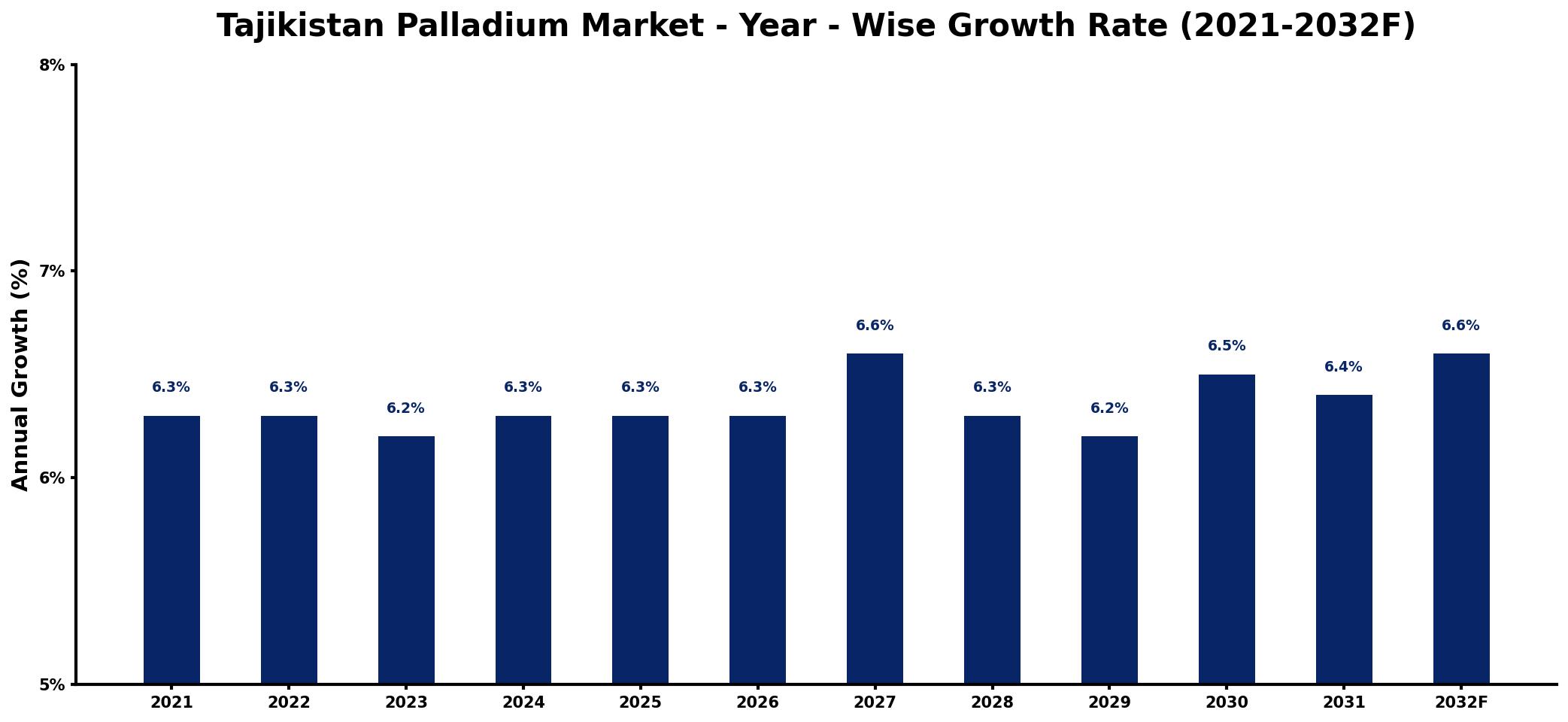
The table below presents the year‑wise growth rates along with the key drivers influencing the market
| Year | Growth Rate | Major Drivers |
| 2021 | 6.3% | Increased industrial manufacturing activities |
| 2022 | 6.3% | Growing demand from automotive sector |
| 2023 | 6.2% | Expansion in electronics production facilities |
| 2024 | 6.3% | Rising investments in renewable energy |
| 2025 | 6.3% | Higher consumer electronics consumption |
| 2026 | 6.3% | Increased adoption of hydrogen technologies |
| 2027 | 6.6% | Emerging markets demand growth |
| 2028 | 6.3% | Technological advancements in production |
| 2029 | 6.2% | Strengthening automotive emissions regulations |
| 2030 | 6.5% | Surge in jewelry market sales |
| 2031 | 6.4% | Increased global trade partnerships |
| 2032 | 6.6% | improved processing technologies adoption |
Note: Market size estimations and growth projections presented in this report are based on 6Wresearch's proprietary forecasting methodology, utilizing the latest available industry data, government publications, and primary research inputs.
Tajikistan Palladium Market Synopsis
The strongest force currently shaping the Tajikistan Palladium Market is the burgeoning demand from the automotive industry for palladium in catalytic converters. As global automotive production ramps up, so does the need for efficient emission control technologies, translating into heightened interest in palladium procurement.
Additionally, geopolitical dynamics are playing a critical role in market behavior. Supply chain interruptions due to international tensions create volatility in palladium prices, urging stakeholders to seek reliable sources, which places Tajikistans resources under renewed scrutiny and consideration.
Tajikistan Palladium Market Key Takeaways
- The market is supported by growing global demand for palladium, particularly for automotive applications.
- Tajikistan's strategic focus on mining infrastructure development aims to bolster its production capabilities.
- Geopolitical factors continue to influence market dynamics and investor confidence.
- Investment opportunities are emerging as companies look to tap into Tajikistan's palladium reserves.
- Future policies from the government could further enhance market viability.
Evaluation of Restraints in Tajikistan Palladium Market
Despite the positive outlook, the Tajikistan Palladium Market is constrained by several critical limitations. Chief among these is the insufficient infrastructure and outdated technology that hinder efficient extraction and processing of palladium. This inefficiency limits the country's ability to compete on a global scale. Furthermore, a lack of investment in research and development stifles innovation, while political instability and regulatory uncertainties deter foreign investors, complicating the market landscape.
Tajikistan Palladium Market Trends
Current trends indicate a notable shift towards sustainable technologies in automotive manufacturing, amplifying the demand for palladium. With global automotive players aggressively pursuing environmentally friendly solutions, the push for innovative emission control devices is particularly noteworthy. Additionally, the rise in electric vehicle production, although initially reducing the need for palladium, may soon create new avenues for palladium applications in hybrid systems.
Tajikistan Palladium Market Opportunities
The evolving landscape presents numerous investment opportunities in the Tajikistan Palladium Market. As automotive and electronics industries grow, there is increasing potential for both local and foreign investors to engage with mining companies or explore palladium trading options. Furthermore, the anticipated improvements in mining infrastructure could enhance production capacity, making investments in this sector highly lucrative.
Government Initiatives in the Tajikistan Palladium Market
The Tajikistan government has shown a commitment to improving its mining sector through various initiatives aimed at attracting foreign investment. While specific policies concerning palladium have not been extensively developed, broader mineral resource strategies are in place. These include efforts to streamline regulations, enhance infrastructure, and provide financial incentives for mining ventures, all of which could indirectly benefit the palladium segment.
Future Insights of the Tajikistan Palladium Market
Looking ahead to 2026-2032, the Tajikistan Palladium Market is expected to enjoy steady growth fueled by rising global demand and the country's capacity to increase production. Investments in technology and infrastructure will be critical to overcoming current challenges. As Tajikistan continues to strengthen its position in the global palladium industry, it is poised to become a key player, especially if geopolitical factors stabilize and infrastructure improvements take hold.
Tajikistan Palladium Market Latest Developments (2025 - 2026)
Recent months have witnessed a notable shift in the Tajikistan Palladium Market, with increasing conversations around enhancing mining capabilities. Industry stakeholders are exploring collaborative efforts to improve infrastructure and production efficiency. The governments ongoing engagement with international mining firms indicates a proactive approach towards developing this niche sector. Additionally, the focus on sustainable practices and technologies continues to gain momentum, which may significantly impact future market dynamics.
Tajikistan Palladium Market - Key Attractiveness of the Report
- 10 Years of Market Numbers
- Historical Data Starting from 2022 to 2025
- Base Year: 2025
- Forecast Data until 2032
- Key Performance Indicators Impacting the Market
- Major Upcoming Developments and Projects
Key Highlights of the Report:
- Tajikistan Palladium Market Outlook
- Market Size of Tajikistan Palladium Market, 2025
- Forecast of Tajikistan Palladium Market, 2032
- Historical Data and Forecast of Tajikistan Palladium Revenues & Volume for the Period 2022-2032F
- Tajikistan Palladium Market Trend Evolution
- Tajikistan Palladium Market Drivers and Challenges
- Tajikistan Palladium Price Trends
- Tajikistan Palladium Porter's Five Forces
- Tajikistan Palladium Industry Life Cycle
- Historical Data and Forecast of Tajikistan Palladium Market Revenues & Volume By Application for the Period 2022-2032F
- Historical Data and Forecast of Tajikistan Palladium Market Revenues & Volume By Automotive for the Period 2022-2032F
- Historical Data and Forecast of Tajikistan Palladium Market Revenues & Volume By Chemicals for the Period 2022-2032F
- Historical Data and Forecast of Tajikistan Palladium Market Revenues & Volume By Electronics for the Period 2022-2032F
- Historical Data and Forecast of Tajikistan Palladium Market Revenues & Volume By Medical for the Period 2022-2032F
- Historical Data and Forecast of Tajikistan Palladium Market Revenues & Volume By Water Treatment for the Period 2022-2032F
- Tajikistan Palladium Import Export Trade Statistics
- Market Opportunity Assessment By Application
- Tajikistan Palladium Top Companies Market Share
- Tajikistan Palladium Competitive Benchmarking By Technical and Operational Parameters
- Tajikistan Palladium Company Profiles
- Tajikistan Palladium Key Strategic Recommendations






































