Tajikistan Planting Equipment Market Size, Share & Growth Rate
The Tajikistan Planting Equipment Market was estimated at USD 742 Million in 2025 and is projected to reach USD 1056 Million by 2032, growing at a CAGR of 5.2% from 2026 to 2032. This growth trajectory is largely driven by the government's strategic push towards agricultural modernization, which is making advanced planting technologies more accessible to farmers. Additionally, there is a notable shift towards mechanization as farmers recognize the benefits of efficiency and higher crop yields.
Tajikistan Planting Equipment Market Year-wise Growth Rate and Key Drivers
This graph highlights how the Tajikistan Planting Equipment Market has steadily grown over the years, supported by major growth factors.
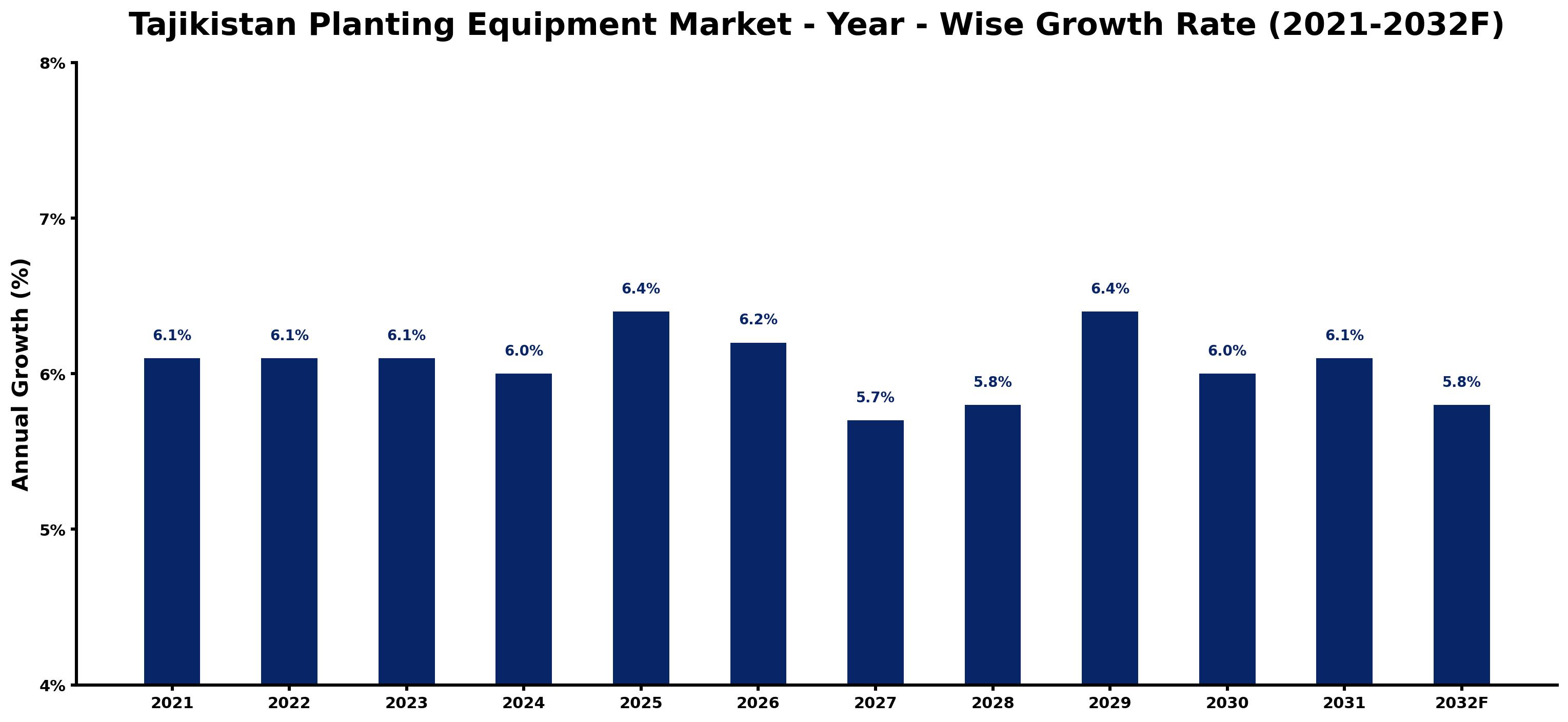
The table below presents the year‑wise growth rates along with the key drivers influencing the market
| Year | Growth Rate | Major Drivers |
| 2021 | 6.1% | Government infrastructure modernization initiatives |
| 2022 | 6.1% | Government infrastructure modernization initiatives |
| 2023 | 6.1% | Increasing adoption of advanced technologies |
| 2024 | 6.0% | Expansion of manufacturing activities |
| 2025 | 6.4% | Government infrastructure modernization initiatives |
| 2026 | 6.2% | Expansion of commercial construction activities |
| 2027 | 5.7% | Rising electricity demand across industries |
| 2028 | 5.8% | Growing urbanization and commercial development |
| 2029 | 6.4% | Rising electricity demand across industries |
| 2030 | 6.0% | Rising electricity demand across industries |
| 2031 | 6.1% | Increasing adoption of advanced technologies |
| 2032 | 5.8% | Increasing industrial infrastructure investments |
Note - Market size estimations and growth projections presented in this report are based on 6Wresearch’s advanced forecasting approach, validated with industry datasets as of June 2026.
Tajikistan Planting Equipment Market Synopsis
The most significant force shaping the Tajikistan planting equipment market is the increasing government commitment to agricultural reform. These reforms aim to provide farmers with the necessary tools and financial support to enhance productivity and sustainability. As a result, there is a notable trend towards the adoption of advanced planting methods that promise both efficiency and improved output.
Furthermore, the growing awareness of environmental sustainability among farmers is fostering demand for eco-friendly planting solutions. This dual focus on modernization and sustainability positions the market for robust growth, encouraging stakeholders to invest in innovative technologies that cater to these emerging needs.
Tajikistan Planting Equipment Market Key Takeaways
- The market is set for significant growth, supported by government initiatives aimed at agricultural modernization.
- There is a rising trend toward mechanization, with farmers increasingly investing in advanced planting equipment.
- Environmental sustainability is becoming a key consideration in planting practices, affecting equipment choices.
- Access to financing remains a challenge for many small-scale farmers, impacting their ability to adopt modern technologies.
- Collaboration between local and foreign investors is crucial for introducing innovative planting solutions tailored to the local context.
Evaluation of Restraints in Tajikistan Planting Equipment Market
Despite the promising growth potential, several restraints hinder the expansion of the Tajikistan planting equipment market. A primary concern is the limited access to financing for small-scale farmers, who often lack the resources to invest in modern machinery. Furthermore, the region's challenging geography, including rugged terrain and severe climatic conditions, complicates the efficient deployment of planting equipment. These factors, alongside inconsistent government policies and a fragmented distribution network, underscore the need for tailored solutions and support to enable wider adoption of advanced planting technologies.
Tajikistan Planting Equipment Market Trends
Current trends in the Tajikistan planting equipment market indicate a notable shift towards precision agriculture. Farmers are increasingly interested in technologies that facilitate optimal seed placement and minimize wastage. The rising preference for equipment that supports conservation agriculture techniques is also noteworthy, as it aligns with the global trend towards sustainable farming. Moreover, collaborative efforts are emerging, with various stakeholders working to improve farmers' access to education and financing for advanced planting solutions.
Tajikistan Planting Equipment Market Opportunities
Investment opportunities in the Tajikistan planting equipment market are substantial, primarily due to the government's focus on modernizing the agricultural sector. There is increasing potential for foreign investors to form partnerships with local manufacturers, facilitating the introduction of innovative and cost-effective planting technologies. Additionally, the development of precision agriculture solutions that are specifically designed for Tajikistan's diverse agricultural landscapes can yield significant returns. By leveraging the trends of mechanization and sustainability, investors can tap into a rapidly evolving market with considerable growth prospects.
Government Initiatives in the Tajikistan Planting Equipment Market
The Tajikistan government has implemented a range of initiatives to bolster the planting equipment market. These include subsidies and financial assistance programs aimed at enabling farmers to procure modern machinery. Furthermore, the government is committed to enhancing agricultural infrastructure, including irrigation systems and logistical frameworks, to ensure efficient planting operations. A strong emphasis is also placed on promoting sustainable agricultural practices, which is reflected in various policies designed to support increased productivity and food security in the region.
Future Insights of the Tajikistan Planting Equipment Market
Looking ahead to 2026-2032, the Tajikistan planting equipment market is poised for steady growth, driven by ongoing government support for agricultural modernization and an expanding adoption of mechanized farming techniques. The demand for planting equipment such as seed drills, planters, and transplanters is expected to rise significantly, spurred by the need for improved crop yields and operational efficiency. As technological advancements continue and financing options become more accessible, the market will likely see an influx of innovative solutions tailored to the specific challenges faced by Tajikistani farmers.
Tajikistan Planting Equipment Market Latest Developments (May 2025 - June 2026)
In recent months, the Tajikistan planting equipment market has witnessed a trend towards increased collaboration among stakeholders. Local agricultural cooperatives are beginning to form partnerships with technology providers to enhance access to modern planting solutions. Furthermore, various initiatives are underway to educate farmers about the benefits of mechanization, focusing on training programs aimed at improving technical skills. These developments point towards a more integrated approach to agricultural modernization, highlighting the collective efforts to bolster the country's agricultural productivity.
Tajikistan Planting Equipment Market - Key Attractiveness of the Report
- 10 Years of Market Numbers
- Historical Data Starting from 2022 to 2025
- Base Year: 2025
- Forecast Data until 2032
- Key Performance Indicators Impacting the Market
- Major Upcoming Developments and Projects
Key Highlights of the Report:
- Tajikistan Planting Equipment Market Outlook
- Market Size of Tajikistan Planting Equipment Market, 2025
- Forecast of Tajikistan Planting Equipment Market, 2032
- Historical Data and Forecast of Tajikistan Planting Equipment Revenues & Volume for the Period 2022-2032F
- Tajikistan Planting Equipment Market Trend Evolution
- Tajikistan Planting Equipment Market Drivers and Challenges
- Tajikistan Planting Equipment Price Trends
- Tajikistan Planting Equipment Porter's Five Forces
- Tajikistan Planting Equipment Industry Life Cycle
- Historical Data and Forecast of Tajikistan Planting Equipment Market Revenues & Volume By Type for the Period 2022-2032F
- Historical Data and Forecast of Tajikistan Planting Equipment Market Revenues & Volume By Air seeders for the Period 2022-2032F
- Historical Data and Forecast of Tajikistan Planting Equipment Market Revenues & Volume By Seed drills for the Period 2022-2032F
- Historical Data and Forecast of Tajikistan Planting Equipment Market Revenues & Volume By Planters for the Period 2022-2032F
- Historical Data and Forecast of Tajikistan Planting Equipment Market Revenues & Volume By Others for the Period 2022-2032F
- Historical Data and Forecast of Tajikistan Planting Equipment Market Revenues & Volume By Design for the Period 2022-2032F
- Historical Data and Forecast of Tajikistan Planting Equipment Market Revenues & Volume By Mechanical for the Period 2022-2032F
- Historical Data and Forecast of Tajikistan Planting Equipment Market Revenues & Volume By Automatic for the Period 2022-2032F
- Historical Data and Forecast of Tajikistan Planting Equipment Market Revenues & Volume By Crop Type for the Period 2022-2032F
- Historical Data and Forecast of Tajikistan Planting Equipment Market Revenues & Volume By Cereals & grains for the Period 2022-2032F
- Historical Data and Forecast of Tajikistan Planting Equipment Market Revenues & Volume By Oilseeds & pulses for the Period 2022-2032F
- Historical Data and Forecast of Tajikistan Planting Equipment Market Revenues & Volume By Fruits & vegetables for the Period 2022-2032F
- Historical Data and Forecast of Tajikistan Planting Equipment Market Revenues & Volume By Others for the Period 2022-2032F
- Tajikistan Planting Equipment Import Export Trade Statistics
- Market Opportunity Assessment By Type
- Market Opportunity Assessment By Design
- Market Opportunity Assessment By Crop Type
- Tajikistan Planting Equipment Top Companies Market Share
- Tajikistan Planting Equipment Competitive Benchmarking By Technical and Operational Parameters
- Tajikistan Planting Equipment Company Profiles
- Tajikistan Planting Equipment Key Strategic Recommendations






































