Tajikistan Plastic Bottles Market Size, Share & Growth Rate
The Tajikistan Plastic Bottles Market was estimated at USD 151 Million in 2025 and is projected to reach USD 200 Million by 2032, growing at a CAGR of 4.1% from 2026 to 2032. This upward trajectory is primarily driven by the increasing consumer demand for packaged beverages and personal care products, supported by rising urbanization and a growing population. Additionally, the trend towards convenient, single-use packaging solutions continues to bolster market expansion.
Tajikistan Plastic Bottles Market Year-wise Growth Rate and Key Drivers
This graph highlights how the Tajikistan Plastic Bottles Market has steadily grown over the years, supported by major growth factors.
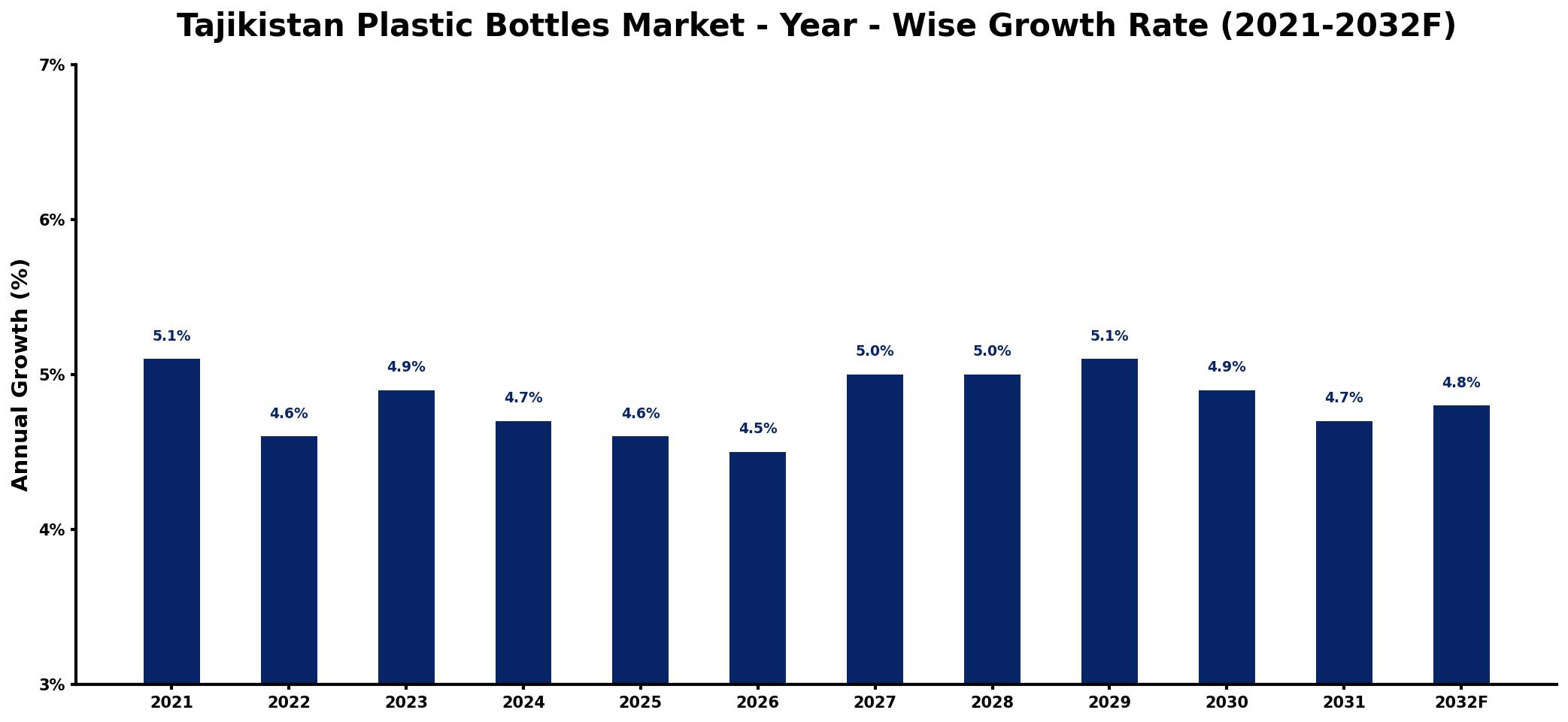
The table below presents the year‑wise growth rates along with the key drivers influencing the market
| Year | Growth Rate | Major Drivers |
| 2021 | 5.1% | Rising consumer demand for convenience |
| 2022 | 4.6% | Increased investment in local production |
| 2023 | 4.9% | Expanding beverage industry requirements |
| 2024 | 4.7% | Growing health and wellness trends |
| 2025 | 4.6% | Surge in e-commerce packaging needs |
| 2026 | 4.5% | Innovations in sustainable materials |
| 2027 | 5.0% | Strengthened distribution network capabilities |
| 2028 | 5.0% | Higher demand for personalized packaging |
| 2029 | 5.1% | Emerging markets adopting new technologies |
| 2030 | 4.9% | Regulatory support for recycling initiatives |
| 2031 | 4.7% | Expanding agriculture and food sectors |
| 2032 | 4.8% | Rising focus on export opportunities |
Note: Market size estimations and growth projections presented in this report are based on 6Wresearch's proprietary forecasting methodology, utilizing the latest available industry data, government publications, and primary research inputs.
Tajikistan Plastic Bottles Market Synopsis
The strongest force shaping the Tajikistan Plastic Bottles Market currently is the burgeoning food and beverage industry, which heavily relies on plastic bottles for packaging water, juices, and other beverages. This increasing demand is further propelled by the convenience offered by single-use plastics, attracting a diverse consumer base.
Amidst this growth, there is a pronounced shift towards sustainability, with manufacturers responding to consumer awareness surrounding environmental concerns. A focus on eco-friendly packaging solutions is driving innovation within the market, making it imperative for stakeholders to adapt and evolve in this dynamic landscape.
Tajikistan Plastic Bottles Market Key Takeaways
- The market is witnessing significant growth due to rising demand from the food and beverage sector.
- Consumer preferences are shifting towards sustainable and recyclable packaging options.
- Opportunities exist for investment in domestic manufacturing and recycling infrastructure.
- Government regulations are influencing market practices towards eco-friendly solutions.
- Urbanization trends are accelerating the demand for convenient plastic packaging.
Evaluation of Restraints in Tajikistan Plastic Bottles Market
Despite the promising growth prospects, the Tajikistan Plastic Bottles Market faces notable restraints. A significant challenge is the inadequate waste management infrastructure, which has resulted in environmental pollution and low recycling rates. Moreover, reliance on imported raw materials hinders local production capabilities and elevates costs. Compounding these issues are fluctuations in raw material prices and consumer awareness regarding recycling, limiting the potential for a fully sustainable market approach.
Tajikistan Plastic Bottles Market Trends
Current trends indicate a distinct pivot towards sustainability and innovation in the Tajikistan Plastic Bottles Market. Consumers are increasingly demanding biodegradable and recyclable options, compelling manufacturers to innovate using alternative materials and production methods that minimize environmental impact. Additionally, the rising preference for lightweight and portable packaging formats aligns with a broader trend of convenience-focused consumption, pushing manufacturers to create smaller, user-friendly bottle designs.
Tajikistan Plastic Bottles Market Opportunities
The market's growth trajectory unveils several lucrative investment opportunities. The burgeoning population and urbanization trends present a ripe environment for establishing new production facilities or partnerships with local businesses in the beverage and personal care sectors. Theres also considerable potential in developing recycling infrastructure to support sustainability initiatives, addressing the current gaps and paving the way for a circular economy. These avenues promise substantial returns for investors looking to capitalize on the expanding consumer packaged goods landscape in Tajikistan.
Government Initiatives in the Tajikistan Plastic Bottles Market
The Tajik government is actively pursuing policies that aim to mitigate the environmental impact of plastic waste, which directly influences the plastic bottles market. Regulations banning single-use plastics and promoting recycling initiatives reflect a commitment to sustainable practices. Furthermore, incentives for companies that adopt biodegradable alternatives or implement proper waste disposal practices are designed to foster an environmentally friendly marketplace, encouraging compliance among industry players.
Future Insights of the Tajikistan Plastic Bottles Market
Looking ahead to 2026-2032, the Tajikistan Plastic Bottles Market is poised for sustained expansion, propelled by demographic growth and a heightened focus on sustainability. As consumers increasingly prioritize eco-friendly options, manufacturers will likely innovate with biodegradable materials and reusable designs. The governments emphasis on enhancing recycling efforts, coupled with technological advancements in production, is expected to shape a more sustainable and resilient market framework, catering to the evolving preferences of environmentally conscious consumers.
Tajikistan Plastic Bottles Market Latest Developments (2025 - 2026)
Recent industry developments suggest a growing emphasis on sustainable practices, with numerous manufacturers exploring the integration of biodegradable materials into their production processes. Initiatives aimed at improving recycling rates are gaining traction, as stakeholders increasingly collaborate with local governments to address waste management challenges. Moreover, consumer feedback is driving the evolution of product designs, emphasizing convenience and sustainability in packaging solutions.
Tajikistan Plastic Bottles Market - Key Attractiveness of the Report
- 10 Years of Market Numbers
- Historical Data Starting from 2022 to 2025
- Base Year: 2025
- Forecast Data until 2032
- Key Performance Indicators Impacting the Market
- Major Upcoming Developments and Projects
Key Highlights of the Report:
- Tajikistan Plastic Bottles Market Outlook
- Market Size of Tajikistan Plastic Bottles Market, 2025
- Forecast of Tajikistan Plastic Bottles Market, 2032
- Historical Data and Forecast of Tajikistan Plastic Bottles Revenues & Volume for the Period 2022-2032F
- Tajikistan Plastic Bottles Market Trend Evolution
- Tajikistan Plastic Bottles Market Drivers and Challenges
- Tajikistan Plastic Bottles Price Trends
- Tajikistan Plastic Bottles Porter's Five Forces
- Tajikistan Plastic Bottles Industry Life Cycle
- Historical Data and Forecast of Tajikistan Plastic Bottles Market Revenues & Volume By Raw Material Type for the Period 2022-2032F
- Historical Data and Forecast of Tajikistan Plastic Bottles Market Revenues & Volume By Polyethylene Terephthalate (PET) for the Period 2022-2032F
- Historical Data and Forecast of Tajikistan Plastic Bottles Market Revenues & Volume By Poly Propylene (PP) for the Period 2022-2032F
- Historical Data and Forecast of Tajikistan Plastic Bottles Market Revenues & Volume By Low-density Polyethylene (LDPE) for the Period 2022-2032F
- Historical Data and Forecast of Tajikistan Plastic Bottles Market Revenues & Volume By High-density Polyethylene (HDPE) for the Period 2022-2032F
- Historical Data and Forecast of Tajikistan Plastic Bottles Market Revenues & Volume By Other Raw Materials for the Period 2022-2032F
- Historical Data and Forecast of Tajikistan Plastic Bottles Market Revenues & Volume By End-user for the Period 2022-2032F
- Historical Data and Forecast of Tajikistan Plastic Bottles Market Revenues & Volume By Beverage for the Period 2022-2032F
- Historical Data and Forecast of Tajikistan Plastic Bottles Market Revenues & Volume By Food for the Period 2022-2032F
- Historical Data and Forecast of Tajikistan Plastic Bottles Market Revenues & Volume By Cosmetics for the Period 2022-2032F
- Historical Data and Forecast of Tajikistan Plastic Bottles Market Revenues & Volume By Pharmaceutical for the Period 2022-2032F
- Historical Data and Forecast of Tajikistan Plastic Bottles Market Revenues & Volume By Household Care for the Period 2022-2032F
- Historical Data and Forecast of Tajikistan Plastic Bottles Market Revenues & Volume By Other for the Period 2022-2032F
- Tajikistan Plastic Bottles Import Export Trade Statistics
- Market Opportunity Assessment By Raw Material Type
- Market Opportunity Assessment By End-user
- Tajikistan Plastic Bottles Top Companies Market Share
- Tajikistan Plastic Bottles Competitive Benchmarking By Technical and Operational Parameters
- Tajikistan Plastic Bottles Company Profiles
- Tajikistan Plastic Bottles Key Strategic Recommendations






































