Tajikistan Plastic Waste Management Market Size, Share & Growth Rate
The Tajikistan Plastic Waste Management Market was estimated at USD 172 Million in 2025 and is projected to reach USD 231 Million by 2032, growing at a CAGR of 4.3% from 2026 to 2032. This growth trajectory is propelled by a combination of increasing public awareness regarding environmental sustainability and governmental initiatives aimed at enhancing waste management practices. As Tajikistan grapples with rising plastic waste generation, the need for effective recycling and waste management solutions is becoming increasingly urgent.
Tajikistan Plastic Waste Management Market Year-wise Growth Rate and Key Drivers
This graph highlights how the Tajikistan Plastic Waste Management Market has steadily grown over the years, supported by major growth factors.
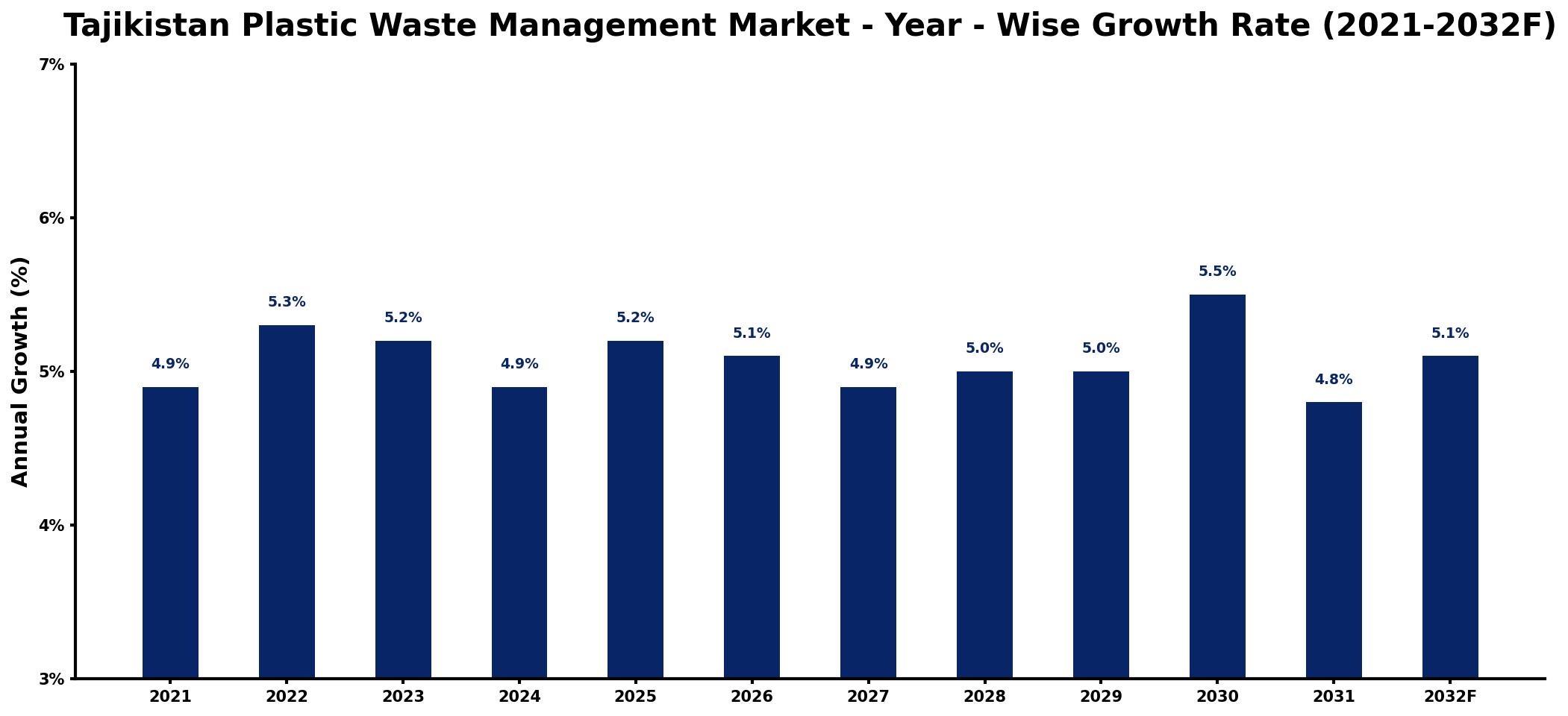
The table below presents the year‑wise growth rates along with the key drivers influencing the market
| Year | Growth Rate | Major Drivers |
| 2021 | 4.9% | Rising environmental awareness initiatives |
| 2022 | 5.3% | Increased recycling infrastructure investments |
| 2023 | 5.2% | Growth in sustainable packaging solutions |
| 2024 | 4.9% | Expansion of circular economy policies |
| 2025 | 5.2% | Emergence of eco-friendly startups |
| 2026 | 5.1% | Development of biodegradable alternatives |
| 2027 | 4.9% | Strengthening regulatory frameworks globally |
| 2028 | 5.0% | Increased corporate sustainability commitments |
| 2029 | 5.0% | Enhanced public-private partnerships initiatives |
| 2030 | 5.5% | Growing demand for eco-labeling certifications |
| 2031 | 4.8% | Shift towards renewable resource utilization |
| 2032 | 5.1% | growing emerging market penetration |
Note: Market size estimations and growth projections presented in this report are based on 6Wresearch's proprietary forecasting methodology, utilizing the latest available industry data, government publications, and primary research inputs.
Tajikistan Plastic Waste Management Market Synopsis
The burgeoning concern over plastic pollution in Tajikistan has catalyzed a surge in demand for recycling services and waste management solutions. This shift is mirrored in the government's proactive stance to implement policies that encourage sustainable practices among citizens and businesses alike.
Despite the nascent stage of the market, investment in recycling infrastructure is on the rise, addressing a critical gap in waste management capabilities. Innovations in recycling technologies are not only enhancing efficiency but also aligning with circular economy principles, thus fortifying the market's future.
Tajikistan Plastic Waste Management Market Key Takeaways
- The market is witnessing a significant shift towards sustainable waste management solutions driven by environmental concerns.
- Government initiatives play a crucial role in promoting recycling and waste reduction strategies.
- Investment opportunities are emerging, particularly in the development of recycling facilities and innovative processing technologies.
- Public-private collaborations are essential for overcoming existing infrastructure deficits in waste management.
- Rising consumer expectations for eco-friendly practices are reshaping market dynamics.
Evaluation of Restraints in Tajikistan Plastic Waste Management Market
The Tajikistan Plastic Waste Management Market faces substantial hurdles that hinder its advancement. A significant obstacle is the limited infrastructure available for waste collection and recycling processes, which constrains efficient operations. Moreover, there is a general lack of public awareness regarding proper waste disposal practices, leading to ineffective waste segregation. Coupled with inadequate government regulations specifically targeting plastic waste management, these challenges result in a considerable proportion of plastic waste being improperly disposed of, thereby exacerbating environmental pollution. To overcome these limitations, a concerted effort involving government, private stakeholders, and local communities is essential to build robust waste management systems.
Tajikistan Plastic Waste Management Market Trends
Emerging trends in the Tajikistan Plastic Waste Management Market are increasingly characterized by a focus on sustainability and technological innovation. As stakeholders recognize the importance of minimizing plastic waste, recycling and waste-to-energy technologies are becoming popular solutions. The emphasis on circular economy principles is fostering the development of novel recycling processes and strategies to reduce plastic waste at the source, reflecting a broader commitment to environmental stewardship. Furthermore, collaborative efforts between public and private sectors are being prioritized to establish more effective recycling facilities and waste processing systems.
Tajikistan Plastic Waste Management Market Opportunities
Investment opportunities abound in the Tajikistan Plastic Waste Management Market, largely fueled by growing awareness and government initiatives to mitigate environmental challenges. Key areas for investment include the establishment of advanced recycling facilities and the development of innovative technologies for processing plastic waste. There is also a promising market for sustainable solutions such as biodegradable alternatives and waste-to-energy initiatives. Partnerships with local municipalities and NGOs can facilitate infrastructure development and support efficient waste management practices, representing a win-win for investors looking to make a positive impact while securing profitable returns.
Government Initiatives in the Tajikistan Plastic Waste Management Market
The Tajikistan government has actively pursued various policies to enhance plastic waste management throughout the country. Central to these initiatives is the National Waste Management Strategy, which aims to significantly reduce plastic waste generation and foster a recycling culture. Furthermore, measures such as banning the import and production of plastic bags are encouraging the adoption of eco-friendly alternatives. The government also emphasizes public awareness campaigns designed to educate citizens about the importance of recycling and responsible waste disposal, thereby reinforcing a commitment to environmental health.
Future Insights of the Tajikistan Plastic Waste Management Market
Looking ahead to 2026-2032, the Tajikistan Plastic Waste Management Market is set to expand as public consciousness regarding environmental issues grows. Governmental initiatives aimed at improving waste management infrastructure and regulatory frameworks are expected to significantly boost market dynamics. With increasing public concern about plastic pollution, demand for innovative recycling technologies and services will likely rise. Collaborations between various stakeholders, including governmental agencies and private enterprises, will be essential in advancing the development of recycling facilities and promoting effective plastic waste reduction strategies.
Tajikistan Plastic Waste Management Market Latest Developments (2025 - 2026)
In recent months, the Tajikistan Plastic Waste Management Market has seen several notable developments aimed at enhancing waste management capabilities. New partnerships are emerging between private enterprises and governmental bodies to establish more efficient waste collection systems. Additionally, investment in innovative recycling technologies is being prioritized to address the urgent need for sustainable waste management solutions. Furthermore, public awareness campaigns have intensified, focusing on educating communities about the significance of recycling and proper waste disposal practices, contributing to a more environmentally-conscious society.
Tajikistan Plastic Waste Management Market - Key Attractiveness of the Report
- 10 Years of Market Numbers
- Historical Data Starting from 2022 to 2025
- Base Year: 2025
- Forecast Data until 2032
- Key Performance Indicators Impacting the Market
- Major Upcoming Developments and Projects
Key Highlights of the Report:
- Tajikistan Plastic Waste Management Market Outlook
- Market Size of Tajikistan Plastic Waste Management Market, 2025
- Forecast of Tajikistan Plastic Waste Management Market, 2032
- Historical Data and Forecast of Tajikistan Plastic Waste Management Revenues & Volume for the Period 2022-2032F
- Tajikistan Plastic Waste Management Market Trend Evolution
- Tajikistan Plastic Waste Management Market Drivers and Challenges
- Tajikistan Plastic Waste Management Price Trends
- Tajikistan Plastic Waste Management Porter's Five Forces
- Tajikistan Plastic Waste Management Industry Life Cycle
- Historical Data and Forecast of Tajikistan Plastic Waste Management Market Revenues & Volume By Source for the Period 2022-2032F
- Historical Data and Forecast of Tajikistan Plastic Waste Management Market Revenues & Volume By Industrial Waste for the Period 2022-2032F
- Historical Data and Forecast of Tajikistan Plastic Waste Management Market Revenues & Volume By Municipal Waste for the Period 2022-2032F
- Historical Data and Forecast of Tajikistan Plastic Waste Management Market Revenues & Volume By Material for the Period 2022-2032F
- Historical Data and Forecast of Tajikistan Plastic Waste Management Market Revenues & Volume By Polyethylene for the Period 2022-2032F
- Historical Data and Forecast of Tajikistan Plastic Waste Management Market Revenues & Volume By Polypropylene for the Period 2022-2032F
- Historical Data and Forecast of Tajikistan Plastic Waste Management Market Revenues & Volume By Polyethylene Terephthalate for the Period 2022-2032F
- Historical Data and Forecast of Tajikistan Plastic Waste Management Market Revenues & Volume By Polystyrene for the Period 2022-2032F
- Historical Data and Forecast of Tajikistan Plastic Waste Management Market Revenues & Volume By Others for the Period 2022-2032F
- Historical Data and Forecast of Tajikistan Plastic Waste Management Market Revenues & Volume By Product Type for the Period 2022-2032F
- Historical Data and Forecast of Tajikistan Plastic Waste Management Market Revenues & Volume By Packaging for the Period 2022-2032F
- Historical Data and Forecast of Tajikistan Plastic Waste Management Market Revenues & Volume By Construction for the Period 2022-2032F
- Historical Data and Forecast of Tajikistan Plastic Waste Management Market Revenues & Volume By Automotive for the Period 2022-2032F
- Historical Data and Forecast of Tajikistan Plastic Waste Management Market Revenues & Volume By Electrical & Electronics for the Period 2022-2032F
- Historical Data and Forecast of Tajikistan Plastic Waste Management Market Revenues & Volume By Others for the Period 2022-2032F
- Historical Data and Forecast of Tajikistan Plastic Waste Management Market Revenues & Volume By Treatment Method for the Period 2022-2032F
- Historical Data and Forecast of Tajikistan Plastic Waste Management Market Revenues & Volume By Collection for the Period 2022-2032F
- Historical Data and Forecast of Tajikistan Plastic Waste Management Market Revenues & Volume By Recycling for the Period 2022-2032F
- Historical Data and Forecast of Tajikistan Plastic Waste Management Market Revenues & Volume By Disposal for the Period 2022-2032F
- Tajikistan Plastic Waste Management Import Export Trade Statistics
- Market Opportunity Assessment By Source
- Market Opportunity Assessment By Material
- Market Opportunity Assessment By Product Type
- Market Opportunity Assessment By Treatment Method
- Tajikistan Plastic Waste Management Top Companies Market Share
- Tajikistan Plastic Waste Management Competitive Benchmarking By Technical and Operational Parameters
- Tajikistan Plastic Waste Management Company Profiles
- Tajikistan Plastic Waste Management Key Strategic Recommendations






































