Tajikistan Player Tracking Market Size & Growth Rate (2026-2032)
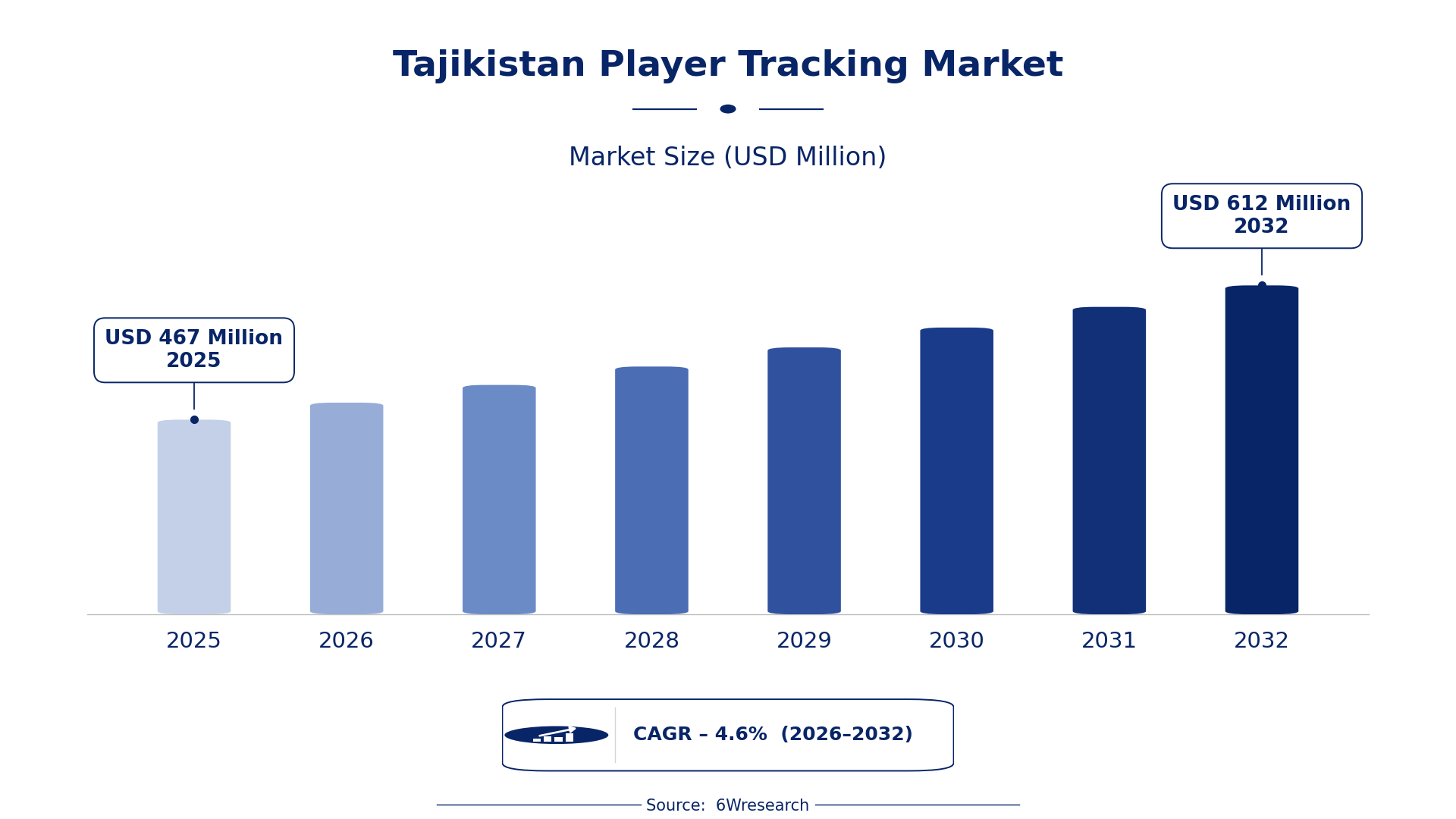
The Tajikistan Player Tracking Market was estimated at USD 467 Million in 2025 and is projected to reach USD 612 Million by 2032, growing at a CAGR of 4.6% from 2026 to 2032.
Tajikistan Player Tracking Market Synopsis
The Tajikistan Player Tracking Market is witnessing a notable uptick in interest from various stakeholders within the sports community. Professional teams, coaches, and sports academies are increasingly investing in player tracking technologies, recognizing their potential to enhance athletic performance through data-driven insights.
With the growing popularity of sports analytics, the demand for advanced tools such as GPS trackers and wearables is on the rise. These technologies are critical for real-time performance monitoring, and their adoption is reshaping how athletes train and compete in Tajikistan.
Tajikistan Player Tracking Market Year-wise Growth Rate and Key Drivers
This graph illustrates the annual growth rates of the Tajikistan Player Tracking Market from 2021 to 2032, highlighting a steady upward trajectory and projected expansion over the forecast period.
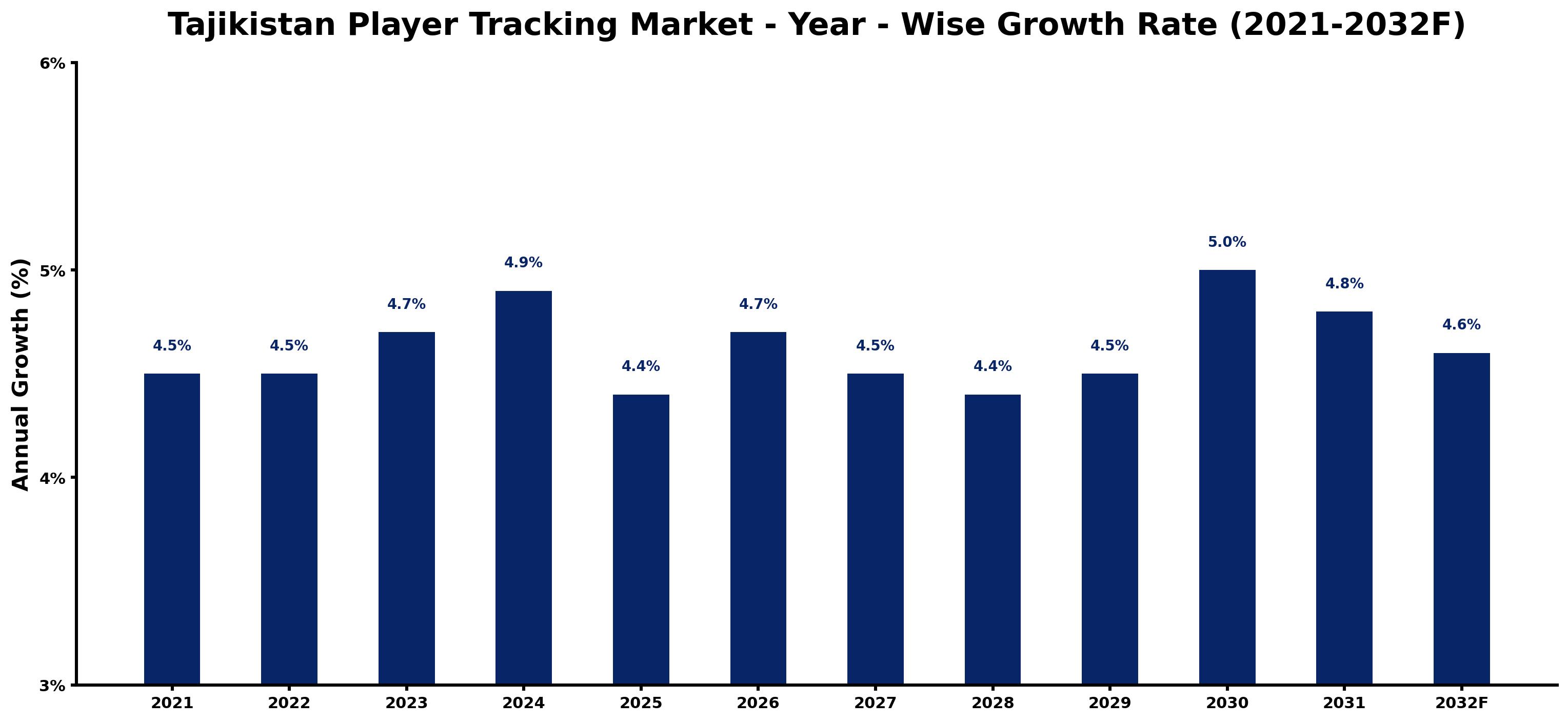
The table below presents the year‑wise growth rates along with the key drivers influencing the market
| Year | Growth Rate | Major Drivers |
| 2021 | 4.5% | Increased investment in sports infrastructure ahead of events. |
| 2022 | 4.5% | Growing youth sports participation drives player tracking demand. |
| 2023 | 4.7% | Government initiatives enhance sports data analytics accessibility. |
| 2024 | 4.9% | Rise in esports popularity boosts tracking technology interest. |
| 2025 | 4.4% | Local clubs prioritize performance analytics for youth development. |
| 2026 | 4.7% | Improved connectivity supports real-time tracking implementations. |
| 2027 | 4.5% | Increased international partnerships for sports technology integration. |
| 2028 | 4.4% | Tajikistan athletes garnering attention spurs tracking innovations. |
| 2029 | 4.5% | Ongoing regional sports competitions require advanced tracking systems. |
| 2030 | 5.0% | Investment in health data monitoring enhances player safety focus. |
| 2031 | 4.8% | Emergence of local tech startups advancing tracking solutions. |
| 2032 | 4.6% | Increased media coverage raising awareness of player performance. |
Note: Market size estimations and growth projections presented in this report are based on 6Wresearch's proprietary forecasting methodology, utilizing the latest available industry data, government publications, and primary research inputs.
Tajikistan Player Tracking Market Key Takeaways
Below are some of the specific key takeaways from the market, including:
- The market is driven by the demand for advanced analytics tools among sports professionals.
- Real-time data tracking is becoming a standard practice for performance optimization.
- Investment in wearable technology is expected to increase significantly in the coming years.
- Partnerships with sports organizations are vital for market growth and innovation.
- Challenges related to infrastructure and costs remain significant barriers to widespread adoption.
Evaluation of Restraints in Tajikistan Player Tracking Market
Despite the promising growth trajectory, the Tajikistan Player Tracking Market faces several restraints that could impede its expansion. A major issue is the limited technology infrastructure in the country, which hampers the effective implementation of player tracking systems. Additionally, many smaller sports clubs struggle with the financial burden associated with acquiring and maintaining advanced tracking technologies.
on top of that, there's a notable gap in awareness and understanding of the benefits of these systems among key stakeholders. Without sufficient education and outreach, the full potential of player tracking solutions may remain untapped.
Tajikistan Player Tracking Market Trends
Current trends in the Tajikistan Player Tracking Market include an increased reliance on GPS tracking devices and wearable sensors. Coaches are now employing these tools to monitor player movements, fitness levels, and tactical decision-making. The trend towards data-driven coaching is gaining momentum, allowing teams to make informed decisions and refine their training approaches.
Another emerging trend is the integration of player tracking technology into fan engagement strategies, enhancing the viewing experience through interactive data presentation. This not only satisfies a growing appetite for analytics among fans but also elevates the overall experience associated with sports events in Tajikistan.
Tajikistan Player Tracking Market Opportunities
There are considerable opportunities for growth within the Tajikistan Player Tracking Market. The development of customized tracking solutions tailored to specific sports can cater to a wider range of athletes, including those in the amateur and youth segments. This opens the door for innovative partnerships with local sports organizations aiming to enhance their training programs.
Additionally, investing in educational initiatives to raise awareness about the benefits of player tracking technologies can spur adoption. As the sports ecosystem in Tajikistan continues to mature, the potential for advanced analytics to drive performance improvements is becoming increasingly clear.
Government Initiatives in the Tajikistan Player Tracking Market
Government policies are gradually shaping the direction of the Tajikistan Player Tracking Market. Emphasis is placed on promoting ethical practices and transparency in data usage, which is crucial for building trust among stakeholders. Regulatory frameworks are being established to ensure responsible use of player tracking technologies, reflecting a commitment to safeguarding user privacy.
- A regulatory framework implemented in early 2025 focuses on data protection and ethical guidelines for player tracking technologies.
- Ongoing efforts to enhance digital infrastructure are expected to improve connectivity and support the deployment of tracking systems.
- A national sports initiative launched in 2026 aims to integrate advanced analytics into training programs for youth athletes.
- Plans for a public-private partnership aimed at promoting technology investments in sports are currently under discussion.
Future Insights of the Tajikistan Player Tracking Market
Looking ahead, the Tajikistan Player Tracking Market is set for substantial growth through 2032. As more sports organizations recognize the value of data in optimizing athlete performance, demand for tracking solutions will likely accelerate. Continuous advancements in wearable technology and data analytics will further enhance the capabilities available to coaches and athletes, solidifying the market's foundation for innovation.
This shift towards data-driven training and performance monitoring will be instrumental in transforming the competitive dynamics of sports in Tajikistan, promoting a culture of excellence across all levels.
Tajikistan Player Tracking Market Latest Developments
Recent activity in the Tajikistan Player Tracking Market indicates a vibrant evolution as stakeholders increasingly adopt technology for performance enhancement. The past year has seen several initiatives aimed at integrating player tracking solutions into various sports disciplines.
- A major technology vendor launched a new line of wearable tracking devices in Q2 2025, designed specifically for team sports.
- An initiative that began in early 2025 is underway to provide training programs for coaches on utilizing analytics effectively.
- A partnership between local sports academies and technology providers is expected to roll out new tracking solutions by mid-2026.
- Efforts to expand connectivity infrastructure are ongoing, with a focus on increasing access to rural areas by late 2025.
Tajikistan Player Tracking Market - Key Attractiveness of the Report
- 10 Years of Market Numbers
- Historical Data Starting from 2022 to 2025
- Base Year: 2025
- Forecast Data until 2032
- Key Performance Indicators Impacting the Market
- Major Upcoming Developments and Projects
Key Highlights of the Report:
- Tajikistan Player Tracking Market Outlook
- Market Size of Tajikistan Player Tracking Market, 2025
- Forecast of Tajikistan Player Tracking Market, 2032
- Historical Data and Forecast of Tajikistan Player Tracking Revenues & Volume for the Period 2022-2032F
- Tajikistan Player Tracking Market Trend Evolution
- Tajikistan Player Tracking Market Drivers and Challenges
- Tajikistan Player Tracking Price Trends
- Tajikistan Player Tracking Porter's Five Forces
- Tajikistan Player Tracking Industry Life Cycle
- Historical Data and Forecast of Tajikistan Player Tracking Market Revenues & Volume By Solution for the Period 2022-2032F
- Historical Data and Forecast of Tajikistan Player Tracking Market Revenues & Volume By Wearables for the Period 2022-2032F
- Historical Data and Forecast of Tajikistan Player Tracking Market Revenues & Volume By Opticals for the Period 2022-2032F
- Historical Data and Forecast of Tajikistan Player Tracking Market Revenues & Volume By Application-Based for the Period 2022-2032F
- Historical Data and Forecast of Tajikistan Player Tracking Market Revenues & Volume By Application for the Period 2022-2032F
- Historical Data and Forecast of Tajikistan Player Tracking Market Revenues & Volume By Fitness Tracking for the Period 2022-2032F
- Historical Data and Forecast of Tajikistan Player Tracking Market Revenues & Volume By Performance Tracking for the Period 2022-2032F
- Historical Data and Forecast of Tajikistan Player Tracking Market Revenues & Volume By Fraud Detection for the Period 2022-2032F
- Historical Data and Forecast of Tajikistan Player Tracking Market Revenues & Volume By Player Safety for the Period 2022-2032F
- Historical Data and Forecast of Tajikistan Player Tracking Market Revenues & Volume By End User for the Period 2022-2032F
- Historical Data and Forecast of Tajikistan Player Tracking Market Revenues & Volume By Individual Sports for the Period 2022-2032F
- Historical Data and Forecast of Tajikistan Player Tracking Market Revenues & Volume By Team Sports for the Period 2022-2032F
- Historical Data and Forecast of Tajikistan Player Tracking Market Revenues & Volume By Component for the Period 2022-2032F
- Historical Data and Forecast of Tajikistan Player Tracking Market Revenues & Volume By Solution for the Period 2022-2032F
- Historical Data and Forecast of Tajikistan Player Tracking Market Revenues & Volume By Wearables for the Period 2022-2032F
- Historical Data and Forecast of Tajikistan Player Tracking Market Revenues & Volume By Optical for the Period 2022-2032F
- Historical Data and Forecast of Tajikistan Player Tracking Market Revenues & Volume By Application-Based for the Period 2022-2032F
- Historical Data and Forecast of Tajikistan Player Tracking Market Revenues & Volume By Services for the Period 2022-2032F
- Tajikistan Player Tracking Import Export Trade Statistics
- Market Opportunity Assessment By Solution
- Market Opportunity Assessment By Application
- Market Opportunity Assessment By End User
- Market Opportunity Assessment By Component
- Tajikistan Player Tracking Top Companies Market Share
- Tajikistan Player Tracking Competitive Benchmarking By Technical and Operational Parameters
- Tajikistan Player Tracking Company Profiles
- Tajikistan Player Tracking Key Strategic Recommendations






































