Tajikistan Potassium chlorate Market Size, Share & Growth Rate
The Tajikistan Potassium chlorate Market was estimated at USD 437 Million in 2025 and is projected to reach USD 619 Million by 2032, growing at a CAGR of 5.1% from 2026 to 2032. This steady growth trajectory is underpinned by the rising demand from the agricultural sector, particularly for herbicides and fertilizers, along with a significant boost in industrial applications such as fireworks manufacturing. As the country invests in enhancing its agricultural productivity, the need for potassium chlorate is set to expand across multiple sectors.
Tajikistan Potassium chlorate Market Year-wise Growth Rate and Key Drivers
This graph highlights how the Tajikistan Potassium chlorate Market has steadily grown over the years, supported by major growth factors.
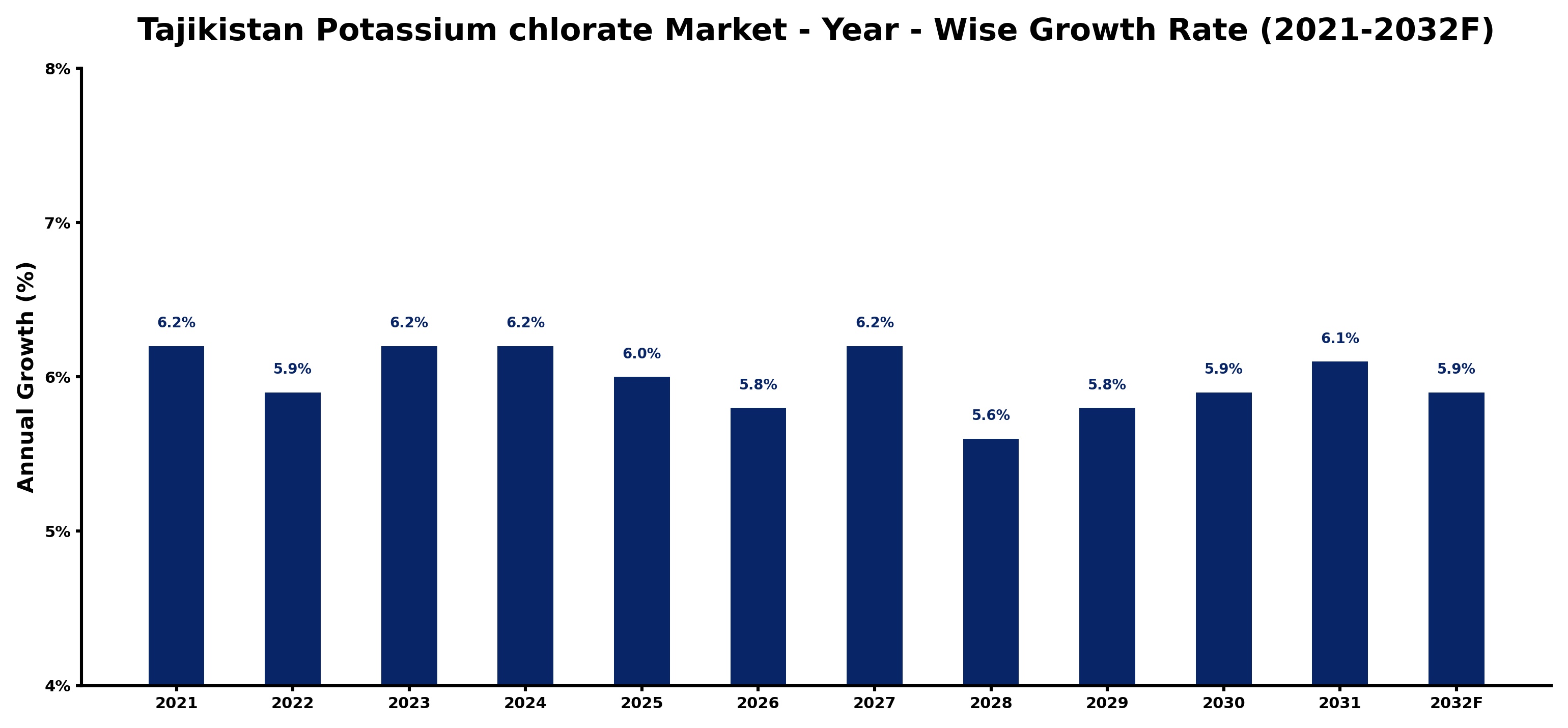
The table below presents the year‑wise growth rates along with the key drivers influencing the market
| Year | Growth Rate | Major Drivers |
| 2021 | 6.2% | Local mining investments boosted potassium chlorate production capacity expansion |
| 2022 | 5.9% | Domestic fertilizer production boost increased potassium chlorate consumption |
| 2023 | 6.2% | Upgraded manufacturing processes boosted potassium chlorate production efficiency |
| 2024 | 6.2% | Advanced mixing technology improved potassium chlorate production efficiency |
| 2025 | 6.0% | Domestic mining operations boost potassium chlorate production capacity expansion |
| 2026 | 5.8% | Local chemical plants upgrade processes to enhance potassium chlorate output |
| 2027 | 6.2% | Plant upgrades optimize potassium chlorate production for regional supply |
| 2028 | 5.6% | Potassium chlorate production capacity upgrades enhance regional agricultural applications |
| 2029 | 5.8% | New processing technologies enhanced potassium chlorate production efficiency |
| 2030 | 5.9% | Improved chemical processing capacity boosts potassium chlorate manufacturing output |
| 2031 | 6.1% | Modernized manufacturing processes drive potassium chlorate production efficiency |
| 2032 | 5.9% | Technological upgrades in potassium chlorate production enhance yield efficiency |
Note - Market size estimations and growth projections presented in this report are based on 6Wresearch's advanced forecasting approach, validated with industry datasets as of June 2026.
Tajikistan Potassium chlorate Market Synopsis
The Tajikistan Potassium chlorate market is undergoing notable transformation, driven primarily by agricultural needs and industrial applications. As the region focuses on improving crop yields, potassium chlorate emerges as a crucial component in herbicides and fertilizers, fostering its demand.
Furthermore, the cultural significance of fireworks in local festivities underscores the importance of potassium chlorate in pyrotechnics. This dual demand from agriculture and industry positions the market for substantial growth in the coming years.
Tajikistan Potassium chlorate Market Key Takeaways
- The market is experiencing robust growth due to its applications in agriculture and fireworks manufacturing.
- Government regulations are shaping production and distribution dynamics within the industry.
- Investment opportunities exist in local production facilities and distribution networks.
- Technological advancements are critical for improving market efficiency and product quality.
- Import reliance presents potential vulnerabilities, necessitating strategic planning from market participants.
Evaluation of Restraints in Tajikistan Potassium chlorate Market
The Tajikistan Potassium chlorate market faces significant restraints that may hinder its growth trajectory. A primary concern is the limited domestic production capacity, which leads to heavy reliance on imports. This dependency can cause supply chain disruptions and price volatility influenced by external factors such as global market trends and geopolitical dynamics. Additionally, the country grapples with outdated infrastructure and technology, which compromises the efficiency of production and distribution processes. Furthermore, compliance with stringent government regulations around safety and environmental concerns can impose further barriers, demanding careful navigation by market participants.
Tajikistan Potassium chlorate Market Trends
Recent trends in the Tajikistan Potassium chlorate market indicate a shift towards more sustainable agricultural practices. Growing awareness of environmental issues is prompting farmers to adopt integrated pest management strategies, where potassium chlorate is viewed as a critical tool in their arsenal. Meanwhile, the fireworks industry is evolving, with increasing emphasis on safety standards and innovative formulations that enhance performance while ensuring compliance with regulations.
The chemical manufacturing sector also shows a rising interest in potassium chlorate as a versatile ingredient in various processes, further solidifying its market relevance. These trends signify an evolving landscape that calls for continuous adaptation and innovation from industry stakeholders.
Tajikistan Potassium chlorate Market Opportunities
The Tajikistan Potassium chlorate market presents several promising investment opportunities. As agricultural development becomes a government priority, the demand for fertilizers and herbicides is set to rise, making local production facilities increasingly viable. Moreover, the strategic location of Tajikistan along key trade routes offers potential for export opportunities to neighboring countries, enhancing the market's appeal to investors.
Establishing partnerships with local manufacturers can streamline the production process and reduce reliance on imports, while technological advancements could improve both quality and production efficiency. Investors who conduct thorough market research and understand regulatory landscapes will be well-positioned to capitalize on this growth segment.
Government Initiatives in the Tajikistan Potassium chlorate Market
Tajikistan's government has enacted comprehensive regulations governing the production and use of potassium chlorate. The Ministry of Industry and New Technologies is actively involved in licensing producers, ensuring compliance with safety standards, and overseeing environmental safeguards. Additionally, protective measures such as import tariffs aim to bolster domestic producers and encourage self-sufficiency in the potassium chlorate sector. These initiatives are crucial for maintaining market stability and promoting sustainable practices in the industry.
Future Insights of the Tajikistan Potassium chlorate Market
Looking ahead to 2026-2032, the Tajikistan Potassium chlorate market is expected to grow steadily as agricultural and industrial applications expand. Government efforts to increase agricultural productivity and enhance the use of fertilizers will drive demand. Moreover, ongoing advancements in technology and product development are likely to improve market offerings and efficiency.
However, challenges such as raw material price fluctuations and compliance with environmental regulations may temper growth rates. Still, the overall outlook remains positive, with strong potential for market expansion aligned with the country's economic development goals.
Tajikistan Potassium chlorate Market Latest Developments (May 2025 - June 2026)
Recent developments in the Tajikistan Potassium chlorate market highlight a growing focus on enhancing production capabilities and regulatory compliance. Initiatives aimed at improving infrastructure and technological adoption have gained traction, enabling market players to increase efficiency in their operations. Meanwhile, discussions around government policies to further support local production are emerging, reflecting a commitment to fostering a robust domestic industry.
Tajikistan Potassium chlorate Market - Key Attractiveness of the Report
- 10 Years of Market Numbers
- Historical Data Starting from 2022 to 2025
- Base Year: 2025
- Forecast Data until 2032
- Key Performance Indicators Impacting the Market
- Major Upcoming Developments and Projects
Key Highlights of the Report:
- Tajikistan Potassium chlorate Market Outlook
- Market Size of Tajikistan Potassium chlorate Market, 2025
- Forecast of Tajikistan Potassium chlorate Market, 2032
- Historical Data and Forecast of Tajikistan Potassium chlorate Revenues & Volume for the Period 2022-2032F
- Tajikistan Potassium chlorate Market Trend Evolution
- Tajikistan Potassium chlorate Market Drivers and Challenges
- Tajikistan Potassium chlorate Price Trends
- Tajikistan Potassium chlorate Porter's Five Forces
- Tajikistan Potassium chlorate Industry Life Cycle
- Historical Data and Forecast of Tajikistan Potassium chlorate Market Revenues & Volume By Product type for the Period 2022-2032F
- Historical Data and Forecast of Tajikistan Potassium chlorate Market Revenues & Volume By Pharmaceutical Grade for the Period 2022-2032F
- Historical Data and Forecast of Tajikistan Potassium chlorate Market Revenues & Volume By Chemical Grade for the Period 2022-2032F
- Historical Data and Forecast of Tajikistan Potassium chlorate Market Revenues & Volume By End-use for the Period 2022-2032F
- Historical Data and Forecast of Tajikistan Potassium chlorate Market Revenues & Volume By Explosives for the Period 2022-2032F
- Historical Data and Forecast of Tajikistan Potassium chlorate Market Revenues & Volume By Matches for the Period 2022-2032F
- Historical Data and Forecast of Tajikistan Potassium chlorate Market Revenues & Volume By Disinfectants for the Period 2022-2032F
- Historical Data and Forecast of Tajikistan Potassium chlorate Market Revenues & Volume By Bleaches for the Period 2022-2032F
- Historical Data and Forecast of Tajikistan Potassium chlorate Market Revenues & Volume By Medical for the Period 2022-2032F
- Tajikistan Potassium chlorate Import Export Trade Statistics
- Market Opportunity Assessment By Product type
- Market Opportunity Assessment By End-use
- Tajikistan Potassium chlorate Top Companies Market Share
- Tajikistan Potassium chlorate Competitive Benchmarking By Technical and Operational Parameters
- Tajikistan Potassium chlorate Company Profiles
- Tajikistan Potassium chlorate Key Strategic Recommendations






































