Tajikistan Power Supply Market Summary
The tajikistan power supply market was estimated at USD 250 Million in 2025 and is projected to reach USD 350 Million by 2032, growing at a CAGR of 5.7% from 2026 to 2032.
Tajikistan Power Supply Market Year-wise Growth Rate and Key Drivers
This graph highlights how the Tajikistan Power Supply Market has steadily grown over the past five years, supported by major growth factors.
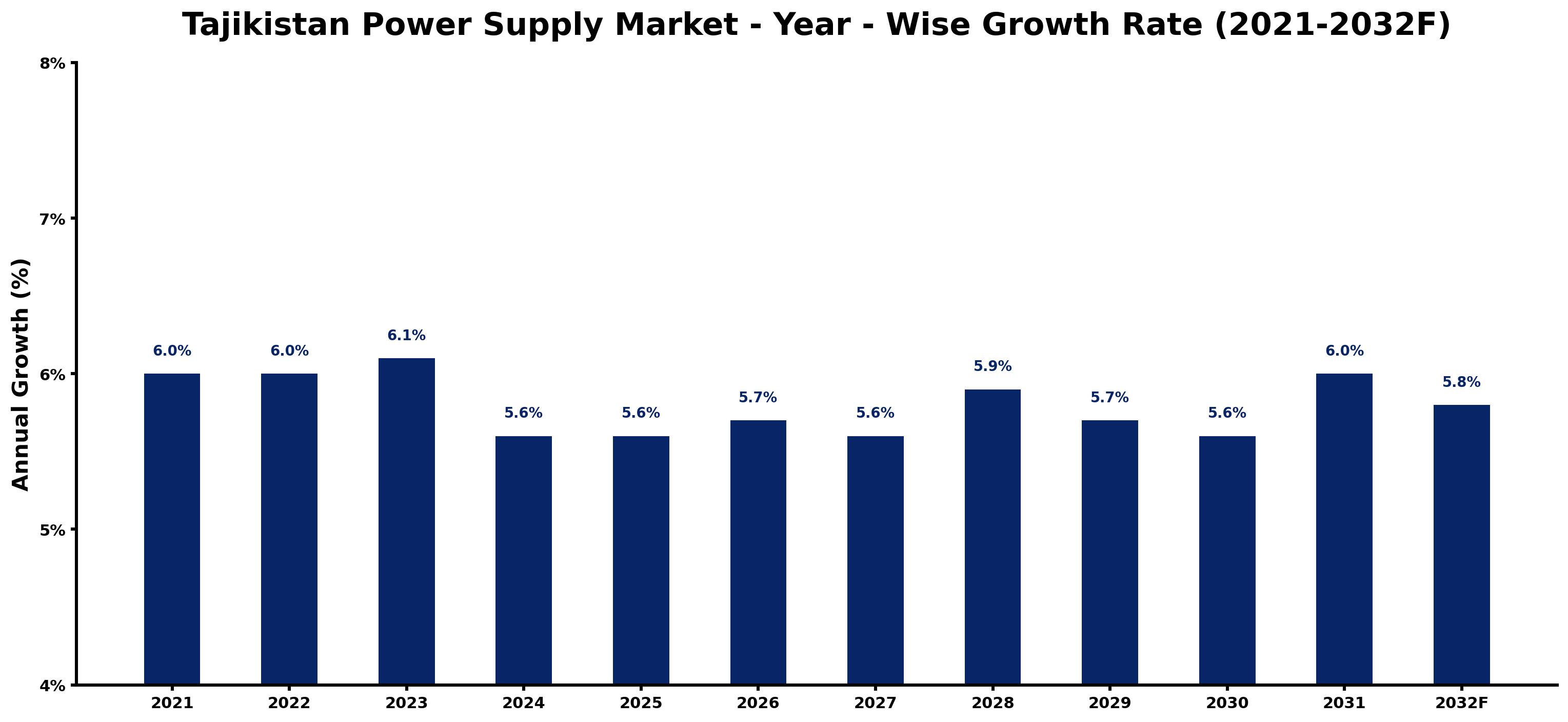
The table below presents the year wise growth rates along with the key drivers influencing the market
| Year | Growth Rate | Major Drivers |
| 2021 | 6.0% | Infrastructure investments are essential for modernizing the power supply network. |
| 2022 | 6.0% | Natural resource exploitation offers potential for renewable energy expansion in Tajikistan. |
| 2023 | 6.1% | International partnerships will enhance technology transfer in power generation sectors. |
| 2024 | 5.6% | Rural electrification initiatives are critical for improving access to electricity nationwide. |
| 2025 | 5.6% | Public-private collaborations attract investment for enhancing energy storage solutions. |
| 2026 | 5.7% | Increased focus on sustainability encourages growth in small-scale hydropower projects. |
| 2027 | 5.6% | Emerging technologies present opportunities for efficiency improvements in energy distribution. |
| 2028 | 5.9% | Regional energy trading could foster competitive pricing and energy security for consumers. |
| 2029 | 5.7% | Rising urbanization demands innovative solutions to meet electricity consumption needs. |
| 2030 | 5.6% | Climate adaptation strategies will prioritize resilience in energy infrastructure planning. |
| 2031 | 6.0% | Cultural shifts towards green technologies will influence consumer preferences for energy sources. |
| 2032 | 5.8% | Global energy trends will shape local policies and investment priorities in power supply. |
Note - Market size estimations and growth projections presented in this report are based on 6Wresearch's advanced forecasting approach, validated with industry datasets as of June 2026.
Tajikistan Power Supply Market Synopsis
The Tajikistan Power Supply Market is projected to reach 5.7% and witness significant growth during the forecast period (2026-2032). This market is predominantly driven by the country's substantial reliance on hydropower, which constitutes the majority of its electricity generation. The state-owned Barqi Tojik serves as the principal utility provider, overseeing the generation, transmission, and distribution of electric power. However, several systemic challenges need addressing to establish a more reliable and efficient power supply, including aging infrastructure, limited investment in upgrades, and the vulnerability of hydropower to climatic variations.
Tajikistan Power Supply Market Trends
In the evolving landscape of the Tajikistan Power Supply Market, several notable trends are emerging. Firstly, the government's increasing emphasis on renewable energy sources, especially within the hydropower segment, indicates a strategic shift towards enhancing energy independence. This initiative is critical in decreasing dependency on imported electricity and bolstering national energy security.
- Expansion projects in hydropower are receiving significant attention as existing facilities are modernized to increase output and efficiency. Investments are being directed toward infrastructure to reduce transmission losses, a persistent issue in the current system.
- The privatization movement within the power sector is gaining momentum, aiming to attract foreign investments and bolster operational performance. This trend is fostering a competitive environment essential for driving innovation.
- Technological advancements in energy management systems are being explored to improve the reliability and efficiency of power supply across the grid.
- Collaborative ventures with international organizations are paving the way for knowledge transfer and financial backing necessary to modernize the aging infrastructure.
- The push for regional integration in energy trading is becoming more pronounced, with the aim of stabilizing supply and creating new market opportunities.
Tajikistan Power Supply Market Challenges and Restraints
The Tajikistan Power Supply Market faces several challenges that could impede its growth trajectory. Chief among these is the aging infrastructure, which leads to recurrent power outages, thereby undermining consumer confidence. The lack of robust investments in modernizing the power grid exacerbates inefficiencies, further complicating service delivery.
- Reliance on hydropower generation renders the system susceptible to fluctuations in water availability, influenced by climate change and seasonal cycles, which poses risks to power consistency.
- Political instability, coupled with economic constraints, has hampered the sector's development, creating a challenging environment for attracting the necessary foreign investments.
- Regulatory bottlenecks can delay essential reforms required to modernize the power sector, limiting the adoption of best practices and cutting-edge technologies.
- Social and operational factors, such as resistance to privatization and the need for public awareness about energy efficiency, pose additional hurdles in the sector's reform journey.
- These challenges necessitate a multifaceted approach involving substantial investment, infrastructure diversification, and a strategic policy framework to ensure a reliable power supply.
Tajikistan Power Supply Market Investment Opportunities
Tajikistan's Power Supply Market presents numerous investment opportunities driven by the increasing demand for electricity and strategic government initiatives aimed at enhancing energy infrastructure. Key areas ripe for investment include:
- Development of new hydropower plants to harness the country's extensive water resources and meet domestic and regional energy needs.
- Modernization and rehabilitation of existing power generation facilities to improve operational performance and reliability.
- Investments in renewable energy projects, particularly in solar and wind, to diversify the energy mix and enhance energy security.
- Reconstruction and expansion of transmission and distribution networks to minimize losses and improve service delivery to end users.
- Collaborative partnerships with international stakeholders to facilitate knowledge exchange and investment influx in the power sector.
Tajikistan Power Supply Market Government Investment and Initiatives
The government of Tajikistan plays a crucial role in regulating and promoting the power supply market through various initiatives. Notably, the State Committee on Investment and State Property Management along with the Ministry of Energy and Water Resources are responsible for implementing policies aimed at enhancing sector performance.
- Recent policies focus on attracting private investments while offering incentives such as tax breaks, which are designed to encourage innovation and efficiency improvements.
- Government plans are underway to construct additional hydropower plants and enhance existing facilities, reducing reliance on energy imports.
- Investment in energy infrastructure is prioritized, supported by incentives that facilitate public-private partnerships.
- Regional cooperation frameworks are being developed to improve electricity trade with neighboring countries, contributing to the overall growth of the energy market.
- Ongoing regulatory reforms target the establishment of an attractive investment climate, essential for fostering growth and sustainability in the power supply sector.
Tajikistan Power Supply Market Latest Developments (May 2025 - June 2026)
During the period from May 2025 to June 2026, the Tajikistan Power Supply Market has experienced notable developments aimed at addressing existing challenges within the sector. Efforts are being made to modernize the aging infrastructure, with the government actively engaging in discussions with international investors to secure funding for critical projects.
- The government has been prioritizing policies that support the expansion of renewable energy sources, particularly focusing on hydropower projects that are expected to significantly enhance national production capacity.
- Strategic collaborations with international bodies have been instrumental in facilitating technology transfers aimed at improving energy efficiency across the grid.
- Momentum is also building towards diversification of energy resources, with initiatives set to explore solar and wind energy potential in response to the increasing energy demand.
- Measures to streamline regulatory frameworks are ongoing, which aim to attract private investment needed for sustained infrastructure improvements.
- The situation presents a conducive environment for foreign interests to engage in the Tajikistan Power Supply Market, enhancing collaboration prospects and overall market resilience.
Tajikistan Power Supply Market - Key Attractiveness of the Report
- 10 Years of Market Numbers
- Historical Data Starting from 2022 to 2025
- Base Year: 2025
- Forecast Data until 2032
- Key Performance Indicators Impacting the Market
- Major Upcoming Developments and Projects
Key Highlights of the Report:
- Tajikistan Power Supply Market Outlook
- Market Size of Tajikistan Power Supply Market, 2025
- Forecast of Tajikistan Power Supply Market, 2032F
- Historical Data and Forecast of Tajikistan Power Supply Revenues & Volume for the Period 2022-2032F
- Tajikistan Power Supply Market Trend Evolution
- Tajikistan Power Supply Market Drivers and Challenges
- Tajikistan Power Supply Price Trends
- Tajikistan Power Supply Porter's Five Forces
- Tajikistan Power Supply Industry Life Cycle
- Historical Data and Forecast of Tajikistan Power Supply Market Revenues & Volume By Output Power for the Period 2022-2032F
- Historical Data and Forecast of Tajikistan Power Supply Market Revenues & Volume By Power Supply With Low Output (500 W and Below) for the Period 2022-2032F
- Historical Data and Forecast of Tajikistan Power Supply Market Revenues & Volume By Power Supply With Medium Output (500?1,000 W) for the Period 2022-2032F
- Historical Data and Forecast of Tajikistan Power Supply Market Revenues & Volume By Power Supply With High Output (More Than 1,000 W) for the Period 2022-2032F
- Historical Data and Forecast of Tajikistan Power Supply Market Revenues & Volume By Type for the Period 2022-2032F
- Historical Data and Forecast of Tajikistan Power Supply Market Revenues & Volume By AC-DC Power Supply for the Period 2022-2032F
- Historical Data and Forecast of Tajikistan Power Supply Market Revenues & Volume By DC-DC Power Supply for the Period 2022-2032F
- Historical Data and Forecast of Tajikistan Power Supply Market Revenues & Volume By Vertical for the Period 2022-2032F
- Historical Data and Forecast of Tajikistan Power Supply Market Revenues & Volume By Medical & Healthcare for the Period 2022-2032F
- Historical Data and Forecast of Tajikistan Power Supply Market Revenues & Volume By Military & Aerospace for the Period 2022-2032F
- Historical Data and Forecast of Tajikistan Power Supply Market Revenues & Volume By Telecommunications for the Period 2022-2032F
- Historical Data and Forecast of Tajikistan Power Supply Market Revenues & Volume By Consumer Electronics for the Period 2022-2032F
- Historical Data and Forecast of Tajikistan Power Supply Market Revenues & Volume By Transportation for the Period 2022-2032F
- Historical Data and Forecast of Tajikistan Power Supply Market Revenues & Volume By Lighting for the Period 2022-2032F
- Historical Data and Forecast of Tajikistan Power Supply Market Revenues & Volume By Food & Beverages for the Period 2022-2032F
- Historical Data and Forecast of Tajikistan Power Supply Market Revenues & Volume By Industrial for the Period 2022-2032F
- Tajikistan Power Supply Import Export Trade Statistics
- Market Opportunity Assessment By Output Power
- Market Opportunity Assessment By Type
- Market Opportunity Assessment By Vertical
- Tajikistan Power Supply Top Companies Market Share
- Tajikistan Power Supply Competitive Benchmarking By Technical and Operational Parameters
- Tajikistan Power Supply Company Profiles
- Tajikistan Power Supply Key Strategic Recommendations






































