Tajikistan Prepaid Cards Market Size, Share & Growth Rate
The Tajikistan Prepaid Cards Market was estimated at USD 388 Million in 2025 and is projected to reach USD 733 Million by 2032, growing at a CAGR of 9.5% from 2026 to 2032. This remarkable growth trajectory is propelled by a rising consumer shift toward cashless payments and an increasing appetite for online shopping. The government's commitment to enhancing financial inclusion and a more robust payment infrastructure will further stimulate market expansion and attract diverse customer demographics.
Tajikistan Prepaid Cards Market Year-wise Growth Rate and Key Drivers
This graph highlights how the Tajikistan Prepaid Cards Market has steadily grown over the years, supported by major growth factors.
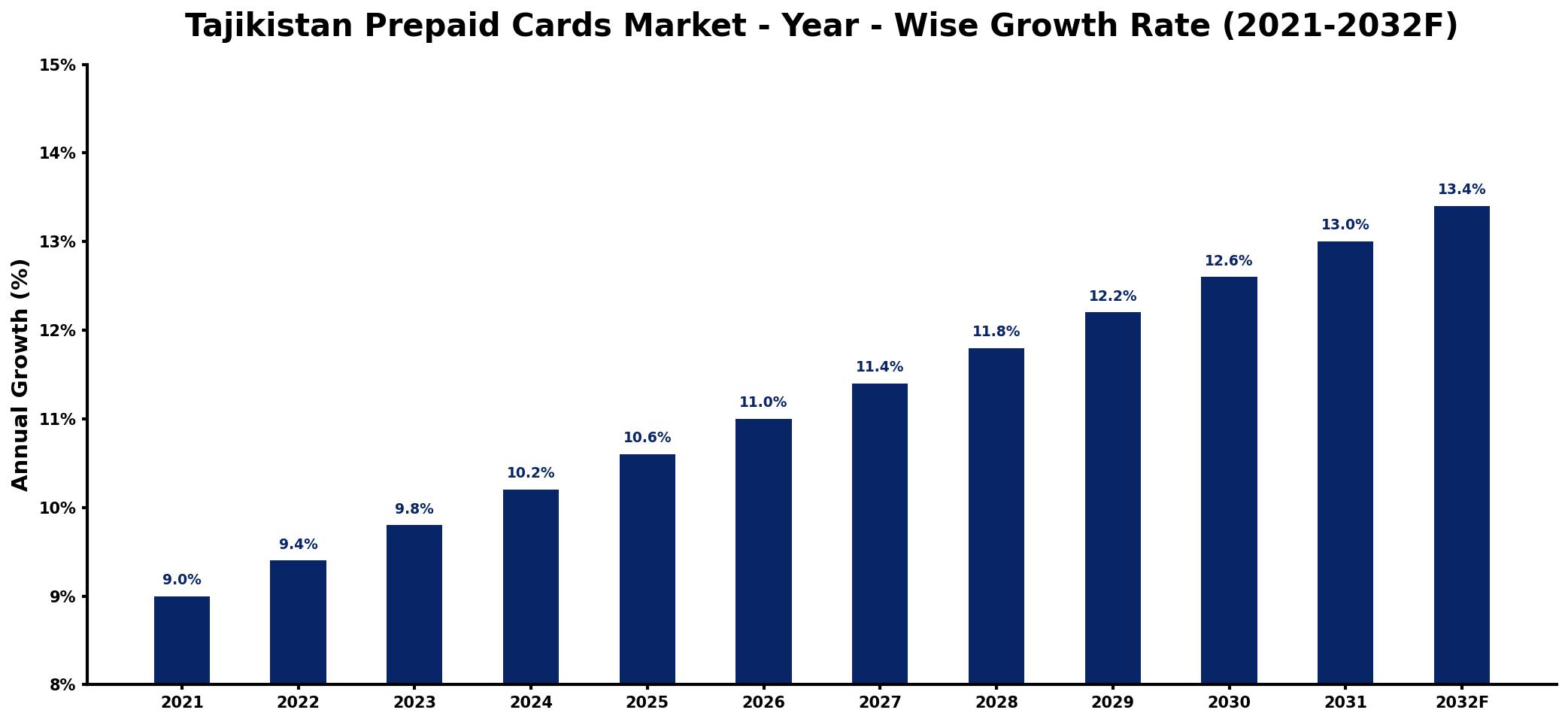
The table below presents the year‑wise growth rates along with the key drivers influencing the market
| Year | Growth Rate | Major Drivers |
| 2021 | 9.0% | increased digital payment adoption |
| 2022 | 9.4% | growing e-commerce transactions volume |
| 2023 | 9.8% | rising mobile wallet usage |
| 2024 | 10.2% | enhanced financial inclusion initiatives |
| 2025 | 10.6% | expansion of retail acceptance networks |
| 2026 | 11.0% | growing remittance inflow trends |
| 2027 | 11.4% | increased consumer spending capacity |
| 2028 | 11.8% | adoption of innovative payment solutions |
| 2029 | 12.2% | higher demand for contactless payments |
| 2030 | 12.6% | strengthening underlying market demand |
| 2031 | 13.0% | increased investments in digital infrastructure |
| 2032 | 13.4% | growing interest in loyalty programs |
Note: Market size estimations and growth projections presented in this report are based on 6Wresearch's proprietary forecasting methodology, utilizing the latest available industry data, government publications, and primary research inputs.
Tajikistan Prepaid Cards Market Synopsis
The demand for prepaid cards in Tajikistan is primarily driven by a growing base of unbanked consumers who seek accessible and secure financial solutions. The convenience of prepaid cards makes them an appealing option for everyday transactions, especially among younger demographics that are increasingly tech-savvy.
Currently, the prepaid cards market encompasses various offerings such as gift cards, travel cards, and general-purpose reloadable cards. Telecom companies and banks play a crucial role in delivering these services, further enhancing the diversity and reach of prepaid card solutions throughout the country.
Tajikistan Prepaid Cards Market Key Takeaways
- The market is witnessing robust growth due to increased consumer adoption of electronic payment methods.
- Government initiatives aimed at promoting digital payments are driving market dynamics.
- Mobile prepaid cards are gaining popularity due to widespread smartphone usage.
- Investment opportunities abound, particularly in enhancing payment infrastructure.
- Consumer education regarding prepaid cards remains a focal point for market expansion.
Evaluation of Restraints in Tajikistan Prepaid Cards Market
Despite its promising outlook, the Tajikistan prepaid cards market faces significant restraints. A prevailing preference for cash transactions among businesses limits the broader acceptance and utility of prepaid cards. Additionally, the countrys underdeveloped financial sector poses challenges in terms of compliance and operational efficiencies for card issuers. Awareness and education surrounding the benefits of prepaid cards among consumers also remain insufficient, hindering market growth and limiting potential customer engagement.
Tajikistan Prepaid Cards Market Trends
Key trends shaping the Tajikistan prepaid cards market include a surge in digital payment adoption and a growing consumer inclination towards e-commerce. Mobile prepaid cards, in particular, are becoming increasingly popular as mobile phone penetration rises. Moreover, issuers are enhancing the security and convenience features of prepaid cards to attract a broader user base, effectively tapping into the changing preferences of consumers.
Tajikistan Prepaid Cards Market Opportunities
The evolving landscape of the Tajikistan prepaid cards market presents numerous investment opportunities. With a substantial unbanked population and limited access to traditional banking services, prepaid cards can serve as a vital payment solution. The government's initiatives to facilitate cashless transactions coupled with the expansion of online shopping platforms offer avenues for prepaid card providers to innovate and develop tailored solutions for the Tajik market.
Government Initiatives in the Tajikistan Prepaid Cards Market
The Tajik government is actively implementing policies to regulate the prepaid cards market, including requirements for issuers to secure licenses from the National Bank of Tajikistan. These regulations ensure compliance with anti-money laundering laws and consumer protection measures, providing a safe environment for both businesses and consumers. Furthermore, the government is focused on enhancing the overall payment infrastructure, which will facilitate the growth of digital payment solutions across the country.
Future Insights of the Tajikistan Prepaid Cards Market
Looking ahead to 2026-2032, the Tajikistan prepaid cards market is set to continue its upward momentum. The growing young population, coupled with improvements in financial infrastructure, offers a fertile ground for prepaid card providers. As e-commerce trends gain traction and consumer awareness of prepaid card advantages increases, innovative products and services will emerge, further driving market growth.
Tajikistan Prepaid Cards Market Latest Developments (2025 - 2026)
In recent months, there has been a notable increase in partnerships between financial institutions and digital payment platforms in Tajikistan. These collaborations aim to introduce cutting-edge prepaid card solutions tailored to local consumer needs. Additionally, the expansion of retail networks accepting prepaid cards signifies a positive shift toward greater market acceptance and usability.
Tajikistan Prepaid Cards Market - Key Attractiveness of the Report
- 10 Years of Market Numbers
- Historical Data Starting from 2022 to 2025
- Base Year: 2025
- Forecast Data until 2032
- Key Performance Indicators Impacting the Market
- Major Upcoming Developments and Projects
Key Highlights of the Report:
- Tajikistan Prepaid Cards Market Outlook
- Market Size of Tajikistan Prepaid Cards Market, 2025
- Forecast of Tajikistan Prepaid Cards Market, 2032
- Historical Data and Forecast of Tajikistan Prepaid Cards Revenues & Volume for the Period 2022-2032F
- Tajikistan Prepaid Cards Market Trend Evolution
- Tajikistan Prepaid Cards Market Drivers and Challenges
- Tajikistan Prepaid Cards Price Trends
- Tajikistan Prepaid Cards Porter's Five Forces
- Tajikistan Prepaid Cards Industry Life Cycle
- Historical Data and Forecast of Tajikistan Prepaid Cards Market Revenues & Volume By Offering for the Period 2022-2032F
- Historical Data and Forecast of Tajikistan Prepaid Cards Market Revenues & Volume By General Purpose Card for the Period 2022-2032F
- Historical Data and Forecast of Tajikistan Prepaid Cards Market Revenues & Volume By Gift Card for the Period 2022-2032F
- Historical Data and Forecast of Tajikistan Prepaid Cards Market Revenues & Volume By Government Benefit/Disbursement Card for the Period 2022-2032F
- Historical Data and Forecast of Tajikistan Prepaid Cards Market Revenues & Volume By Incentive/Payroll Card for the Period 2022-2032F
- Historical Data and Forecast of Tajikistan Prepaid Cards Market Revenues & Volume By Others for the Period 2022-2032F
- Historical Data and Forecast of Tajikistan Prepaid Cards Market Revenues & Volume By Card Type for the Period 2022-2032F
- Historical Data and Forecast of Tajikistan Prepaid Cards Market Revenues & Volume By Closed Loop Card for the Period 2022-2032F
- Historical Data and Forecast of Tajikistan Prepaid Cards Market Revenues & Volume By Open Loop Card for the Period 2022-2032F
- Historical Data and Forecast of Tajikistan Prepaid Cards Market Revenues & Volume By End User for the Period 2022-2032F
- Historical Data and Forecast of Tajikistan Prepaid Cards Market Revenues & Volume By Retail for the Period 2022-2032F
- Historical Data and Forecast of Tajikistan Prepaid Cards Market Revenues & Volume By Corporate for the Period 2022-2032F
- Historical Data and Forecast of Tajikistan Prepaid Cards Market Revenues & Volume By Government/Public Sector for the Period 2022-2032F
- Tajikistan Prepaid Cards Import Export Trade Statistics
- Market Opportunity Assessment By Offering
- Market Opportunity Assessment By Card Type
- Market Opportunity Assessment By End User
- Tajikistan Prepaid Cards Top Companies Market Share
- Tajikistan Prepaid Cards Competitive Benchmarking By Technical and Operational Parameters
- Tajikistan Prepaid Cards Company Profiles
- Tajikistan Prepaid Cards Key Strategic Recommendations






































