Tajikistan Publishing Market Summary
The tajikistan publishing market was estimated at USD 814 Million in 2025 and is projected to reach USD 1189 Million by 2032, growing at a CAGR of 6.6% from 2026 to 2032.
Tajikistan Publishing Market Year-wise Growth Rate and Key Drivers
This graph highlights how the Tajikistan Publishing Market has steadily grown over the past five years, supported by major growth factors.
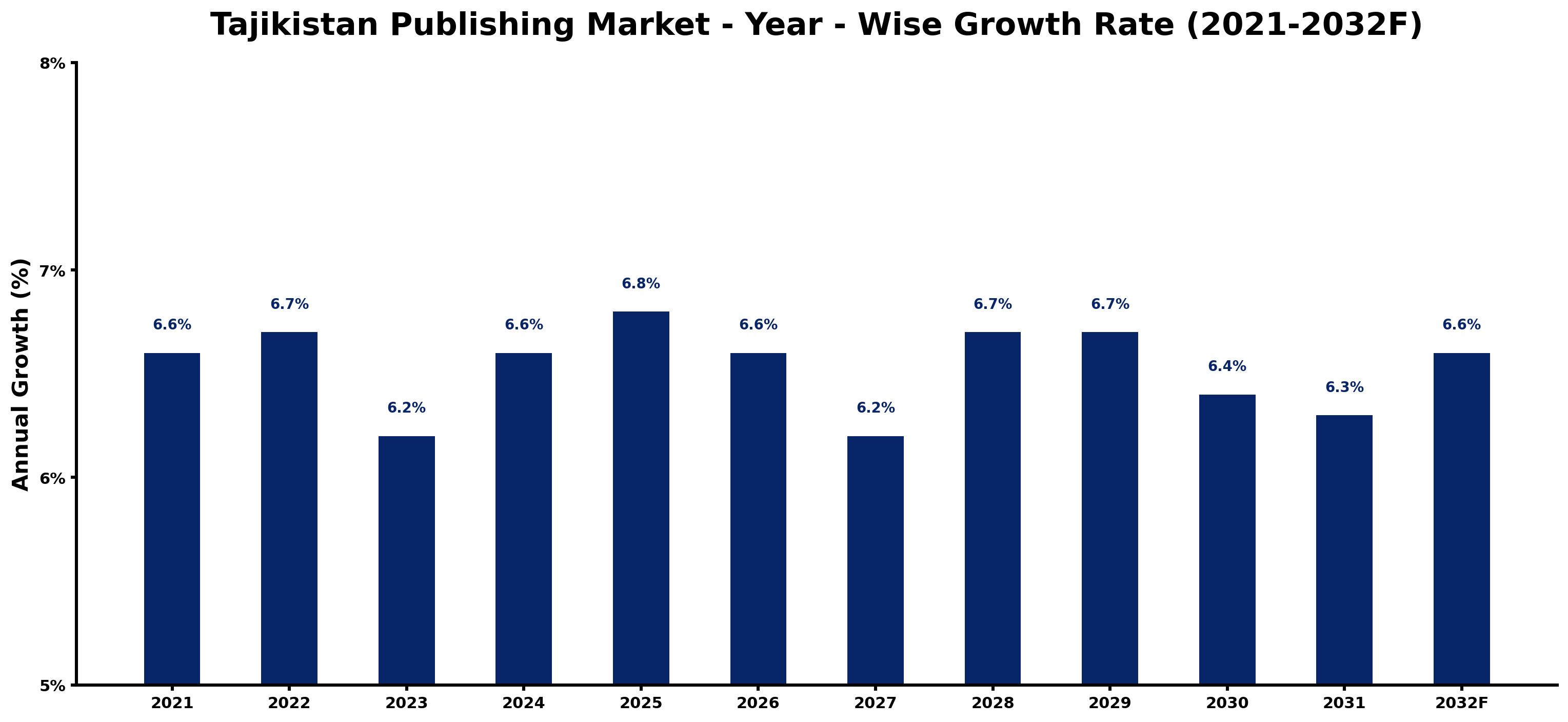
The table below presents the year wise growth rates along with the key drivers influencing the market
| Year | Growth Rate | Major Drivers |
| 2021 | 6.6% | Increased internet accessibility has encouraged digital content consumption across Tajikistan. |
| 2022 | 6.7% | Local authors began gaining popularity, reflecting cultural narratives in published works. |
| 2023 | 6.2% | Book fairs in urban centers sparked interest in diverse literary genres. |
| 2024 | 6.6% | Educational reforms emphasized reading, boosting demand for textbooks and learning materials. |
| 2025 | 6.8% | E-commerce platforms expanded, facilitating easier access to books and publications online. |
| 2026 | 6.6% | Collaborations between publishers and educational institutions enhanced curriculum-related publishing activities. |
| 2027 | 6.2% | Increased investment in local publishing houses improved production quality and distribution channels. |
| 2028 | 6.7% | Emerging self-publishing platforms empowered writers to share their stories independently. |
| 2029 | 6.7% | Youth engagement in literary events highlighted a growing community of aspiring writers. |
| 2030 | 6.4% | Partnerships with international publishers introduced global best practices in the local market. |
| 2031 | 6.3% | Rising literacy rates contributed to a larger audience eager for diverse reading materials. |
| 2032 | 6.6% | Cultural preservation projects promoted local literature, increasing national pride and readership. |
Note - Market size estimations and growth projections presented in this report are based on 6Wresearch's advanced forecasting approach, validated with industry datasets as of June 2026.
Tajikistan Publishing Market Synopsis
The Tajikistan Publishing Market is projected to reach 6.6% and witness significant growth during the forecast period (2026-2032). This growth is largely supported by the increasing demand for educational materials, literature, and religious texts, reflecting the country's ongoing efforts to enhance literacy and educational standards. While state-owned publishing houses dominate the market landscape, the emergence of private companies also signifies a diversification of the industry. Nevertheless, multiple challenges are present, such as limited resources and outdated technology, which need addressing in order to unlock the market's full potential.
Tajikistan Publishing Market Growth Drivers
Several key factors are contributing to the growth of the Tajikistan Publishing Market. Firstly, the high demand for educational materials is a primary driver, fueled by governmental initiatives aimed at improving literacy rates and educational quality. Secondly, the gradual shift towards digital content is being propelled by increasing internet access, fostering a burgeoning market for e-books and online reading platforms. Thirdly, the rise of self-publishing is empowering local authors to disseminate their works widely, which in turn is expanding the diversity of published content. Furthermore, collaborations with international publishers are enhancing the visibility of Tajikistani literature on a global stage, showcasing its richness and diversity. Lastly, supportive government policies aimed at promoting local authorship and preserving cultural heritage also play a crucial role in this market growth.
Tajikistan Publishing Market Trends and Opportunities
The current trends within the Tajikistan Publishing Market indicate a significant pivot towards digital formats. As internet penetration rises, digital content is increasingly favored by consumers. The popularity of e-books, along with online reading platforms, is on an upward trajectory, capturing the attention of a tech-savvy younger audience. Moreover, independent authors are tapping into these digital opportunities, allowing them to reach wider demographics without the constraints of traditional publishing. Investing in educational publishing, particularly resources that align with local curricula, presents lucrative opportunities for stakeholders. The potential for developing e-learning platforms and digital educational content is also notable, as more institutions seek to modernize their offerings. Overall, these trends suggest a dynamic evolution within the market that embraces both traditional print and innovative digital paradigms.
Tajikistan Publishing Market Challenges and Restraints
Despite the positive growth indicators, the Tajikistan Publishing Market faces several challenges that could impede its advancement. Limited access to modern printing technology and infrastructure hinders the production capabilities of local publishers. Additionally, a fragmented market with inconsistent quality control measures often results in subpar published materials. Low purchasing power among segments of the population further restricts market growth, as many consumers prioritize essential goods over literary and educational materials. Moreover, piracy issues remain a significant concern, undermining the rights of authors and publishers. Addressing these challenges is essential for the market to realize its full potential and for local stakeholders to compete more effectively on a global scale.
Tajikistan Publishing Market Investment Opportunities
The Tajikistan Publishing Market offers noteworthy investment opportunities, particularly in educational publishing and digital media. As literacy rates improve and educational priorities strengthen, there is an increasing need for quality educational materials tailored to local needs. Investors can find lucrative prospects in developing educational resources, textbooks, and supplementary materials that are aligned with the national curriculum. In addition, the digital media sector is gaining momentum, making investments in digital publishing and content platforms a viable avenue for growth. Capitalizing on the digital wave by leveraging technology can enhance distribution capacities and outreach. Collaborating with local educational institutions or publishers could provide valuable insights into navigating the market effectively, ensuring a strategic foothold in a rapidly evolving environment.
Tajikistan Publishing Market Government Investment and Initiatives
The government of Tajikistan has implemented various policies aimed at nurturing the publishing sector. Regulation of publishing activities is overseen by the Ministry of Culture, which ensures that industry standards are upheld. Financial support and grants have been established to encourage the development of local publishing initiatives, with a particular emphasis on preserving Tajik cultural heritage through literature. There are also ongoing efforts to promote the translation of foreign works into the Tajik language, fostering cultural exchange and enriching the local publishing landscape. These government initiatives reflect a commitment to enhance the publishing ecosystem, ensuring that it remains vibrant and relevant to societal needs.
Tajikistan Publishing Market Latest Developments (May 2025 - June 2026)
Recent developments in the Tajikistan Publishing Market indicate a growing focus on modernization and digital transformation. Emerging digital platforms have gained traction, facilitating broader access to literature and educational resources. Additionally, there has been an increase in literary events designed to promote local authors, drawing attention to Tajikistani narratives both domestically and internationally. Government policies aimed at enhancing support for the publishing sector have also become more pronounced, creating a conducive environment for innovation. These trends suggest a market that is progressively evolving, with stakeholders adapting to new consumer behaviors while still valuing the rich traditions of print publishing.
Tajikistan Publishing Market - Key Attractiveness of the Report
- 10 Years of Market Numbers
- Historical Data Starting from 2022 to 2025
- Base Year: 2025
- Forecast Data until 2032
- Key Performance Indicators Impacting the Market
- Major Upcoming Developments and Projects
Key Highlights of the Report:
- Tajikistan Publishing Market Outlook
- Market Size of Tajikistan Publishing Market, 2025
- Forecast of Tajikistan Publishing Market, 2032F
- Historical Data and Forecast of Tajikistan Publishing Revenues & Volume for the Period 2022-2032F
- Tajikistan Publishing Market Trend Evolution
- Tajikistan Publishing Market Drivers and Challenges
- Tajikistan Publishing Price Trends
- Tajikistan Publishing Porter's Five Forces
- Tajikistan Publishing Industry Life Cycle
- Historical Data and Forecast of Tajikistan Publishing Market Revenues & Volume By Types for the Period 2022-2032F
- Historical Data and Forecast of Tajikistan Publishing Market Revenues & Volume By Newspaper for the Period 2022-2032F
- Historical Data and Forecast of Tajikistan Publishing Market Revenues & Volume By Journals for the Period 2022-2032F
- Historical Data and Forecast of Tajikistan Publishing Market Revenues & Volume By Catalogues for the Period 2022-2032F
- Historical Data and Forecast of Tajikistan Publishing Market Revenues & Volume By Magazine for the Period 2022-2032F
- Historical Data and Forecast of Tajikistan Publishing Market Revenues & Volume By Books for the Period 2022-2032F
- Historical Data and Forecast of Tajikistan Publishing Market Revenues & Volume By E-Books for the Period 2022-2032F
- Historical Data and Forecast of Tajikistan Publishing Market Revenues & Volume By Platform for the Period 2022-2032F
- Historical Data and Forecast of Tajikistan Publishing Market Revenues & Volume By Digital? for the Period 2022-2032F
- Historical Data and Forecast of Tajikistan Publishing Market Revenues & Volume By Paper for the Period 2022-2032F
- Tajikistan Publishing Import Export Trade Statistics
- Market Opportunity Assessment By Types
- Market Opportunity Assessment By Platform
- Tajikistan Publishing Top Companies Market Share
- Tajikistan Publishing Competitive Benchmarking By Technical and Operational Parameters
- Tajikistan Publishing Company Profiles
- Tajikistan Publishing Key Strategic Recommendations






































