Tajikistan Refined Petroleum Products Market Size, Share & Growth Rate
The Tajikistan Refined Petroleum Products Market was estimated at USD 1391 Million in 2025 and is projected to reach USD 1989 Million by 2032, growing at a CAGR of 5.2% from 2026 to 2032. This growth trajectory is primarily driven by increasing urbanization and industrial activity within the country, alongside a rising vehicle population that demands more fuel. Additionally, infrastructure projects aimed at enhancing the energy sector are further fueling demand for refined petroleum products.
Tajikistan Refined Petroleum Products Market Year-wise Growth Rate and Key Drivers
This graph highlights how the Tajikistan Refined Petroleum Products Market has steadily grown over the years, supported by major growth factors.
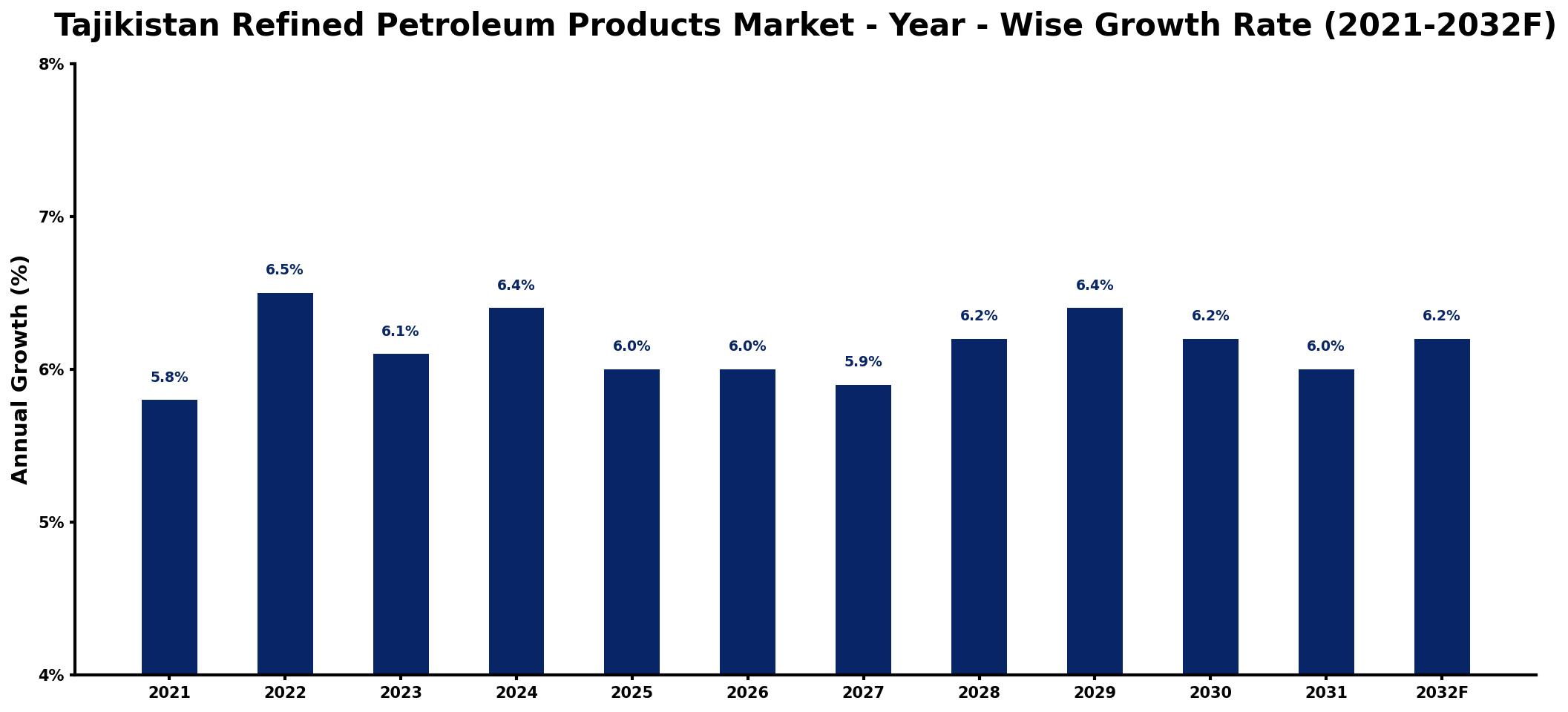
The table below presents the year‑wise growth rates along with the key drivers influencing the market
| Year | Growth Rate | Major Drivers |
| 2021 | 5.8% | Rising transportation sector demand |
| 2022 | 6.5% | Increased industrial activity growth |
| 2023 | 6.1% | Expansion of domestic infrastructure projects |
| 2024 | 6.4% | Boost in energy sector investments |
| 2025 | 6.0% | Growing residential energy consumption |
| 2026 | 6.0% | Surge in agricultural machinery usage |
| 2027 | 5.9% | Development of regional trade agreements |
| 2028 | 6.2% | Increase in tourism-related activities |
| 2029 | 6.4% | Higher urbanization rate impacts |
| 2030 | 6.2% | Strengthened cross-border trade relations |
| 2031 | 6.0% | Enhanced logistics and distribution networks |
| 2032 | 6.2% | Rise in alternative energy exploration |
Note: Market size estimations and growth projections presented in this report are based on 6Wresearch's proprietary forecasting methodology, utilizing the latest available industry data, government publications, and primary research inputs.
Tajikistan Refined Petroleum Products Market Synopsis
The Tajikistan Refined Petroleum Products Market is currently navigating through a critical phase, marked by a significant reliance on imports due to limited domestic refining capacity. This dependence poses challenges for the market while also presenting opportunities for future development and investments aimed at building local production capabilities.
As the demand for gasoline, diesel, and aviation fuel grows, fueled by urbanization and a surge in transportation needs, the government is striving to balance regulation and market competitiveness. This dynamic landscape reflects both the challenges and potential that lie ahead in the Tajikistan Refined Petroleum Products Market.
Tajikistan Refined Petroleum Products Market Key Takeaways
- The market exhibits a promising growth rate, driven by urbanization and increased industrial activities.
- Heavy reliance on imports underscores the critical need for domestic refining capacity development.
- Government regulations aim to promote competition while ensuring safety and environmental sustainability.
- Investment in infrastructure development is essential to overcome logistical challenges.
- Shifts towards cleaner fuel options align with global sustainability goals, presenting a forward-looking market landscape.
Evaluation of Restraints in Tajikistan Refined Petroleum Products Market
The Tajikistan Refined Petroleum Products Market faces significant restraints, notably its limited domestic production capacity which constrains supply and increases reliance on imports. Furthermore, fluctuating global oil prices lead to unpredictable pricing dynamics that affect market stability. Inadequate infrastructure for both storage and distribution creates logistical headaches, while the country's landlocked geography intensifies transportation challenges. These issues, compounded by regulatory barriers and external economic vulnerabilities, necessitate a strategic approach to enhance market resilience.
Tajikistan Refined Petroleum Products Market Trends
A noteworthy trend in the Tajikistan Refined Petroleum Products Market is the gradual shift towards renewable energy and cleaner fuel alternatives. With an increasing focus on sustainability, government initiatives promoting natural gas and renewable sources are gaining traction. Concurrently, market participants are investing in technologies that enhance fuel efficiency and reduce emissions, aligning with evolving consumer preferences and environmental regulations. This transition towards sustainable energy solutions marks a pivotal shift in the market dynamics.
Tajikistan Refined Petroleum Products Market Opportunities
Investment opportunities abound in the Tajikistan Refined Petroleum Products Market. Key areas include the establishment of storage and distribution facilities, which are critical for overcoming logistical constraints. Upgrading refining capabilities to meet international quality standards presents another avenue for growth, particularly as demand continues to rise. Additionally, forging partnerships with local enterprises can help international investors expand their market reach. With ongoing government efforts to attract foreign investment, the landscape is ripe for strategic investments aimed at long-term profitability.
Government Initiatives in the Tajikistan Refined Petroleum Products Market
The Tajikistan government has implemented various policies that directly influence the Refined Petroleum Products Market. These include regulations on import and export procedures, quality standards, and pricing mechanisms designed to foster a competitive environment. The government actively promotes multiple suppliers to prevent monopolistic practices while ensuring safety and environmental compliance through regular inspections. Furthermore, subsidies are in place to support domestic production, aiming to reduce import dependence and enhance the local petroleum industry's growth.
Future Insights of the Tajikistan Refined Petroleum Products Market
Looking ahead to 2026-2032, the Tajikistan Refined Petroleum Products Market appears poised for steady growth. Factors such as population growth, urbanization, and increased industrial activity will drive demand for refined petroleum products. Additionally, the countrys strategic geographical position along major transportation routes bolsters its potential as a key player in the regional energy market. However, market participants must navigate challenges such as fluctuating global oil prices and environmental concerns, while leveraging opportunities from infrastructure improvements and foreign investment initiatives.
Tajikistan Refined Petroleum Products Market Latest Developments (2025 - 2026)
Recent developments in the Tajikistan Refined Petroleum Products Market have highlighted a concerted push towards enhancing local refining capabilities, as well as increasing government efforts to improve energy infrastructure. There are ongoing discussions about investment in storage facilities and distribution networks aimed at addressing supply chain inefficiencies. Additionally, initiatives promoting cleaner fuels and technologies reflect an evolving landscape, aligning with global sustainability trends.
Tajikistan Refined Petroleum Products Market - Key Attractiveness of the Report
- 10 Years of Market Numbers
- Historical Data Starting from 2022 to 2025
- Base Year: 2025
- Forecast Data until 2032
- Key Performance Indicators Impacting the Market
- Major Upcoming Developments and Projects
Key Highlights of the Report:
- Tajikistan Refined Petroleum Products Market Outlook
- Market Size of Tajikistan Refined Petroleum Products Market, 2025
- Forecast of Tajikistan Refined Petroleum Products Market, 2032
- Historical Data and Forecast of Tajikistan Refined Petroleum Products Revenues & Volume for the Period 2022-2032F
- Tajikistan Refined Petroleum Products Market Trend Evolution
- Tajikistan Refined Petroleum Products Market Drivers and Challenges
- Tajikistan Refined Petroleum Products Price Trends
- Tajikistan Refined Petroleum Products Porter's Five Forces
- Tajikistan Refined Petroleum Products Industry Life Cycle
- Historical Data and Forecast of Tajikistan Refined Petroleum Products Market Revenues & Volume By Product Type for the Period 2022-2032F
- Historical Data and Forecast of Tajikistan Refined Petroleum Products Market Revenues & Volume By Diesel for the Period 2022-2032F
- Historical Data and Forecast of Tajikistan Refined Petroleum Products Market Revenues & Volume By Gasoline for the Period 2022-2032F
- Historical Data and Forecast of Tajikistan Refined Petroleum Products Market Revenues & Volume By Fuel Oils for the Period 2022-2032F
- Historical Data and Forecast of Tajikistan Refined Petroleum Products Market Revenues & Volume By Kerosene for the Period 2022-2032F
- Historical Data and Forecast of Tajikistan Refined Petroleum Products Market Revenues & Volume By Others for the Period 2022-2032F
- Historical Data and Forecast of Tajikistan Refined Petroleum Products Market Revenues & Volume By Application for the Period 2022-2032F
- Historical Data and Forecast of Tajikistan Refined Petroleum Products Market Revenues & Volume By Fuel for the Period 2022-2032F
- Historical Data and Forecast of Tajikistan Refined Petroleum Products Market Revenues & Volume By Chemical for the Period 2022-2032F
- Historical Data and Forecast of Tajikistan Refined Petroleum Products Market Revenues & Volume By Others for the Period 2022-2032F
- Historical Data and Forecast of Tajikistan Refined Petroleum Products Market Revenues & Volume By Fraction for the Period 2022-2032F
- Historical Data and Forecast of Tajikistan Refined Petroleum Products Market Revenues & Volume By Light Distillates for the Period 2022-2032F
- Historical Data and Forecast of Tajikistan Refined Petroleum Products Market Revenues & Volume By Middle Distillates for the Period 2022-2032F
- Historical Data and Forecast of Tajikistan Refined Petroleum Products Market Revenues & Volume By Heavy Oils for the Period 2022-2032F
- Tajikistan Refined Petroleum Products Import Export Trade Statistics
- Market Opportunity Assessment By Product Type
- Market Opportunity Assessment By Application
- Market Opportunity Assessment By Fraction
- Tajikistan Refined Petroleum Products Top Companies Market Share
- Tajikistan Refined Petroleum Products Competitive Benchmarking By Technical and Operational Parameters
- Tajikistan Refined Petroleum Products Company Profiles
- Tajikistan Refined Petroleum Products Key Strategic Recommendations






































