Tajikistan Residential Boiler Market Size, Share & Growth Rate
The Tajikistan Residential Boiler Market was estimated at USD 700 Million in 2025 and is projected to reach USD 1030 Million by 2032, growing at a CAGR of 5.7% from 2026 to 2032. This growth trajectory is fueled by an increasing demand for efficient heating systems in residential areas, driven by the countrys cold climatic conditions. Additionally, government initiatives promoting energy-efficient solutions and rising urbanization are further expected to support this upward trend.
Tajikistan Residential Boiler Market Year-wise Growth Rate and Key Drivers
This graph highlights how the Tajikistan Residential Boiler Market has steadily grown over the years, supported by major growth factors.
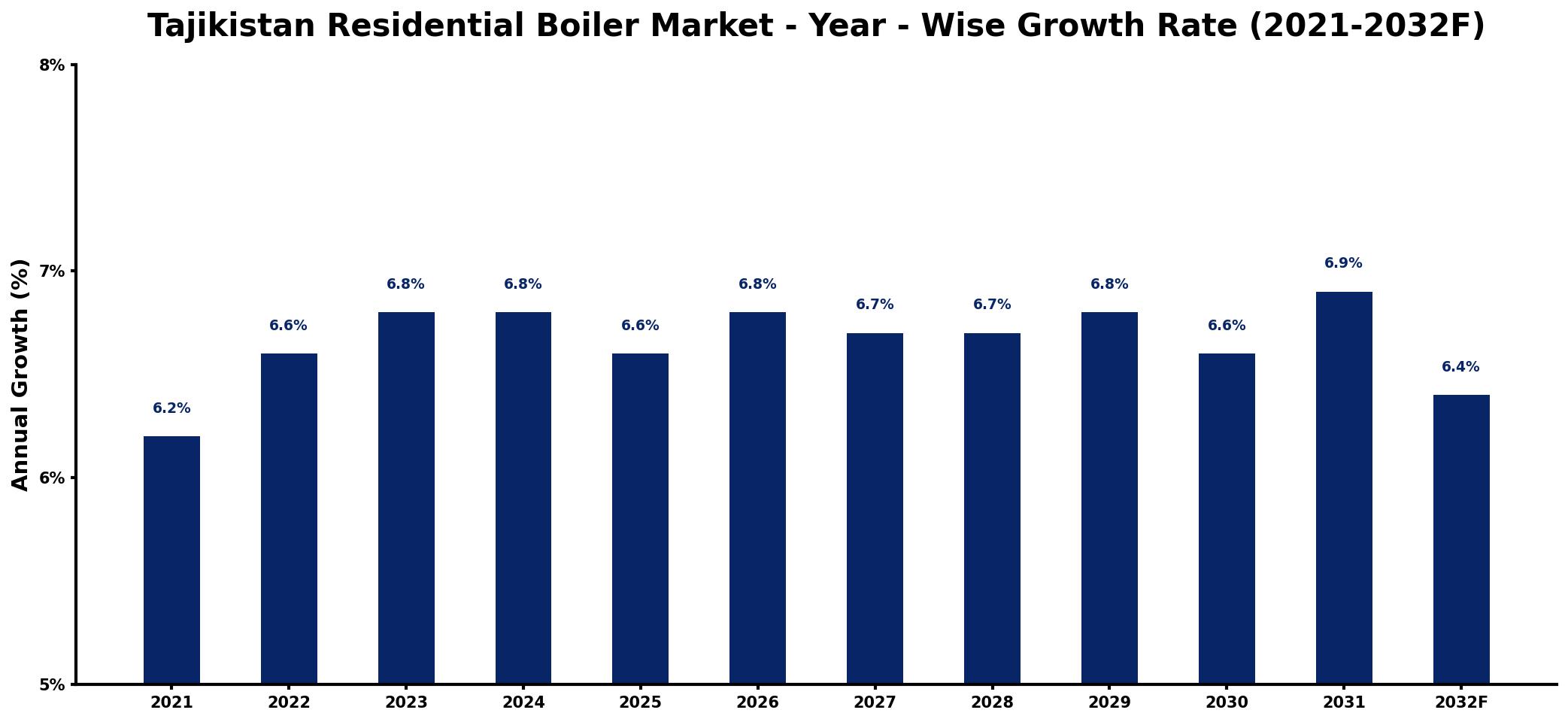
The table below presents the year‑wise growth rates along with the key drivers influencing the market
| Year | Growth Rate | Major Drivers |
| 2021 | 6.2% | Rising energy efficiency standards |
| 2022 | 6.6% | Increased urban population growth |
| 2023 | 6.8% | Government incentives for sustainability |
| 2024 | 6.8% | Expansion of renewable energy initiatives |
| 2025 | 6.6% | Growing consumer environmental awareness |
| 2026 | 6.8% | Technological advancements in heating |
| 2027 | 6.7% | Investments in infrastructure development |
| 2028 | 6.7% | Enhanced energy security measures |
| 2029 | 6.8% | Greater availability of financing options |
| 2030 | 6.6% | Shift towards smart home technologies |
| 2031 | 6.9% | Emerging trends in energy conservation |
| 2032 | 6.4% | Focus on affordable energy solutions |
Note: Market size estimations and growth projections presented in this report are based on 6Wresearch's proprietary forecasting methodology, utilizing the latest available industry data, government publications, and primary research inputs.
Tajikistan Residential Boiler Market Synopsis
In Tajikistan, there is a notable shift towards energy-efficient residential heating solutions, with consumers gravitating towards condensing and biomass boilers due to their lower environmental impact. The demand for traditional gas and oil boilers remains strong, yet the awareness of cleaner alternatives is gradually reshaping consumer preferences.
As urban areas expand and more residential buildings are constructed, the need for reliable heating solutions becomes imperative. Local manufacturers are adapting to this changing landscape by introducing innovative technologies that align with both consumer needs and government regulations aimed at enhancing energy efficiency.
Tajikistan Residential Boiler Market Key Takeaways
- The market is poised for growth, driven by urbanization and increasing disposable incomes among residents.
- Energy-efficient condensing boilers are gaining popularity as consumers prioritize sustainability and lower carbon emissions.
- Government policies incentivizing the transition to advanced heating solutions are shaping market dynamics.
- Local manufacturers are responding to market demands with innovative technologies and competitive pricing.
- Investment opportunities abound in value-added services, including maintenance and system upgrades.
Evaluation of Restraints in Tajikistan Residential Boiler Market
Despite the promising outlook, the Tajikistan Residential Boiler Market faces significant challenges. Limited access to modern heating systems can restrict consumer options, particularly in rural areas. Additionally, high upfront costs associated with the purchase and installation of energy-efficient boilers deter many potential buyers. A general lack of awareness regarding the benefits of upgrading to advanced models further hampers growth. Lastly, inconsistent regulations and policies related to energy efficiency can create an unpredictable market environment.
Tajikistan Residential Boiler Market Trends
The market is currently trending towards smart heating solutions that offer enhanced control and monitoring capabilities. These systems provide convenience for users and promote energy savings. Moreover, the increasing adoption of renewable energy sources, such as biomass and solar-powered heating, reflects a significant shift towards more sustainable options. As consumers become more conscious of their environmental footprint, the demand for eco-friendly heating solutions is likely to rise, creating a robust market for advanced boiler technologies.
Tajikistan Residential Boiler Market Opportunities
There is substantial growth potential for investors within the Tajikistan Residential Boiler Market, particularly in energy-efficient technologies and smart heating systems. As the demand for modern heating solutions escalates, opportunities for partnerships with local distributors and service providers can facilitate market entry and expansion. Furthermore, offering maintenance, repair, and upgrade services for existing systems can create additional revenue streams, appealing to homeowners looking to enhance their heating solutions.
Government Initiatives in the Tajikistan Residential Boiler Market
The Tajik government has been proactive in implementing policies designed to foster energy efficiency within the residential boiler market. Regulations mandate that new residential buildings utilize high-efficiency boilers to curb energy consumption and reduce greenhouse gas emissions. Homeowners are also provided with subsidies and incentives for upgrading existing systems. These initiatives aim not only to improve energy efficiency but also to minimize environmental impact, contributing to the overall enhancement of residential heating systems across the country.
Future Insights of the Tajikistan Residential Boiler Market
Looking ahead to 2026-2032, the Tajikistan Residential Boiler Market is set for robust growth driven by ongoing urbanization and increasing awareness of energy-efficient solutions. The push for cleaner heating technologies, supported by government incentives, will catalyze the adoption of innovative products. As more residential projects emerge, both new constructions and renovations will provide fertile ground for advanced boiler technologies that cater to the evolving preferences of consumers.
Tajikistan Residential Boiler Market Latest Developments (2025 - 2026)
Recent developments in the Tajikistan Residential Boiler Market indicate a growing collaboration between local manufacturers and international brands, leading to a more diverse range of products available to consumers. Innovations in smart heating systems are being showcased at trade events, highlighting the increasing focus on energy efficiency. Moreover, government-backed campaigns to raise awareness about the benefits of modern heating solutions are expected to bolster consumer interest in upgrading their systems.
Tajikistan Residential Boiler Market - Key Attractiveness of the Report
- 10 Years of Market Numbers
- Historical Data Starting from 2022 to 2025
- Base Year: 2025
- Forecast Data until 2032
- Key Performance Indicators Impacting the Market
- Major Upcoming Developments and Projects
Key Highlights of the Report:
- Tajikistan Residential Boiler Market Outlook
- Market Size of Tajikistan Residential Boiler Market, 2025
- Forecast of Tajikistan Residential Boiler Market, 2032
- Historical Data and Forecast of Tajikistan Residential Boiler Revenues & Volume for the Period 2022-2032F
- Tajikistan Residential Boiler Market Trend Evolution
- Tajikistan Residential Boiler Market Drivers and Challenges
- Tajikistan Residential Boiler Price Trends
- Tajikistan Residential Boiler Porter's Five Forces
- Tajikistan Residential Boiler Industry Life Cycle
- Historical Data and Forecast of Tajikistan Residential Boiler Market Revenues & Volume By Type for the Period 2022-2032F
- Historical Data and Forecast of Tajikistan Residential Boiler Market Revenues & Volume By Water Tube Boiler for the Period 2022-2032F
- Historical Data and Forecast of Tajikistan Residential Boiler Market Revenues & Volume By Fire Tube Boiler for the Period 2022-2032F
- Historical Data and Forecast of Tajikistan Residential Boiler Market Revenues & Volume By Electric Boiler for the Period 2022-2032F
- Historical Data and Forecast of Tajikistan Residential Boiler Market Revenues & Volume By Fuel Type for the Period 2022-2032F
- Historical Data and Forecast of Tajikistan Residential Boiler Market Revenues & Volume By Coal Fired for the Period 2022-2032F
- Historical Data and Forecast of Tajikistan Residential Boiler Market Revenues & Volume By Oil Fired for the Period 2022-2032F
- Historical Data and Forecast of Tajikistan Residential Boiler Market Revenues & Volume By Gas Fired for the Period 2022-2032F
- Historical Data and Forecast of Tajikistan Residential Boiler Market Revenues & Volume By Others for the Period 2022-2032F
- Historical Data and Forecast of Tajikistan Residential Boiler Market Revenues & Volume By Technology for the Period 2022-2032F
- Historical Data and Forecast of Tajikistan Residential Boiler Market Revenues & Volume By Condensing for the Period 2022-2032F
- Historical Data and Forecast of Tajikistan Residential Boiler Market Revenues & Volume By Non-condensing for the Period 2022-2032F
- Tajikistan Residential Boiler Import Export Trade Statistics
- Market Opportunity Assessment By Type
- Market Opportunity Assessment By Fuel Type
- Market Opportunity Assessment By Technology
- Tajikistan Residential Boiler Top Companies Market Share
- Tajikistan Residential Boiler Competitive Benchmarking By Technical and Operational Parameters
- Tajikistan Residential Boiler Company Profiles
- Tajikistan Residential Boiler Key Strategic Recommendations






































