Tajikistan Retail And Wholesale Market Size, Share & Growth Rate
The Tajikistan Retail And Wholesale Market was estimated at USD 1018 Million in 2025 and is projected to reach USD 1716 Million by 2032, growing at a CAGR of 7.7% from 2026 to 2032. This growth trajectory is primarily driven by an expanding middle class, increased urbanization, and evolving consumer preferences that favor a diverse range of products and services. Additionally, the shift toward online shopping and digital payment systems has become a catalyst for retail expansion across the country.
Tajikistan Retail And Wholesale Market Year-wise Growth Rate and Key Drivers
This graph highlights how the Tajikistan Retail And Wholesale Market has steadily grown over the years, supported by major growth factors.
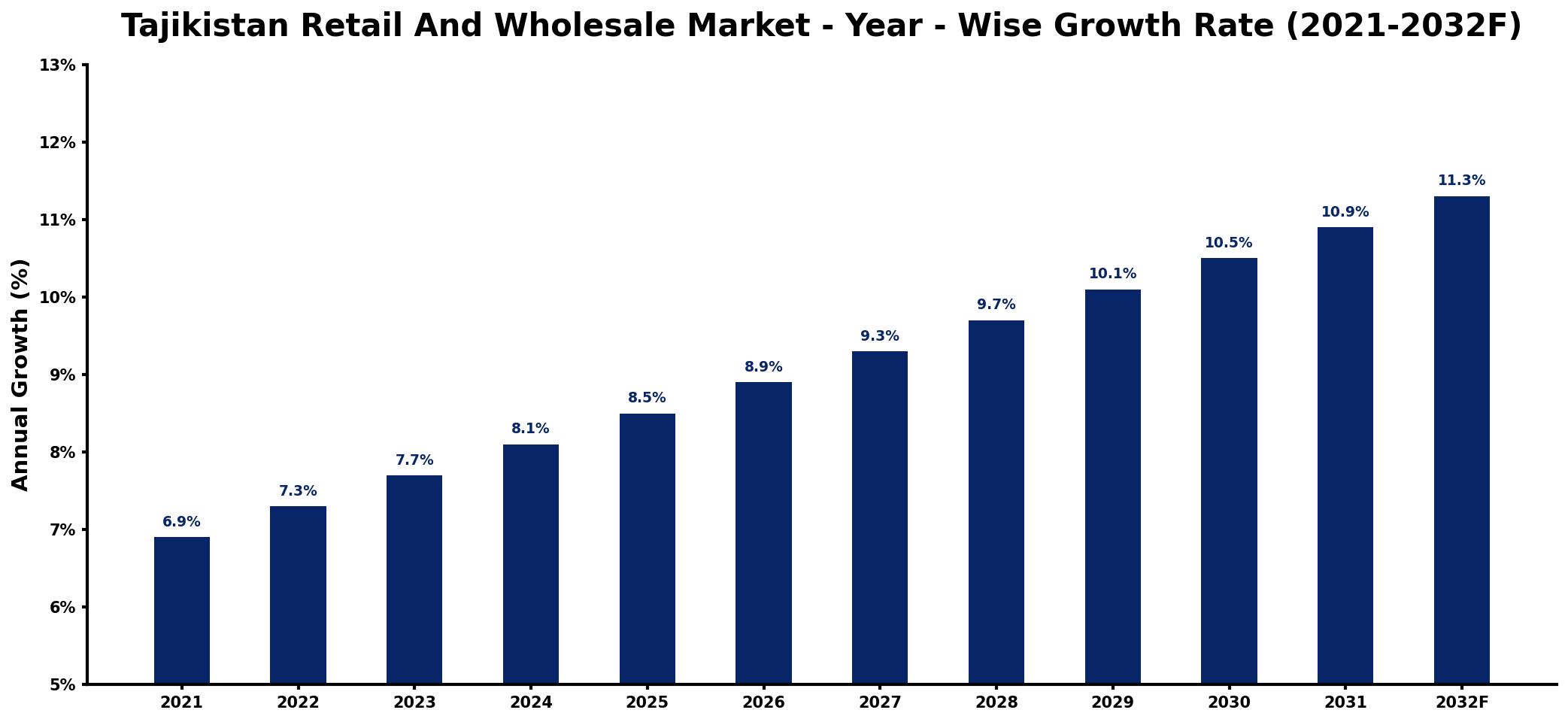
The table below presents the year‑wise growth rates along with the key drivers influencing the market
| Year | Growth Rate | Major Drivers |
| 2021 | 6.9% | Rising consumer spending trends |
| 2022 | 7.3% | Expansion of e-commerce platforms |
| 2023 | 7.7% | Increasing foreign investment influx |
| 2024 | 8.1% | Growth in urban population density |
| 2025 | 8.5% | Enhanced logistics and distribution networks |
| 2026 | 8.9% | Development of local manufacturing capabilities |
| 2027 | 9.3% | Diversification of product offerings |
| 2028 | 9.7% | Strengthening of supply chain resilience |
| 2029 | 10.1% | Boost in disposable income levels |
| 2030 | 10.5% | Growing demand for sustainable products |
| 2031 | 10.9% | growing emerging market penetration |
| 2032 | 11.3% | Rising trend of health consciousness |
Note: Market size estimations and growth projections presented in this report are based on 6Wresearch's proprietary forecasting methodology, utilizing the latest available industry data, government publications, and primary research inputs.
Tajikistan Retail And Wholesale Market Synopsis
The retail and wholesale market in Tajikistan reflects a unique blend of tradition and modernity, with bustling bazaars coexisting alongside contemporary shopping malls. Consumer spending is on the rise, fueled by a burgeoning middle class that is increasingly seeking a wider variety of goods and services.
While the market is showing significant growth potential, it is also challenged by infrastructure deficiencies and regulatory hurdles. Nonetheless, the ongoing efforts to enhance the business landscape suggest a commitment to fostering a more conducive environment for both local and international businesses.
Tajikistan Retail And Wholesale Market Key Takeaways
- The market is witnessing a steady transformation driven by urbanization and a rising middle class.
- Digital shopping platforms are rapidly gaining traction, reflecting a shift in consumer shopping behaviors.
- Challenges such as infrastructure limitations and regulatory complexities need to be navigated carefully.
- There is a notable interest in sustainability among consumers, affecting product choices.
- Investment opportunities are emerging in sectors such as food, clothing, electronics, and e-commerce.
Evaluation of Restraints in Tajikistan Retail And Wholesale Market
Despite its promising outlook, the Tajikistan retail and wholesale market grapples with several significant challenges. The countrys landlocked position creates high import costs and logistical issues that burden businesses. Additionally, infrastructure remains underdeveloped, particularly in transportation, which can hinder supply chain efficiency. A lack of skilled labor further complicates operational dynamics, while regulatory inconsistencies and political instability contribute to a challenging business environment, making it difficult for companies to achieve sustainable growth.
Tajikistan Retail And Wholesale Market Trends
Currently, the Tajikistan retail and wholesale market is experiencing notable trends that are shaping its future. The growth of e-commerce is one of the most significant trends, as businesses increasingly invest in online platforms to reach consumers. Sustainability is another important theme, with a rising demand for eco-friendly products reflecting evolving consumer values. Furthermore, the traditional shopping experience is being enhanced by the introduction of modern retail formats and digital payment solutions, facilitating more convenient shopping opportunities.
Tajikistan Retail And Wholesale Market Opportunities
There are substantial investment opportunities within the Tajikistan retail and wholesale market, particularly in sectors that cater to a growing consumer base. With the middle class expanding, businesses that establish modern retail formats such as supermarkets and specialty stores stand to benefit significantly. The wholesale sector presents further potential for businesses aiming to distribute goods efficiently to retailers. Additionally, the burgeoning e-commerce space offers a platform for innovative retail concepts, making it a promising area for investment.
Government Initiatives in the Tajikistan Retail And Wholesale Market
The Tajikistan government has implemented several initiatives aimed at bolstering the retail and wholesale market. Policies are focused on attracting foreign investment and enhancing local production capabilities. Additionally, the government is actively working to create a regulatory framework that supports fair competition and consumer protection. Trade agreements with neighboring countries also facilitate cross-border commerce, indicating a proactive stance towards increasing market accessibility and fostering a healthy business environment.
Future Insights of the Tajikistan Retail And Wholesale Market
Looking ahead to 2026-2032, the Tajikistan retail and wholesale market is set to undergo significant changes driven by continued economic growth and urbanization. As consumer preferences evolve, larger retail formats are expected to gain popularity, while e-commerce will likely become an integral component of the retail landscape. Furthermore, the wholesale market will likely expand to support the needs of modern retail, emphasizing efficient supply chains and distribution networks. Overall, the outlook remains optimistic, with ample opportunities for both domestic and international players to succeed.
Tajikistan Retail And Wholesale Market Latest Developments (2025 - 2026)
Recent developments in the Tajikistan retail and wholesale market indicate a trend towards modernization, with more retailers exploring digital platforms to engage consumers. There is also an increasing emphasis on sustainable practices, as businesses adapt to consumer preferences for eco-friendly products. Moreover, collaboration between local businesses and foreign investors is becoming more prevalent, contributing to market evolution and increased competitiveness.
Tajikistan Retail And Wholesale Market - Key Attractiveness of the Report
- 10 Years of Market Numbers
- Historical Data Starting from 2022 to 2025
- Base Year: 2025
- Forecast Data until 2032
- Key Performance Indicators Impacting the Market
- Major Upcoming Developments and Projects
Key Highlights of the Report:
- Tajikistan Retail And Wholesale Market Outlook
- Market Size of Tajikistan Retail And Wholesale Market, 2025
- Forecast of Tajikistan Retail And Wholesale Market, 2032
- Historical Data and Forecast of Tajikistan Retail And Wholesale Revenues & Volume for the Period 2022-2032F
- Tajikistan Retail And Wholesale Market Trend Evolution
- Tajikistan Retail And Wholesale Market Drivers and Challenges
- Tajikistan Retail And Wholesale Price Trends
- Tajikistan Retail And Wholesale Porter's Five Forces
- Tajikistan Retail And Wholesale Industry Life Cycle
- Historical Data and Forecast of Tajikistan Retail And Wholesale Market Revenues & Volume By Type for the Period 2022-2032F
- Historical Data and Forecast of Tajikistan Retail And Wholesale Market Revenues & Volume By Retail for the Period 2022-2032F
- Historical Data and Forecast of Tajikistan Retail And Wholesale Market Revenues & Volume By Wholesale for the Period 2022-2032F
- Historical Data and Forecast of Tajikistan Retail And Wholesale Market Revenues & Volume By Ownership for the Period 2022-2032F
- Historical Data and Forecast of Tajikistan Retail And Wholesale Market Revenues & Volume By Retail Chain/Wholesale Chain for the Period 2022-2032F
- Historical Data and Forecast of Tajikistan Retail And Wholesale Market Revenues & Volume By Independent Retailer/Independent Wholesalers for the Period 2022-2032F
- Historical Data and Forecast of Tajikistan Retail And Wholesale Market Revenues & Volume By Price Range for the Period 2022-2032F
- Historical Data and Forecast of Tajikistan Retail And Wholesale Market Revenues & Volume By Premium for the Period 2022-2032F
- Historical Data and Forecast of Tajikistan Retail And Wholesale Market Revenues & Volume By Mid-Range for the Period 2022-2032F
- Historical Data and Forecast of Tajikistan Retail And Wholesale Market Revenues & Volume By Economy for the Period 2022-2032F
- Historical Data and Forecast of Tajikistan Retail And Wholesale Market Revenues & Volume By Distribution Channel for the Period 2022-2032F
- Historical Data and Forecast of Tajikistan Retail And Wholesale Market Revenues & Volume By Supermarkets/Hypermarkets for the Period 2022-2032F
- Historical Data and Forecast of Tajikistan Retail And Wholesale Market Revenues & Volume By Convenience Stores for the Period 2022-2032F
- Historical Data and Forecast of Tajikistan Retail And Wholesale Market Revenues & Volume By Department Stores for the Period 2022-2032F
- Historical Data and Forecast of Tajikistan Retail And Wholesale Market Revenues & Volume By Specialty Stores for the Period 2022-2032F
- Tajikistan Retail And Wholesale Import Export Trade Statistics
- Market Opportunity Assessment By Type
- Market Opportunity Assessment By Ownership
- Market Opportunity Assessment By Price Range
- Market Opportunity Assessment By Distribution Channel
- Tajikistan Retail And Wholesale Top Companies Market Share
- Tajikistan Retail And Wholesale Competitive Benchmarking By Technical and Operational Parameters
- Tajikistan Retail And Wholesale Company Profiles
- Tajikistan Retail And Wholesale Key Strategic Recommendations






































