Tajikistan Retail Industry Market Size, Share & Growth Rate
The Tajikistan Retail Industry Market was estimated at USD 283 Million in 2025 and is projected to reach USD 361 Million by 2032, growing at a CAGR of 3.5% from 2026 to 2032. This growth is primarily driven by increasing urbanization and a rising middle class that demands better quality products and services. Additionally, an evolving consumer landscape that favors modern retail formats and e-commerce platforms is also pivotal in shaping the market trajectory.
Tajikistan Retail Industry Market Year-wise Growth Rate and Key Drivers
This graph highlights how the Tajikistan Retail Industry Market has steadily grown over the years, supported by major growth factors.
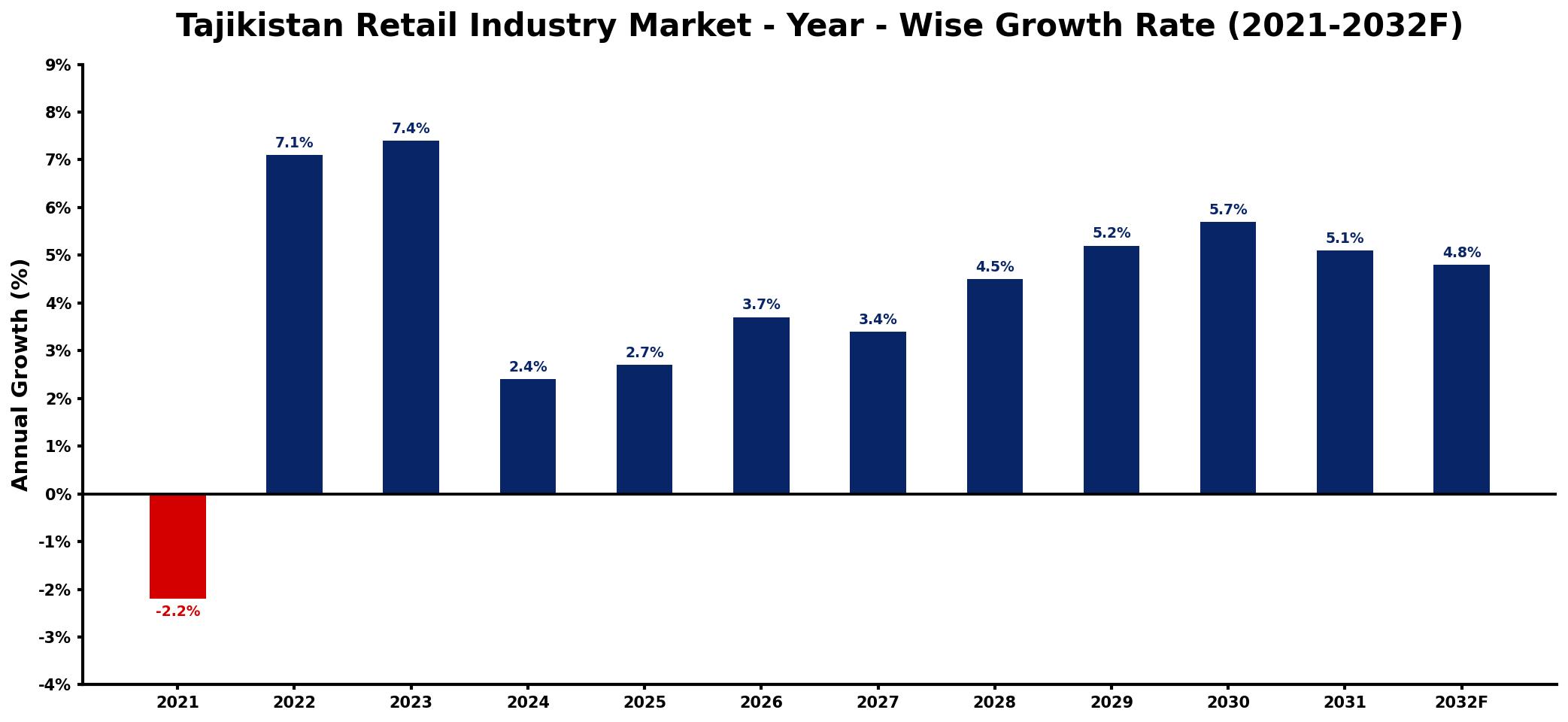
The table below presents the year‑wise growth rates along with the key drivers influencing the market
| Year | Growth Rate | Major Drivers |
| 2021 | -2.2% | decreased consumer spending levels |
| 2022 | 7.1% | rise in consumer purchasing power |
| 2023 | 7.4% | increased investment in infrastructure |
| 2024 | 2.4% | growing e-commerce platforms adoption |
| 2025 | 2.7% | expansion of local manufacturing capacity |
| 2026 | 3.7% | enhanced supply chain efficiency |
| 2027 | 3.4% | growth in disposable income levels |
| 2028 | 4.5% | increased foreign direct investments |
| 2029 | 5.2% | development of new distribution channels |
| 2030 | 5.7% | higher consumer confidence indices |
| 2031 | 5.1% | greater urbanization and migration trends |
| 2032 | 4.8% | increased focus on sustainability initiatives |
Note: Market size estimations and growth projections presented in this report are based on 6Wresearch's proprietary forecasting methodology, utilizing the latest available industry data, government publications, and primary research inputs.
Tajikistan Retail Industry Market Synopsis
Traditional bazaars, with their vibrant offerings ranging from fresh produce to textiles, remain a cornerstone of the Tajik retail landscape. This enduring preference for local products contrasts with the gradual rise of modern shopping facilities, reflecting a duality that presents unique market dynamics.
The growth of supermarkets and international retail chains in urban centers like Dushanbe signifies a shift in consumer habits. As disposable incomes rise, there is an increasing appetite for international brands, prompting local retailers to adapt their offerings to meet this changing demand.
Tajikistan Retail Industry Market Key Takeaways
- The retail sector is experiencing a transformative shift toward modernization and digital commerce.
- Infrastructure challenges persist, but opportunities for logistical development are emerging.
- Consumer preferences are evolving, with a notable demand for international brands.
- The government is implementing favorable policies to encourage investment in retail.
- Investment in e-commerce and modern retail outlets is crucial for future growth.
Evaluation of Restraints in Tajikistan Retail Industry Market
Despite the optimistic outlook, the Tajikistan retail market grapples with significant restraints. The country's underdeveloped infrastructure remains a critical hurdle, complicating the distribution of goods and increasing operational costs. Coupled with high interest rates and limited access to financing, these factors pose challenges for retailers aiming to expand or modernize. Furthermore, low disposable incomes and political uncertainties further stymie growth potential, requiring strategic investments to address these issues effectively.
Tajikistan Retail Industry Market Trends
A notable trend in the Tajikistan retail industry is the rapid digitization and rise of e-commerce platforms. As internet penetration increases, consumers, particularly younger demographics, are gravitating toward the convenience of online shopping. Additionally, retailers are focusing on enhancing customer experiences by integrating technology into their operations, thereby improving supply chain efficiencies. Modern retail formats, including shopping malls and supermarkets, are also evolving to cater to changing consumer demands.
Tajikistan Retail Industry Market Opportunities
There are considerable investment opportunities within the Tajikistan retail sector. With a population exceeding 9 million, the market potential for local and international retailers is significant, particularly in grocery, fashion, electronics, and e-commerce. Infrastructure development remains a pivotal area for investment; enhancing logistics networks and digital payment systems will improve retail market efficiencies. As the Tajik economy continues to modernize, strategic alignment with local consumer preferences can yield substantial returns.
Government Initiatives in the Tajikistan Retail Industry Market
The Tajik government is actively fostering a conducive environment for retail growth through various initiatives. Measures such as tax incentives and streamlined licensing processes are designed to attract investment. Furthermore, regulations aimed at ensuring fair competition and protecting consumers are being reinforced. The government's commitment to monitoring essential goods prices also reflects a focus on maintaining affordability while nurturing the retail sector.
Future Insights of the Tajikistan Retail Industry Market
Looking ahead to 2026-2032, the Tajikistan retail industry is set for further expansion, supported by steady economic growth and a burgeoning middle class. As urbanization accelerates, and more international brands enter the market, competition will intensify, fostering innovation and improved customer experiences. However, addressing existing challenges, such as regulatory barriers and financing access, will be critical for sustaining this growth trajectory. With the right strategies, both domestic and foreign retailers can effectively leverage the opportunities this evolving market presents.
Tajikistan Retail Industry Market Latest Developments (2025 - 2026)
Recent developments in the Tajikistan retail sector indicate a growing interest from foreign investors looking to establish a presence in the market. E-commerce platforms are also gaining traction, with several local startups emerging to meet the rising demand for online shopping. Additionally, ongoing infrastructure projects are being announced to enhance distribution networks, further contributing to the sectors growth potential. Retailers are actively adapting to consumer trends, focusing on technology integration to enhance the shopping experience.
Tajikistan Retail Industry Market - Key Attractiveness of the Report
- 10 Years of Market Numbers
- Historical Data Starting from 2022 to 2025
- Base Year: 2025
- Forecast Data until 2032
- Key Performance Indicators Impacting the Market
- Major Upcoming Developments and Projects
Key Highlights of the Report:
- Tajikistan Retail Industry Market Outlook
- Market Size of Tajikistan Retail Industry Market, 2025
- Forecast of Tajikistan Retail Industry Market, 2032
- Historical Data and Forecast of Tajikistan Retail Industry Revenues & Volume for the Period 2022-2032F
- Tajikistan Retail Industry Market Trend Evolution
- Tajikistan Retail Industry Market Drivers and Challenges
- Tajikistan Retail Industry Price Trends
- Tajikistan Retail Industry Porter's Five Forces
- Tajikistan Retail Industry Industry Life Cycle
- Historical Data and Forecast of Tajikistan Retail Industry Market Revenues & Volume By Product for the Period 2022-2032F
- Historical Data and Forecast of Tajikistan Retail Industry Market Revenues & Volume By Food and Beverages for the Period 2022-2032F
- Historical Data and Forecast of Tajikistan Retail Industry Market Revenues & Volume By Personal and Household Care for the Period 2022-2032F
- Historical Data and Forecast of Tajikistan Retail Industry Market Revenues & Volume By Apparel, Footwear, and Accessories for the Period 2022-2032F
- Historical Data and Forecast of Tajikistan Retail Industry Market Revenues & Volume By Furniture, Toys, and Hobby for the Period 2022-2032F
- Historical Data and Forecast of Tajikistan Retail Industry Market Revenues & Volume By Electronic and Household Appliances for the Period 2022-2032F
- Historical Data and Forecast of Tajikistan Retail Industry Market Revenues & Volume By Other Products for the Period 2022-2032F
- Historical Data and Forecast of Tajikistan Retail Industry Market Revenues & Volume By Distribution Channel for the Period 2022-2032F
- Historical Data and Forecast of Tajikistan Retail Industry Market Revenues & Volume By Supermarkets/Hypermarkets for the Period 2022-2032F
- Historical Data and Forecast of Tajikistan Retail Industry Market Revenues & Volume By Convenience Stores for the Period 2022-2032F
- Historical Data and Forecast of Tajikistan Retail Industry Market Revenues & Volume By Department Stores for the Period 2022-2032F
- Historical Data and Forecast of Tajikistan Retail Industry Market Revenues & Volume By Specialty Stores for the Period 2022-2032F
- Historical Data and Forecast of Tajikistan Retail Industry Market Revenues & Volume By Online for the Period 2022-2032F
- Historical Data and Forecast of Tajikistan Retail Industry Market Revenues & Volume By Other Distribution Channels for the Period 2022-2032F
- Tajikistan Retail Industry Import Export Trade Statistics
- Market Opportunity Assessment By Product
- Market Opportunity Assessment By Distribution Channel
- Tajikistan Retail Industry Top Companies Market Share
- Tajikistan Retail Industry Competitive Benchmarking By Technical and Operational Parameters
- Tajikistan Retail Industry Company Profiles
- Tajikistan Retail Industry Key Strategic Recommendations






































