Tajikistan Screwdriver Market Summary
The tajikistan screwdriver market was estimated at USD 189 Million in 2025 and is projected to reach USD 260 Million by 2032, growing at a CAGR of 5.6% from 2026 to 2032.
Tajikistan Screwdriver Market Year-wise Growth Rate and Key Drivers
This graph highlights how the Tajikistan Screwdriver Market has steadily grown over the past five years, supported by major growth factors.
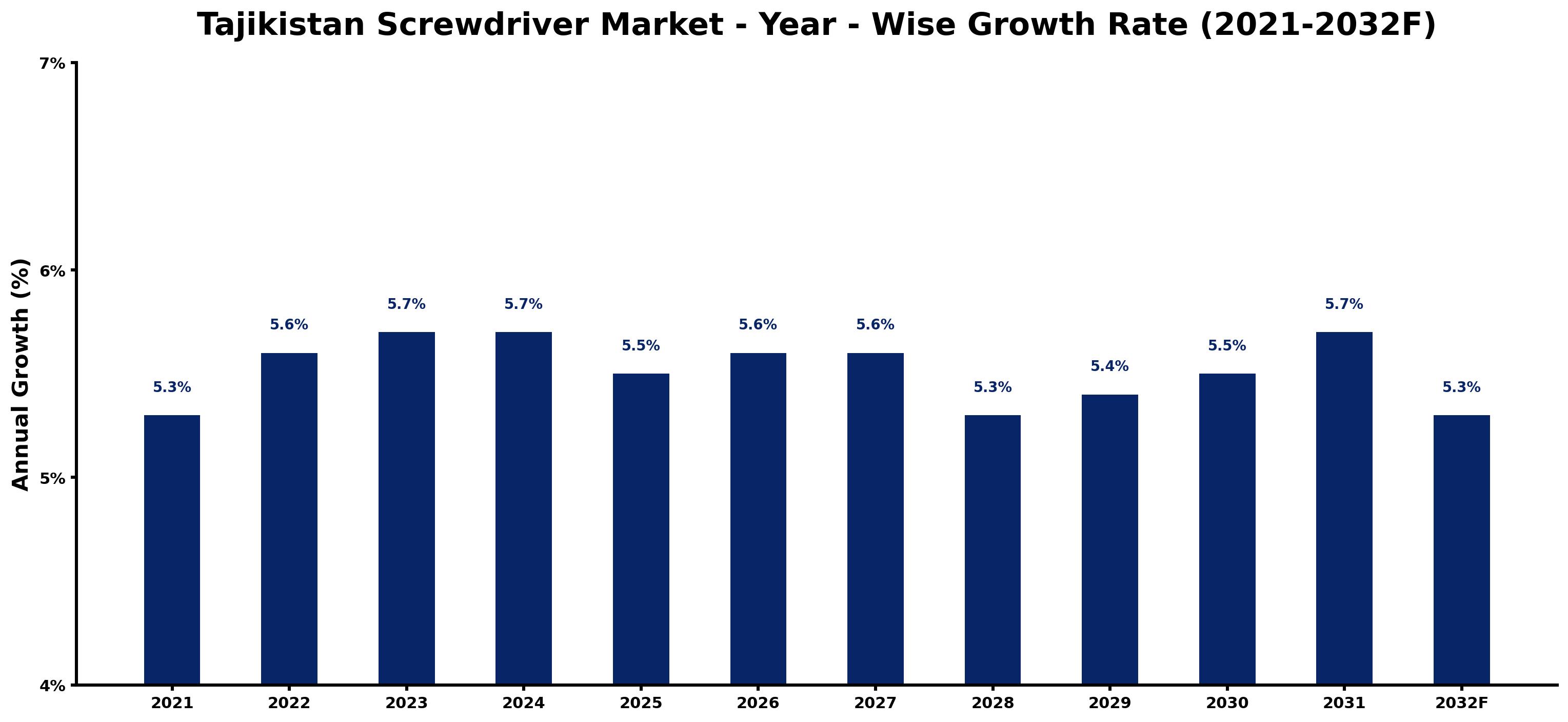
The table below presents the year wise growth rates along with the key drivers influencing the market
| Year | Growth Rate | Major Drivers |
| 2021 | 5.3% | Local manufacturing facilities began to address the screwdriver supply gap. |
| 2022 | 5.6% | Infrastructure projects increased, boosting the need for durable hand tools. |
| 2023 | 5.7% | E-commerce platforms emerged, expanding access to screwdriver varieties and brands. |
| 2024 | 5.7% | Local artisans and craftsmen played a vital role in promoting tool usage. |
| 2025 | 5.5% | Rising home improvement trends encouraged DIY enthusiasts to purchase screwdrivers. |
| 2026 | 5.6% | A gradual shift towards modern retail formats improved consumer tool access. |
| 2027 | 5.6% | With urban development, the demand for professional-grade tools surged significantly. |
| 2028 | 5.3% | A renewed focus on vocational training enhanced skills in tool usage and care. |
| 2029 | 5.4% | Promotional campaigns by brands introduced innovative screwdriver technologies. |
| 2030 | 5.5% | The regional construction boom fostered partnerships between manufacturers and contractors. |
| 2031 | 5.7% | Sustainability trends began influencing the production of eco-friendly screwdriver materials. |
| 2032 | 5.3% | Increased disposable income allowed households to invest in quality toolbox essentials. |
Note - Market size estimations and growth projections presented in this report are based on 6Wresearch's advanced forecasting approach, validated with industry datasets as of June 2026.
Tajikistan Screwdriver Market Synopsis
The Tajikistan Screwdriver Market is projected to reach 5.6% and witness significant growth during the forecast period (2026-2032). The increasing demand for screwdrivers, both manual and power-driven, is primarily fueled by ongoing developments in construction, manufacturing, and automotive industries. Manual screwdrivers remain a staple among DIY enthusiasts and small businesses due to their cost-effectiveness and versatility, while power screwdrivers are gaining traction in larger industrial settings for their speed and efficiency.
Tajikistan Screwdriver Market Growth Drivers
The growth trajectory of the Tajikistan Screwdriver Market is influenced by several pivotal factors:
- The construction sector is witnessing robust growth, spurred by ongoing infrastructure projects and urban development initiatives, which significantly elevates the demand for quality screwdrivers.
- Increased investment in the manufacturing industry necessitates the use of efficient tools, thereby promoting the use of power screwdrivers among manufacturers aiming to enhance productivity.
- A shift in consumer preference towards electric and cordless screwdrivers is enhancing the market landscape as consumers seek efficiency and convenience for mobile applications and remote jobs.
- The rising DIY culture, especially within urban areas, has contributed to a consistent demand for manual screwdrivers, which serve both practical and hobbyist needs.
- Technological advancements in screwdriver design and functionality continue to attract both professional users and hobbyists, further fueling market growth.
Tajikistan Screwdriver Market Trends and Opportunities
The Tajikistan Screwdriver Market is rapidly evolving, shaped by emerging trends that are indicative of shifting consumer preferences:
- Electric screwdrivers are becoming increasingly popular due to their enhanced precision and performance, fulfilling the needs of industries demanding high-quality fastening solutions.
- There is a growing preference for cordless screwdrivers, attributed to their portability and ease of use in various work environments, particularly where power sources are limited.
- Consumers are gravitating towards ergonomically designed screwdrivers that improve user comfort during extended use, indicating a move towards products that prioritize user experience.
- Innovative features, such as integrated LED lights and interchangeable bits, are becoming sought after, appealing to both professionals and DIY enthusiasts who value versatility.
- With an increase in public awareness regarding environmental impacts, there is an opportunity to introduce eco-friendly screwdriver options, which could resonate well with a growing segment of environmentally conscious consumers.
Tajikistan Screwdriver Market Challenges and Restraints
Despite the favorable growth outlook for the Tajikistan Screwdriver Market, several challenges persist:
- Limited access to advanced manufacturing techniques and technology can compromise the quality and efficiency of locally produced screwdrivers.
- The reliance on imported raw materials presents supply chain vulnerabilities, particularly during economic fluctuations, impacting production consistency.
- Consumer awareness regarding the benefits of locally manufactured products remains low, which can hinder brand loyalty and market penetration for domestic manufacturers.
- Economic instability, accompanied by fluctuating exchange rates, poses risks to pricing strategies, ultimately affecting profitability in a competitive marketplace.
- Manufacturers must adapt to changing regulatory landscapes which may impose additional operational challenges, particularly concerning quality control and compliance.
Tajikistan Screwdriver Market Investment Opportunities
The potential for investment in the Tajikistan Screwdriver Market remains strong, driven by several factors:
- The ongoing demand for quality hand tools in the construction and manufacturing sectors creates opportunities for both local and foreign investors to establish a presence in this market.
- Partnerships with local distributors or manufacturers can facilitate market entry, allowing for the introduction of innovative screwdriver products that cater specifically to local preferences.
- Investments in technology transfer and manufacturing upgrades can enhance local production capabilities, enabling manufacturers to produce higher-quality screwdrivers.
- The increasing focus on sustainability presents an opportunity for eco-friendly tools, meeting the rising demand for greener products in the market.
- Conducting thorough market research can guide strategies for competitive pricing, ensuring that new entrants can effectively capture market share amidst existing players.
Tajikistan Screwdriver Market Government Investment and Initiatives
The Tajikistan government plays a crucial role in fostering the screwdriver market through various initiatives:
- Import tariffs on tools, including screwdrivers, are designed to protect local manufacturers, thereby encouraging domestic production and reducing reliance on foreign products.
- Quality standards have been established by the government to ensure that screwdrivers sold in the market are safe and meet industry benchmarks, promoting consumer trust.
- Public spending in infrastructure projects directly correlates with the growing demand for construction tools, including screwdrivers, thus bolstering market potential.
- There are ongoing initiatives focused on enhancing innovation within the screwdriver industry, which are aimed at building competitiveness and fostering local manufacturing capabilities.
- The government is also promoting investment in the technology sector, facilitating greater access to modern manufacturing processes that can enhance product quality and efficiency.
Tajikistan Screwdriver Market Latest Developments (May 2025 - June 2026)
Recent developments in the Tajikistan Screwdriver Market between May 2025 and June 2026 highlight notable trends and shifts:
- Improved accessibility to advanced manufacturing technology has begun to change production capabilities, enabling higher-quality screwdriver products to enter the market.
- An increase in government-sponsored infrastructure projects has stimulated demand for both manual and electric screwdrivers, indicating a positive trend in construction activity.
- Local manufacturers are adapting to consumer demand by incorporating innovative features into their screwdriver designs, enhancing the user experience.
- The emergence of eco-friendly product alternatives is gaining traction among consumers, aligning with global sustainability trends and consumer preferences.
- Market players are increasingly investing in marketing efforts aimed at raising awareness of the benefits of locally produced screwdrivers compared to imports, thereby fostering brand loyalty.
Tajikistan Screwdriver Market - Key Attractiveness of the Report
- 10 Years of Market Numbers
- Historical Data Starting from 2022 to 2025
- Base Year: 2025
- Forecast Data until 2032
- Key Performance Indicators Impacting the Market
- Major Upcoming Developments and Projects
Key Highlights of the Report:
- Tajikistan Screwdriver Market Outlook
- Market Size of Tajikistan Screwdriver Market, 2025
- Forecast of Tajikistan Screwdriver Market, 2032F
- Historical Data and Forecast of Tajikistan Screwdriver Revenues & Volume for the Period 2022-2032F
- Tajikistan Screwdriver Market Trend Evolution
- Tajikistan Screwdriver Market Drivers and Challenges
- Tajikistan Screwdriver Price Trends
- Tajikistan Screwdriver Porter's Five Forces
- Tajikistan Screwdriver Industry Life Cycle
- Historical Data and Forecast of Tajikistan Screwdriver Market Revenues & Volume By Product Type for the Period 2022-2032F
- Historical Data and Forecast of Tajikistan Screwdriver Market Revenues & Volume By Electric Screwdrivers for the Period 2022-2032F
- Historical Data and Forecast of Tajikistan Screwdriver Market Revenues & Volume By Pneumatic Screwdrivers for the Period 2022-2032F
- Historical Data and Forecast of Tajikistan Screwdriver Market Revenues & Volume By Self-feeding Screwdrivers for the Period 2022-2032F
- Historical Data and Forecast of Tajikistan Screwdriver Market Revenues & Volume By Application for the Period 2022-2032F
- Historical Data and Forecast of Tajikistan Screwdriver Market Revenues & Volume By Household for the Period 2022-2032F
- Historical Data and Forecast of Tajikistan Screwdriver Market Revenues & Volume By Industrial for the Period 2022-2032F
- Tajikistan Screwdriver Import Export Trade Statistics
- Market Opportunity Assessment By Product Type
- Market Opportunity Assessment By Application
- Tajikistan Screwdriver Top Companies Market Share
- Tajikistan Screwdriver Competitive Benchmarking By Technical and Operational Parameters
- Tajikistan Screwdriver Company Profiles
- Tajikistan Screwdriver Key Strategic Recommendations






































