Tajikistan Smart Locks Market Size, Share & Growth Rate
The Tajikistan Smart Locks Market was estimated at USD 647 Million in 2025 and is projected to reach USD 1216 Million by 2032, growing at a CAGR of 9.4% from 2026 to 2032. This robust growth trajectory is fueled by increasing urbanization and a rising middle class with heightened security concerns. Furthermore, the adoption of smart home technologies is leading to a significant shift in consumer preferences toward advanced locking systems that offer convenience and enhanced control.
Tajikistan Smart Locks Market Year-wise Growth Rate and Key Drivers
This graph highlights how the Tajikistan Smart Locks Market has steadily grown over the years, supported by major growth factors.
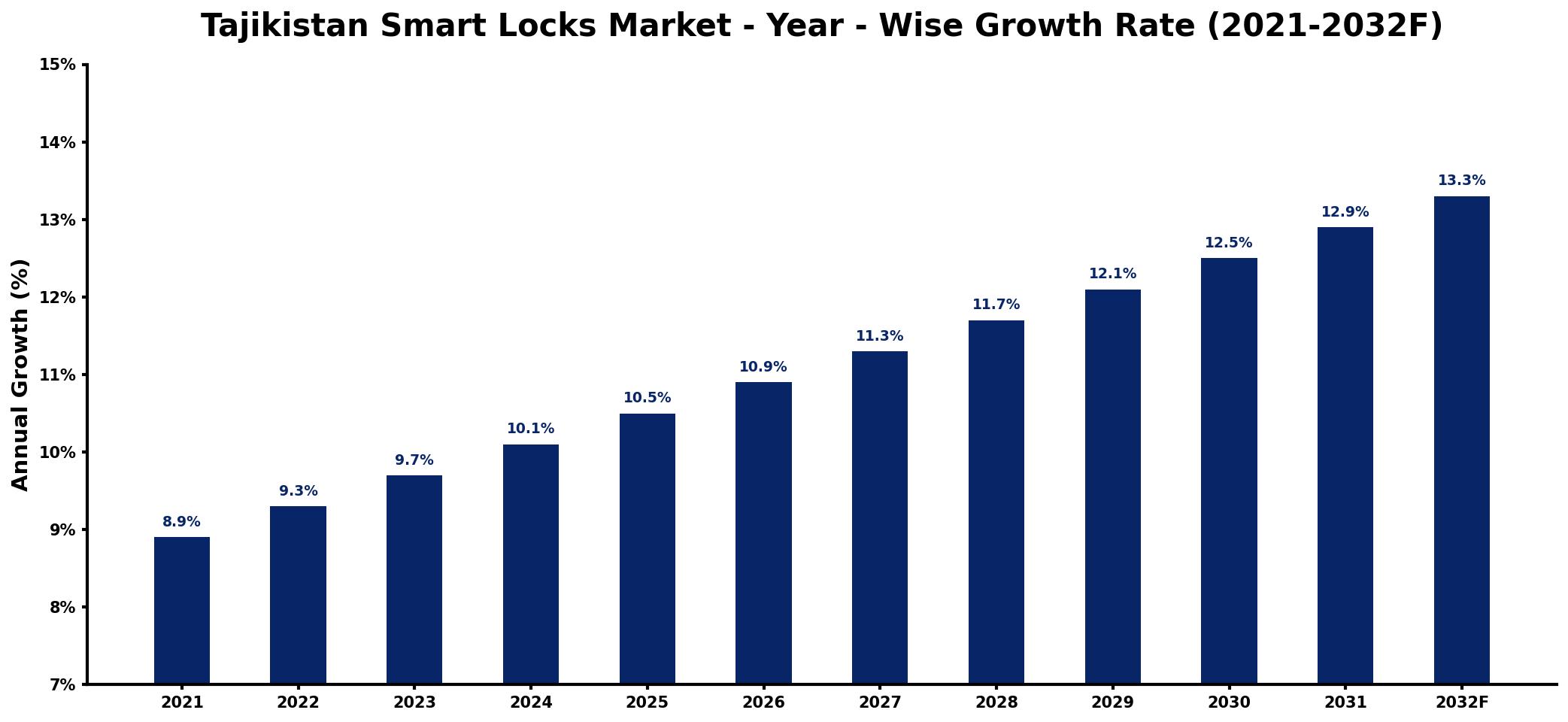
The table below presents the year‑wise growth rates along with the key drivers influencing the market
| Year | Growth Rate | Major Drivers |
| 2021 | 8.9% | Rising urbanization and security concerns |
| 2022 | 9.3% | Increased investment in technology infrastructure |
| 2023 | 9.7% | Growing demand for home automation |
| 2024 | 10.1% | improved processing technologies adoption |
| 2025 | 10.5% | Enhanced consumer awareness of safety |
| 2026 | 10.9% | rising procurement volume requirements |
| 2027 | 11.3% | Government initiatives promoting innovation |
| 2028 | 11.7% | Surge in residential construction projects |
| 2029 | 12.1% | Adoption of IoT technologies increases |
| 2030 | 12.5% | Shift towards contactless security solutions |
| 2031 | 12.9% | Rising disposable income among consumers |
| 2032 | 13.3% | Growing interest in energy efficiency |
Note: Market size estimations and growth projections presented in this report are based on 6Wresearch's proprietary forecasting methodology, utilizing the latest available industry data, government publications, and primary research inputs.
Tajikistan Smart Locks Market Synopsis
The Tajikistan Smart Locks Market has gained considerable momentum, characterized by a growing consumer interest in security and convenience. As urban living spaces evolve, the demand for innovative locking solutions is climbing, pushing market players to focus on product differentiation and integration with smart technologies.
Looking ahead, the market is poised for continued expansion. With strategic partnerships between smart lock manufacturers and home automation entities, consumers will have access to more comprehensive smart home solutions, further driving adoption rates across both residential and commercial sectors.
Tajikistan Smart Locks Market Key Takeaways
- Rapid urbanization is significantly driving demand for smart locks in residential and commercial properties.
- The market is witnessing strong product innovation, including biometric and remote access features.
- Partnerships between manufacturers and technology firms are enhancing the availability of integrated smart home solutions.
- Consumer education will be essential to overcome existing awareness gaps regarding smart lock benefits.
- The market is anticipated to expand significantly, fueled by government initiatives supporting digitalization and cybersecurity.
Evaluation of Restraints in Tajikistan Smart Locks Market
Despite the market's promising outlook, several constraints are hindering the rapid adoption of smart locks. A significant barrier is consumer awareness; many potential buyers remain unfamiliar with smart lock functionalities compared to traditional locking mechanisms. This lack of understanding slows adoption rates. Additionally, affordability is a concern as smart locks are often viewed as premium products, which can alienate cost-sensitive consumers. There are also ongoing worries about data security, as potential users may hesitate to rely on technology perceived as vulnerable to cyber threats. Addressing these issues will require targeted education campaigns and competitive pricing strategies to instill confidence in consumers.
Tajikistan Smart Locks Market Trends
The market is currently witnessing a growing trend towards keyless entry systems, driven by consumer desire for convenience and enhanced security. Moreover, the integration of smart locks with home automation systems is becoming increasingly prevalent, with features such as remote monitoring and access control gaining traction. Technology advancements, including voice-activated controls and biometric authentication, are also influencing consumer preferences. The push toward smart cities and widespread Internet of Things (IoT) adoption further solidifies the necessity for smart locking solutions in urban environments.
Tajikistan Smart Locks Market Opportunities
The landscape for investment in the Tajikistan Smart Locks Market is ripe with opportunities. Companies can capitalize on the burgeoning demand for secure and technologically sophisticated locking solutions tailored to the local market. There is significant potential for growth in developing integrated security systems that merge access control, monitoring, and smart home connectivity. Establishing partnerships with local distributors and employing effective digital marketing strategies will be crucial for penetrating the market effectively. Furthermore, providing superior customer support can help build brand loyalty and drive repeat purchases in this evolving market.
Government Initiatives in the Tajikistan Smart Locks Market
While there are no specific policies directly targeting the smart locks market, the Tajikistan government is actively working to enhance digital infrastructure across various sectors. This broad initiative is creating an environment conducive to the adoption of smart technologies, including smart home devices. The government's commitment to improving cybersecurity measures also aligns with the needs of smart lock manufacturers and consumers, thereby fostering a greater sense of security and trust in these innovative products.
Future Insights of the Tajikistan Smart Locks Market
Looking to 2026 and beyond, the Tajikistan Smart Locks Market is set to flourish, driven by the increasing urban population and a heightened emphasis on security and convenience. The continued integration of IoT capabilities and smartphone connectivity will likely enhance product offerings, making smart locks more appealing to consumers. Additionally, government support for infrastructure development and smart city initiatives will promote wider adoption of these advanced security solutions in both residential and commercial settings. As competition intensifies, innovation and differentiation will play pivotal roles in shaping market dynamics.
Tajikistan Smart Locks Market Latest Developments (2025 - 2026)
Recently, the industry has seen a notable shift towards offering smart locks with advanced features, such as enhanced biometric authentication and AI-driven functionalities. Manufacturers are increasingly collaborating with technology firms to develop integrated solutions that cater to the evolving needs of consumers. Moreover, there's a growing focus on ensuring data security within smart lock systems, aligning with governmental efforts to promote safer digital environments. Overall, innovation and consumer education are at the forefront of driving the market's evolution during this period.
Tajikistan Smart Locks Market - Key Attractiveness of the Report
- 10 Years of Market Numbers
- Historical Data Starting from 2022 to 2025
- Base Year: 2025
- Forecast Data until 2032
- Key Performance Indicators Impacting the Market
- Major Upcoming Developments and Projects
Key Highlights of the Report:
- Tajikistan Smart Locks Market Outlook
- Market Size of Tajikistan Smart Locks Market, 2025
- Forecast of Tajikistan Smart Locks Market, 2032
- Historical Data and Forecast of Tajikistan Smart Locks Revenues & Volume for the Period 2022-2032F
- Tajikistan Smart Locks Market Trend Evolution
- Tajikistan Smart Locks Market Drivers and Challenges
- Tajikistan Smart Locks Price Trends
- Tajikistan Smart Locks Porter's Five Forces
- Tajikistan Smart Locks Industry Life Cycle
- Historical Data and Forecast of Tajikistan Smart Locks Market Revenues & Volume By Product for the Period 2022-2032F
- Historical Data and Forecast of Tajikistan Smart Locks Market Revenues & Volume By Deadbolts for the Period 2022-2032F
- Historical Data and Forecast of Tajikistan Smart Locks Market Revenues & Volume By Lever Handles for the Period 2022-2032F
- Historical Data and Forecast of Tajikistan Smart Locks Market Revenues & Volume By Padlocks for the Period 2022-2032F
- Historical Data and Forecast of Tajikistan Smart Locks Market Revenues & Volume By Others for the Period 2022-2032F
- Historical Data and Forecast of Tajikistan Smart Locks Market Revenues & Volume By Technology for the Period 2022-2032F
- Historical Data and Forecast of Tajikistan Smart Locks Market Revenues & Volume By Bluetooth for the Period 2022-2032F
- Historical Data and Forecast of Tajikistan Smart Locks Market Revenues & Volume By Wi-Fi for the Period 2022-2032F
- Historical Data and Forecast of Tajikistan Smart Locks Market Revenues & Volume By End User for the Period 2022-2032F
- Historical Data and Forecast of Tajikistan Smart Locks Market Revenues & Volume By Residential for the Period 2022-2032F
- Historical Data and Forecast of Tajikistan Smart Locks Market Revenues & Volume By Commercial for the Period 2022-2032F
- Tajikistan Smart Locks Import Export Trade Statistics
- Market Opportunity Assessment By Product
- Market Opportunity Assessment By Technology
- Market Opportunity Assessment By End User
- Tajikistan Smart Locks Top Companies Market Share
- Tajikistan Smart Locks Competitive Benchmarking By Technical and Operational Parameters
- Tajikistan Smart Locks Company Profiles
- Tajikistan Smart Locks Key Strategic Recommendations






































