Tajikistan Smart Toilet Market Size, Share & Growth Rate
The Tajikistan Smart Toilet Market was estimated at USD 1069 Million in 2025 and is projected to reach USD 2010 Million by 2032, growing at a CAGR of 9.4% from 2026 to 2032. This robust growth trajectory is primarily driven by increasing urbanization and a heightened awareness of hygiene standards among the population. Additionally, government initiatives aimed at enhancing sanitation infrastructure further propel the demand for advanced sanitation solutions, including smart toilets.
Tajikistan Smart Toilet Market Year-wise Growth Rate and Key Drivers
This graph highlights how the Tajikistan Smart Toilet Market has steadily grown over the years, supported by major growth factors.
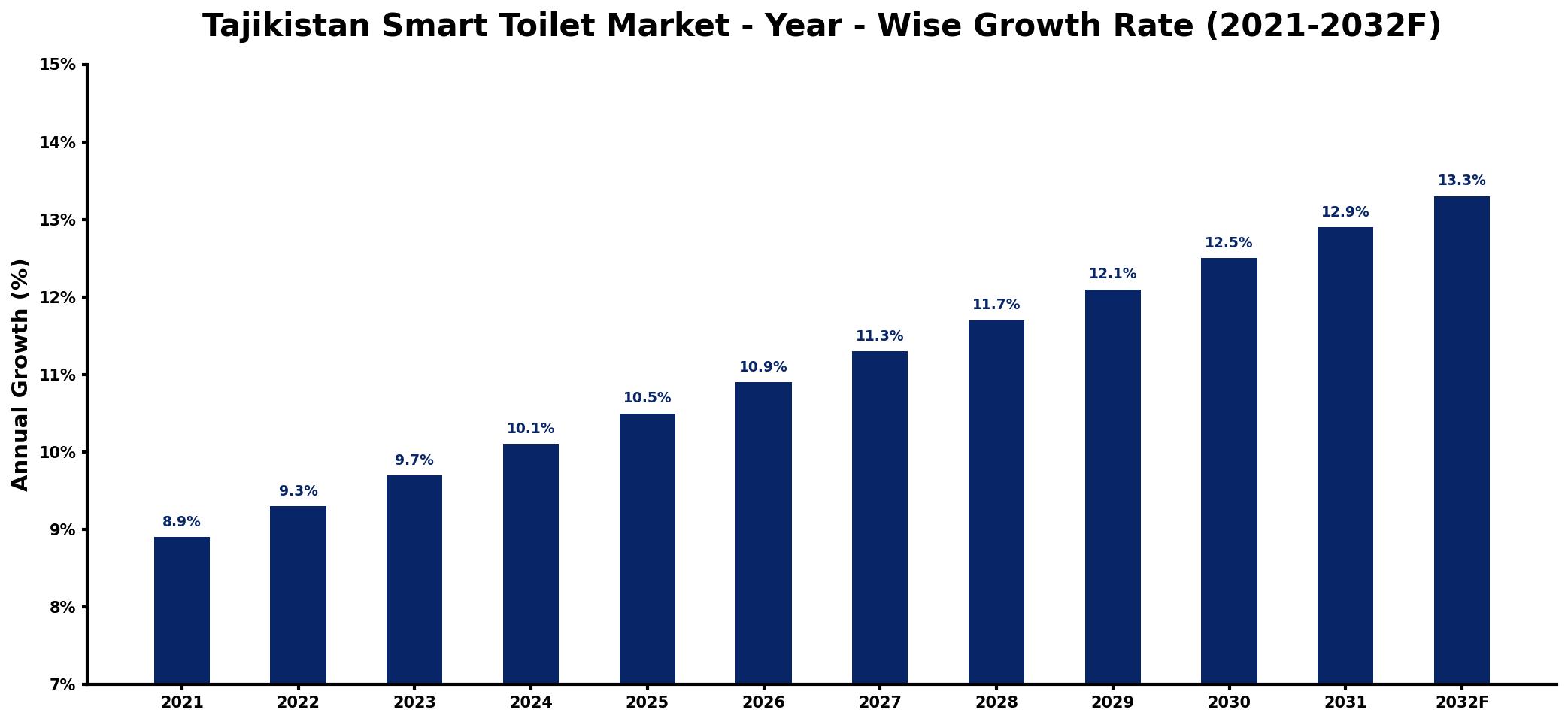
The table below presents the year‑wise growth rates along with the key drivers influencing the market
| Year | Growth Rate | Major Drivers |
| 2021 | 8.9% | increased urban infrastructure development |
| 2022 | 9.3% | growing emphasis on hygiene standards |
| 2023 | 9.7% | rising disposable income levels |
| 2024 | 10.1% | expansion of eco-friendly technologies |
| 2025 | 10.5% | increased health awareness initiatives |
| 2026 | 10.9% | growth in luxury home features |
| 2027 | 11.3% | rising demand for automation solutions |
| 2028 | 11.7% | increased investment in sanitation projects |
| 2029 | 12.1% | rising end-use demand growth |
| 2030 | 12.5% | growing interest in water conservation |
| 2031 | 12.9% | increased urbanization and population density |
| 2032 | 13.3% | improved raw material availability |
Note: Market size estimations and growth projections presented in this report are based on 6Wresearch's proprietary forecasting methodology, utilizing the latest available industry data, government publications, and primary research inputs.
Tajikistan Smart Toilet Market Synopsis
The primary force shaping the Tajikistan Smart Toilet Market is the growing awareness regarding sanitation and hygiene among consumers. This heightened consciousness is prompting a shift towards modern toilet solutions equipped with innovative features that enhance comfort and convenience.
Moreover, urban areas are witnessing a trend towards home automation, with smart toilets being viewed as essential components of modern living. Features such as automated flushing, heated seats, and bidet functions are increasingly appealing to consumers seeking both luxury and practicality in their bathroom experiences.
Tajikistan Smart Toilet Market Key Takeaways
- Significant market growth fueled by increasing urbanization and hygiene awareness.
- Technological innovations are driving consumer demand for enhanced functionalities.
- Eco-friendly smart toilet solutions are becoming a priority for environmentally conscious consumers.
- Challenges in consumer awareness and infrastructure remain key barriers to market expansion.
- Investment opportunities abound in strategic partnerships and innovative technology deployment.
Evaluation of Restraints in Tajikistan Smart Toilet Market
Despite the promising growth trajectory, the Tajikistan Smart Toilet Market grapples with several constraints. One major hurdle is the limited awareness among consumers, particularly in rural regions, regarding the advantages of smart toilet technology. This lack of understanding hampers adoption rates, as many potential buyers are hesitant to invest in new technologies. Additionally, the high initial costs associated with smart toilet installation pose significant barriers, especially given the income levels prevalent in the country. Moreover, inadequate infrastructure and a shortage of trained technicians for maintenance further complicate the landscape, limiting the market's growth potential.
Tajikistan Smart Toilet Market Trends
The trends in the Tajikistan Smart Toilet Market are gravitating towards advanced features and sustainable solutions. Consumers are now increasingly attracted to models that boast self-cleaning capabilities, integrated bidets, and personalized settings that cater to individual preferences. Furthermore, the demand for eco-friendly options is on the rise, with more consumers seeking solutions that reduce water and energy consumption. Smart toilets that offer remote control and IoT connectivity features are also gaining traction among tech-savvy users, enhancing the appeal of these products in urban markets.
Tajikistan Smart Toilet Market Opportunities
Investment opportunities in the Tajikistan Smart Toilet Market are ripe for exploration. The growing emphasis on modernizing sanitation infrastructure presents avenues for stakeholders to introduce advanced toilet solutions with features like water conservation and IoT integration. Collaborating with local municipalities for public installations can also drive growth, enhancing sanitation facilities in public spaces. Furthermore, partnerships with governmental bodies focused on improving sanitation standards could serve as effective entry points into this emerging market segment, aligning with national development priorities.
Government Initiatives in the Tajikistan Smart Toilet Market
While no specific policies target the smart toilet market directly, the Tajik government is committed to enhancing sanitation infrastructure across urban and rural areas. Initiatives aimed at improving access to quality sanitation facilities indirectly support the adoption of smart toilet technologies. This aligns with Tajikistan's broader goals of achieving the Sustainable Development Goals (SDGs) related to water and sanitation, creating an encouraging backdrop for innovative sanitation solutions.
Future Insights of the Tajikistan Smart Toilet Market
The future outlook for the Tajikistan Smart Toilet Market is optimistic as the country seeks to modernize its sanitation facilities. With increasing urbanization and a shift toward smarter home solutions, the demand for innovative sanitation technologies is expected to soar. The government's initiatives to enhance sanitation standards will further drive market growth, positioning manufacturers to focus on research and development for tailored products. Overall, the market is poised for steady expansion, offering lucrative opportunities for both local and international manufacturers as consumer preferences evolve.
Tajikistan Smart Toilet Market Latest Developments (2025 - 2026)
In recent months, the Tajikistan Smart Toilet Market has experienced notable advancements, with increased interest in eco-friendly and energy-efficient models. Manufacturers are actively exploring partnerships to facilitate the introduction of smart toilet technologies in both urban and rural areas. Public discourse surrounding sanitation improvements has also gained momentum, reflecting a growing commitment to enhancing hygiene standards across the country. Such developments underscore the market's readiness to embrace innovative solutions that align with both consumer desires and government objectives.
Tajikistan Smart Toilet Market - Key Attractiveness of the Report
- 10 Years of Market Numbers
- Historical Data Starting from 2022 to 2025
- Base Year: 2025
- Forecast Data until 2032
- Key Performance Indicators Impacting the Market
- Major Upcoming Developments and Projects
Key Highlights of the Report:
- Tajikistan Smart Toilet Market Outlook
- Market Size of Tajikistan Smart Toilet Market, 2025
- Forecast of Tajikistan Smart Toilet Market, 2032
- Historical Data and Forecast of Tajikistan Smart Toilet Revenues & Volume for the Period 2022-2032F
- Tajikistan Smart Toilet Market Trend Evolution
- Tajikistan Smart Toilet Market Drivers and Challenges
- Tajikistan Smart Toilet Price Trends
- Tajikistan Smart Toilet Porter's Five Forces
- Tajikistan Smart Toilet Industry Life Cycle
- Historical Data and Forecast of Tajikistan Smart Toilet Market Revenues & Volume By Technology for the Period 2022-2032F
- Historical Data and Forecast of Tajikistan Smart Toilet Market Revenues & Volume By Mobile Application for the Period 2022-2032F
- Historical Data and Forecast of Tajikistan Smart Toilet Market Revenues & Volume By Non-Mobile Application for the Period 2022-2032F
- Historical Data and Forecast of Tajikistan Smart Toilet Market Revenues & Volume By Type for the Period 2022-2032F
- Historical Data and Forecast of Tajikistan Smart Toilet Market Revenues & Volume By Wall Hung Toilet for the Period 2022-2032F
- Historical Data and Forecast of Tajikistan Smart Toilet Market Revenues & Volume By Close-Coupled for the Period 2022-2032F
- Historical Data and Forecast of Tajikistan Smart Toilet Market Revenues & Volume By Single Floor Standing Toilet for the Period 2022-2032F
- Historical Data and Forecast of Tajikistan Smart Toilet Market Revenues & Volume By One-Piece Toilet for the Period 2022-2032F
- Historical Data and Forecast of Tajikistan Smart Toilet Market Revenues & Volume By Others for the Period 2022-2032F
- Historical Data and Forecast of Tajikistan Smart Toilet Market Revenues & Volume By Usage for the Period 2022-2032F
- Historical Data and Forecast of Tajikistan Smart Toilet Market Revenues & Volume By Residential for the Period 2022-2032F
- Historical Data and Forecast of Tajikistan Smart Toilet Market Revenues & Volume By Commercial for the Period 2022-2032F
- Historical Data and Forecast of Tajikistan Smart Toilet Market Revenues & Volume By Distribution Channel for the Period 2022-2032F
- Historical Data and Forecast of Tajikistan Smart Toilet Market Revenues & Volume By Online Stores for the Period 2022-2032F
- Historical Data and Forecast of Tajikistan Smart Toilet Market Revenues & Volume By Offline Stores for the Period 2022-2032F
- Tajikistan Smart Toilet Import Export Trade Statistics
- Market Opportunity Assessment By Technology
- Market Opportunity Assessment By Type
- Market Opportunity Assessment By Usage
- Market Opportunity Assessment By Distribution Channel
- Tajikistan Smart Toilet Top Companies Market Share
- Tajikistan Smart Toilet Competitive Benchmarking By Technical and Operational Parameters
- Tajikistan Smart Toilet Company Profiles
- Tajikistan Smart Toilet Key Strategic Recommendations






































