Tajikistan Smart Warehousing Market Size & Growth Rate (2026-2032)
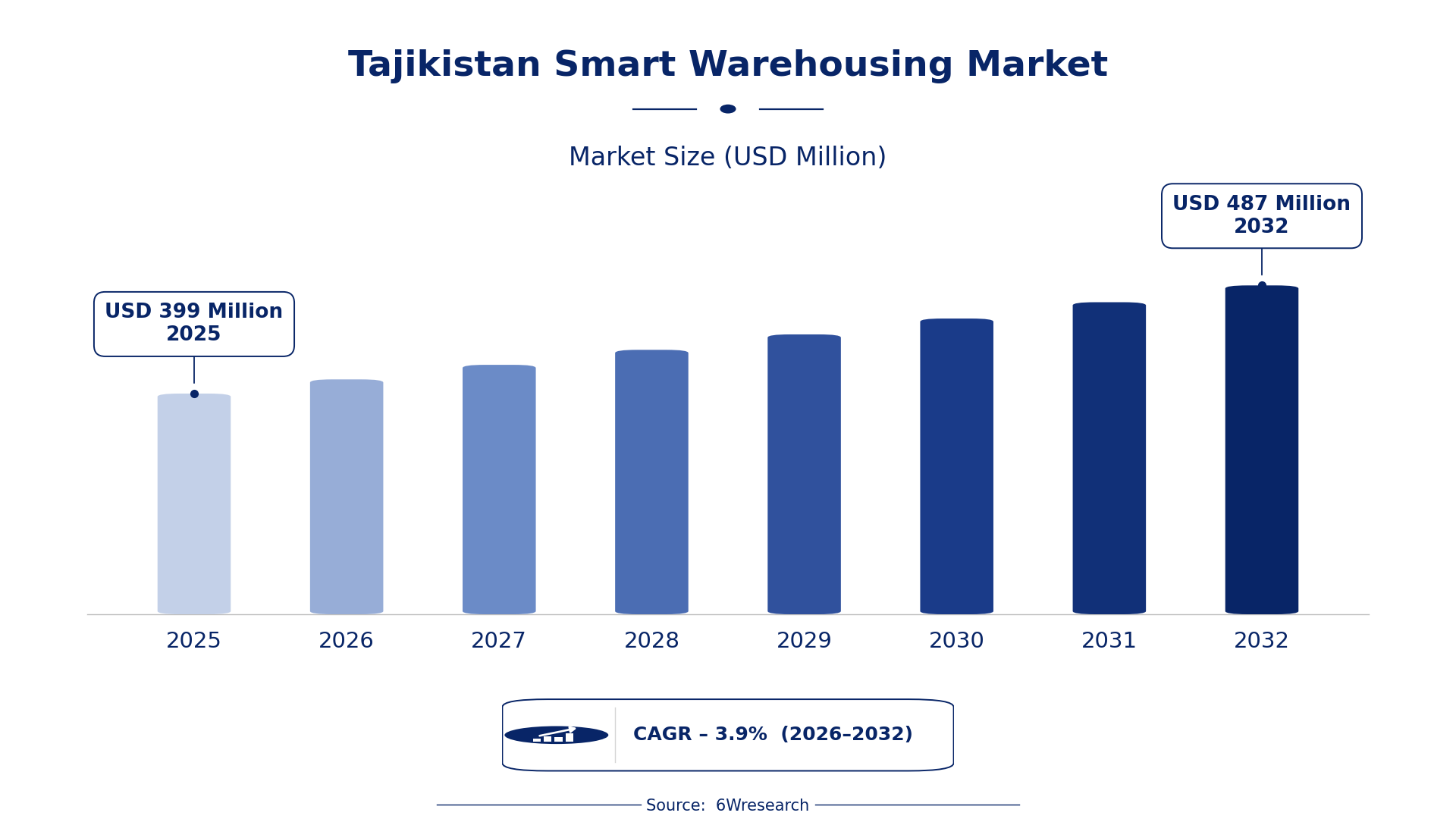
The Tajikistan Smart Warehousing Market was estimated at USD 399 Million in 2025 and is projected to reach USD 487 Million by 2032, growing at a CAGR of 3.9% from 2026 to 2032.
Tajikistan Smart Warehousing Market Synopsis
The Tajikistan Smart Warehousing Market is on a trajectory of growth, influenced by the increasing integration of technology within logistics and supply chain operations. While the market has recently gained momentum, the future holds even greater promise as businesses seek efficient solutions to manage rising demand, particularly from the booming e-commerce sector.
As smart technologies like IoT and automation become more prevalent, the market is adapting to meet evolving demands. With government initiatives aimed at modernizing warehousing infrastructure, Tajikistan is positioning itself to become a competitive player in the Central Asian logistics arena.
Tajikistan Smart Warehousing Market Year-wise Growth Rate and Key Drivers
This graph illustrates the annual growth rates of the Tajikistan Smart Warehousing Market from 2021 to 2032, highlighting a steady upward trajectory and projected expansion over the forecast period.
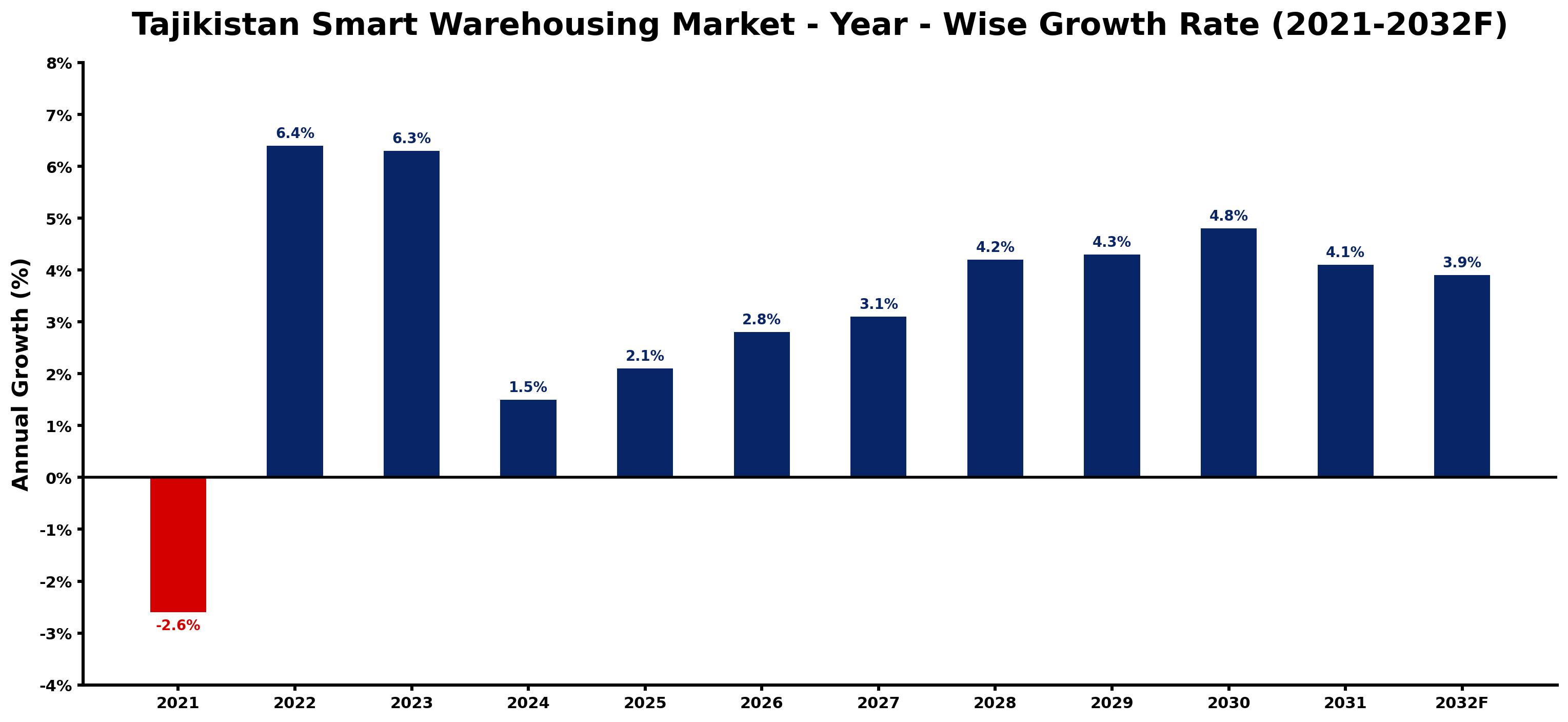
The table below presents the year‑wise growth rates along with the key drivers influencing the market
| Year | Growth Rate | Major Drivers |
| 2021 | -2.6% | Energy shortages disrupting warehouse operations nationwide. |
| 2022 | 6.4% | Government incentives for tech adoption in warehousing. |
| 2023 | 6.3% | Increased e-commerce activities boosting logistics efficiency needs. |
| 2024 | 1.5% | Local partnerships enhancing smart technology implementation. |
| 2025 | 2.1% | Rising urban population drives demand for efficient storage. |
| 2026 | 2.8% | Regulatory support for automation in supply chain processes. |
| 2027 | 3.1% | Investment in infrastructure facilitating smart warehousing growth. |
| 2028 | 4.2% | Focus on reduction of supply chain costs intensifies. |
| 2029 | 4.3% | Technological advancements improving inventory management systems. |
| 2030 | 4.8% | Changing consumer habits driving automation in storage solutions. |
| 2031 | 4.1% | Local startups innovating in warehouse management technology. |
| 2032 | 3.9% | Tajik government promoting digitization of logistics sector. |
Note: Market size estimations and growth projections presented in this report are based on 6Wresearch's proprietary forecasting methodology, utilizing the latest available industry data, government publications, and primary research inputs.
Tajikistan Smart Warehousing Market Key Takeaways
Below are some of the specific key takeaways from the market, including:
- Increasing automation is driving efficiency in warehousing operations.
- The e-commerce sector is a primary catalyst for smart warehousing adoption.
- Government initiatives are focused on enhancing logistics infrastructure.
- Technology integration, including IoT and data analytics, is becoming standard practice.
- Investment in skilled labor is essential for future growth and implementation.
Evaluation of Restraints in Tajikistan Smart Warehousing Market
Despite the positive outlook, the Tajikistan Smart Warehousing Market faces notable challenges that hinder its growth. Limited technological infrastructure remains a significant barrier, as many facilities lack the necessary equipment to implement advanced smart solutions. High initial investment costs can deter businesses from transitioning to smart warehousing, particularly small and medium enterprises that are essential for economic diversification.
on top of that, a shortage of skilled labor in smart warehousing technologies complicates the adoption process. Inconsistent power supply and underdeveloped telecommunications networks add layers of complexity, making it difficult for businesses to rely on tech-driven solutions consistently. Addressing these restraints is crucial for unlocking the market's full potential.
Tajikistan Smart Warehousing Market Trends
A marked trend toward automation and digitization is reshaping the Tajikistan Smart Warehousing Market. The adoption of technologies such as RFID and cloud-based management systems is gaining traction, facilitating real-time inventory tracking and streamlined processes. Businesses are increasingly recognizing the benefits of data-driven decision-making, leading to improved efficiency.
on top of that, the strategic location of Tajikistan along key trade routes is prompting logistics companies to invest in smarter warehousing solutions. As global supply chains become more interconnected, the demand for advanced warehousing capabilities will only continue to rise.
Tajikistan Smart Warehousing Market Opportunities
Opportunities abound for businesses entering the Tajikistan Smart Warehousing Market. The growing e-commerce sector presents a significant avenue for investment, as companies seek efficient solutions to manage increasing order volumes. Additionally, the government's commitment to improving infrastructure enhances prospects for logistics providers.
Fostering partnerships with local firms can facilitate market entry and provide insights into regional needs. Companies that focus on innovative and cost-effective solutions will find themselves well-positioned to cater to evolving demands.
Government Initiatives in the Tajikistan Smart Warehousing Market
The Tajikistan government is actively promoting the development of smart warehousing through a range of policies and initiatives. Emphasis on enhancing logistics infrastructure and implementing digital technologies is evident in government strategies. These initiatives aim to boost efficiency, attract private investments, and strengthen the overall supply chain.
- A national digital infrastructure upgrade programme now in its rollout phase is focused on improving connectivity and access to technology.
- Currently ongoing is a framework established in 2024 aimed at streamlining customs procedures to facilitate faster logistics operations.
- Recent efforts include tax incentives introduced in 2025 to encourage private sector investment in smart warehousing.
- A planned public-private initiative is expected to improve telecommunications infrastructure by 2027, enhancing data access for warehousing operations.
- Support programmes to train skilled labor in smart technologies are set to launch in 2026 to address workforce gaps.
Future Insights of the Tajikistan Smart Warehousing Market
Looking ahead to 2026-2032, the Tajikistan Smart Warehousing Market is expected to witness significant transformation driven by technological advancements and increasing demand for efficient logistics solutions. The integration of artificial intelligence and data analytics will further streamline operations and improve inventory management.
As the market adapts to global supply chain shifts, Tajikistan's strategic location will continue to attract investments in smart warehousing solutions. Businesses that capitalize on these trends will find ample opportunities to thrive in the coming years.
Tajikistan Smart Warehousing Market Latest Developments
Recent developments in the Tajikistan Smart Warehousing Market reflect a growing commitment to technology and efficiency. Over the last year, various initiatives have been undertaken to enhance warehouse operations and meet increasing demand.
- A major technology vendor launched a pilot project in early 2025 to implement IoT-based solutions in select warehouses, aiming for completion by late 2025.
- An initiative that began in mid-2025 focuses on upgrading existing warehouse management systems to cloud-based platforms, improving operational efficiency.
- In Q4 2025, a partnership between local logistics firms and tech providers was established to enhance automation capabilities across the sector.
- Upcoming in 2026 is a rollout of a national training programme aimed at equipping the workforce with skills in advanced warehousing technologies.
- A regulatory initiative expected to begin in early 2026 aims to standardize smart warehousing practices across the country.
Tajikistan Smart Warehousing Market - Key Attractiveness of the Report
- 10 Years of Market Numbers
- Historical Data Starting from 2022 to 2025
- Base Year: 2025
- Forecast Data until 2032
- Key Performance Indicators Impacting the Market
- Major Upcoming Developments and Projects
Key Highlights of the Report:
- Tajikistan Smart Warehousing Market Outlook
- Market Size of Tajikistan Smart Warehousing Market, 2025
- Forecast of Tajikistan Smart Warehousing Market, 2032
- Historical Data and Forecast of Tajikistan Smart Warehousing Revenues & Volume for the Period 2022-2032F
- Tajikistan Smart Warehousing Market Trend Evolution
- Tajikistan Smart Warehousing Market Drivers and Challenges
- Tajikistan Smart Warehousing Price Trends
- Tajikistan Smart Warehousing Porter's Five Forces
- Tajikistan Smart Warehousing Industry Life Cycle
- Historical Data and Forecast of Tajikistan Smart Warehousing Market Revenues & Volume By Component for the Period 2022-2032F
- Historical Data and Forecast of Tajikistan Smart Warehousing Market Revenues & Volume By Hardware for the Period 2022-2032F
- Historical Data and Forecast of Tajikistan Smart Warehousing Market Revenues & Volume By Solutions for the Period 2022-2032F
- Historical Data and Forecast of Tajikistan Smart Warehousing Market Revenues & Volume By Services for the Period 2022-2032F
- Historical Data and Forecast of Tajikistan Smart Warehousing Market Revenues & Volume By Application for the Period 2022-2032F
- Historical Data and Forecast of Tajikistan Smart Warehousing Market Revenues & Volume By Transport Management for the Period 2022-2032F
- Historical Data and Forecast of Tajikistan Smart Warehousing Market Revenues & Volume By Inventory Management for the Period 2022-2032F
- Historical Data and Forecast of Tajikistan Smart Warehousing Market Revenues & Volume By Order Management for the Period 2022-2032F
- Historical Data and Forecast of Tajikistan Smart Warehousing Market Revenues & Volume By Yard Management for the Period 2022-2032F
- Historical Data and Forecast of Tajikistan Smart Warehousing Market Revenues & Volume By Shipping Management for the Period 2022-2032F
- Historical Data and Forecast of Tajikistan Smart Warehousing Market Revenues & Volume By Labor Management for the Period 2022-2032F
- Historical Data and Forecast of Tajikistan Smart Warehousing Market Revenues & Volume By Other Applications for the Period 2022-2032F
- Historical Data and Forecast of Tajikistan Smart Warehousing Market Revenues & Volume By Technology for the Period 2022-2032F
- Historical Data and Forecast of Tajikistan Smart Warehousing Market Revenues & Volume By IoT and Analytics for the Period 2022-2032F
- Historical Data and Forecast of Tajikistan Smart Warehousing Market Revenues & Volume By AI in Warehouse for the Period 2022-2032F
- Historical Data and Forecast of Tajikistan Smart Warehousing Market Revenues & Volume By Automated Guided Vehicles (AGV) for the Period 2022-2032F
- Historical Data and Forecast of Tajikistan Smart Warehousing Market Revenues & Volume By RFID for the Period 2022-2032F
- Historical Data and Forecast of Tajikistan Smart Warehousing Market Revenues & Volume By Blockchain in Warehouse for the Period 2022-2032F
- Historical Data and Forecast of Tajikistan Smart Warehousing Market Revenues & Volume By Other Technologies for the Period 2022-2032F
- Historical Data and Forecast of Tajikistan Smart Warehousing Market Revenues & Volume By Vertical for the Period 2022-2032F
- Historical Data and Forecast of Tajikistan Smart Warehousing Market Revenues & Volume By Transportation and Logistics for the Period 2022-2032F
- Historical Data and Forecast of Tajikistan Smart Warehousing Market Revenues & Volume By Retail and eCommerce for the Period 2022-2032F
- Historical Data and Forecast of Tajikistan Smart Warehousing Market Revenues & Volume By Manufacturing for the Period 2022-2032F
- Historical Data and Forecast of Tajikistan Smart Warehousing Market Revenues & Volume By Healthcare and Life Sciences for the Period 2022-2032F
- Historical Data and Forecast of Tajikistan Smart Warehousing Market Revenues & Volume By Energy and Utilities for the Period 2022-2032F
- Historical Data and Forecast of Tajikistan Smart Warehousing Market Revenues & Volume By Automotive for the Period 2022-2032F
- Historical Data and Forecast of Tajikistan Smart Warehousing Market Revenues & Volume By Food and Beverages for the Period 2022-2032F
- Historical Data and Forecast of Tajikistan Smart Warehousing Market Revenues & Volume By Other Verticals for the Period 2022-2032F
- Historical Data and Forecast of Tajikistan Smart Warehousing Market Revenues & Volume By Deployment Mode for the Period 2022-2032F
- Historical Data and Forecast of Tajikistan Smart Warehousing Market Revenues & Volume By Cloud for the Period 2022-2032F
- Historical Data and Forecast of Tajikistan Smart Warehousing Market Revenues & Volume By On-premises for the Period 2022-2032F
- Historical Data and Forecast of Tajikistan Smart Warehousing Market Revenues & Volume By Organization Size for the Period 2022-2032F
- Historical Data and Forecast of Tajikistan Smart Warehousing Market Revenues & Volume By Large enterprises for the Period 2022-2032F
- Historical Data and Forecast of Tajikistan Smart Warehousing Market Revenues & Volume By Small and medium-sized enterprises (SMEs) for the Period 2022-2032F
- Tajikistan Smart Warehousing Import Export Trade Statistics
- Market Opportunity Assessment By Component
- Market Opportunity Assessment By Application
- Market Opportunity Assessment By Technology
- Market Opportunity Assessment By Vertical
- Market Opportunity Assessment By Deployment Mode
- Market Opportunity Assessment By Organization Size
- Tajikistan Smart Warehousing Top Companies Market Share
- Tajikistan Smart Warehousing Competitive Benchmarking By Technical and Operational Parameters
- Tajikistan Smart Warehousing Company Profiles
- Tajikistan Smart Warehousing Key Strategic Recommendations






































