Tajikistan Spinning Machinery Market Size, Share & Growth Rate
The Tajikistan Spinning Machinery Market was estimated at USD 166 Million in 2025 and is projected to reach USD 230 Million by 2032, growing at a CAGR of 4.8% from 2026 to 2032. This growth trajectory is being driven by the burgeoning textile industry within the country, which is increasingly catering to both domestic and international demands. Government policies aimed at enhancing local manufacturing capabilities and fostering foreign investment further reinforce this optimistic outlook.
Tajikistan Spinning Machinery Market Year-wise Growth Rate and Key Drivers
This graph highlights how the Tajikistan Spinning Machinery Market has steadily grown over the years, supported by major growth factors.
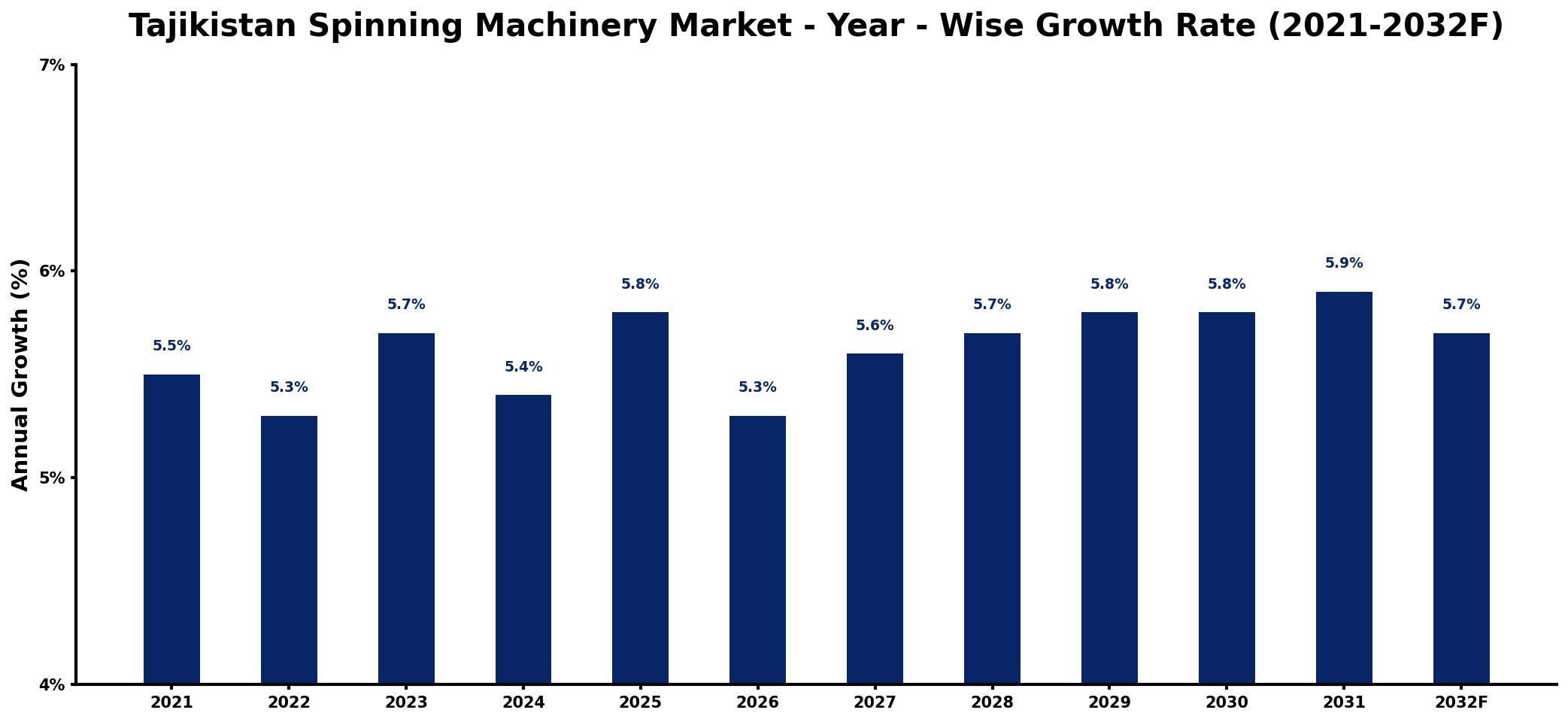
The table below presents the year‑wise growth rates along with the key drivers influencing the market
| Year | Growth Rate | Major Drivers |
| 2021 | 5.5% | Rising textile production capacity |
| 2022 | 5.3% | Increased investment in automation |
| 2023 | 5.7% | Growth in cotton processing industry |
| 2024 | 5.4% | Expansion of export markets |
| 2025 | 5.8% | Surge in sustainable practices adoption |
| 2026 | 5.3% | Boost in local manufacturing initiatives |
| 2027 | 5.6% | Growing demand for high-quality fibers |
| 2028 | 5.7% | Increase in government support programs |
| 2029 | 5.8% | Advancements in technology integration |
| 2030 | 5.8% | growing commercial sector adoption |
| 2031 | 5.9% | Rising consumer preference for textiles |
| 2032 | 5.7% | rising end-use demand growth |
Note: Market size estimations and growth projections presented in this report are based on 6Wresearch's proprietary forecasting methodology, utilizing the latest available industry data, government publications, and primary research inputs.
Tajikistan Spinning Machinery Market Synopsis
The demand for spinning machinery in Tajikistan is rapidly increasing due to the expansion of textile production, which has become a vital sector for the national economy. As local manufacturers strive to modernize their facilities, they are actively seeking advanced spinning technology to improve yarn quality and production efficiency.
Amidst this growing demand, the market is witnessing a blend of local and international entities, each contributing to a diverse range of machinery options. This competition is instrumental in driving innovation and enhancing the overall quality of spinning machinery available in Tajikistan.
Tajikistan Spinning Machinery Market Key Takeaways
- The market is projected to reach USD 230 Million by 2032, reflecting robust growth and investment opportunities.
- Technological advancements are shifting focus toward energy-efficient, high-productivity machines that are eco-friendly.
- Government initiatives play a crucial role in stimulating the local textile sector and attracting foreign investment.
- Investment in skilled labor and training programs is essential for maximizing operational efficiency in spinning operations.
- Digitalization and smart solutions are becoming increasingly important to optimize production processes in the market.
Evaluation of Restraints in Tajikistan Spinning Machinery Market
Despite the promising prospects of the Tajikistan Spinning Machinery Market, several factors pose significant challenges to its growth. One of the primary restraints is the limited access to advanced spinning technology, which hinders manufacturers from upgrading their production capabilities. Additionally, sourcing quality raw materials locally is problematic, leading to inflated production costs and diminished competitiveness in the global market.
Moreover, the shortage of skilled labor in operating modern machinery hampers operational efficiency. Inadequate infrastructure and logistical support further restrict the ability of manufacturers to expand and reach broader markets. Addressing these challenges requires concerted efforts to enhance training, invest in technology, and improve infrastructural conditions.
Tajikistan Spinning Machinery Market Trends
The landscape of the Tajikistan Spinning Machinery Market is evolving, with a marked trend towards adopting advanced technologies and automation solutions. Manufacturers are increasingly prioritizing machinery that not only boosts productivity but also integrates sustainable practices to minimize environmental impacts. Compact spinning technology is gaining traction due to its capacity to reduce fiber waste while improving yarn quality, aligning well with global sustainability goals.
Additionally, the digital transformation of the textile industry is taking hold, with smart spinning solutions designed to optimize manufacturing processes and enhance overall operational performance. These trends signify a shift towards innovation as textile producers seek to meet the evolving demands of both local and international markets.
Tajikistan Spinning Machinery Market Opportunities
Investment opportunities within the Tajikistan Spinning Machinery Market are abundant, particularly given the robust growth of the textile sector. The increasing demand for high-quality textiles creates a pressing need for modern spinning machinery, opening avenues for both domestic and international suppliers. Establishing partnerships to set up new spinning mills or upgrade existing facilities could yield substantial returns.
With the government actively promoting the textile industry and providing favorable conditions for foreign investment, the landscape for investment is more promising than ever. This environment allows investors to not only tap into the rising demand but also contribute to the industrial development of Tajikistan.
Government Initiatives in the Tajikistan Spinning Machinery Market
The Tajik government has recognized the significance of the spinning machinery market in fostering economic growth and has implemented several policies to support its development. Initiatives include offering incentives like tax breaks and subsidies aimed at boosting domestic production and attracting foreign investments. Moreover, there is a concerted effort to enhance the skill sets of the local workforce through partnerships with educational institutions and vocational training programs. These initiatives are designed to create a more competitive and sustainable textile industry in Tajikistan.
Future Insights of the Tajikistan Spinning Machinery Market
Looking ahead, the Tajikistan Spinning Machinery Market is poised for continuous growth from 2026 to 2032. As the textile industry expands, driven by both domestic needs and international exports, the demand for modern, efficient spinning machinery will intensify. Additionally, the anticipated advancements in technology, particularly in the realms of automation and digitalization, will likely enhance production capabilities significantly.
Government policies aimed at supporting the textile sector will further cement the foundations for a thriving spinning machinery market. Investors and manufacturers alike have reason to be optimistic as they navigate this evolving landscape, filled with opportunity and potential for innovation.
Tajikistan Spinning Machinery Market Latest Developments (2025 - 2026)
Recent developments in the Tajikistan Spinning Machinery Market have underscored a commitment to modernization and efficiency. Ongoing investments in new technologies and infrastructure improvements signal a robust effort to bolster the local textile manufacturing capacity. Additionally, there are ongoing initiatives focusing on enhancing the skill sets of workers to ensure they are equipped to operate advanced spinning machinery effectively. As these advancements unfold, they are expected to significantly contribute to the overall growth and competitiveness of the market.
Tajikistan Spinning Machinery Market - Key Attractiveness of the Report
- 10 Years of Market Numbers
- Historical Data Starting from 2022 to 2025
- Base Year: 2025
- Forecast Data until 2032
- Key Performance Indicators Impacting the Market
- Major Upcoming Developments and Projects
Key Highlights of the Report:
- Tajikistan Spinning Machinery Market Outlook
- Market Size of Tajikistan Spinning Machinery Market, 2025
- Forecast of Tajikistan Spinning Machinery Market, 2032
- Historical Data and Forecast of Tajikistan Spinning Machinery Revenues & Volume for the Period 2022-2032F
- Tajikistan Spinning Machinery Market Trend Evolution
- Tajikistan Spinning Machinery Market Drivers and Challenges
- Tajikistan Spinning Machinery Price Trends
- Tajikistan Spinning Machinery Porter's Five Forces
- Tajikistan Spinning Machinery Industry Life Cycle
- Historical Data and Forecast of Tajikistan Spinning Machinery Market Revenues & Volume By Type for the Period 2022-2032F
- Historical Data and Forecast of Tajikistan Spinning Machinery Market Revenues & Volume By Ring for the Period 2022-2032F
- Historical Data and Forecast of Tajikistan Spinning Machinery Market Revenues & Volume By Rotor Spinning for the Period 2022-2032F
- Historical Data and Forecast of Tajikistan Spinning Machinery Market Revenues & Volume By Material for the Period 2022-2032F
- Historical Data and Forecast of Tajikistan Spinning Machinery Market Revenues & Volume By Natural for the Period 2022-2032F
- Historical Data and Forecast of Tajikistan Spinning Machinery Market Revenues & Volume By Synthetic for the Period 2022-2032F
- Historical Data and Forecast of Tajikistan Spinning Machinery Market Revenues & Volume By Others for the Period 2022-2032F
- Historical Data and Forecast of Tajikistan Spinning Machinery Market Revenues & Volume By End-Use Industry for the Period 2022-2032F
- Historical Data and Forecast of Tajikistan Spinning Machinery Market Revenues & Volume By Clothing for the Period 2022-2032F
- Historical Data and Forecast of Tajikistan Spinning Machinery Market Revenues & Volume By Textile for the Period 2022-2032F
- Historical Data and Forecast of Tajikistan Spinning Machinery Market Revenues & Volume By Other Industry for the Period 2022-2032F
- Tajikistan Spinning Machinery Import Export Trade Statistics
- Market Opportunity Assessment By Type
- Market Opportunity Assessment By Material
- Market Opportunity Assessment By End-Use Industry
- Tajikistan Spinning Machinery Top Companies Market Share
- Tajikistan Spinning Machinery Competitive Benchmarking By Technical and Operational Parameters
- Tajikistan Spinning Machinery Company Profiles
- Tajikistan Spinning Machinery Key Strategic Recommendations






































