Tajikistan Sports Equipment Market Size, Share & Growth Rate
The Tajikistan Sports Equipment Market was estimated at USD 422 Million in 2025 and is projected to reach USD 579 Million by 2032, growing at a CAGR of 4.6% from 2026 to 2032. This upward trajectory is primarily driven by a burgeoning interest in fitness and sports among the Tajik population, coupled with increasing government support for sports infrastructure. As more citizens embrace healthier lifestyles, the demand for quality sports products continues to rise, reflecting a significant shift in consumer behavior.
Tajikistan Sports Equipment Market Year-wise Growth Rate and Key Drivers
This graph highlights how the Tajikistan Sports Equipment Market has steadily grown over the years, supported by major growth factors.
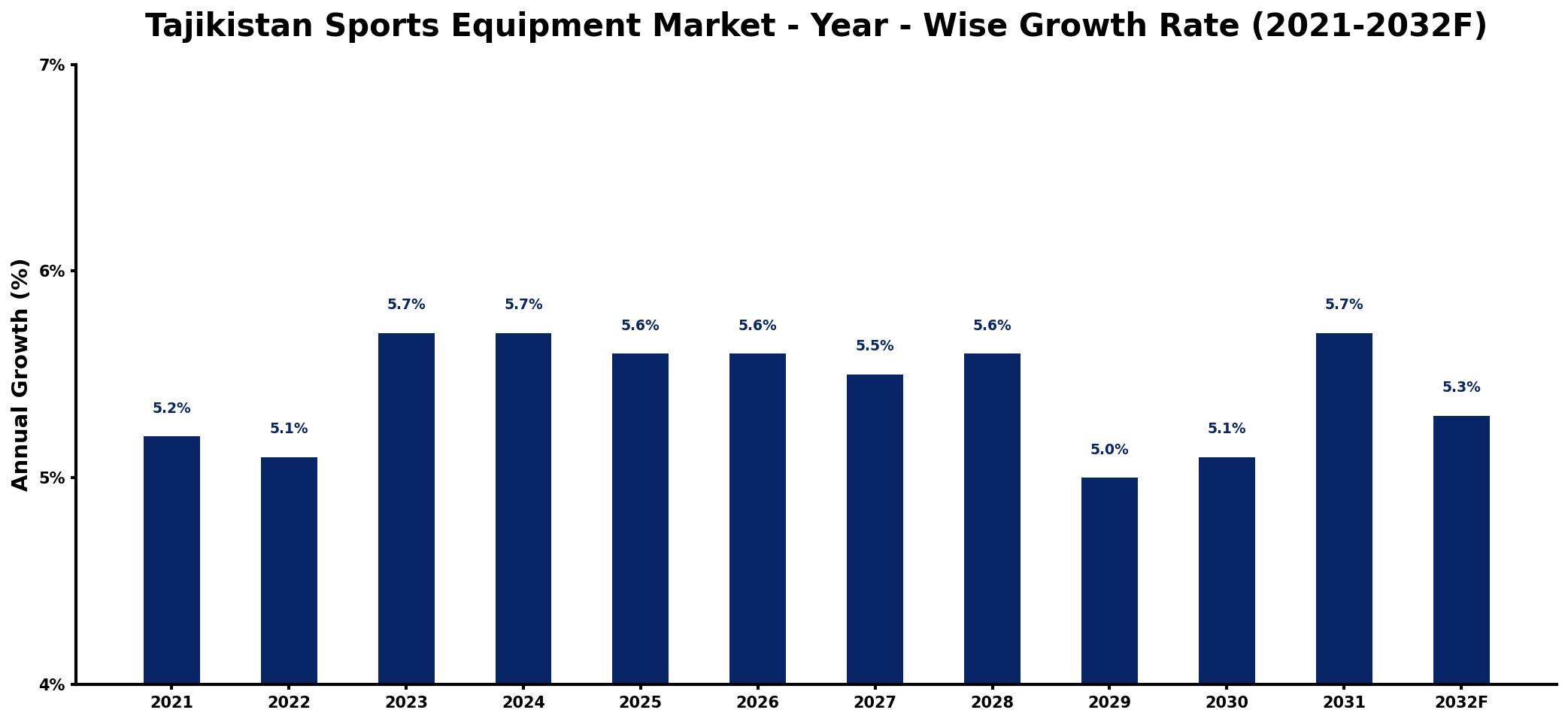
The table below presents the year‑wise growth rates along with the key drivers influencing the market
| Year | Growth Rate | Major Drivers |
| 2021 | 5.2% | Increased consumer fitness awareness |
| 2022 | 5.1% | Growing popularity of outdoor activities |
| 2023 | 5.7% | Rising government health initiatives |
| 2024 | 5.7% | Expansion of retail distribution channels |
| 2025 | 5.6% | expanding healthcare application demand |
| 2026 | 5.6% | expanding industrial usage applications |
| 2027 | 5.5% | Strengthened community fitness events |
| 2028 | 5.6% | Enhanced digital marketing strategies |
| 2029 | 5.0% | Diversification of product offerings |
| 2030 | 5.1% | Growth in online shopping platforms |
| 2031 | 5.7% | Boost in corporate wellness programs |
| 2032 | 5.3% | Increase in fitness influencer collaborations |
Note: Market size estimations and growth projections presented in this report are based on 6Wresearch's proprietary forecasting methodology, utilizing the latest available industry data, government publications, and primary research inputs.
Tajikistan Sports Equipment Market Synopsis
In recent years, the Tajikistan Sports Equipment Market has witnessed a commendable expansion, spurred by a growing enthusiasm for sports and wellness. However, as the market evolves, it is expected to navigate various challenges that could influence its momentum. The increasing accessibility of e-commerce platforms is set to further diversify the market, enabling consumers to explore a wider array of products at competitive prices.
Looking ahead, the market's potential is bolstered by rising health consciousness among consumers and a strong governmental push toward enhancing sports facilities. This dynamic environment not only offers a promising outlook for established players but also beckons new entrants eager to capture the evolving consumer sentiment. As the culture of sports deepens, the market is poised for sustained growth.
Tajikistan Sports Equipment Market Key Takeaways
- The market's growth is propelled by increasing health awareness and participation in various sports.
- Government initiatives aimed at improving sports infrastructure are creating favorable conditions for growth.
- E-commerce is rapidly becoming a preferred channel for purchasing sports equipment, expanding market reach.
- Consumers are prioritizing high-quality, durable products, indicating a shift in purchasing behavior.
- Investment opportunities abound for companies looking to offer affordable sports solutions tailored to local needs.
Evaluation of Restraints in Tajikistan Sports Equipment Market
Despite the promising outlook, several restraints hinder the growth of the Tajikistan Sports Equipment Market. Limited access to high-quality sports gear due to geographical constraints often leads to consumer reliance on subpar alternatives. The prevailing low purchasing power among the population poses a significant challenge, affecting the willingness to invest in quality sports equipment. Additionally, the prevalence of counterfeit products raises concerns about safety and performance, further complicating the consumer landscape. These factors emphasize the need for enhanced awareness regarding the importance of genuine sports equipment and better distribution strategies to reach underserved areas.
Tajikistan Sports Equipment Market Trends
Current trends in the Tajikistan Sports Equipment Market indicate a robust demand for fitness and outdoor gear, reflecting an active lifestyle shift among the population. The growing popularity of sports like football and basketball has led to a corresponding increase in equipment sales, while a surge in interest for hiking and outdoor activities is further driving the market. Concurrently, technology integration is becoming evident, with fitness trackers and smart wearables gaining traction among health-conscious consumers, thus altering the traditional sports equipment landscape.
Tajikistan Sports Equipment Market Opportunities
Investment opportunities within the Tajikistan Sports Equipment Market are ripe, particularly in the realm of quality and affordable offerings. As more consumers shift their focus toward health and fitness, introducing innovative products tailored to local preferences could yield substantial returns. Collaborations with local sports clubs and gyms provide an avenue for reaching new customers and fostering brand loyalty. Moreover, as awareness surrounding the importance of sports participation grows, the potential for expanded product ranges, including specialized gear for emerging sports, presents a significant market opening.
Government Initiatives in the Tajikistan Sports Equipment Market
The Tajik government has implemented various initiatives aimed at promoting sports participation and enhancing the overall sporting environment. Investments in sports infrastructure, including the development of stadiums and recreational facilities, underline a commitment to fostering a culture of health and wellness. Additionally, policies that offer tax incentives and support for local sports equipment manufacturers aim to stimulate market growth and encourage domestic production, ultimately benefiting consumers and businesses alike.
Future Insights of the Tajikistan Sports Equipment Market
The Tajikistan Sports Equipment Market is expected to experience a steady upward trend through 2032, buoyed by increasing health consciousness and government support for sports initiatives. As consumer preferences continue to evolve toward high-quality and durable products, manufacturers who prioritize innovation will likely gain a competitive edge. Additionally, as participation in competitive sports events rises, the demand for various sports equipment is anticipated to grow, positioning the market for robust growth in alignment with global fitness trends.
Tajikistan Sports Equipment Market Latest Developments (2025 - 2026)
Recent developments in the Tajikistan Sports Equipment Market indicate a shift towards greater consumer engagement through online platforms, reflecting the global trend in retail. Many retailers have begun to optimize their e-commerce strategies, enhancing user experience and expanding product availability. Moreover, collaborations between local fitness entities and international brands have emerged, promoting awareness and boosting interest in quality sports equipment. Such partnerships signify a positive move toward integrating international best practices with local market needs.
Tajikistan Sports Equipment Market - Key Attractiveness of the Report
- 10 Years of Market Numbers
- Historical Data Starting from 2022 to 2025
- Base Year: 2025
- Forecast Data until 2032
- Key Performance Indicators Impacting the Market
- Major Upcoming Developments and Projects
Key Highlights of the Report:
- Tajikistan Sports Equipment Market Outlook
- Market Size of Tajikistan Sports Equipment Market, 2025
- Forecast of Tajikistan Sports Equipment Market, 2032
- Historical Data and Forecast of Tajikistan Sports Equipment Revenues & Volume for the Period 2022-2032F
- Tajikistan Sports Equipment Market Trend Evolution
- Tajikistan Sports Equipment Market Drivers and Challenges
- Tajikistan Sports Equipment Price Trends
- Tajikistan Sports Equipment Porter's Five Forces
- Tajikistan Sports Equipment Industry Life Cycle
- Historical Data and Forecast of Tajikistan Sports Equipment Market Revenues & Volume By Product for the Period 2022-2032F
- Historical Data and Forecast of Tajikistan Sports Equipment Market Revenues & Volume By Ball over net games for the Period 2022-2032F
- Historical Data and Forecast of Tajikistan Sports Equipment Market Revenues & Volume By Ball games for the Period 2022-2032F
- Historical Data and Forecast of Tajikistan Sports Equipment Market Revenues & Volume By Fitness/Strength equipment for the Period 2022-2032F
- Historical Data and Forecast of Tajikistan Sports Equipment Market Revenues & Volume By Athletic training equipment for the Period 2022-2032F
- Historical Data and Forecast of Tajikistan Sports Equipment Market Revenues & Volume By Others for the Period 2022-2032F
- Historical Data and Forecast of Tajikistan Sports Equipment Market Revenues & Volume By Distribution Channel for the Period 2022-2032F
- Historical Data and Forecast of Tajikistan Sports Equipment Market Revenues & Volume By Online retail for the Period 2022-2032F
- Historical Data and Forecast of Tajikistan Sports Equipment Market Revenues & Volume By Specialty & sports shops for the Period 2022-2032F
- Historical Data and Forecast of Tajikistan Sports Equipment Market Revenues & Volume By Department & discount stores for the Period 2022-2032F
- Tajikistan Sports Equipment Import Export Trade Statistics
- Market Opportunity Assessment By Product
- Market Opportunity Assessment By Distribution Channel
- Tajikistan Sports Equipment Top Companies Market Share
- Tajikistan Sports Equipment Competitive Benchmarking By Technical and Operational Parameters
- Tajikistan Sports Equipment Company Profiles
- Tajikistan Sports Equipment Key Strategic Recommendations






































