Tajikistan Thermostats Market Summary
The tajikistan thermostats market was estimated at USD 205 Million in 2025 and is projected to reach USD 268 Million by 2032, growing at a CAGR of 4.3% from 2026 to 2032.
Tajikistan Thermostats Market Year-wise Growth Rate and Key Drivers
This graph highlights how the Tajikistan Thermostats Market has steadily grown over the past five years, supported by major growth factors.
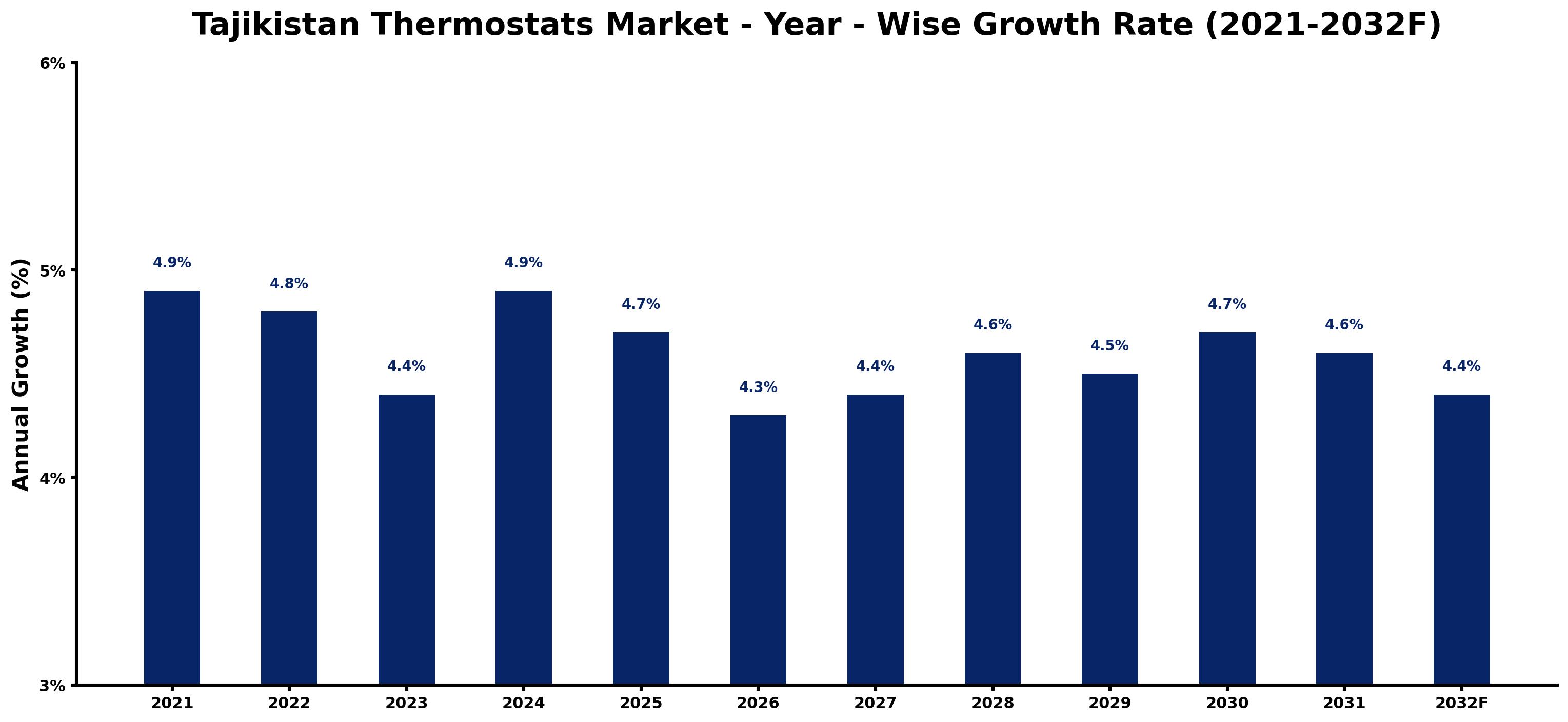
The table below presents the year wise growth rates along with the key drivers influencing the market
| Year | Growth Rate | Major Drivers |
| 2021 | 4.9% | Market efforts focus on enhancing energy efficiency in residential heating solutions. |
| 2022 | 4.8% | Awareness campaigns about smart home technologies encourage consumer interest in thermostats. |
| 2023 | 4.4% | Local manufacturers begin producing thermostats tailored to the regional climate conditions. |
| 2024 | 4.9% | Urbanization trends drive the construction of new housing requiring advanced climate control. |
| 2025 | 4.7% | Increasing electricity consumption prompts households to seek intelligent energy management systems. |
| 2026 | 4.3% | Partnerships between tech firms and local installers enhance service reliability for consumers. |
| 2027 | 4.4% | Real estate developments prioritize energy-efficient technologies, influencing thermostat product designs. |
| 2028 | 4.6% | Environmental considerations push consumers toward sustainable heating and cooling solutions. |
| 2029 | 4.5% | Rural electrification projects expand, creating new market segments for thermostatic devices. |
| 2030 | 4.7% | Emerging middle-class households demand greater comfort and automation in home environments. |
| 2031 | 4.6% | Integration of IoT devices into homes increases thermostat connectivity and functionality. |
| 2032 | 4.4% | Competitive pricing strategies among manufacturers stimulate wider consumer adoption of thermostats. |
Note - Market size estimations and growth projections presented in this report are based on 6Wresearch's advanced forecasting approach, validated with industry datasets as of June 2026.
Tajikistan Thermostats Market Synopsis
The Tajikistan Thermostats Market is projected to reach 4.3% and witness significant growth during the forecast period (2026-2032). This market is currently experiencing a notable upward trajectory driven by heightened awareness regarding energy efficiency and a rapidly expanding construction sector. The Tajikistan government's emphasis on modernizing infrastructure and fostering sustainable practices is leading to an increased demand for thermostats across residential, commercial, and industrial segments. Although the market is predominantly fueled by imported brands due to limited local manufacturing capabilities, there exists substantial potential for domestic production to satisfy burgeoning demand.
Tajikistan Thermostats Market Growth Drivers
Several key factors are propelling growth in the Tajikistan Thermostats Market. First and foremost, the increasing focus on energy efficiency has made advanced heating and cooling solutions indispensable for both consumers and businesses alike. Additionally, the ongoing urbanization and infrastructure development projects provide a fertile ground for thermostat adoption. As households and businesses increasingly opt for smart technologies, smart thermostats are gaining traction due to their remote control capabilities and energy-saving features.
- The government's commitment to modernizing infrastructure is creating a favorable environment for the adoption of energy-efficient technologies, including thermostats.
- Rising disposable incomes among consumers are enabling more households to invest in advanced thermostat solutions that enhance energy management.
- The growing trend of smart home technologies is influencing consumer preferences towards programmable and smart thermostats with user-friendly interfaces.
- Increased public awareness regarding environmental concerns is motivating both residential and commercial sectors to seek energy-saving solutions.
- Partnerships between local distributors and international brands are facilitating the penetration of innovative thermostat technologies in the market.
Tajikistan Thermostats Market Trends and Opportunities
The Tajikistan Thermostats Market is increasingly gravitating towards smart thermostats that not only provide energy efficiency but also offer remote operational capabilities. A notable trend within the market is the growing consumer interest in thermostats that can reduce energy consumption and lower monthly utility bills. As more consumers become aware of environmental issues, the shift towards programmable thermostats that enable customized heating schedules continues to gain momentum.
- Smart thermostats are becoming prevalent, offering advanced features such as mobile application control and compatibility with various smart home devices.
- There is a significant rise in demand for programmable thermostats, allowing users to optimize their heating and cooling schedules effectively.
- The focus on sustainability is driving the development and adoption of eco-friendly thermostat options that harness renewable energy sources.
- As the construction sector expands, the integration of energy-efficient technologies within new projects presents further growth opportunities.
- Educational initiatives aimed at informing consumers about the benefits of energy-efficient solutions are becoming vital for market expansion.
Tajikistan Thermostats Market Challenges and Restraints
Despite the promising outlook, the Tajikistan Thermostats Market faces several challenges that may impede its growth. Limited consumer awareness surrounding energy-efficient technologies hinders widespread adoption. Furthermore, the absence of standardized regulations for thermostat installation poses obstacles to the growth of the market. In certain regions, traditional heating methods are still preferred, which can delay the transition towards modern solutions.
- The market's reliance on imports can lead to supply chain disruptions and price volatility, impacting availability and affordability.
- Low disposable income levels among some segments of the population can affect the overall demand for advanced thermostat solutions.
- The relatively small size of the market makes it difficult for local manufacturers to achieve economies of scale, potentially affecting pricing strategies.
- The established preference for traditional heating solutions in certain areas poses a barrier to market penetration for new technologies.
- Targeted marketing efforts and consumer education are essential to address the challenges related to limited awareness and adoption.
Tajikistan Thermostats Market Government Investment and Initiatives
Currently, the Tajikistan government does not have targeted policies or regulations explicitly aimed at the thermostats market. However, the country is actively working to enhance energy efficiency and promote sustainable development through various initiatives. These initiatives are anticipated to indirectly influence the demand for energy-efficient thermostats. The government's broader focus on increasing the utilization of renewable energy sources presents a potential avenue for growth in smart thermostats and other energy-saving technologies in the future. Overall, while specific regulations for the thermostats market are lacking, ongoing government efforts aimed at sustainability could create favorable conditions for energy-efficient heating and cooling solutions.
Tajikistan Thermostats Market Latest Developments (May 2025 - June 2026)
Recent developments in the Tajikistan Thermostats Market indicate a concentrated push towards smarter and more energy-efficient heating and cooling solutions. As urbanization progresses, an increasing number of construction projects are incorporating advanced thermostat technologies. Awareness campaigns have gained momentum, emphasizing the importance of energy conservation. Additionally, collaborations between local HVAC companies and international distributors are fostering the availability of innovative products in the market. The period has also seen greater engagement from consumers regarding energy management, with a noticeable uptick in interest for programmable and smart thermostats that offer convenience and efficiency.
Tajikistan Thermostats Market - Key Attractiveness of the Report
- 10 Years of Market Numbers
- Historical Data Starting from 2022 to 2025
- Base Year: 2025
- Forecast Data until 2032
- Key Performance Indicators Impacting the Market
- Major Upcoming Developments and Projects
Key Highlights of the Report:
- Tajikistan Thermostats Market Outlook
- Market Size of Tajikistan Thermostats Market, 2025
- Forecast of Tajikistan Thermostats Market, 2032F
- Historical Data and Forecast of Tajikistan Thermostats Revenues & Volume for the Period 2022-2032F
- Tajikistan Thermostats Market Trend Evolution
- Tajikistan Thermostats Market Drivers and Challenges
- Tajikistan Thermostats Price Trends
- Tajikistan Thermostats Porter's Five Forces
- Tajikistan Thermostats Industry Life Cycle
- Historical Data and Forecast of Tajikistan Thermostats Market Revenues & Volume By Products for the Period 2022-2032F
- Historical Data and Forecast of Tajikistan Thermostats Market Revenues & Volume By Smart Thermostat for the Period 2022-2032F
- Historical Data and Forecast of Tajikistan Thermostats Market Revenues & Volume By Mechanical Thermostat for the Period 2022-2032F
- Historical Data and Forecast of Tajikistan Thermostats Market Revenues & Volume By Programmable Thermostat for the Period 2022-2032F
- Historical Data and Forecast of Tajikistan Thermostats Market Revenues & Volume By Distribution Channel for the Period 2022-2032F
- Historical Data and Forecast of Tajikistan Thermostats Market Revenues & Volume By Utility for the Period 2022-2032F
- Historical Data and Forecast of Tajikistan Thermostats Market Revenues & Volume By Retail for the Period 2022-2032F
- Historical Data and Forecast of Tajikistan Thermostats Market Revenues & Volume By Security for the Period 2022-2032F
- Historical Data and Forecast of Tajikistan Thermostats Market Revenues & Volume By HVAC for the Period 2022-2032F
- Historical Data and Forecast of Tajikistan Thermostats Market Revenues & Volume By Mode of Operations for the Period 2022-2032F
- Historical Data and Forecast of Tajikistan Thermostats Market Revenues & Volume By Line Voltage for the Period 2022-2032F
- Historical Data and Forecast of Tajikistan Thermostats Market Revenues & Volume By Low Voltage for the Period 2022-2032F
- Historical Data and Forecast of Tajikistan Thermostats Market Revenues & Volume By Millivolt for the Period 2022-2032F
- Historical Data and Forecast of Tajikistan Thermostats Market Revenues & Volume By Applications for the Period 2022-2032F
- Historical Data and Forecast of Tajikistan Thermostats Market Revenues & Volume By Residential for the Period 2022-2032F
- Historical Data and Forecast of Tajikistan Thermostats Market Revenues & Volume By Commercial for the Period 2022-2032F
- Tajikistan Thermostats Import Export Trade Statistics
- Market Opportunity Assessment By Products
- Market Opportunity Assessment By Distribution Channel
- Market Opportunity Assessment By Mode of Operations
- Market Opportunity Assessment By Applications
- Tajikistan Thermostats Top Companies Market Share
- Tajikistan Thermostats Competitive Benchmarking By Technical and Operational Parameters
- Tajikistan Thermostats Company Profiles
- Tajikistan Thermostats Key Strategic Recommendations






































