Tajikistan Tire Machinery Market Size, Share & Growth Rate
The Tajikistan Tire Machinery Market was estimated at USD 431 Million in 2025 and is projected to reach USD 574 Million by 2032, growing at a CAGR of 4.2% from 2026 to 2032. This growth trajectory is fueled by the robust expansion of the automotive sector, leading to an increased demand for tires across both commercial and passenger vehicle segments. Furthermore, as the local manufacturers enhance their production capabilities, the need for advanced tire manufacturing machinery becomes increasingly critical.
Tajikistan Tire Machinery Market Year-wise Growth Rate and Key Drivers
This graph highlights how the Tajikistan Tire Machinery Market has steadily grown over the years, supported by major growth factors.
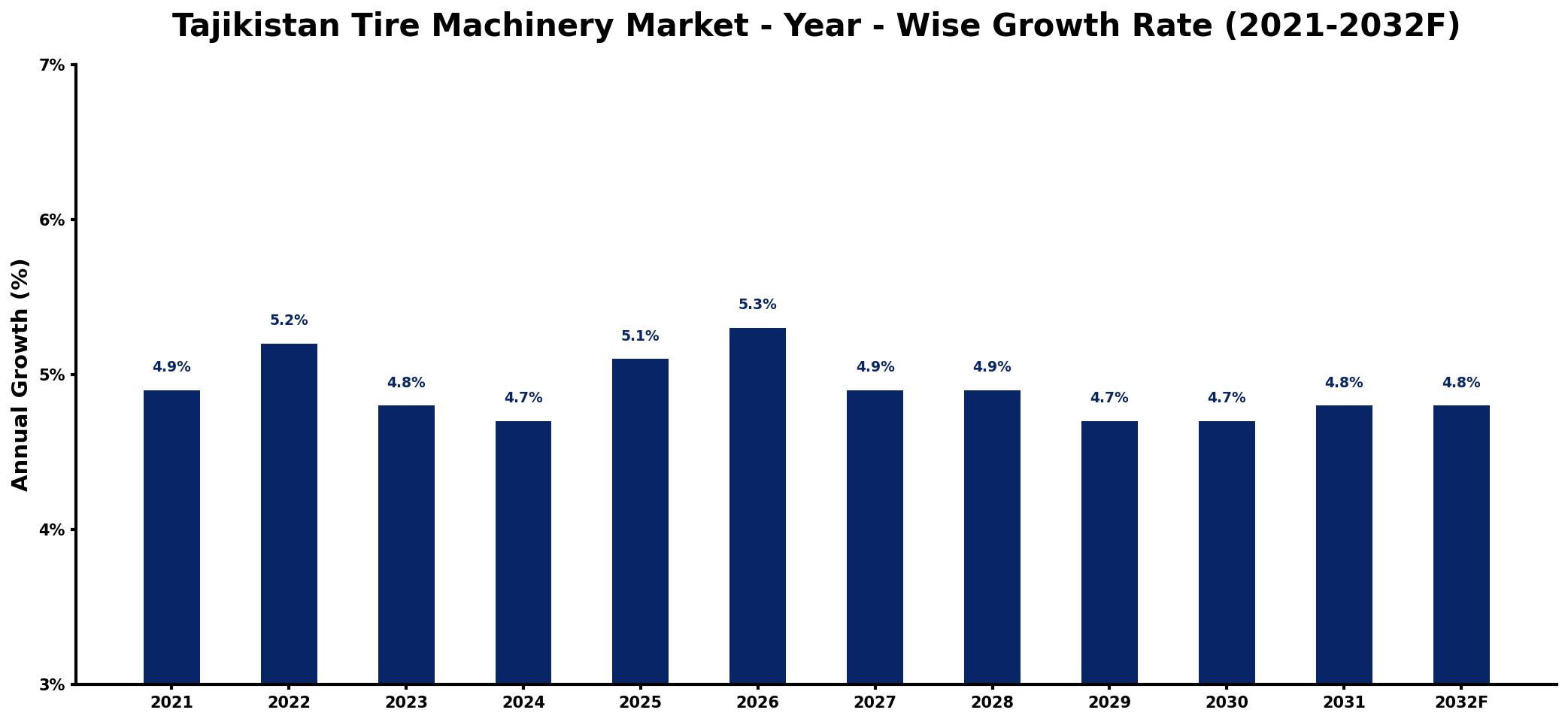
The table below presents the year‑wise growth rates along with the key drivers influencing the market
| Year | Growth Rate | Major Drivers |
| 2021 | 4.9% | Rising automotive production rates |
| 2022 | 5.2% | Increased infrastructure development projects |
| 2023 | 4.8% | Growing demand for logistics services |
| 2024 | 4.7% | Expansion of transportation networks |
| 2025 | 5.1% | Boost in regional trade activities |
| 2026 | 5.3% | Higher investments in manufacturing sectors |
| 2027 | 4.9% | Emergence of electric vehicle segment |
| 2028 | 4.9% | Improvement in export opportunities |
| 2029 | 4.7% | Strengthening domestic supply chains |
| 2030 | 4.7% | Advancements in recycling technologies |
| 2031 | 4.8% | Surge in consumer spending habits |
| 2032 | 4.8% | Growth in aftermarket services demand |
Note: Market size estimations and growth projections presented in this report are based on 6Wresearch's proprietary forecasting methodology, utilizing the latest available industry data, government publications, and primary research inputs.
Tajikistan Tire Machinery Market Synopsis
Currently, the Tajikistan tire machinery market is on an upward trend, driven by a burgeoning automotive industry and rising tire demand. Investments in domestic tire manufacturing are becoming more pronounced, as local firms look to meet both local and regional market needs.
Technological innovations, particularly in automation and digitalization, are reshaping the market landscape. These advancements not only enhance production efficiency but also significantly improve the quality of the final products, aligning with global industry standards.
Tajikistan Tire Machinery Market Key Takeaways
- The market is witnessing substantial growth due to increasing demand for tires from the automotive sector.
- Technological advancements, particularly in automation, are critical in enhancing manufacturing efficiency.
- Government initiatives focus on promoting domestic production to reduce reliance on imports.
- Sustainability and eco-friendly practices are becoming increasingly integrated into tire manufacturing processes.
- Investment opportunities exist in supplying modern machinery and establishing local production facilities.
Evaluation of Restraints in Tajikistan Tire Machinery Market
Despite its promising outlook, the Tajikistan tire machinery market faces notable constraints. Limited access to advanced technologies hampers the ability of local manufacturers to innovate and upgrade their operations. Infrastructure deficiencies further complicate the distribution and manufacturing processes, leading to higher operational costs. Additionally, the high costs associated with importing necessary machinery can be a significant barrier to growth. The labor market also presents challenges, as there is a pronounced lack of skilled technicians capable of operating modern tire machinery, which could hinder the industrys development.
Tajikistan Tire Machinery Market Trends
The market is observing several key trends that are shaping its future direction. The increasing adoption of automated machinery is streamlining production lines and enhancing overall efficiency. Additionally, manufacturers are increasingly prioritizing sustainability, integrating eco-friendly materials and practices into their operations. This trend is not only a response to global demands but also a proactive approach to meet regulatory standards. Moreover, there is a growing focus on research and development, with investments directed towards innovative machinery solutions that align with the evolving needs of the tire industry.
Tajikistan Tire Machinery Market Opportunities
Investment opportunities in the Tajikistan tire machinery market are becoming increasingly viable. With the automotive industry expanding, there is a demand for state-of-the-art tire manufacturing equipment and technologies. Potential investors can leverage this growth by supplying modern machinery that improves production efficiency and quality. Furthermore, the establishment of partnerships or joint ventures to set up tire production facilities within Tajikistan presents an attractive opportunity, catering to both domestic needs and export possibilities.
Government Initiatives in the Tajikistan Tire Machinery Market
The Tajik government is actively promoting the development of the tire machinery sector through various initiatives aimed at bolstering local manufacturing. Policies are in place to reduce import reliance, including tariffs and trade restrictions designed to protect domestic producers. Additionally, the government offers incentives such as tax breaks and subsidies to encourage investments in this sector. By emphasizing quality standards and regulatory compliance, these initiatives aim to enhance the competitiveness of Tajikistans tire machinery industry in the global market.
Future Insights of the Tajikistan Tire Machinery Market
Looking ahead to the period between 2026 and 2032, the Tajikistan Tire Machinery Market is poised for significant growth. The anticipated increase in demand for tires will correlate with ongoing infrastructure development, which is expected to further stimulate market expansion. Technological advancements will continue to play a crucial role in enhancing production capabilities, while government initiatives are likely to foster a more robust manufacturing environment. However, attention must be paid to external economic factors and fluctuating raw material prices that could impact growth trajectories.
Tajikistan Tire Machinery Market Latest Developments (2025 - 2026)
Recent trends in the tire machinery market reveal a growing focus on adopting high-efficiency manufacturing processes. Initiatives aimed at enhancing local production capabilities are being implemented, aligning with government efforts to stimulate the industrial sector. Additionally, partnerships between domestic manufacturers and foreign technology providers are emerging, aimed at leveraging advanced machinery and expertise to improve product offerings in the region.
Tajikistan Tire Machinery Market - Key Attractiveness of the Report
- 10 Years of Market Numbers
- Historical Data Starting from 2022 to 2025
- Base Year: 2025
- Forecast Data until 2032
- Key Performance Indicators Impacting the Market
- Major Upcoming Developments and Projects
Key Highlights of the Report:
- Tajikistan Tire Machinery Market Outlook
- Market Size of Tajikistan Tire Machinery Market, 2025
- Forecast of Tajikistan Tire Machinery Market, 2032
- Historical Data and Forecast of Tajikistan Tire Machinery Revenues & Volume for the Period 2022-2032F
- Tajikistan Tire Machinery Market Trend Evolution
- Tajikistan Tire Machinery Market Drivers and Challenges
- Tajikistan Tire Machinery Price Trends
- Tajikistan Tire Machinery Porter's Five Forces
- Tajikistan Tire Machinery Industry Life Cycle
- Historical Data and Forecast of Tajikistan Tire Machinery Market Revenues & Volume By Type for the Period 2022-2032F
- Historical Data and Forecast of Tajikistan Tire Machinery Market Revenues & Volume By Mixing Machine/ Rubber Mixers for the Period 2022-2032F
- Historical Data and Forecast of Tajikistan Tire Machinery Market Revenues & Volume By Calendaring Machine for the Period 2022-2032F
- Historical Data and Forecast of Tajikistan Tire Machinery Market Revenues & Volume By Extrusion Machines for the Period 2022-2032F
- Historical Data and Forecast of Tajikistan Tire Machinery Market Revenues & Volume By Multi Extrusion Lines for the Period 2022-2032F
- Historical Data and Forecast of Tajikistan Tire Machinery Market Revenues & Volume By Inner Liner Lines for the Period 2022-2032F
- Historical Data and Forecast of Tajikistan Tire Machinery Market Revenues & Volume By Extruders for the Period 2022-2032F
- Historical Data and Forecast of Tajikistan Tire Machinery Market Revenues & Volume By Cooling Units for the Period 2022-2032F
- Historical Data and Forecast of Tajikistan Mixing Machine/ Rubber Mixers Tire Machinery Market Revenues & Volume By Cutting Machines for the Period 2022-2032F
- Historical Data and Forecast of Tajikistan Tire Machinery Market Revenues & Volume By Tire Type for the Period 2022-2032F
- Historical Data and Forecast of Tajikistan Tire Machinery Market Revenues & Volume By Radial Tire for the Period 2022-2032F
- Historical Data and Forecast of Tajikistan Tire Machinery Market Revenues & Volume By Bias Tire for the Period 2022-2032F
- Historical Data and Forecast of Tajikistan Tire Machinery Market Revenues & Volume By Application for the Period 2022-2032F
- Historical Data and Forecast of Tajikistan Tire Machinery Market Revenues & Volume By Two-wheeler tires for the Period 2022-2032F
- Historical Data and Forecast of Tajikistan Tire Machinery Market Revenues & Volume By Passenger Vehicle Tires for the Period 2022-2032F
- Historical Data and Forecast of Tajikistan Tire Machinery Market Revenues & Volume By Hatchback for the Period 2022-2032F
- Historical Data and Forecast of Tajikistan Tire Machinery Market Revenues & Volume By Sedan for the Period 2022-2032F
- Historical Data and Forecast of Tajikistan Tire Machinery Market Revenues & Volume By Utility Vehicles for the Period 2022-2032F
- Historical Data and Forecast of Tajikistan Tire Machinery Market Revenues & Volume By Light Commercial Vehicle Tires for the Period 2022-2032F
- Historical Data and Forecast of Tajikistan Tire Machinery Market Revenues & Volume By Medium & Heavy Commercial Vehicle Tires for the Period 2022-2032F
- Historical Data and Forecast of Tajikistan Tire Machinery Market Revenues & Volume By Off-road Vehicle Tires for the Period 2022-2032F
- Tajikistan Tire Machinery Import Export Trade Statistics
- Market Opportunity Assessment By Type
- Market Opportunity Assessment By Tire Type
- Market Opportunity Assessment By Application
- Tajikistan Tire Machinery Top Companies Market Share
- Tajikistan Tire Machinery Competitive Benchmarking By Technical and Operational Parameters
- Tajikistan Tire Machinery Company Profiles
- Tajikistan Tire Machinery Key Strategic Recommendations






































