Tajikistan Toys and Games Market Size, Share & Growth Rate
The Tajikistan Toys and Games Market was estimated at USD 345 Million in 2025 and is projected to reach USD 476 Million by 2032, growing at a CAGR of 4.7% from 2026 to 2032. This upward trajectory is fueled by rising disposable incomes, increased urbanization, and a youthful population eager for diverse play experiences. The dual demand for both traditional toys and innovative electronic games further underscores the potential for growth in this vibrant market.
Tajikistan Toys and Games Market Year-wise Growth Rate and Key Drivers
This graph highlights how the Tajikistan Toys and Games Market has steadily grown over the years, supported by major growth factors.
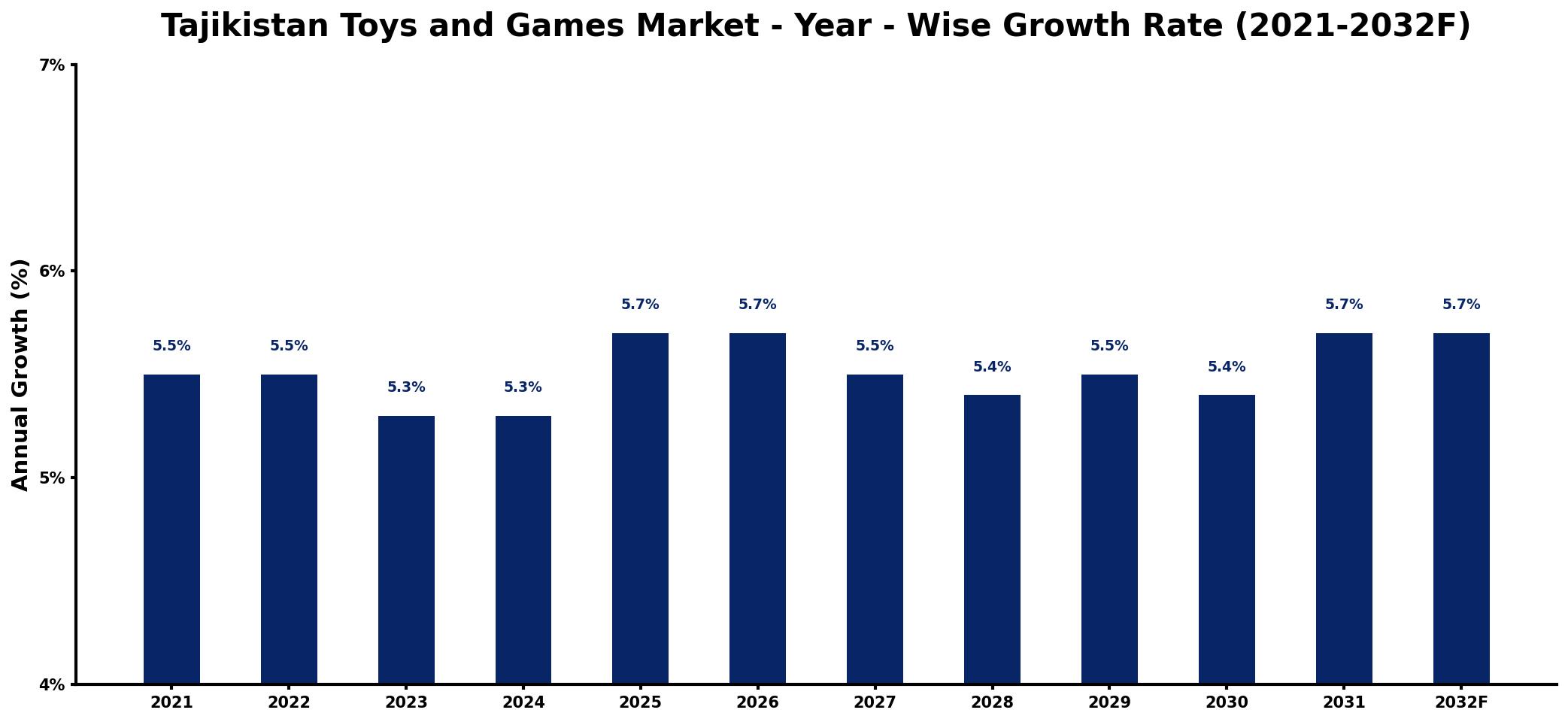
The table below presents the year‑wise growth rates along with the key drivers influencing the market
| Year | Growth Rate | Major Drivers |
| 2021 | 5.5% | Increased consumer spending on leisure |
| 2022 | 5.5% | Rising disposable income among families |
| 2023 | 5.3% | Expansion of retail distribution networks |
| 2024 | 5.3% | Growing popularity of educational products |
| 2025 | 5.7% | Increased investment in local manufacturing |
| 2026 | 5.7% | Surge in online shopping platforms |
| 2027 | 5.5% | Enhanced marketing strategies for youth |
| 2028 | 5.4% | Diversification of product offerings available |
| 2029 | 5.5% | growing regional consumption patterns |
| 2030 | 5.4% | Rising interest in sustainable options |
| 2031 | 5.7% | Emergence of innovative product designs |
| 2032 | 5.7% | Strengthened partnerships with global suppliers |
Note: Market size estimations and growth projections presented in this report are based on 6Wresearch's proprietary forecasting methodology, utilizing the latest available industry data, government publications, and primary research inputs.
Tajikistan Toys and Games Market Synopsis
Recently, the Tajikistan Toys and Games Market has seen a consistent upward momentum, driven by changing consumer preferences and an expanding middle class. Looking ahead, the market is poised for further transformation, with a growing emphasis on educational and interactive products that foster child development.
While traditional toys such as dolls and board games maintain their popularity, there is a noticeable shift towards digital and STEM-focused options. This evolution reflects the demands of modern parenting, aiming to provide children with both entertainment and developmental benefits.
Tajikistan Toys and Games Market Key Takeaways
- The market is projected to grow steadily, with a focus on educational and STEM-based products.
- Online sales channels are emerging as key players, providing access to a broader array of products.
- International brands are increasingly entering the market, enhancing product diversity.
- Consumer safety regulations remain a priority, ensuring the availability of quality toys for children.
- Investment opportunities abound in local manufacturing and e-commerce platforms.
Evaluation of Restraints in Tajikistan Toys and Games Market
Despite its growth prospects, the Tajikistan Toys and Games Market faces several restraints that may limit its potential. One significant challenge is the limited purchasing power among consumers in certain regions, which can restrict the demand for higher-priced products. Moreover, the inadequate distribution networks and infrastructure, particularly in remote areas, create barriers for reaching potential customers. The dependence on imports, due to a lack of local manufacturing facilities, also leaves the market vulnerable to supply chain disruptions and fluctuating costs. Tailoring products to align with cultural preferences is essential for success in this diverse consumer landscape.
Tajikistan Toys and Games Market Trends
In recent years, there has been a noticeable trend towards educational and interactive toys in the Tajikistan market. Parents increasingly prioritize products that contribute to their childrens cognitive development, leading to a surge in demand for STEM-oriented toys. Additionally, licensed merchandise based on popular media continues to captivate children's interest, maintaining a strong segment within the market.
E-commerce platforms are emerging as a crucial component of the retail landscape, making it easier for consumers to access a wider variety of toys and games. Concurrently, the global shift towards sustainability is influencing local market preferences, with eco-friendly toys gaining traction among environmentally conscious consumers.
Tajikistan Toys and Games Market Opportunities
The evolving dynamics of the Tajikistan Toys and Games Market present substantial investment opportunities. With a rapidly growing middle-class population, there is increasing demand for both educational and traditional toys. Establishing local manufacturing facilities could reduce reliance on imports and enhance product availability. The rise of e-commerce offers an exciting avenue for brands looking to reach consumers directly, providing a convenient shopping experience. Furthermore, partnerships with local retailers or educational institutions could open new pathways for bulk sales, enhancing market penetration.
Government Initiatives in the Tajikistan Toys and Games Market
Government policies in Tajikistan focus primarily on consumer safety and protection, particularly concerning toys and games. Regulatory measures ensure that imported products comply with safety standards, safeguarding children from potential hazards. There are also initiatives aimed at promoting local toy manufacturing, with incentives designed to support domestic producers. These efforts help foster a competitive market environment while enhancing consumer trust in the available products.
Future Insights of the Tajikistan Toys and Games Market
The future of the Tajikistan Toys and Games Market looks promising, with robust growth expected from 2026 to 2032. Factors such as a significant youth demographic, increasing disposable incomes, and a clear shift towards digital and interactive toys will play a crucial role in shaping this market. As parents prioritize educational and STEM-focused products, manufacturers that align with these preferences will likely flourish. The rise of online retail is set to enhance consumer access and broaden market reach, providing a fertile ground for innovative brands to thrive.
Tajikistan Toys and Games Market Latest Developments (2025 - 2026)
Recent developments in the Tajikistan Toys and Games Market have highlighted a growing interest in sustainability, with more manufacturers exploring eco-friendly materials for their products. Additionally, there has been a noticeable increase in collaborations between toy brands and educational institutions, aiming to promote learning through play. This shift reflects broader trends in consumer preferences towards products that support child development while remaining entertaining.
Tajikistan Toys and Games Market - Key Attractiveness of the Report
- 10 Years of Market Numbers
- Historical Data Starting from 2022 to 2025
- Base Year: 2025
- Forecast Data until 2032
- Key Performance Indicators Impacting the Market
- Major Upcoming Developments and Projects
Key Highlights of the Report:
- Tajikistan ToysandGames Market Outlook
- Market Size of Tajikistan ToysandGames Market, 2025
- Forecast of Tajikistan ToysandGames Market, 2032
- Historical Data and Forecast of Tajikistan ToysandGames Revenues & Volume for the Period 2022-2032F
- Tajikistan ToysandGames Market Trend Evolution
- Tajikistan ToysandGames Market Drivers and Challenges
- Tajikistan ToysandGames Price Trends
- Tajikistan ToysandGames Porter's Five Forces
- Tajikistan ToysandGames Industry Life Cycle
- Historical Data and Forecast of Tajikistan ToysandGames Market Revenues & Volume By Product Type for the Period 2022-2032F
- Historical Data and Forecast of Tajikistan ToysandGames Market Revenues & Volume By Games and Puzzles for the Period 2022-2032F
- Historical Data and Forecast of Tajikistan ToysandGames Market Revenues & Volume By Video Games for the Period 2022-2032F
- Historical Data and Forecast of Tajikistan ToysandGames Market Revenues & Volume By Construction Toys for the Period 2022-2032F
- Historical Data and Forecast of Tajikistan ToysandGames Market Revenues & Volume By Dolls and Accessories for the Period 2022-2032F
- Historical Data and Forecast of Tajikistan ToysandGames Market Revenues & Volume By Outdoor and Sports Toys for the Period 2022-2032F
- Historical Data and Forecast of Tajikistan ToysandGames Market Revenues & Volume By Other for the Period 2022-2032F
- Historical Data and Forecast of Tajikistan ToysandGames Market Revenues & Volume By Distribution Channel for the Period 2022-2032F
- Historical Data and Forecast of Tajikistan ToysandGames Market Revenues & Volume By Online Channel for the Period 2022-2032F
- Historical Data and Forecast of Tajikistan ToysandGames Market Revenues & Volume By Offline Channel for the Period 2022-2032F
- Tajikistan ToysandGames Import Export Trade Statistics
- Market Opportunity Assessment By Product Type
- Market Opportunity Assessment By Distribution Channel
- Tajikistan ToysandGames Top Companies Market Share
- Tajikistan ToysandGames Competitive Benchmarking By Technical and Operational Parameters
- Tajikistan ToysandGames Company Profiles
- Tajikistan ToysandGames Key Strategic Recommendations






































