Tajikistan Washable Markers Market Size, Share & Growth Rate
The Tajikistan Washable Markers Market was estimated at USD 908 Million in 2025 and is projected to reach USD 1308 Million by 2032, growing at a CAGR of 5.4% from 2026 to 2032. This upward trajectory is largely fueled by the increasing utilization of washable markers in educational settings and households, where safety and ease of cleanup are paramount. Furthermore, the rising trend of arts and crafts among children, combined with heightened consumer awareness regarding non-toxic materials, continues to propel the market forward.
Tajikistan Washable Markers Market Year-wise Growth Rate and Key Drivers
This graph highlights how the Tajikistan Washable Markers Market has steadily grown over the years, supported by major growth factors.
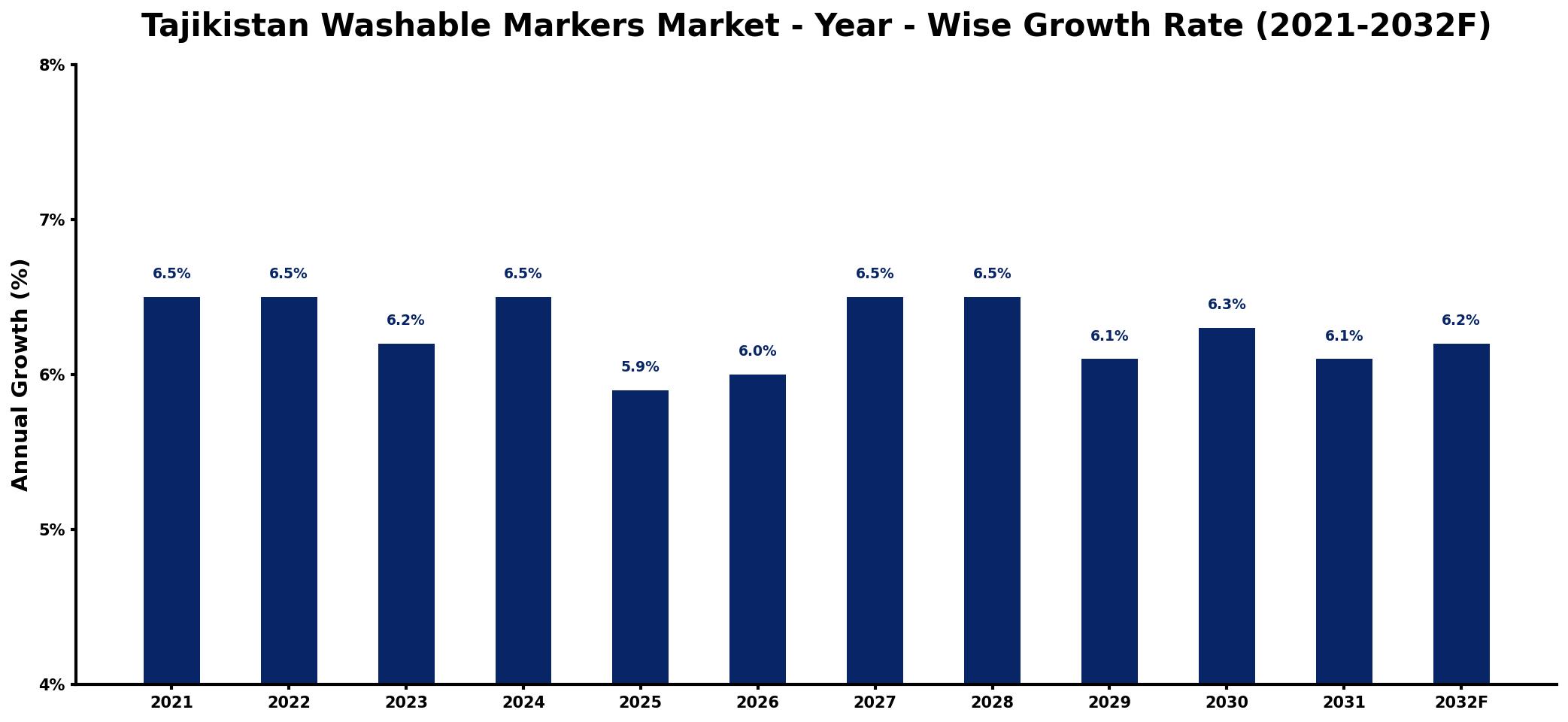
The table below presents the year‑wise growth rates along with the key drivers influencing the market
| Year | Growth Rate | Major Drivers |
| 2021 | 6.5% | Increased educational sector investments |
| 2022 | 6.5% | Rising demand for creative supplies |
| 2023 | 6.2% | Growing popularity in art therapy |
| 2024 | 6.5% | Expansion of local manufacturing capabilities |
| 2025 | 5.9% | Emerging trends in DIY projects |
| 2026 | 6.0% | Surge in online retail platforms |
| 2027 | 6.5% | Enhanced distribution network efficiency |
| 2028 | 6.5% | Increased collaborations with schools |
| 2029 | 6.1% | Rising interest in eco-friendly products |
| 2030 | 6.3% | growing downstream application demand |
| 2031 | 6.1% | Increased participation in art events |
| 2032 | 6.2% | enhanced product quality standards |
Note: Market size estimations and growth projections presented in this report are based on 6Wresearch's proprietary forecasting methodology, utilizing the latest available industry data, government publications, and primary research inputs.
Tajikistan Washable Markers Market Synopsis
In recent years, the Tajikistan Washable Markers Market has experienced a surge in demand, driven predominantly by educational institutions emphasizing creative arts. As more parents seek safe and clean alternatives for their children, the market is well-positioned for continued growth. Moving forward, however, the challenge will be meeting consumer expectations for quality and sustainability.
Looking ahead, the market is evolving with a stronger focus on eco-friendly products. As the awareness surrounding health and environmental issues grows, consumers in Tajikistan are leaning towards non-toxic and biodegradable options, which are likely to become key differentiators in the competitive landscape.
Tajikistan Washable Markers Market Key Takeaways
- The market is projected to grow from USD 908 Million in 2025 to USD 1308 Million by 2032.
- Increased emphasis on arts and crafts in education is driving demand.
- There is a rising consumer preference for non-toxic and eco-friendly markers.
- Quality and innovative designs are becoming essential to attract consumers.
- Competition from traditional markers and counterfeit products remains a concern.
Evaluation of Restraints in Tajikistan Washable Markers Market
Despite the promising outlook, the Tajikistan Washable Markers Market faces significant barriers. One major restraint is the limited consumer awareness regarding the advantages of washable markers compared to their traditional counterparts. Many consumers remain unaware of the benefits these markers provide, which could hinder potential growth. Additionally, the market's potential is constrained by limited manufacturing capabilities and distribution networks, affecting the availability and affordability of high-quality products. Fluctuating economic conditions also pose challenges, particularly regarding purchasing power among consumers.
Tajikistan Washable Markers Market Trends
The current trend in the Tajikistan Washable Markers Market is clearly leaning towards eco-friendliness. As consumers seek safer options for children, water-based, non-permanent markers are gaining traction. Furthermore, vibrant color offerings and long-lasting ink options are increasingly popular, catering to the needs of both educational purposes and artistic expression. Brands are also prioritizing innovative packaging and marketing strategies to enhance consumer engagement and loyalty.
Tajikistan Washable Markers Market Opportunities
The growth trajectory of the Tajikistan Washable Markers Market presents substantial investment opportunities. As the need for quality and safe art supplies rises, introducing innovative products that prioritize eco-friendliness could be a game changer. Collaborations with educational institutions can help manufacturers establish credibility and expand market reach. Additionally, tapping into e-commerce and online sales channels can facilitate greater accessibility for consumers, amplifying market penetration and brand recognition.
Government Initiatives in the Tajikistan Washable Markers Market
The government of Tajikistan has implemented a series of policies aimed at enhancing product safety and regulating market competition within the Washable Markers Market. The State Committee for Investment and State Property Management oversees the enforcement of quality standards and consumer protection laws, ensuring that both manufacturers and importers comply with essential safety regulations. By promoting domestic production through tariffs on foreign imports, the government is fostering a favorable environment for local businesses to thrive.
Future Insights of the Tajikistan Washable Markers Market
Looking towards the future, the Tajikistan Washable Markers Market is expected to continue on its growth path, bolstered by increasing disposable incomes and a rising appetite for quality stationery products. The growing trend of home-based learning and creative activities will further drive demand. As consumers increasingly prioritize product safety and durability, innovations such as dual-tip markers and eco-friendly formulations are likely to gain popularity, offering exciting avenues for market players to explore.
Tajikistan Washable Markers Market Latest Developments (2025 - 2026)
Recent developments in the Tajikistan Washable Markers Market reflect a heightened focus on sustainability and product innovation. Companies are increasingly adopting eco-friendly materials and production processes, responding to the growing consumer demand for safe art supplies. Marketing campaigns are also becoming more targeted, emphasizing the unique benefits of washable markers. Additionally, collaborations with educational institutions are being leveraged to enhance brand visibility and consumer trust.
Tajikistan Washable Markers Market - Key Attractiveness of the Report
- 10 Years of Market Numbers
- Historical Data Starting from 2022 to 2025
- Base Year: 2025
- Forecast Data until 2032
- Key Performance Indicators Impacting the Market
- Major Upcoming Developments and Projects
Key Highlights of the Report:
- Tajikistan Washable Markers Market Outlook
- Market Size of Tajikistan Washable Markers Market, 2025
- Forecast of Tajikistan Washable Markers Market, 2032
- Historical Data and Forecast of Tajikistan Washable Markers Revenues & Volume for the Period 2022-2032F
- Tajikistan Washable Markers Market Trend Evolution
- Tajikistan Washable Markers Market Drivers and Challenges
- Tajikistan Washable Markers Price Trends
- Tajikistan Washable Markers Porter's Five Forces
- Tajikistan Washable Markers Industry Life Cycle
- Historical Data and Forecast of Tajikistan Washable Markers Market Revenues & Volume By Washability for the Period 2022-2032F
- Historical Data and Forecast of Tajikistan Washable Markers Market Revenues & Volume By Basic- Washable for the Period 2022-2032F
- Historical Data and Forecast of Tajikistan Washable Markers Market Revenues & Volume By Super-washable for the Period 2022-2032F
- Historical Data and Forecast of Tajikistan Washable Markers Market Revenues & Volume By End User for the Period 2022-2032F
- Historical Data and Forecast of Tajikistan Washable Markers Market Revenues & Volume By Children for the Period 2022-2032F
- Historical Data and Forecast of Tajikistan Washable Markers Market Revenues & Volume By Professionals for the Period 2022-2032F
- Tajikistan Washable Markers Import Export Trade Statistics
- Market Opportunity Assessment By Washability
- Market Opportunity Assessment By End User
- Tajikistan Washable Markers Top Companies Market Share
- Tajikistan Washable Markers Competitive Benchmarking By Technical and Operational Parameters
- Tajikistan Washable Markers Company Profiles
- Tajikistan Washable Markers Key Strategic Recommendations






































