Tajikistan Watch Straps Market Size, Share & Growth Rate
The Tajikistan Watch Straps Market was estimated at USD 329 Million in 2025 and is projected to reach USD 479 Million by 2032, growing at a CAGR of 5.5% from 2026 to 2032. This growth is propelled by a rising consumer inclination towards personalized accessories and a burgeoning online shopping culture, facilitating greater accessibility to diverse strap options. Additionally, the increasing interest in fashion trends, spurred by social media influences, plays a significant role in shaping demand within the market.
Tajikistan Watch Straps Market Year-wise Growth Rate and Key Drivers
This graph highlights how the Tajikistan Watch Straps Market has steadily grown over the years, supported by major growth factors.
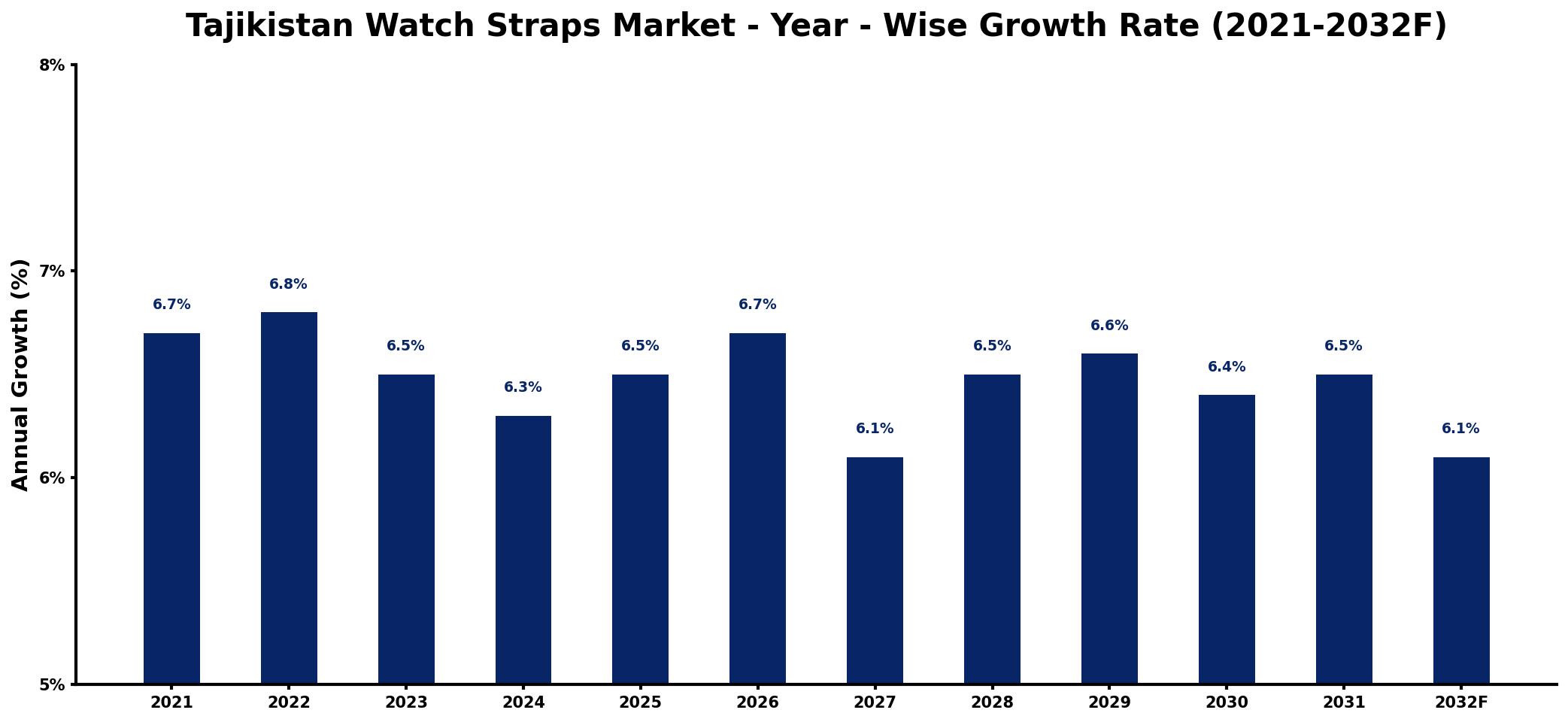
The table below presents the year‑wise growth rates along with the key drivers influencing the market
| Year | Growth Rate | Major Drivers |
| 2021 | 6.7% | Rising consumer fashion preferences |
| 2022 | 6.8% | Increased disposable income spending |
| 2023 | 6.5% | Growing online retail penetration |
| 2024 | 6.3% | Expansion of domestic manufacturing |
| 2025 | 6.5% | Surge in youth market engagement |
| 2026 | 6.7% | Enhanced product customization options |
| 2027 | 6.1% | Shift towards sustainable materials |
| 2028 | 6.5% | Growing popularity of fitness tracking |
| 2029 | 6.6% | growing automotive sector requirements |
| 2030 | 6.4% | Increased brand collaborations emerging |
| 2031 | 6.5% | Higher demand for luxury accessories |
| 2032 | 6.1% | Continued innovation in designs |
Note: Market size estimations and growth projections presented in this report are based on 6Wresearch's proprietary forecasting methodology, utilizing the latest available industry data, government publications, and primary research inputs.
Tajikistan Watch Straps Market Synopsis
Currently, the Tajikistan Watch Straps Market reflects a vibrant landscape, characterized by a strong consumer interest in customization. A wide array of materials and designs, particularly leather and stainless steel, cater to diverse aesthetic preferences and emphasize quality and durability.
The market is witnessing notable momentum fueled by the expanding e-commerce sector, which grants consumers access to a broader range of products. As fashion awareness increases among the population, the drive for unique and fashionable watch straps continues to be a pivotal force in market evolution.
Tajikistan Watch Straps Market Key Takeaways
- Customization and personalization are major driving factors in the Tajikistan Watch Straps Market.
- Online shopping is significantly increasing consumer access to diverse watch strap options.
- Eco-friendly materials are gaining traction among consumers seeking sustainable choices.
- Quality craftsmanship and durability are key factors influencing consumer purchase decisions.
- Social media is shaping fashion trends, impacting consumer preferences in watch straps.
Evaluation of Restraints in Tajikistan Watch Straps Market
Despite its promising growth trajectory, the Tajikistan Watch Straps Market faces several hurdles. One significant restraint is the limited access to high-quality raw materials, which often necessitates reliance on imports, thus increasing costs for manufacturers. This challenge is compounded by competition from less expensive alternatives, including synthetic straps that may appeal to budget-conscious consumers. Additionally, there is a relatively low demand for premium watch straps, which could hinder the potential for market expansion. Logistical issues, including transportation constraints, further exacerbate these challenges, making timely delivery a persistent concern in the market.
Tajikistan Watch Straps Market Trends
Emerging trends in the Tajikistan Watch Straps Market indicate a shift towards customizable and interchangeable options. Consumers are increasingly interested in the ability to adapt their watch straps to match different styles and occasions. Moreover, there is a growing inclination towards sustainable materials, with vegan leather, recycled nylon, and natural fibers becoming popular choices among environmentally conscious buyers. Alongside this, minimalist and classic designs are maintaining their stronghold as preferred options, placing an emphasis on quality and durability.
Tajikistan Watch Straps Market Opportunities
The Tajikistan Watch Straps Market presents several lucrative investment opportunities. As consumer interest in fashion accessories grows, there is an increasing demand for high-quality and stylish watch straps. Investors can leverage this trend by diversifying their product offerings across various materials, including leather, stainless steel, and silicone. E-commerce platforms are also ripe for development, providing a convenient purchasing avenue for consumers and allowing businesses to expand their reach. By understanding local preferences and market dynamics, investors can strategically position themselves to capitalize on the expanding demand for innovative watch straps.
Government Initiatives in the Tajikistan Watch Straps Market
Government policies affecting the Tajikistan Watch Straps Market primarily revolve around trade regulations and import/export policies. While there are no specific regulations targeting watch straps, general trade policies—including customs duties, taxes, and quality standards—impact imported products. The government promotes a conducive business environment by maintaining transparent trade practices, ensuring fair competition, and enforcing regulations that protect consumer interests. These efforts aim to foster market growth and sustainability within the industry.
Future Insights of the Tajikistan Watch Straps Market
Looking ahead to the period between 2026 and 2032, the Tajikistan Watch Straps Market is poised for substantial growth. Factors driving this optimism include rising disposable incomes and an evolving retail landscape that is increasingly attentive to fashion accessories. Consumers are expected to continue gravitating towards unique, high-quality watch straps that reflect personal style. Moreover, as e-commerce continues to gain traction, it will likely play a vital role in enhancing consumer accessibility and purchase convenience. Overall, the market appears well-positioned to adapt and thrive in the coming years.
Tajikistan Watch Straps Market Latest Developments (2025 - 2026)
In recent months, the Tajikistan Watch Straps Market has seen a burgeoning interest in innovative designs and sustainable materials. Retailers are increasingly incorporating eco-friendly options into their inventories, responding to the growing consumer demand for sustainable fashion. E-commerce platforms have also expanded their offerings, making a wider variety of watch straps available online. This shift indicates a broader trend towards convenience in consumer purchasing habits, likely further enhancing market dynamics.
Tajikistan Watch Straps Market - Key Attractiveness of the Report
- 10 Years of Market Numbers
- Historical Data Starting from 2022 to 2025
- Base Year: 2025
- Forecast Data until 2032
- Key Performance Indicators Impacting the Market
- Major Upcoming Developments and Projects
Key Highlights of the Report:
- Tajikistan Watch Straps Market Outlook
- Market Size of Tajikistan Watch Straps Market, 2025
- Forecast of Tajikistan Watch Straps Market, 2032
- Historical Data and Forecast of Tajikistan Watch Straps Revenues & Volume for the Period 2022-2032F
- Tajikistan Watch Straps Market Trend Evolution
- Tajikistan Watch Straps Market Drivers and Challenges
- Tajikistan Watch Straps Price Trends
- Tajikistan Watch Straps Porter's Five Forces
- Tajikistan Watch Straps Industry Life Cycle
- Historical Data and Forecast of Tajikistan Watch Straps Market Revenues & Volume By Product Type for the Period 2022-2032F
- Historical Data and Forecast of Tajikistan Watch Straps Market Revenues & Volume By Type for the Period 2022-2032F
- Historical Data and Forecast of Tajikistan Watch Straps Market Revenues & Volume By Ceramic for the Period 2022-2032F
- Historical Data and Forecast of Tajikistan Watch Straps Market Revenues & Volume By Fabric for the Period 2022-2032F
- Historical Data and Forecast of Tajikistan Watch Straps Market Revenues & Volume By Leather for the Period 2022-2032F
- Historical Data and Forecast of Tajikistan Watch Straps Market Revenues & Volume By Metal for the Period 2022-2032F
- Historical Data and Forecast of Tajikistan Watch Straps Market Revenues & Volume By Plastic for the Period 2022-2032F
- Historical Data and Forecast of Tajikistan Watch Straps Market Revenues & Volume By Rubber for the Period 2022-2032F
- Historical Data and Forecast of Tajikistan Watch Straps Market Revenues & Volume By Distribution Channel Outlook (Revenue, USD Million, 2023 - 2032) for the Period 2022-2032F
- Historical Data and Forecast of Tajikistan Watch Straps Market Revenues & Volume By Online for the Period 2022-2032F
- Historical Data and Forecast of Tajikistan Watch Straps Market Revenues & Volume By Offline for the Period 2022-2032F
- Historical Data and Forecast of Tajikistan Watch Straps Market Revenues & Volume By Application for the Period 2022-2032F
- Historical Data and Forecast of Tajikistan Watch Straps Market Revenues & Volume By Women for the Period 2022-2032F
- Historical Data and Forecast of Tajikistan Watch Straps Market Revenues & Volume By Men for the Period 2022-2032F
- Tajikistan Watch Straps Import Export Trade Statistics
- Market Opportunity Assessment By Product Type
- Market Opportunity Assessment By Distribution Channel Outlook (Revenue, USD Million, 2023 - 2032)
- Market Opportunity Assessment By Application
- Tajikistan Watch Straps Top Companies Market Share
- Tajikistan Watch Straps Competitive Benchmarking By Technical and Operational Parameters
- Tajikistan Watch Straps Company Profiles
- Tajikistan Watch Straps Key Strategic Recommendations






































