Tajikistan Water Desalination Equipment Market Size, Share & Growth Rate
The Tajikistan Water Desalination Equipment Market was estimated at USD 450 Million in 2025 and is projected to reach USD 630 Million by 2032, growing at a CAGR of 4.9% from 2026 to 2032. This growth trajectory is largely driven by the escalating issues of water scarcity in the region, prompting both governmental and industrial stakeholders to seek sustainable water solutions. Additionally, as awareness regarding water conservation increases, the push for advanced desalination technology becomes even more pronounced, reflecting the country's commitment to enhancing water resource management.
Tajikistan Water Desalination Equipment Market Year-wise Growth Rate and Key Drivers
This graph highlights how the Tajikistan Water Desalination Equipment Market has steadily grown over the years, supported by major growth factors.
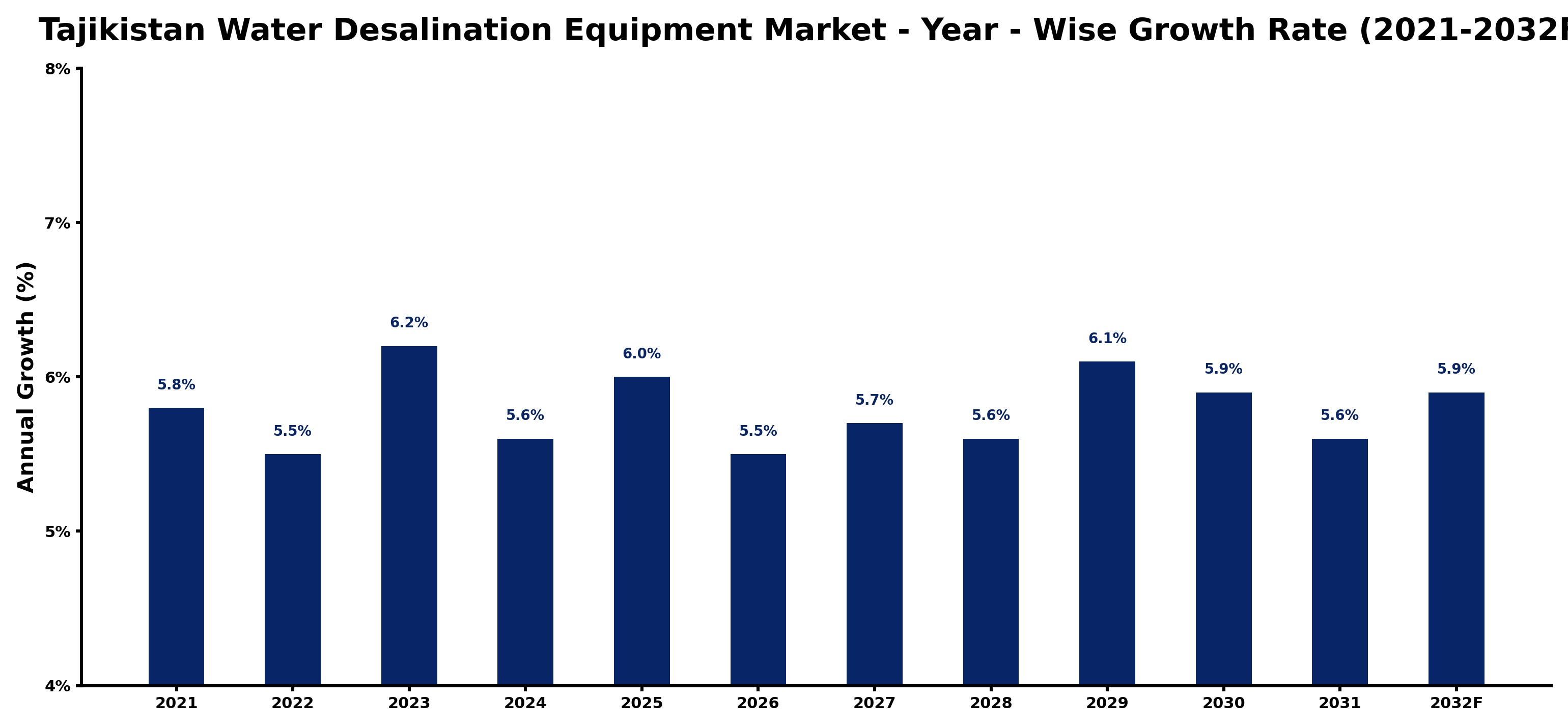
The table below presents the year‑wise growth rates along with the key drivers influencing the market
| Year | Growth Rate | Major Drivers |
| 2021 | 5.8% | Increasing smart city development projects |
| 2022 | 5.5% | Rising electricity demand across industries |
| 2023 | 6.2% | Increasing industrial automation investments |
| 2024 | 5.6% | Growing renewable energy integration projects |
| 2025 | 6.0% | Increasing adoption of advanced technologies |
| 2026 | 5.5% | Growing renewable energy integration projects |
| 2027 | 5.7% | Increasing smart city development projects |
| 2028 | 5.6% | Expansion of transportation and logistics networks |
| 2029 | 6.1% | Rising electricity demand across industries |
| 2030 | 5.9% | Growing renewable energy integration projects |
| 2031 | 5.6% | Increasing industrial infrastructure investments |
| 2032 | 5.9% | Increasing industrial automation investments |
Note - Market size estimations and growth projections presented in this report are based on 6Wresearch's advanced forecasting approach, validated with industry datasets as of June 2026.
Tajikistan Water Desalination Equipment Market Synopsis
Tajikistan is witnessing a crucial turning point in its approach to water management, marked by a growing reliance on desalination technologies. With limited freshwater resources and increasing demand from both urban and agricultural sectors, the market is evolving rapidly to address these pressing needs.
The predominant use of reverse osmosis technology underpins the market's structure, optimizing the removal of salts and impurities from water. Local companies, alongside international leaders, are focusing on developing solutions that are not only efficient but also environmentally sustainable, ensuring that the country can meet its water needs without compromising ecological integrity.
Tajikistan Water Desalination Equipment Market Key Takeaways
- The market is transitioning towards more sustainable desalination methods to minimize environmental impact.
- Government initiatives are fostering a conducive environment for investments in desalination technologies.
- Growing industrial and agricultural demands for clean water are significantly boosting market prospects.
- Decentralized desalination systems are gaining traction, particularly for remote areas lacking clean water access.
- Research and development efforts are paving the way for innovative solutions tailored to local challenges.
Evaluation of Restraints in Tajikistan Water Desalination Equipment Market
Despite the promising growth potential, the Tajikistan Water Desalination Equipment Market faces several notable restraints. Chief among these are the high initial investment costs associated with establishing desalination facilities, which can deter potential investors. Additionally, there is a scarcity of advanced technology and expertise, which hampers the efficient implementation of projects. The existing infrastructure for the distribution of desalinated water is often inadequate, leading to logistical challenges. Moreover, the country's historical dependence on traditional water sources and limited public awareness regarding the benefits of desalination further inhibit market growth.
Tajikistan Water Desalination Equipment Market Trends
The market is currently trending towards increased innovation in desalination technologies, with a strong emphasis on sustainability. Companies are actively investing in research and development to create eco-friendly solutions that reduce energy consumption and environmental impact. Furthermore, there is a noticeable shift towards decentralized systems, enabling localized water solutions that can effectively serve communities in remote areas. This trend not only supports wider access to clean water but also aligns with the broader global movement towards sustainable resource management.
Tajikistan Water Desalination Equipment Market Opportunities
Opportunities for investment in the Tajikistan Water Desalination Equipment Market are burgeoning. The urgent need for clean water in various sectors, including industry and agriculture, presents a ripe landscape for suppliers of desalination plants and technology upgrades. Collaborations with local authorities to implement community-based desalination projects can yield significant returns. Additionally, as the government prioritizes enhancements to water infrastructure, innovative and efficient desalination technologies are likely to attract substantial long-term investment.
Government Initiatives in the Tajikistan Water Desalination Equipment Market
The Tajikistan government has undertaken several initiatives to bolster the water desalination equipment market. Policies aimed at promoting investment in water technologies are at the forefront, emphasizing improved access to clean water for both domestic and industrial users. The government has implemented various incentives, such as tax breaks and subsidies, to attract foreign investment while ensuring the sustainable management of water resources through regulatory frameworks. These initiatives underscore the commitment to addressing water scarcity challenges effectively.
Future Insights of the Tajikistan Water Desalination Equipment Market
Looking ahead to 2026-2032, the Tajikistan Water Desalination Equipment Market is poised for steady expansion. The rising population and industrialization are set to intensify the demand for potable water, further stimulating market activity. The government's proactive stance in enhancing water infrastructure, coupled with the implementation of desalination projects, will be instrumental in shaping future growth. Moreover, advancements in renewable energy utilization for desalination processes will likely create additional momentum for the market, fostering a more sustainable approach to water management.
Tajikistan Water Desalination Equipment Market Latest Developments (May 2025 - June 2026)
Recent developments within the Tajikistan Water Desalination Equipment Market reveal a strong focus on integrating sustainable technologies and innovative practices. There is a marked increase in partnerships between international firms and local entities, aimed at enhancing the efficiency and effectiveness of desalination processes. Furthermore, ongoing discussions regarding public-private collaborations indicate a shift towards more robust investment strategies that prioritize the development of infrastructure essential for the distribution of desalinated water.
Tajikistan Water Desalination Equipment Market - Key Attractiveness of the Report
- 10 Years of Market Numbers
- Historical Data Starting from 2022 to 2025
- Base Year: 2025
- Forecast Data until 2032
- Key Performance Indicators Impacting the Market
- Major Upcoming Developments and Projects
Key Highlights of the Report:
- Tajikistan Water Desalination Equipment Market Outlook
- Market Size of Tajikistan Water Desalination Equipment Market, 2025
- Forecast of Tajikistan Water Desalination Equipment Market, 2032
- Historical Data and Forecast of Tajikistan Water Desalination Equipment Revenues & Volume for the Period 2022-2032F
- Tajikistan Water Desalination Equipment Market Trend Evolution
- Tajikistan Water Desalination Equipment Market Drivers and Challenges
- Tajikistan Water Desalination Equipment Price Trends
- Tajikistan Water Desalination Equipment Porter's Five Forces
- Tajikistan Water Desalination Equipment Industry Life Cycle
- Historical Data and Forecast of Tajikistan Water Desalination Equipment Market Revenues & Volume By Technology for the Period 2022-2032F
- Historical Data and Forecast of Tajikistan Water Desalination Equipment Market Revenues & Volume By Reverse Osmosis for the Period 2022-2032F
- Historical Data and Forecast of Tajikistan Water Desalination Equipment Market Revenues & Volume By Multi-Stage Flash (MSF) Distillation for the Period 2022-2032F
- Historical Data and Forecast of Tajikistan Water Desalination Equipment Market Revenues & Volume By Multi-Effect Distillation (MED) for the Period 2022-2032F
- Historical Data and Forecast of Tajikistan Water Desalination Equipment Market Revenues & Volume By Others for the Period 2022-2032F
- Historical Data and Forecast of Tajikistan Water Desalination Equipment Market Revenues & Volume By Source for the Period 2022-2032F
- Historical Data and Forecast of Tajikistan Water Desalination Equipment Market Revenues & Volume By Seawater for the Period 2022-2032F
- Historical Data and Forecast of Tajikistan Water Desalination Equipment Market Revenues & Volume By Brackish water for the Period 2022-2032F
- Historical Data and Forecast of Tajikistan Water Desalination Equipment Market Revenues & Volume By River water for the Period 2022-2032F
- Historical Data and Forecast of Tajikistan Water Desalination Equipment Market Revenues & Volume By Others for the Period 2022-2032F
- Historical Data and Forecast of Tajikistan Water Desalination Equipment Market Revenues & Volume By Application for the Period 2022-2032F
- Historical Data and Forecast of Tajikistan Water Desalination Equipment Market Revenues & Volume By Municipal for the Period 2022-2032F
- Historical Data and Forecast of Tajikistan Water Desalination Equipment Market Revenues & Volume By Industrial for the Period 2022-2032F
- Historical Data and Forecast of Tajikistan Water Desalination Equipment Market Revenues & Volume By Others for the Period 2022-2032F
- Tajikistan Water Desalination Equipment Import Export Trade Statistics
- Market Opportunity Assessment By Technology
- Market Opportunity Assessment By Source
- Market Opportunity Assessment By Application
- Tajikistan Water Desalination Equipment Top Companies Market Share
- Tajikistan Water Desalination Equipment Competitive Benchmarking By Technical and Operational Parameters
- Tajikistan Water Desalination Equipment Company Profiles
- Tajikistan Water Desalination Equipment Key Strategic Recommendations






































