Tajikistan Wheat Bran Market Size, Share & Growth Rate
The Tajikistan Wheat Bran Market was estimated at USD 336 Million in 2025 and is projected to reach USD 447 Million by 2032, growing at a CAGR of 4.2% from 2026 to 2032. This growth is primarily fueled by a surge in health consciousness among consumers, driving demand for fiber-rich food products. Furthermore, the increasing application of wheat bran in animal feed is enhancing market dynamics, creating a multifaceted demand that supports this upward trajectory.
Tajikistan Wheat Bran Market Growth Rate Analysis (2021-2032)
The Tajikistan wheat bran market has shown a stable growth pattern with a yearly increase of 4.8% in 2021 and 4.9% in 2022. This robust performance can be attributed to rising consumer demand for healthier food options and a growing awareness of nutritional benefits associated with wheat bran. In 2024, growth is expected to accelerate to 5.2%, driven by increased investments in agricultural technology and infrastructure improvements aimed at enhancing supply chain efficiency. While growth will slightly fluctuate, hovering around 4.6% to 5.2% through 2032, the market's resilience remains evident amid challenges such as climate variability. Overall, the underlying demand for wheat bran remains strong, supporting consistent investment and market stability.
Tajikistan Wheat Bran Market Year-wise Growth Rate and Key Drivers
This graph highlights how the Tajikistan Wheat Bran Market has steadily grown over the past five years, supported by major growth factors.
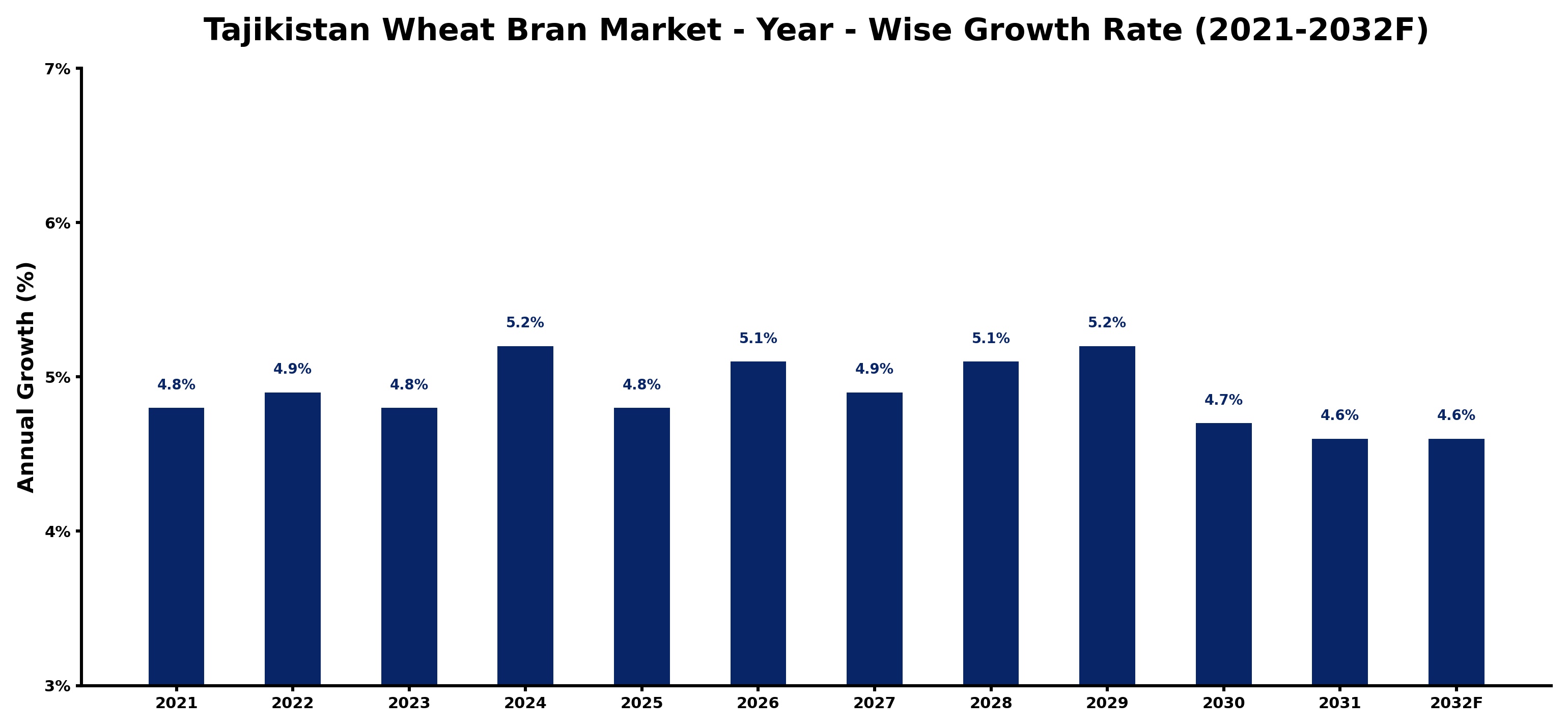
The table below presents the year‑wise growth rates along with the key drivers influencing the market
| Year | Growth Rate | Major Drivers |
| 2021 | 4.8% | Rising health consciousness among consumers |
| 2022 | 4.9% | Increased demand for organic products |
| 2023 | 4.8% | Growing popularity of healthy snacks |
| 2024 | 5.2% | Expansion of local wheat production |
| 2025 | 4.8% | Enhanced distribution networks established |
| 2026 | 5.1% | Rising export opportunities for bran |
| 2027 | 4.9% | Increased awareness of nutritional benefits |
| 2028 | 5.1% | Collaboration with food manufacturers expanded |
| 2029 | 5.2% | Investment in processing technology improved |
| 2030 | 4.7% | Consumer preferences shifted towards sustainability |
| 2031 | 4.6% | Emergence of new product lines |
| 2032 | 4.6% | Strengthened partnerships with retailers |
Note - Market size estimations and growth projections presented in this report are based on 6Wresearch's advanced forecasting approach, validated with industry datasets as of June 2026.
Tajikistan Wheat Bran Market Synopsis
The most significant force currently shaping the Tajikistan Wheat Bran Market is the rising consumer awareness surrounding the health benefits of wheat bran. As individuals prioritize nutritional value, products fortified with wheat bran are gaining traction in various sectors, particularly within food and beverage industries.
Additionally, there is a noticeable shift towards organic and natural products among consumers, fueling demand for high-quality wheat bran. This trend aligns with a broader movement towards sustainable and health-conscious eating, further solidifying wheat bran's position in both local diets and the marketplace.
Tajikistan Wheat Bran Market Key Takeaways
- The market is experiencing growth driven by health-conscious consumer preferences.
- Wheat bran is increasingly utilized in diverse food products, including baked goods and cereals.
- Investment opportunities exist in production and export capabilities, particularly to neighboring markets.
- Government support for agriculture enhances stability and encourages growth within the sector.
- The trend towards organic and natural wheat bran products is reshaping consumer buying habits.
Evaluation of Restraints in Tajikistan Wheat Bran Market
Despite its growth potential, the Tajikistan Wheat Bran Market faces significant constraints. Limited production capacity, influenced by small landholdings and outdated farming practices, hampers efficiency. Furthermore, inadequate storage and transportation infrastructure complicate distribution efforts, making it difficult to meet rising demand. The presence of cheaper imported wheat bran, coupled with consumer misinformation about its benefits, poses additional challenges that need to be addressed for the market to fully realize its potential.
Tajikistan Wheat Bran Market Trends
Current trends in the Tajikistan Wheat Bran Market include a marked increase in consumer preference for whole grain and fiber-rich products. As health and wellness take center stage in consumer choices, there is a growing trend of incorporating wheat bran into snacks, cereals, and baked goods. Moreover, the shift towards organic production practices is gaining momentum, as consumers increasingly prioritize natural ingredients over processed alternatives. This trend is projected to continue shaping product development and marketing strategies in the near future.
Tajikistan Wheat Bran Market Opportunities
The investment landscape within the Tajikistan Wheat Bran Market is ripe with opportunities. The agriculture sector is central to Tajikistan's economy, and initiatives aimed at boosting local wheat production can lead to increased supply of wheat bran. Moreover, establishing processing facilities can enhance product value and facilitate exports to neighboring countries where demand for healthy food options is growing. Collaborations with local farmers can further bolster supply chains and ensure product quality, positioning investors for success in this emerging market.
Government Initiatives in the Tajikistan Wheat Bran Market
The Tajikistan government has implemented various policies to bolster the Wheat Bran Market. Subsidies for wheat farmers are intended to stabilize production levels and ensure a consistent supply of wheat bran. Quality control measures have been established to maintain product safety and standardization, while initiatives aimed at promoting exports enhance the market's competitiveness. These policies collectively support agricultural growth and aim to stimulate the economy by leveraging the country's potential as a wheat producer.
Future Insights of the Tajikistan Wheat Bran Market
Looking ahead to the period between 2026 and 2032, the outlook for the Tajikistan Wheat Bran Market appears positive. As consumer awareness regarding health benefits continues to grow, so too will the demand for wheat bran products. Increased incorporation of wheat bran into diverse food applications is expected to further drive market expansion. Supported by government initiatives that aim to enhance agricultural productivity, the market is positioned for steady growth, aligning with the shifting preferences of health-conscious consumers.
Tajikistan Wheat Bran Market Latest Developments (May 2025 - June 2026)
Recent developments in the Tajikistan Wheat Bran Market indicate a focus on enhancing local production capabilities and diversifying product offerings. A growing number of local companies are experimenting with innovative wheat bran formulations aimed at health-conscious consumers. Efforts to improve infrastructure for storage and transportation have begun, facilitating better distribution channels. As the market evolves, greater emphasis is being placed on product quality and sustainable practices, aligning with global food trends.
Tajikistan Wheat Bran Market - Key Attractiveness of the Report
- 10 Years of Market Numbers
- Historical Data Starting from 2022 to 2025
- Base Year: 2025
- Forecast Data until 2032
- Key Performance Indicators Impacting the Market
- Major Upcoming Developments and Projects
Key Highlights of the Report:
- Tajikistan Wheat Bran Market Outlook
- Market Size of Tajikistan Wheat Bran Market, 2025
- Forecast of Tajikistan Wheat Bran Market, 2032
- Historical Data and Forecast of Tajikistan Wheat Bran Revenues & Volume for the Period 2022-2032F
- Tajikistan Wheat Bran Market Trend Evolution
- Tajikistan Wheat Bran Market Drivers and Challenges
- Tajikistan Wheat Bran Price Trends
- Tajikistan Wheat Bran Porter's Five Forces
- Tajikistan Wheat Bran Industry Life Cycle
- Historical Data and Forecast of Tajikistan Wheat Bran Market Revenues & Volume By Product Type for the Period 2022-2032F
- Historical Data and Forecast of Tajikistan Wheat Bran Market Revenues & Volume By Animal Feed Grade for the Period 2022-2032F
- Historical Data and Forecast of Tajikistan Wheat Bran Market Revenues & Volume By Medical Use Grade for the Period 2022-2032F
- Historical Data and Forecast of Tajikistan Wheat Bran Market Revenues & Volume By Others for the Period 2022-2032F
- Historical Data and Forecast of Tajikistan Wheat Bran Market Revenues & Volume By Application for the Period 2022-2032F
- Historical Data and Forecast of Tajikistan Wheat Bran Market Revenues & Volume By Food Products for the Period 2022-2032F
- Historical Data and Forecast of Tajikistan Wheat Bran Market Revenues & Volume By Animal Feed for the Period 2022-2032F
- Historical Data and Forecast of Tajikistan Wheat Bran Market Revenues & Volume By Pharmacuticals for the Period 2022-2032F
- Historical Data and Forecast of Tajikistan Wheat Bran Market Revenues & Volume By Cosmetics for the Period 2022-2032F
- Historical Data and Forecast of Tajikistan Wheat Bran Market Revenues & Volume By Others for the Period 2022-2032F
- Tajikistan Wheat Bran Import Export Trade Statistics
- Market Opportunity Assessment By Product Type
- Market Opportunity Assessment By Application
- Tajikistan Wheat Bran Top Companies Market Share
- Tajikistan Wheat Bran Competitive Benchmarking By Technical and Operational Parameters
- Tajikistan Wheat Bran Company Profiles
- Tajikistan Wheat Bran Key Strategic Recommendations






































