Tajikistan Wheelchair Market Size, Share & Growth Rate
The Tajikistan Wheelchair Market was estimated at USD 1424 Million in 2025 and is projected to reach USD 2401 Million by 2032, growing at a CAGR of 7.7% from 2026 to 2032. This growth trajectory is significantly driven by an aging population and a rising awareness of the rights of persons with disabilities. Furthermore, government initiatives aimed at enhancing accessibility and social inclusion are expected to create an increasingly favorable environment for wheelchair manufacturers and service providers.
Tajikistan Wheelchair Market Year-wise Growth Rate and Key Drivers
This graph highlights how the Tajikistan Wheelchair Market has steadily grown over the years, supported by major growth factors.
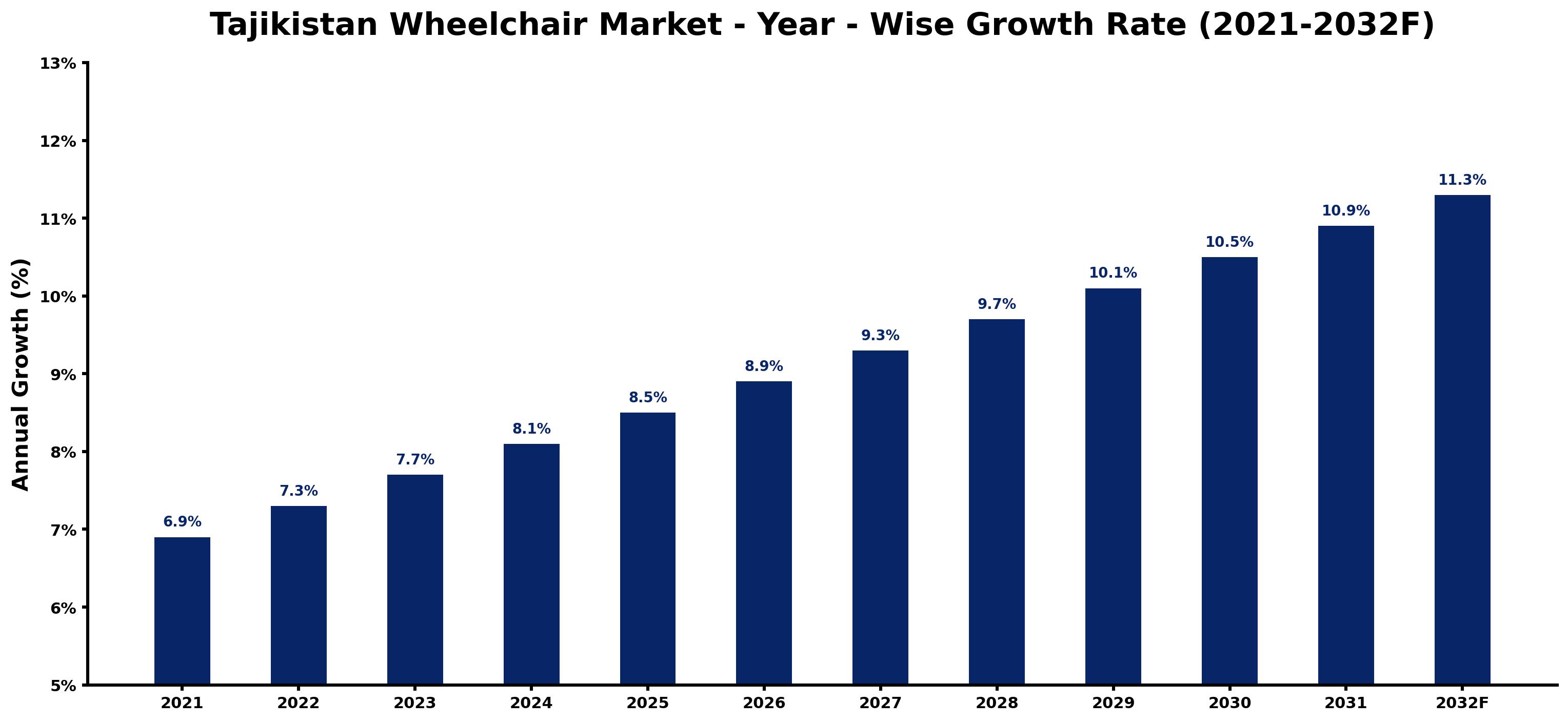
The table below presents the year‑wise growth rates along with the key drivers influencing the market
| Year | Growth Rate | Major Drivers |
| 2021 | 6.9% | Rising electricity demand across industries |
| 2022 | 7.3% | Growing urbanization and commercial development |
| 2023 | 7.7% | Expansion of manufacturing activities |
| 2024 | 8.1% | Growing urbanization and commercial development |
| 2025 | 8.5% | Expansion of manufacturing activities |
| 2026 | 8.9% | Increasing industrial automation investments |
| 2027 | 9.3% | Expansion of transportation and logistics networks |
| 2028 | 9.7% | Growing urbanization and commercial development |
| 2029 | 10.1% | Expansion of transportation and logistics networks |
| 2030 | 10.5% | Increasing industrial infrastructure investments |
| 2031 | 10.9% | Expansion of transportation and logistics networks |
| 2032 | 11.3% | Increasing industrial automation investments |
Note - Market size estimations and growth projections presented in this report are based on 6Wresearch’s advanced forecasting approach, validated with industry datasets as of June 2026.
Tajikistan Wheelchair Market Synopsis
A notable increase in the demand for mobility aids has emerged, primarily due to the growing elderly population in Tajikistan. As people age, their mobility needs become more pronounced, thereby increasing the necessity for both manual and electric wheelchairs.
The market is characterized by a mix of domestic production and imports, catering to various user preferences. This dual supply approach allows consumers to select from a wide range of options that best meet their needs in terms of price, quality, and features.
Tajikistan Wheelchair Market Key Takeaways
- Steady growth driven by an aging population and heightened awareness of disability rights.
- Diverse product offerings, including manual and electric wheelchairs, tailored to various user needs.
- Government policies promote inclusivity and accessibility, supporting market expansion.
- Investment opportunities exist in local manufacturing and distribution networks.
- Innovative wheelchair designs are gaining popularity, enhancing user comfort and usability.
Evaluation of Restraints in Tajikistan Wheelchair Market
Despite its promising growth trajectory, the Tajikistan wheelchair market faces several restraints. One primary concern is the limited availability of high-quality wheelchairs, particularly in rural areas where healthcare resources are scarce. Additionally, there exists a lack of awareness about the critical importance of mobility aids, which hampers market penetration. The suboptimal infrastructure, including poorly maintained roads and insufficiently designed public facilities, further restricts the mobility of wheelchair users, necessitating greater efforts to enhance accessibility and promote education around disability rights.
Tajikistan Wheelchair Market Trends
The Tajikistan wheelchair market is currently witnessing a surge in demand for lightweight and portable wheelchair designs, emphasizing user mobility and convenience. Moreover, innovative features such as adjustable seating positions and ergonomic designs are becoming increasingly popular, enhancing the comfort and usability of wheelchairs. As inclusivity becomes a focal point in societal discourse, there is a corresponding push for wheelchair-friendly infrastructure across public spaces.
Tajikistan Wheelchair Market Opportunities
The evolving landscape of the Tajikistan wheelchair market presents significant investment opportunities. With a rising elderly population and a growing demand for mobility aids, there is ample room for both local manufacturing and the importation of wheelchair products. Investors could explore collaborations with healthcare providers and government agencies to improve access solutions, ultimately contributing to the overall enhancement of the quality of life for individuals requiring mobility assistance.
Government Initiatives in the Tajikistan Wheelchair Market
Government policies in Tajikistan aim to promote accessibility and social inclusion for individuals with disabilities. Recent initiatives have focused on ensuring that public facilities are equipped with essential features such as ramps and accessible parking spaces. Furthermore, the government has introduced subsidies to help cover the costs of wheelchairs, thereby facilitating access for those in need. These policies reflect a commitment to improving the quality of life for wheelchair users and fostering a more inclusive society.
Future Insights of the Tajikistan Wheelchair Market
Looking ahead to the period from 2026 to 2032, the Tajikistan wheelchair market is expected to expand steadily. Factors contributing to this growth include an increasing societal focus on disability rights and inclusive practices, coupled with ongoing government efforts to enhance healthcare infrastructure. As technological advancements lead to the development of more convenient and user-friendly wheelchair designs, consumer demand will likely rise, solidifying the market's upward trajectory.
Tajikistan Wheelchair Market Latest Developments (May 2025 - June 2026)
Recent developments in the Tajikistan wheelchair market have included heightened discussions around improving wheelchair accessibility in public transport. Local manufacturers are increasingly looking to incorporate advanced technologies in their designs, aiming to offer better comfort and usability for end-users. Additionally, community outreach programs aimed at educating the public about the benefits of mobility aids are gaining traction, fostering a more informed consumer base.
Tajikistan Wheelchair Market - Key Attractiveness of the Report
- 10 Years of Market Numbers
- Historical Data Starting from 2022 to 2025
- Base Year: 2025
- Forecast Data until 2032
- Key Performance Indicators Impacting the Market
- Major Upcoming Developments and Projects
Key Highlights of the Report:
- Tajikistan Wheelchair Market Outlook
- Market Size of Tajikistan Wheelchair Market, 2025
- Forecast of Tajikistan Wheelchair Market, 2032
- Historical Data and Forecast of Tajikistan Wheelchair Revenues & Volume for the Period 2022-2032F
- Tajikistan Wheelchair Market Trend Evolution
- Tajikistan Wheelchair Market Drivers and Challenges
- Tajikistan Wheelchair Price Trends
- Tajikistan Wheelchair Porter's Five Forces
- Tajikistan Wheelchair Industry Life Cycle
- Historical Data and Forecast of Tajikistan Wheelchair Market Revenues & Volume By Type for the Period 2022-2032F
- Historical Data and Forecast of Tajikistan Wheelchair Market Revenues & Volume By Manual for the Period 2022-2032F
- Historical Data and Forecast of Tajikistan Wheelchair Market Revenues & Volume By Powered for the Period 2022-2032F
- Historical Data and Forecast of Tajikistan Wheelchair Market Revenues & Volume By Applications for the Period 2022-2032F
- Historical Data and Forecast of Tajikistan Wheelchair Market Revenues & Volume By Standard Wheelchair for the Period 2022-2032F
- Historical Data and Forecast of Tajikistan Wheelchair Market Revenues & Volume By Bariatrich Wheelchair for the Period 2022-2032F
- Historical Data and Forecast of Tajikistan Wheelchair Market Revenues & Volume By Sports Wheelchair for the Period 2022-2032F
- Historical Data and Forecast of Tajikistan Wheelchair Market Revenues & Volume By Others for the Period 2022-2032F
- Historical Data and Forecast of Tajikistan Wheelchair Market Revenues & Volume By End-Users for the Period 2022-2032F
- Tajikistan Wheelchair Import Export Trade Statistics
- Market Opportunity Assessment By Type
- Market Opportunity Assessment By Applications
- Market Opportunity Assessment By End-Users
- Tajikistan Wheelchair Top Companies Market Share
- Tajikistan Wheelchair Competitive Benchmarking By Technical and Operational Parameters
- Tajikistan Wheelchair Company Profiles
- Tajikistan Wheelchair Key Strategic Recommendations






































