Tajikistan Winding Wire Market Size, Share & Growth Rate
The Tajikistan Winding Wire Market was estimated at USD 384 Million in 2025 and is projected to reach USD 522 Million by 2032, growing at a CAGR of 4.5% from 2026 to 2032. This growth trajectory is largely propelled by increasing industrialization and ongoing infrastructural projects across the nation. Sectors such as construction, automotive, and electronics are significant consumers of winding wires, driving demand upward as these industries expand.
Tajikistan Winding Wire Market Growth Rate Analysis (2021-2032)
The Tajikistan winding wire market has experienced stable growth over the past several years, with growth rates fluctuating from 5.2% in 2022 to a notable 5.6% in 2023, reflecting a surge in consumer demand driven by infrastructure projects and energy transition initiatives aimed at modernizing the nation’s power grid. This upward trend is expected to continue, with anticipated growth rates of 5.4% in 2024 and 5.1% in 2025, as investments in the industrial sector further bolster demand. Continued government support for technological innovation and digitalization efforts are also anticipated to sustain market momentum through 2032, despite minor dips. Overall, these factors position the winding wire market for a dynamic future within Tajikistan’s evolving economic landscape.
Tajikistan Winding Wire Market Year-wise Growth Rate and Key Drivers
This graph highlights how the Tajikistan Winding Wire Market has steadily grown over the past five years, supported by major growth factors.
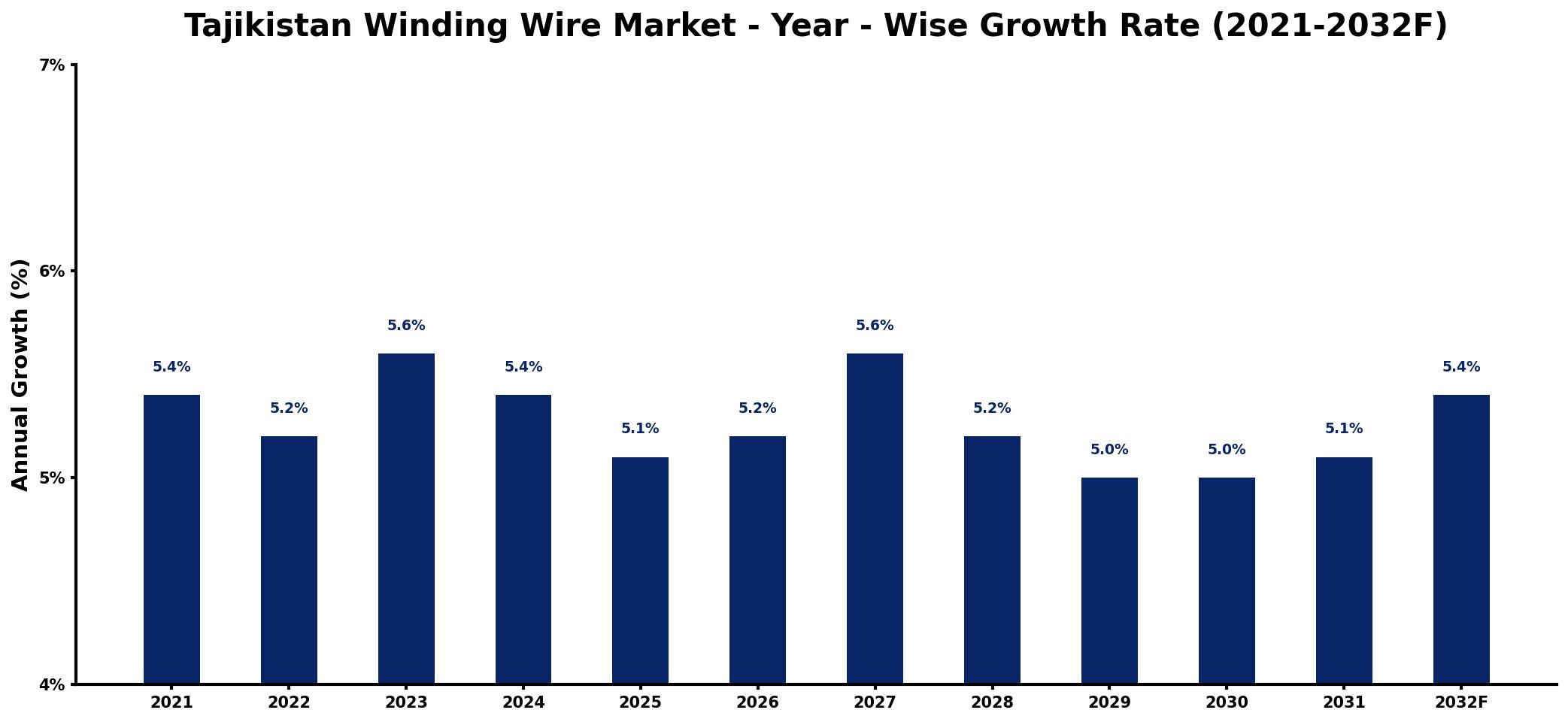
The table below presents the year‑wise growth rates along with the key drivers influencing the market
| Year | Growth Rate | Major Drivers |
| 2021 | 5.4% | Rising infrastructure development projects |
| 2022 | 5.2% | Increased manufacturing sector investments |
| 2023 | 5.6% | Growing renewable energy initiatives |
| 2024 | 5.4% | Expansion of construction activities |
| 2025 | 5.1% | Higher demand from automotive industry |
| 2026 | 5.2% | Surge in electronics production needs |
| 2027 | 5.6% | Boost in telecommunications investments |
| 2028 | 5.2% | Growth in home appliance market |
| 2029 | 5.0% | Increase in export opportunities emerging |
| 2030 | 5.0% | Strengthened local manufacturing capabilities |
| 2031 | 5.1% | Growing demand for energy efficiency |
| 2032 | 5.4% | rising procurement volume requirements |
Note: Market size estimations and growth projections presented in this report are based on 6Wresearch's proprietary forecasting methodology, utilizing the latest available industry data, government publications, and primary research inputs.
Tajikistan Winding Wire Market Synopsis
The demand for copper winding wires is dominating the market due to their excellent conductivity and durability, while aluminum winding wires are emerging as a cost-effective alternative. This trend is indicative of the rising need for efficient electrical components across various industries in Tajikistan.
Government initiatives aimed at bolstering infrastructure and energy projects are anticipated to further drive market demand. As Tajikistan continues to advance its power transmission capabilities, the requirement for high-quality winding wires will grow, presenting a favorable environment for market players.
Tajikistan Winding Wire Market Key Takeaways
- The market is driven by rising industrialization and infrastructure projects in various sectors.
- Copper winding wires dominate due to their superior performance, while aluminum wires are gaining popularity.
- Government policies are supporting local manufacturing and reducing dependency on imports.
- Investment in R&D is fostering innovation in winding wire production.
- Focus on renewable energy projects is creating new demand dynamics in the market.
Evaluation of Restraints in Tajikistan Winding Wire Market
Despite the positive outlook, the Tajikistan Winding Wire Market faces significant challenges. Limited domestic production capacity often results in heavy reliance on imports, creating vulnerability in supply chains. Fluctuating raw material prices can adversely impact manufacturing costs, putting pressure on local producers. Additionally, insufficient infrastructure may hinder distribution channels, making it difficult for manufacturers to reach potential clients effectively. Such complexities, combined with economic instability and the need for technological advancements, present formidable hurdles for market participants.
Tajikistan Winding Wire Market Trends
Current trends indicate a growing preference for energy-efficient solutions and renewable energy sources. As electric vehicles gain traction and investment in renewable energy projects surges, the demand for winding wires that meet these needs is expected to escalate. Furthermore, advancements in production technologies are leading to better-quality winding wires, thus enhancing their appeal in various applications.
Tajikistan Winding Wire Market Opportunities
Investing in the local production of winding wires presents a lucrative opportunity due to the increasing need for electrical components across diverse industries. Collaborations with local manufacturers can streamline entry into the market, allowing new entrants to capitalize on domestic demand while potentially exporting to neighboring regions. Moreover, a focus on R&D to develop innovative products could position companies favorably in an expanding market.
Government Initiatives in the Tajikistan Winding Wire Market
The Tajikistan government is actively fostering growth in the winding wire sector through various supportive policies. Financial incentives and subsidies are provided to local manufacturers to enhance production capabilities and reduce reliance on imports. Moreover, the introduction of technical regulations ensures adherence to quality standards, promoting competitiveness. Such initiatives not only aim to boost domestic production but also to create a conducive environment for innovation and market expansion.
Future Insights of the Tajikistan Winding Wire Market
Looking ahead to the 2026-2032 period, the Tajikistan Winding Wire Market is poised for sustained growth. Increased urbanization and significant infrastructural development are expected to elevate the demand for electrical components. Additionally, the governments commitment to enhancing the energy sector will likely spur investments in power transmission and distribution infrastructure. The shift towards renewable energy sources will further amplify the necessity for high-quality winding wires, heralding a promising future for this market.
Tajikistan Winding Wire Market Latest Developments (2025 - 2026)
Recent developments indicate a continued focus on innovation in winding wire production processes. Manufacturers are increasingly investing in advanced technologies to enhance product quality and efficiency. Furthermore, the governments emphasis on supporting local industries is likely to result in new collaborations and partnerships aimed at boosting production capabilities and meeting rising demand.
Tajikistan Winding Wire Market - Key Attractiveness of the Report
- 10 Years of Market Numbers
- Historical Data Starting from 2022 to 2025
- Base Year: 2025
- Forecast Data until 2032
- Key Performance Indicators Impacting the Market
- Major Upcoming Developments and Projects
Key Highlights of the Report:
- Tajikistan Winding Wire Market Outlook
- Market Size of Tajikistan Winding Wire Market, 2025
- Forecast of Tajikistan Winding Wire Market, 2032
- Historical Data and Forecast of Tajikistan Winding Wire Revenues & Volume for the Period 2022-2032F
- Tajikistan Winding Wire Market Trend Evolution
- Tajikistan Winding Wire Market Drivers and Challenges
- Tajikistan Winding Wire Price Trends
- Tajikistan Winding Wire Porter's Five Forces
- Tajikistan Winding Wire Industry Life Cycle
- Historical Data and Forecast of Tajikistan Winding Wire Market Revenues & Volume By Product for the Period 2022-2032F
- Historical Data and Forecast of Tajikistan Winding Wire Market Revenues & Volume By Copper Winding Wire for the Period 2022-2032F
- Historical Data and Forecast of Tajikistan Winding Wire Market Revenues & Volume By Aluminum Winding Wire for the Period 2022-2032F
- Tajikistan Winding Wire Import Export Trade Statistics
- Market Opportunity Assessment By Product
- Tajikistan Winding Wire Top Companies Market Share
- Tajikistan Winding Wire Competitive Benchmarking By Technical and Operational Parameters
- Tajikistan Winding Wire Company Profiles
- Tajikistan Winding Wire Key Strategic Recommendations






































