Tajikistan Wood Charcoal Market Size, Share & Growth Rate
The Tajikistan Wood Charcoal Market was estimated at USD 203 Million in 2025 and is projected to reach USD 256 Million by 2032, growing at a CAGR of 3.4% from 2026 to 2032. This growth trajectory is being driven by a combination of urbanization and rising consumer preferences for sustainable energy sources. The increasing popularity of outdoor cooking and barbecuing also contributes significantly to the demand for wood charcoal across various segments.
Tajikistan Wood Charcoal Market Year-wise Growth Rate and Key Drivers
This graph highlights how the Tajikistan Wood Charcoal Market has steadily grown over the years, supported by major growth factors.
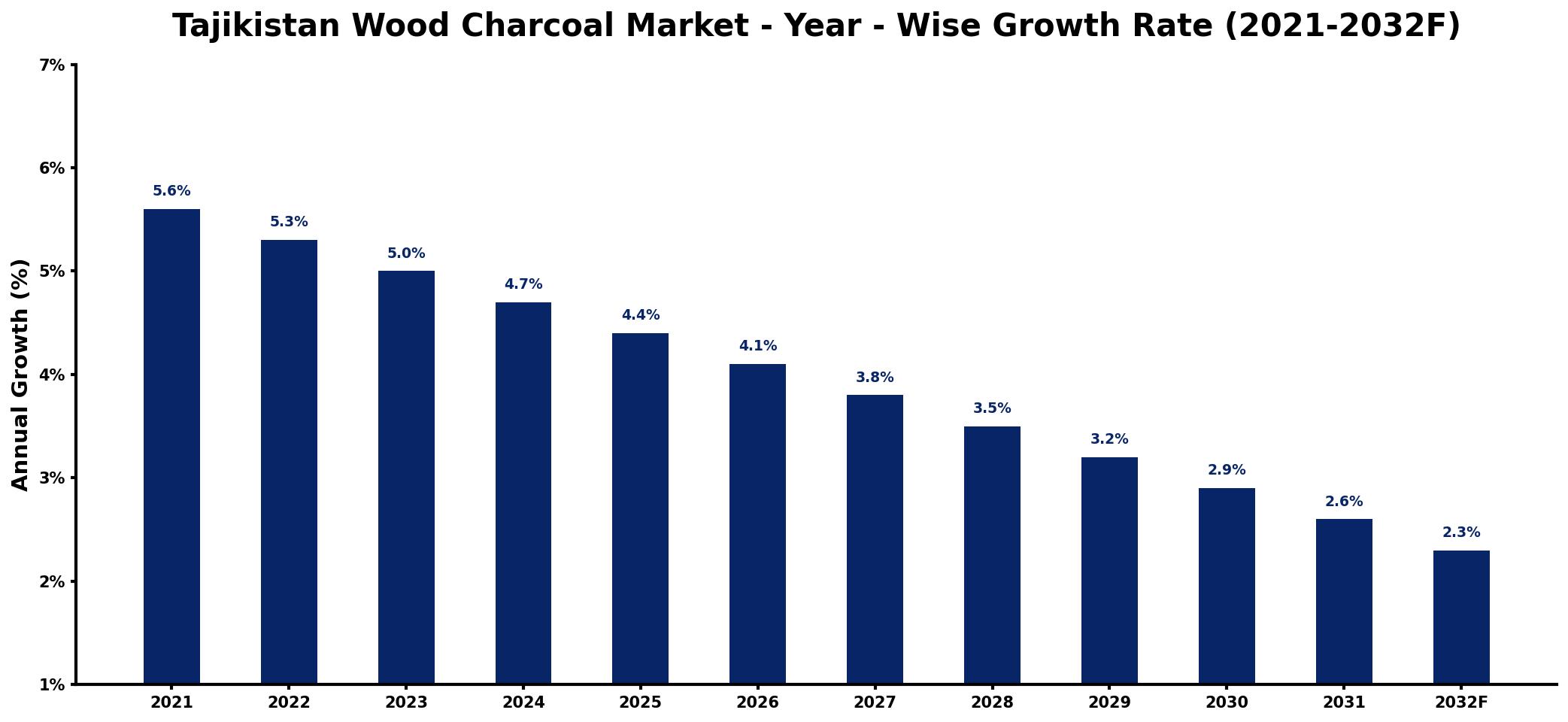
The table below presents the year‑wise growth rates along with the key drivers influencing the market
| Year | Growth Rate | Major Drivers |
| 2021 | 5.6% | Rising energy consumption trends |
| 2022 | 5.3% | Increased demand for sustainable fuel |
| 2023 | 5.0% | Growing market for outdoor cooking |
| 2024 | 4.7% | Expansion of eco-friendly initiatives |
| 2025 | 4.4% | Investment in renewable energy sources |
| 2026 | 4.1% | Enhancement of local production capacity |
| 2027 | 3.8% | Emergence of new distribution channels |
| 2028 | 3.5% | improved processing technologies adoption |
| 2029 | 3.2% | Adoption of energy-efficient practices |
| 2030 | 2.9% | Focus on carbon footprint reduction |
| 2031 | 2.6% | Growth in residential heating solutions |
| 2032 | 2.3% | Popularity of backyard grilling trends |
Note: Market size estimations and growth projections presented in this report are based on 6Wresearch's proprietary forecasting methodology, utilizing the latest available industry data, government publications, and primary research inputs.
Tajikistan Wood Charcoal Market Synopsis
The Tajikistan Wood Charcoal Market is witnessing a notable surge in demand, largely due to its multifaceted applications in cooking, heating, and industrial processes. This market is predominantly composed of small-scale producers utilizing traditional kiln-burning methods, resulting in a fragmented landscape that both defines and limits its expansion.
While local production plays a crucial role, imports significantly supplement the demand for wood charcoal in Tajikistan. Factors such as economic growth, urbanization, and an increasing inclination towards environmentally friendly products are shaping the market dynamics and presenting new opportunities for innovation and sustainable practices.
Tajikistan Wood Charcoal Market Key Takeaways
- The market is characterized by a fragmented structure with numerous small-scale producers.
- Urbanization and economic growth are driving a transition towards sustainable cooking fuels.
- Environmental concerns related to deforestation are prompting a shift towards eco-friendly practices.
- Innovation in product offerings and packaging is key to attracting a broader consumer base.
- Investment opportunities exist in manufacturing and exporting environmentally sustainable charcoal products.
Evaluation of Restraints in Tajikistan Wood Charcoal Market
Despite its growth potential, the Tajikistan Wood Charcoal Market faces significant restraints primarily linked to sustainability issues. The pressure on forest resources due to demand for charcoal has raised alarms about deforestation and environmental degradation. Furthermore, inconsistency in product quality hampers consumer trust, while fluctuating raw material prices complicate the economic landscape. Infrastructure challenges in transport and distribution also limit market reach, impacting the overall competitiveness of local producers.
Tajikistan Wood Charcoal Market Trends
Current trends in the Tajikistan Wood Charcoal Market indicate a marked increase in consumer preference for sustainable and eco-friendly fuel options. Outdoor grilling and barbecuing have gained popularity, further bolstering demand. Market players are actively engaging in product innovation, emphasizing quality and packaging to meet the evolving consumer needs. Additionally, as awareness of environmental issues grows, there is a notable push toward more sustainable production methods in the industry.
Tajikistan Wood Charcoal Market Opportunities
The market presents substantial investment opportunities, particularly for manufacturers looking to harness Tajikistan's rich forestry resources. There is potential for eco-friendly charcoal products that align with global sustainability trends. By adopting efficient production processes and emphasizing quality control, investors can capitalize on the increasing domestic and international demand for wood charcoal. Establishing robust distribution channels could further enhance market access and growth prospects.
Government Initiatives in the Tajikistan Wood Charcoal Market
The Tajikistan government has initiated policies aimed at regulating the wood charcoal market, focusing on sustainable forestry practices. These regulations include restrictions on tree cutting for charcoal production and strict permitting processes for harvesting timber. Moreover, the government promotes alternative energy sources to reduce dependency on wood charcoal, showcasing its commitment to environmental conservation and sustainable development within the industry.
Future Insights of the Tajikistan Wood Charcoal Market
Looking ahead to the period from 2026 to 2032, the Tajikistan Wood Charcoal Market is positioned for steady growth. Factors driving this expansion include heightened environmental awareness among consumers and growth in the food and beverage industry, which increasingly favors sustainable fuel options. However, challenges such as competition from alternative fuels and the need for improved production quality must be addressed. By embracing sustainable practices, the market is set to evolve in alignment with global trends towards eco-friendly products.
Tajikistan Wood Charcoal Market Latest Developments (2025 - 2026)
Recent developments in the Tajikistan Wood Charcoal Market have seen a continued focus on sustainability, with emerging technologies being explored to modernize traditional production methods. Local producers are increasingly adopting eco-friendly practices to mitigate environmental impacts. Additionally, there is a growing interest among investors to tap into the niche market for high-quality, sustainable charcoal products, further shaping the industry's direction.
Tajikistan Wood Charcoal Market - Key Attractiveness of the Report
- 10 Years of Market Numbers
- Historical Data Starting from 2022 to 2025
- Base Year: 2025
- Forecast Data until 2032
- Key Performance Indicators Impacting the Market
- Major Upcoming Developments and Projects
Key Highlights of the Report:
- Tajikistan Wood Charcoal Market Outlook
- Market Size of Tajikistan Wood Charcoal Market, 2025
- Forecast of Tajikistan Wood Charcoal Market, 2032
- Historical Data and Forecast of Tajikistan Wood Charcoal Revenues & Volume for the Period 2022-2032F
- Tajikistan Wood Charcoal Market Trend Evolution
- Tajikistan Wood Charcoal Market Drivers and Challenges
- Tajikistan Wood Charcoal Price Trends
- Tajikistan Wood Charcoal Porter's Five Forces
- Tajikistan Wood Charcoal Industry Life Cycle
- Historical Data and Forecast of Tajikistan Wood Charcoal Market Revenues & Volume By Product for the Period 2022-2032F
- Historical Data and Forecast of Tajikistan Wood Charcoal Market Revenues & Volume By Charcoal Lumps for the Period 2022-2032F
- Historical Data and Forecast of Tajikistan Wood Charcoal Market Revenues & Volume By Charcoal Briquettes for the Period 2022-2032F
- Historical Data and Forecast of Tajikistan Wood Charcoal Market Revenues & Volume By Charcoal Powder for the Period 2022-2032F
- Historical Data and Forecast of Tajikistan Wood Charcoal Market Revenues & Volume By Wood for the Period 2022-2032F
- Historical Data and Forecast of Tajikistan Wood Charcoal Market Revenues & Volume By Softwood for the Period 2022-2032F
- Historical Data and Forecast of Tajikistan Wood Charcoal Market Revenues & Volume By Hardwood for the Period 2022-2032F
- Historical Data and Forecast of Tajikistan Wood Charcoal Market Revenues & Volume By Application for the Period 2022-2032F
- Historical Data and Forecast of Tajikistan Wood Charcoal Market Revenues & Volume By Fuel Feedstock for the Period 2022-2032F
- Historical Data and Forecast of Tajikistan Wood Charcoal Market Revenues & Volume By Reducing Agent for the Period 2022-2032F
- Historical Data and Forecast of Tajikistan Wood Charcoal Market Revenues & Volume By Filtration Agent & Gas Masking for the Period 2022-2032F
- Historical Data and Forecast of Tajikistan Wood Charcoal Market Revenues & Volume By Decolorizing Agent for the Period 2022-2032F
- Historical Data and Forecast of Tajikistan Wood Charcoal Market Revenues & Volume By Gastric Medicine for the Period 2022-2032F
- Historical Data and Forecast of Tajikistan Wood Charcoal Market Revenues & Volume By Sketches & Paints for the Period 2022-2032F
- Historical Data and Forecast of Tajikistan Wood Charcoal Market Revenues & Volume By Soil Conditioning for the Period 2022-2032F
- Historical Data and Forecast of Tajikistan Wood Charcoal Market Revenues & Volume By Others for the Period 2022-2032F
- Historical Data and Forecast of Tajikistan Wood Charcoal Market Revenues & Volume By End Use for the Period 2022-2032F
- Historical Data and Forecast of Tajikistan Wood Charcoal Market Revenues & Volume By Residential for the Period 2022-2032F
- Historical Data and Forecast of Tajikistan Wood Charcoal Market Revenues & Volume By Cooking Fuel for the Period 2022-2032F
- Historical Data and Forecast of Tajikistan Wood Charcoal Market Revenues & Volume By Gardening for the Period 2022-2032F
- Historical Data and Forecast of Tajikistan Wood Charcoal Market Revenues & Volume By Commercial Paints & Sketches for the Period 2022-2032F
- Historical Data and Forecast of Tajikistan Wood Charcoal Market Revenues & Volume By Water Treatment for the Period 2022-2032F
- Historical Data and Forecast of Tajikistan Wood Charcoal Market Revenues & Volume By Industrial for the Period 2022-2032F
- Tajikistan Wood Charcoal Import Export Trade Statistics
- Market Opportunity Assessment By Product
- Market Opportunity Assessment By Wood
- Market Opportunity Assessment By Application
- Market Opportunity Assessment By End Use
- Tajikistan Wood Charcoal Top Companies Market Share
- Tajikistan Wood Charcoal Competitive Benchmarking By Technical and Operational Parameters
- Tajikistan Wood Charcoal Company Profiles
- Tajikistan Wood Charcoal Key Strategic Recommendations






































