Tajikistan Wood Flooring Market Summary
The tajikistan wood flooring market was estimated at USD 939 Million in 2025 and is projected to reach USD 1338 Million by 2032, growing at a CAGR of 6.2% from 2026 to 2032.
Tajikistan Wood Flooring Market Year-wise Growth Rate and Key Drivers
This graph highlights how the Tajikistan Wood Flooring Market has steadily grown over the past five years, supported by major growth factors.
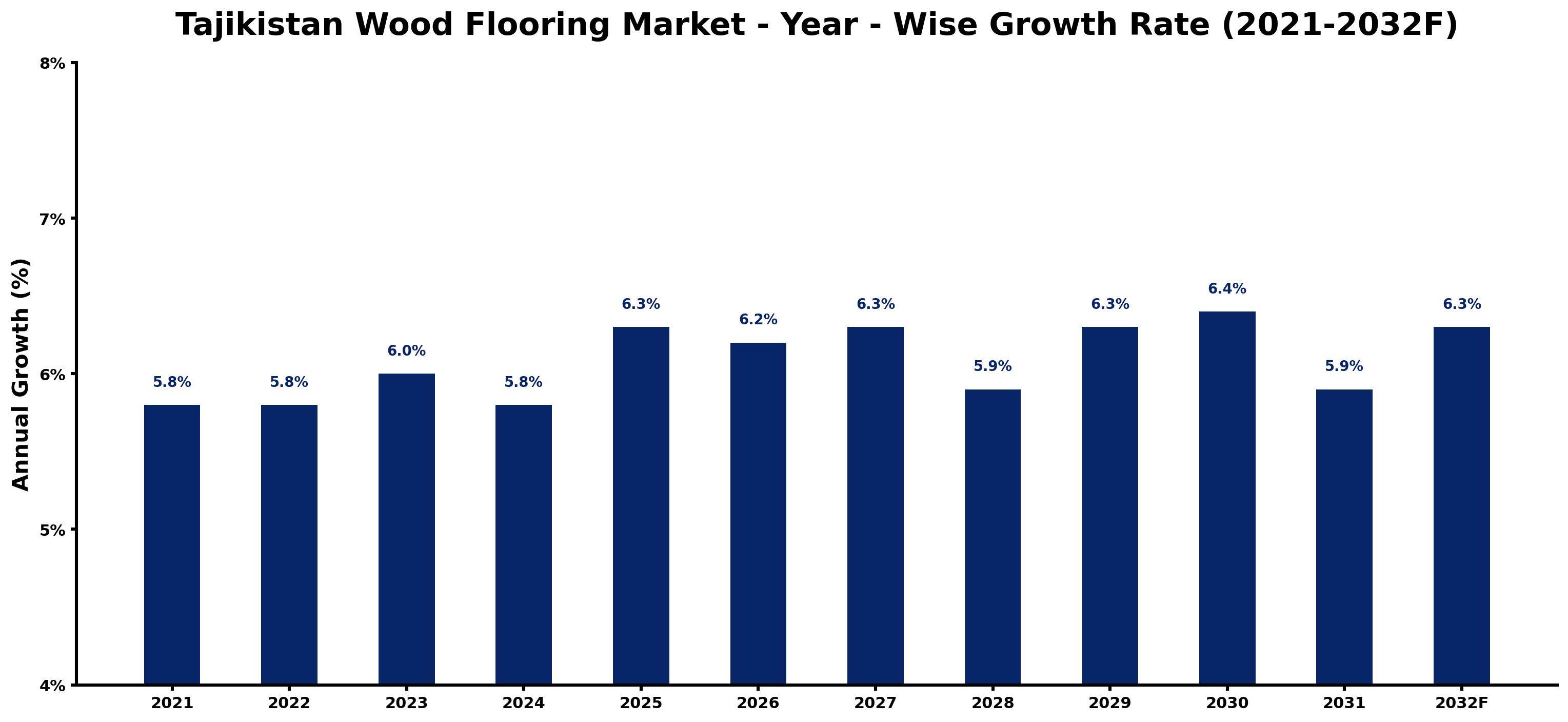
The table below presents the year wise growth rates along with the key drivers influencing the market
| Year | Growth Rate | Major Drivers |
| 2021 | 5.8% | Emerging middle class fuels interest in aesthetic home renovations and upgrades. |
| 2022 | 5.8% | Home construction projects increase due to improving economic conditions and stability. |
| 2023 | 6.0% | Local manufacturers enhance product quality, appealing to environmentally conscious consumers. |
| 2024 | 5.8% | Urbanization trends lead families to seek sustainable and durable flooring solutions. |
| 2025 | 6.3% | Investment in the hospitality sector boosts demand for premium wood flooring products. |
| 2026 | 6.2% | Rising disposable incomes allow consumers to prioritize home interior aesthetics significantly. |
| 2027 | 6.3% | Awareness of eco-friendly products strengthens consumer interest in natural wood options. |
| 2028 | 5.9% | Real estate development projects flourish, increasing demand for high-quality flooring materials. |
| 2029 | 6.3% | Technological innovations in flooring production enhance efficiency and reduce costs. |
| 2030 | 6.4% | Trade agreements open new markets, facilitating access to diverse wood products. |
| 2031 | 5.9% | Collaborative ventures with international firms expand design options for local consumers. |
| 2032 | 6.3% | Sustainable forestry practices gain traction, encouraging environmentally-conscious purchasing decisions. |
Note - Market size estimations and growth projections presented in this report are based on 6Wresearch's advanced forecasting approach, validated with industry datasets as of June 2026.
Tajikistan Wood Flooring Market Synopsis
The Tajikistan Wood Flooring Market is projected to reach 6.2% and witness significant growth during the forecast period (2026-2032). This growth is driven by various factors, including increasing urbanization, rising disposable incomes, and the demand for contemporary interior design solutions. A predominant characteristic of the market is its reliance on imported wood flooring products, attributable to the relatively limited capacity for domestic production. Consumers in Tajikistan are increasingly favoring wood flooring for its aesthetic allure, durability, and low maintenance requirements, highlighting the evolving preferences in home décor.
Tajikistan Wood Flooring Market Growth Drivers
Several key drivers are propelling the expansion of the Tajikistan wood flooring market. Firstly, rising urbanization rates are resulting in increased housing projects and urban redevelopment, pushing demand for flooring materials. Secondly, with an emerging middle class, there is a notable increase in disposable incomes, allowing consumers to invest in premium flooring solutions. Thirdly, the expanding construction sector is further supporting this demand, as builders often seek quality materials to meet modern aesthetic standards. Additionally, the growing inclination towards sustainable and eco-friendly products is influencing purchasing decisions, with many consumers preferring wood sourced from sustainable forests. Lastly, an evolving trend towards modern home design is reinforcing the preference for wood flooring, integrating natural materials into contemporary living spaces.
Tajikistan Wood Flooring Market Trends and Opportunities
Current trends within the Tajikistan wood flooring market are aligned with global shifts towards sustainability and innovation. Notably, there is a heightened consumer interest in eco-friendly wood flooring options, with a focus on products that are ethically sourced and manufactured through environmentally friendly processes. The demand for customized and unique flooring solutions, including handcrafted designs and reclaimed wood, is gaining traction as consumers seek to personalize their living environments.
- The increased production of engineered wood flooring is noteworthy, as it offers a balance of durability and affordability, making it a preferred choice among consumers.
- Moreover, retailers are enhancing their product ranges to include more sustainable options, appealing to environmentally conscious buyers.
- Advancements in production technologies are enabling manufacturers to reduce waste and improve the quality of wood flooring, reflecting a commitment to sustainability.
- There is also a growing market for luxury wood flooring, catering to consumers looking for high-end finishes and premium quality in their flooring choices.
- Furthermore, the industry is witnessing a slow but steady shift towards the use of digital platforms for marketing and sales, making wood flooring products more accessible to a broader audience.
Tajikistan Wood Flooring Market Challenges and Restraints
Despite the promising landscape, the Tajikistan wood flooring market faces several challenges that may impede growth. One significant challenge is the limited availability of high-quality raw materials, which restricts the production of premium flooring products. Additionally, the absence of modern technology and machinery for wood processing hampers the efficiency and quality of domestic output. Furthermore, a relatively small consumer base with lower purchasing power constrains the market's potential. The sector also grapples with inconsistent government regulations regarding forestry and wood processing, which can create uncertainties for businesses. Lastly, competition from alternative flooring materials, such as tiles and laminates, which are often perceived as more economical and easier to maintain, presents another hurdle for the market.
Tajikistan Wood Flooring Market Investment Opportunities
There are lucrative investment opportunities within the Tajikistan wood flooring market, driven by the burgeoning construction and real estate sectors. With urbanization trends and a rising middle class, the demand for aesthetically appealing and high-quality wood flooring continues to grow. Investors can seize this opportunity by introducing innovative and sustainable wood flooring solutions that align with consumer preferences. Additionally, leveraging local forestry resources can provide a cost advantage, enhancing sustainability in the supply chain. Thus, entering the Tajikistan wood flooring market offers promising prospects for long-term growth and profitability.
Tajikistan Wood Flooring Market Government Investment and Initiatives
Government initiatives in Tajikistan are increasingly focused on promoting sustainable practices in the wood flooring market. Policies aimed at ensuring responsible timber harvesting are in place to protect the country's rich forest resources. The government is also implementing regulations that support the development of domestic wood processing industries through incentives and subsidies, which aim to bolster local production capabilities. This strategic focus on both economic development and environmental conservation is vital for the sustainable growth of the wood flooring market, enabling a balance between resource utilization and ecological preservation.
Tajikistan Wood Flooring Market Latest Developments (May 2025 - June 2026)
Recent developments in the Tajikistan wood flooring market indicate a positive trajectory as stakeholders adapt to evolving consumer demands. The period has seen increasing collaborations between local businesses and international suppliers to enhance the diversity of product offerings, particularly in terms of sustainable options. Innovations in manufacturing processes are being explored to improve the quality and reduce the environmental impact of wood flooring production. Additionally, market awareness initiatives are on the rise, aimed at educating consumers about the benefits of wood flooring and the importance of sustainability in product sourcing. Overall, the industry is navigating through challenges while positioning itself for growth and development.
Tajikistan Wood Flooring Market - Key Attractiveness of the Report
- 10 Years of Market Numbers
- Historical Data Starting from 2022 to 2025
- Base Year: 2025
- Forecast Data until 2032
- Key Performance Indicators Impacting the Market
- Major Upcoming Developments and Projects
Key Highlights of the Report:
- Tajikistan Wood Flooring Market Outlook
- Market Size of Tajikistan Wood Flooring Market, 2025
- Forecast of Tajikistan Wood Flooring Market, 2032F
- Historical Data and Forecast of Tajikistan Wood Flooring Revenues & Volume for the Period 2022-2032F
- Tajikistan Wood Flooring Market Trend Evolution
- Tajikistan Wood Flooring Market Drivers and Challenges
- Tajikistan Wood Flooring Price Trends
- Tajikistan Wood Flooring Porter's Five Forces
- Tajikistan Wood Flooring Industry Life Cycle
- Historical Data and Forecast of Tajikistan Wood Flooring Market Revenues & Volume By Product Type for the Period 2022-2032F
- Historical Data and Forecast of Tajikistan Wood Flooring Market Revenues & Volume By Solid Wood for the Period 2022-2032F
- Historical Data and Forecast of Tajikistan Wood Flooring Market Revenues & Volume By Engineered Wood for the Period 2022-2032F
- Historical Data and Forecast of Tajikistan Wood Flooring Market Revenues & Volume By Distribution Channel for the Period 2022-2032F
- Historical Data and Forecast of Tajikistan Wood Flooring Market Revenues & Volume By Home Centers for the Period 2022-2032F
- Historical Data and Forecast of Tajikistan Wood Flooring Market Revenues & Volume By Flagship Stores for the Period 2022-2032F
- Historical Data and Forecast of Tajikistan Wood Flooring Market Revenues & Volume By Specialty Stores for the Period 2022-2032F
- Historical Data and Forecast of Tajikistan Wood Flooring Market Revenues & Volume By Online for the Period 2022-2032F
- Historical Data and Forecast of Tajikistan Wood Flooring Market Revenues & Volume By Other for the Period 2022-2032F
- Historical Data and Forecast of Tajikistan Wood Flooring Market Revenues & Volume By End-User for the Period 2022-2032F
- Historical Data and Forecast of Tajikistan Wood Flooring Market Revenues & Volume By Residential for the Period 2022-2032F
- Historical Data and Forecast of Tajikistan Wood Flooring Market Revenues & Volume By Commercial for the Period 2022-2032F
- Tajikistan Wood Flooring Import Export Trade Statistics
- Market Opportunity Assessment By Product Type
- Market Opportunity Assessment By Distribution Channel
- Market Opportunity Assessment By End-User
- Tajikistan Wood Flooring Top Companies Market Share
- Tajikistan Wood Flooring Competitive Benchmarking By Technical and Operational Parameters
- Tajikistan Wood Flooring Company Profiles
- Tajikistan Wood Flooring Key Strategic Recommendations






































