Tajikistan Wooden Toys Market Size, Share & Growth Rate
The Tajikistan Wooden Toys Market was estimated at USD 542 Million in 2025 and is projected to reach USD 777 Million by 2032, growing at a CAGR of 5.3% from 2026 to 2032. This growth is driven by a rising consumer preference for sustainable and culturally significant toys, as well as increased government support for traditional craftsmanship. As awareness about the environmental impacts of plastic toys heightens, more parents are opting for quality wooden alternatives, further propelling market growth.
Tajikistan Wooden Toys Market Year-wise Growth Rate and Key Drivers
This graph highlights how the Tajikistan Wooden Toys Market has steadily grown over the years, supported by major growth factors.
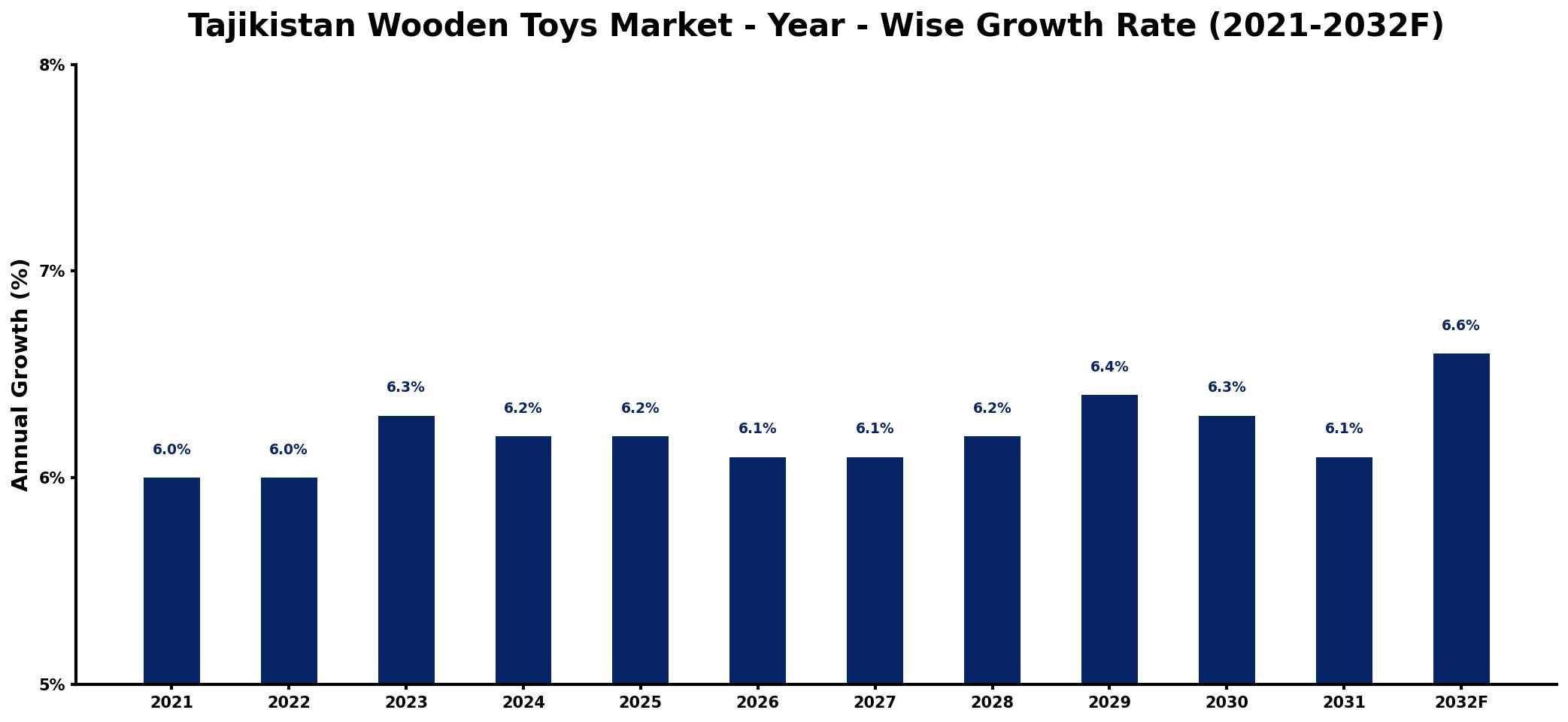
The table below presents the year‑wise growth rates along with the key drivers influencing the market
| Year | Growth Rate | Major Drivers |
| 2021 | 6.0% | Growing consumer interest in sustainability |
| 2022 | 6.0% | Increased focus on eco-friendly products |
| 2023 | 6.3% | Rising demand for handcrafted items |
| 2024 | 6.2% | Expansion of local manufacturing capabilities |
| 2025 | 6.2% | Boost in disposable income levels |
| 2026 | 6.1% | Strengthened distribution networks emerging |
| 2027 | 6.1% | Heightened awareness of educational benefits |
| 2028 | 6.2% | Surge in online shopping preferences |
| 2029 | 6.4% | Increased investment in local artisans |
| 2030 | 6.3% | Growing popularity of natural materials |
| 2031 | 6.1% | Strengthened community-based production initiatives |
| 2032 | 6.6% | expanding manufacturing base activity |
Note: Market size estimations and growth projections presented in this report are based on 6Wresearch's proprietary forecasting methodology, utilizing the latest available industry data, government publications, and primary research inputs.
Tajikistan Wooden Toys Market Synopsis
Currently, the Tajikistan Wooden Toys Market stands out for its unique blend of tradition and sustainability. Local artisans are crafting exceptional handmade toys, reflecting the rich cultural heritage of Tajikistan, which resonates well with both local consumers and international tourists seeking authentic products.
In this niche market, the demand for educational wooden toys is on the rise, as parents increasingly recognize the value of non-toxic and organic materials. The handmade nature of these products offers a sense of authenticity that mass-produced plastic toys cannot match, leading to a distinct competitive advantage for local manufacturers.
Tajikistan Wooden Toys Market Key Takeaways
- The market is growing due to heightened consumer awareness of eco-friendly and non-toxic toy options.
- Handcrafted wooden toys from local artisans appeal to parents seeking quality and cultural relevance.
- The government's initiatives to promote local craftsmanship significantly boost market development.
- Investment opportunities exist due to the current underserved nature of the market and rising disposable incomes.
- Challenges such as distribution and consumer awareness need addressing to maximize growth potential.
Evaluation of Restraints in Tajikistan Wooden Toys Market
Despite its promising trajectory, the Tajikistan Wooden Toys Market faces several constraints. One major challenge is the relatively low consumer awareness of the benefits of wooden toys compared to cheaper plastic alternatives. Additionally, the lack of infrastructure for manufacturing and distribution limits the reach of local producers. High production costs, driven by quality wood sourcing and skilled labor requirements, further inhibit manufacturers. Coupled with limited access to modern technology, these factors collectively pose significant hurdles to expanding the market's overall potential.
Tajikistan Wooden Toys Market Trends
Emerging trends in the Tajikistan Wooden Toys Market include an increasing demand for educational toys that foster cognitive development and creativity in children. Furthermore, the shift towards promoting hands-on, imaginative play rather than screen time is influencing consumer choices. As parents prioritize sustainability and cultural significance in toys, the market is adapting with innovative designs that reflect these values, enhancing appeal and consumer loyalty.
Tajikistan Wooden Toys Market Opportunities
The Tajikistan Wooden Toys Market presents substantial growth and investment opportunities, particularly for new entrants focusing on innovation and quality. As consumer trends shift towards premium, handcrafted goods, there is a significant gap in the market for high-quality wooden toys. Investors can leverage the countrys skilled craftsmanship and cultural heritage to create unique products that appeal to both local and global markets. Furthermore, the potential for niche market development around educational toys offers additional avenues for expansion.
Government Initiatives in the Tajikistan Wooden Toys Market
The government of Tajikistan is actively engaged in promoting the wooden toys market as part of broader efforts to support local artisans and preserve traditional craftsmanship. Initiatives are in place to provide training and resources to artisans, aiming to enhance their skills and production capabilities. Additionally, there are programs promoting the export of Tajik wooden toys, which helps integrate the local market into global supply chains. Such policies are critical in fostering the growth of this traditional industry while contributing to rural income generation.
Future Insights of the Tajikistan Wooden Toys Market
Looking ahead to 2026-2032, the Tajikistan Wooden Toys Market is poised for continued expansion, driven by increasing consumer prioritization of eco-friendly products. As disposable incomes rise and awareness of sustainable play increases, parents are likely to invest more in quality wooden toys. The anticipated decline in plastic toy consumption, coupled with a cultural resurgence in handcrafted goods, positions the market for significant growth. Addressing existing distribution challenges will be essential for harnessing this potential fully.
Tajikistan Wooden Toys Market Latest Developments (2025 - 2026)
Recent developments in the Tajikistan Wooden Toys Market indicate a growing interest in collaborative initiatives between local artisans and non-governmental organizations aimed at enhancing production techniques and marketing strategies. Workshops focused on sustainable practices and product innovation have been organized, fostering a community of skilled artisans. Furthermore, there has been an uptick in local and international exhibitions showcasing Tajik wooden toys, helping to raise awareness and attract potential buyers.
Tajikistan Wooden Toys Market - Key Attractiveness of the Report
- 10 Years of Market Numbers
- Historical Data Starting from 2022 to 2025
- Base Year: 2025
- Forecast Data until 2032
- Key Performance Indicators Impacting the Market
- Major Upcoming Developments and Projects
Key Highlights of the Report:
- Tajikistan Wooden Toys Market Outlook
- Market Size of Tajikistan Wooden Toys Market, 2025
- Forecast of Tajikistan Wooden Toys Market, 2032
- Historical Data and Forecast of Tajikistan Wooden Toys Revenues & Volume for the Period 2022-2032F
- Tajikistan Wooden Toys Market Trend Evolution
- Tajikistan Wooden Toys Market Drivers and Challenges
- Tajikistan Wooden Toys Price Trends
- Tajikistan Wooden Toys Porter's Five Forces
- Tajikistan Wooden Toys Industry Life Cycle
- Historical Data and Forecast of Tajikistan Wooden Toys Market Revenues & Volume By Product Type for the Period 2022-2032F
- Historical Data and Forecast of Tajikistan Wooden Toys Market Revenues & Volume By Educational Toys for the Period 2022-2032F
- Historical Data and Forecast of Tajikistan Wooden Toys Market Revenues & Volume By Construction Toys for the Period 2022-2032F
- Historical Data and Forecast of Tajikistan Wooden Toys Market Revenues & Volume By Musical Toys for the Period 2022-2032F
- Historical Data and Forecast of Tajikistan Wooden Toys Market Revenues & Volume By Game Toys for the Period 2022-2032F
- Historical Data and Forecast of Tajikistan Wooden Toys Market Revenues & Volume By Dolls & Miniatures for the Period 2022-2032F
- Historical Data and Forecast of Tajikistan Wooden Toys Market Revenues & Volume By Automotive Toys for the Period 2022-2032F
- Historical Data and Forecast of Tajikistan Wooden Toys Market Revenues & Volume By Pretend Play Toys for the Period 2022-2032F
- Historical Data and Forecast of Tajikistan Wooden Toys Market Revenues & Volume By Wood Type for the Period 2022-2032F
- Historical Data and Forecast of Tajikistan Wooden Toys Market Revenues & Volume By Softwood for the Period 2022-2032F
- Historical Data and Forecast of Tajikistan Wooden Toys Market Revenues & Volume By Hardwood for the Period 2022-2032F
- Historical Data and Forecast of Tajikistan Wooden Toys Market Revenues & Volume By Age Group for the Period 2022-2032F
- Historical Data and Forecast of Tajikistan Wooden Toys Market Revenues & Volume By Below 1 Year for the Period 2022-2032F
- Historical Data and Forecast of Tajikistan Wooden Toys Market Revenues & Volume By Age 1-3 for the Period 2022-2032F
- Historical Data and Forecast of Tajikistan Wooden Toys Market Revenues & Volume By Age 3-5 for the Period 2022-2032F
- Historical Data and Forecast of Tajikistan Wooden Toys Market Revenues & Volume By Age 5-12 for the Period 2022-2032F
- Historical Data and Forecast of Tajikistan Wooden Toys Market Revenues & Volume By Age 12+ for the Period 2022-2032F
- Historical Data and Forecast of Tajikistan Wooden Toys Market Revenues & Volume By Distribution Channel for the Period 2022-2032F
- Historical Data and Forecast of Tajikistan Wooden Toys Market Revenues & Volume By Online for the Period 2022-2032F
- Historical Data and Forecast of Tajikistan Wooden Toys Market Revenues & Volume By Offline for the Period 2022-2032F
- Tajikistan Wooden Toys Import Export Trade Statistics
- Market Opportunity Assessment By Product Type
- Market Opportunity Assessment By Wood Type
- Market Opportunity Assessment By Age Group
- Market Opportunity Assessment By Distribution Channel
- Tajikistan Wooden Toys Top Companies Market Share
- Tajikistan Wooden Toys Competitive Benchmarking By Technical and Operational Parameters
- Tajikistan Wooden Toys Company Profiles
- Tajikistan Wooden Toys Key Strategic Recommendations






































