Tajikistan Zinc Sulphate Market Size, Share & Growth Rate
The Tajikistan Zinc Sulphate Market was estimated at USD 510 Million in 2025 and is projected to reach USD 739 Million by 2032, growing at a CAGR of 5.4% from 2026 to 2032. This growth trajectory is primarily driven by the agricultural sector's increasing emphasis on soil health and crop productivity. As farmers become more aware of the advantages of using Zinc Sulphate to rectify zinc deficiencies in soil, the demand for this micronutrient is expected to rise significantly.
Tajikistan Zinc Sulphate Market Year-wise Growth Rate and Key Drivers
This graph highlights how the Tajikistan Zinc Sulphate Market has steadily grown over the years, supported by major growth factors.
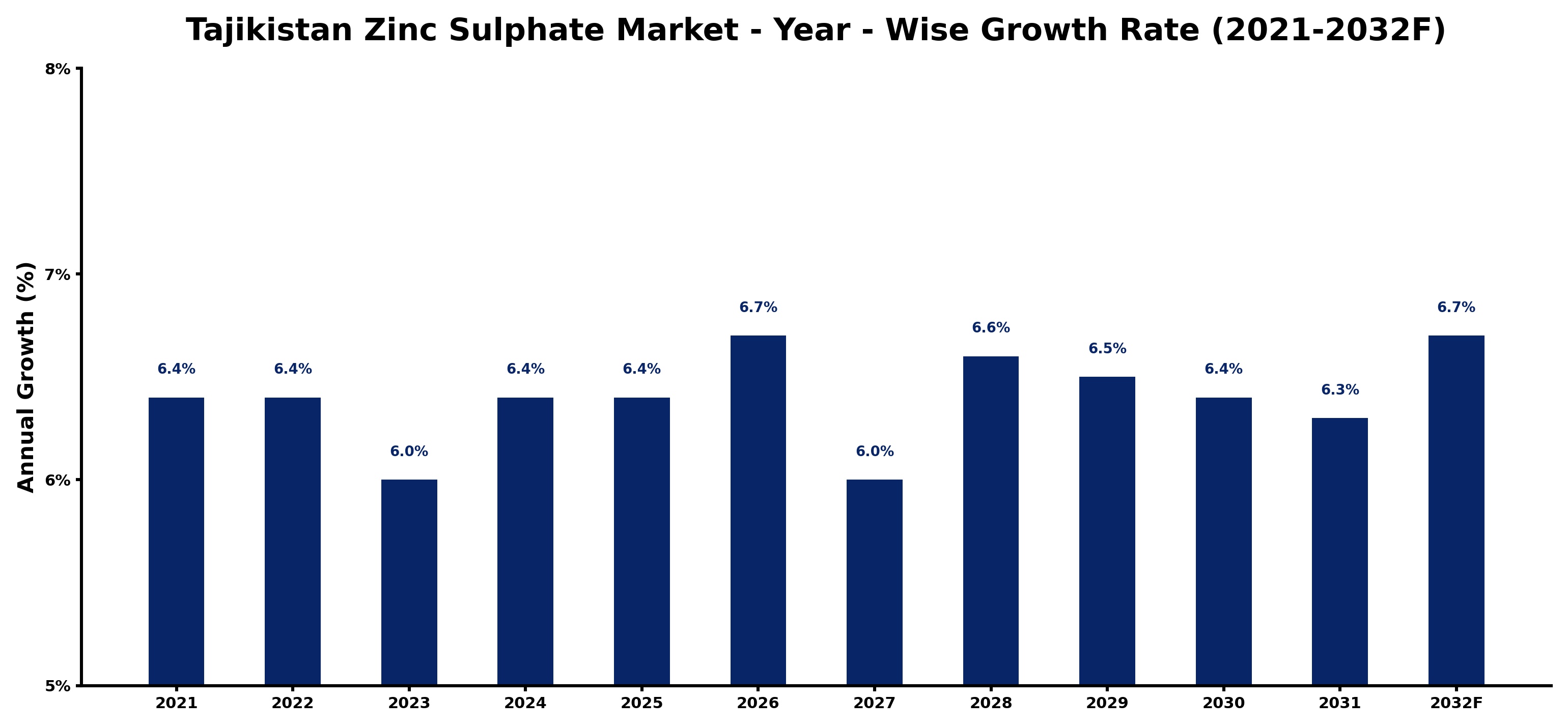
The table below presents the year‑wise growth rates along with the key drivers influencing the market
| Year | Growth Rate | Major Drivers |
| 2021 | 6.4% | Agricultural sector growth accelerated demand |
| 2022 | 6.4% | Increased awareness of micronutrients |
| 2023 | 6.0% | Rising crop yields enhanced usage |
| 2024 | 6.4% | Government support for agriculture expanded |
| 2025 | 6.4% | Fertilizer innovation improved efficiency |
| 2026 | 6.7% | Sustainable farming practices gained traction |
| 2027 | 6.0% | Export opportunities increased market size |
| 2028 | 6.6% | Soil health initiatives promoted adoption |
| 2029 | 6.5% | Zinc deficiency awareness heightened consumption |
| 2030 | 6.4% | Organic farming trends boosted sales |
| 2031 | 6.3% | Research advancements improved formulations |
| 2032 | 6.7% | Partnerships with farmers enhanced distribution |
Note - Market size estimations and growth projections presented in this report are based on 6Wresearch's advanced forecasting approach, validated with industry datasets as of June 2026.
Tajikistan Zinc Sulphate Market Synopsis
Currently, the Tajikistan Zinc Sulphate market is witnessing a robust expansion, fueled by a surge in agricultural activities and a greater focus on sustainable farming practices. As the nation strives to enhance agricultural output and food security, Zinc Sulphate emerges as a vital component in boosting crop yields and improving nutrient absorption.
The competitive landscape of this market is characterized by a mix of local producers and imported products. Government initiatives aimed at encouraging local production further support the burgeoning demand. As Tajikistan continues to invest in agricultural development, the Zinc Sulphate market is poised for notable growth, with opportunities for innovation and enhanced distribution channels.
Tajikistan Zinc Sulphate Market Key Takeaways
- The agriculture sector is the primary driver of demand for Zinc Sulphate in Tajikistan, highlighting its significance in soil treatment.
- Rising awareness among farmers regarding the benefits of balanced nutrition is key to market expansion.
- Government policies are promoting domestic production to reduce import dependence.
- Investment opportunities are abundant, particularly in manufacturing and distribution, catering to both local and regional markets.
- The ongoing focus on sustainable practices will further boost Zinc Sulphate's role in Tajikistan's agricultural framework.
Evaluation of Restraints in Tajikistan Zinc Sulphate Market
While the Tajikistan Zinc Sulphate market is on an upward trajectory, certain restraints persist that could hinder its full potential. Limited awareness of the benefits and applications of Zinc Sulphate among some farmers impacts overall adoption rates. Furthermore, inconsistencies in product quality can lead to skepticism regarding efficacy and safety, affecting purchasing decisions. Additionally, distribution challenges and difficulties in accessing raw materials can create barriers to market entry, ultimately influencing pricing and availability.
Tajikistan Zinc Sulphate Market Trends
A notable trend within the Tajikistan Zinc Sulphate market is the growing shift towards sustainable agricultural practices. Farmers are increasingly incorporating Zinc Sulphate as a key micronutrient to not only enhance soil health but also to comply with emerging regulations around eco-friendly farming. Moreover, the application of Zinc Sulphate in livestock feed supplements is gaining traction, thereby expanding its market presence beyond traditional agricultural use. This broadening scope reflects a significant opportunity for industry stakeholders to innovate and diversify their offerings.
Tajikistan Zinc Sulphate Market Opportunities
The growing demand for Zinc Sulphate in Tajikistan presents numerous investment opportunities. Establishing manufacturing facilities to produce Zinc Sulphate locally can not only cater to domestic needs but also position businesses for potential export to neighboring regions. Partnerships with local distributors can facilitate effective market penetration, while investments in research and development can lead to innovative product enhancements that appeal to modern agricultural practices. Overall, the evolving landscape offers a fertile ground for stakeholders aiming to capitalize on this burgeoning market.
Government Initiatives in the Tajikistan Zinc Sulphate Market
The Tajikistan government is actively fostering a supportive environment for the Zinc Sulphate market through various initiatives. Policies aimed at promoting local production help to lessen reliance on imports while enhancing quality and safety standards. Incentives such as subsidies and tax breaks for domestic manufacturers encourage investment and development in this sector. Furthermore, regulatory frameworks are being established to ensure compliance and safety, reflecting the government's commitment to bolstering the agricultural foundation of the economy.
Future Insights of the Tajikistan Zinc Sulphate Market
Looking ahead to 2026-2032, the Tajikistan Zinc Sulphate market is expected to continue its gradual growth trajectory. As agricultural practices evolve and the government places greater emphasis on sustainable farming, the demand for Zinc Sulphate is anticipated to rise. However, industry stakeholders must remain vigilant in addressing challenges related to pricing volatility and technological advancements in production. By focusing on quality improvements and expanding access to Zinc Sulphate, the market is well-positioned for sustained growth in the coming years.
Tajikistan Zinc Sulphate Market Latest Developments (May 2025 - June 2026)
Recently, the Tajikistan Zinc Sulphate market has seen shifts in production strategies as local manufacturers are adapting to new agricultural requirements. Efforts to enhance distribution networks are underway, with several initiatives focused on improving the accessibility of Zinc Sulphate products to farmers. Furthermore, there has been a growing dialogue among industry participants about innovative applications of Zinc Sulphate beyond conventional agriculture, potentially opening new avenues for market expansion.
Tajikistan Zinc Sulphate Market - Key Attractiveness of the Report
- 10 Years of Market Numbers
- Historical Data Starting from 2022 to 2025
- Base Year: 2025
- Forecast Data until 2032
- Key Performance Indicators Impacting the Market
- Major Upcoming Developments and Projects
Key Highlights of the Report:
- Tajikistan Zinc Sulphate Market Outlook
- Market Size of Tajikistan Zinc Sulphate Market, 2025
- Forecast of Tajikistan Zinc Sulphate Market, 2032
- Historical Data and Forecast of Tajikistan Zinc Sulphate Revenues & Volume for the Period 2022-2032F
- Tajikistan Zinc Sulphate Market Trend Evolution
- Tajikistan Zinc Sulphate Market Drivers and Challenges
- Tajikistan Zinc Sulphate Price Trends
- Tajikistan Zinc Sulphate Porter's Five Forces
- Tajikistan Zinc Sulphate Industry Life Cycle
- Historical Data and Forecast of Tajikistan Zinc Sulphate Market Revenues & Volume By Type for the Period 2022-2032F
- Historical Data and Forecast of Tajikistan Zinc Sulphate Market Revenues & Volume By Zinc Sulphate Anhydrous for the Period 2022-2032F
- Historical Data and Forecast of Tajikistan Zinc Sulphate Market Revenues & Volume By Zinc Sulphate Hexahydrate for the Period 2022-2032F
- Historical Data and Forecast of Tajikistan Zinc Sulphate Market Revenues & Volume By Zinc Sulphate Heptahydrate for the Period 2022-2032F
- Historical Data and Forecast of Tajikistan Zinc Sulphate Market Revenues & Volume By Zinc Sulphate Monohydrate for the Period 2022-2032F
- Historical Data and Forecast of Tajikistan Zinc Sulphate Market Revenues & Volume By Application for the Period 2022-2032F
- Historical Data and Forecast of Tajikistan Zinc Sulphate Market Revenues & Volume By Agrochemicals for the Period 2022-2032F
- Historical Data and Forecast of Tajikistan Zinc Sulphate Market Revenues & Volume By Chemicals for the Period 2022-2032F
- Historical Data and Forecast of Tajikistan Zinc Sulphate Market Revenues & Volume By Pharmaceuticals for the Period 2022-2032F
- Historical Data and Forecast of Tajikistan Zinc Sulphate Market Revenues & Volume By Synthetic Fibers for the Period 2022-2032F
- Historical Data and Forecast of Tajikistan Zinc Sulphate Market Revenues & Volume By Water Treatment for the Period 2022-2032F
- Historical Data and Forecast of Tajikistan Zinc Sulphate Market Revenues & Volume By Others for the Period 2022-2032F
- Tajikistan Zinc Sulphate Import Export Trade Statistics
- Market Opportunity Assessment By Type
- Market Opportunity Assessment By Application
- Tajikistan Zinc Sulphate Top Companies Market Share
- Tajikistan Zinc Sulphate Competitive Benchmarking By Technical and Operational Parameters
- Tajikistan Zinc Sulphate Company Profiles
- Tajikistan Zinc Sulphate Key Strategic Recommendations






































