Tanzania AI in IoT Market Size & Growth Rate (2026-2032)
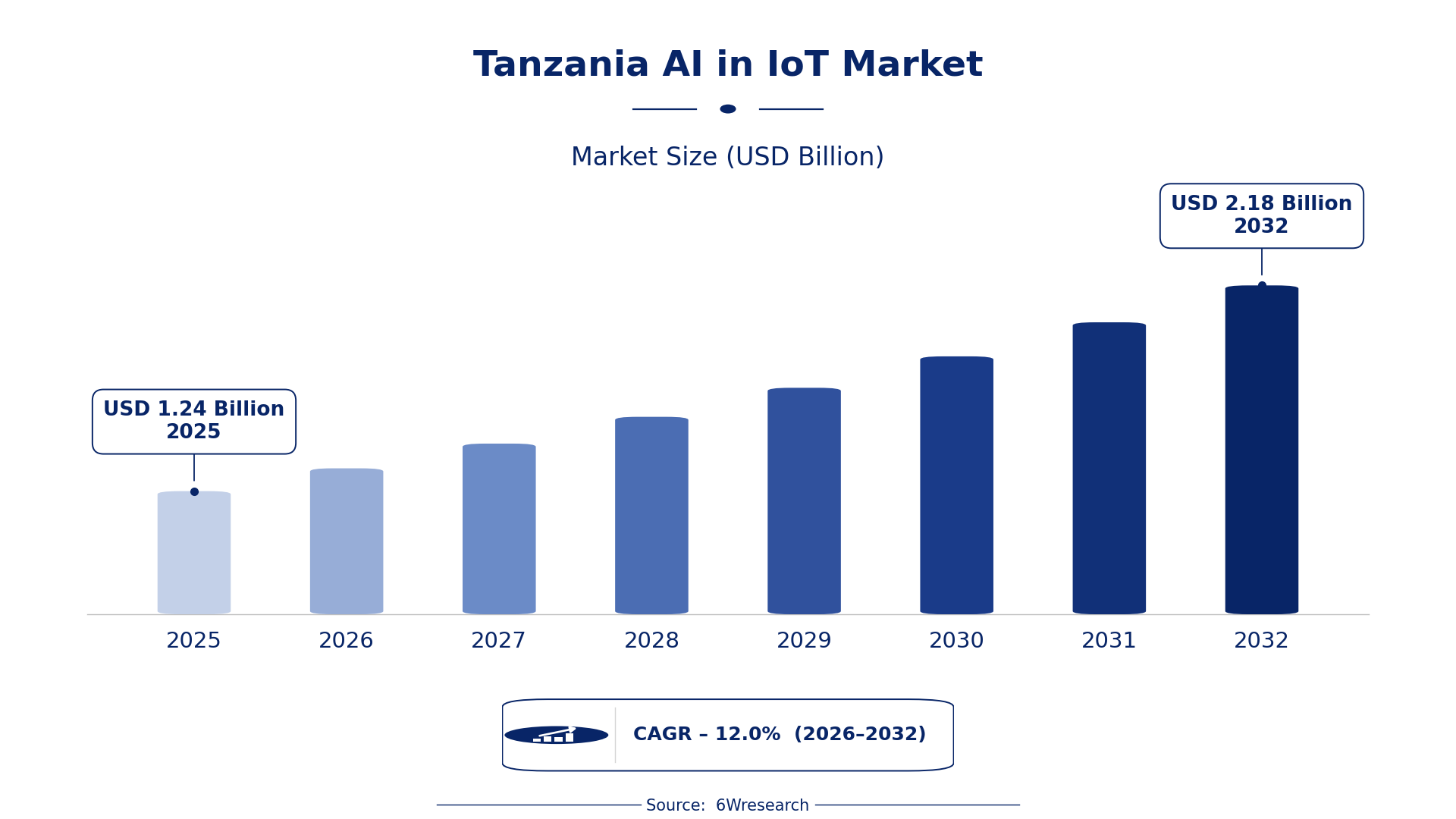
The Tanzania AI in IoT Market was estimated at USD 1242 Million in 2025 and is projected to reach USD 2176 Million by 2032, growing at a CAGR of 12.0% from 2026 to 2032.
Tanzania AI in IoT Market Synopsis
In Tanzania, the intersection of AI and IoT is creating a wave of innovation across various sectors. Businesses are increasingly harnessing these technologies to optimize operations, particularly in agriculture and healthcare, where real-time data can dramatically improve outcomes.
The demand for predictive analytics is escalating, driven by the need for efficient resource management and enhanced decision-making. Companies are customizing solutions to address specific local challenges, making the Tanzania AI in IoT market a focal point for technological advancement.
Tanzania AI in IoT Market Year-wise Growth Rate and Key Drivers
This graph illustrates the annual growth rates of the Tanzania AI in IoT Market from 2021 to 2032, highlighting a steady upward trajectory and projected expansion over the forecast period.
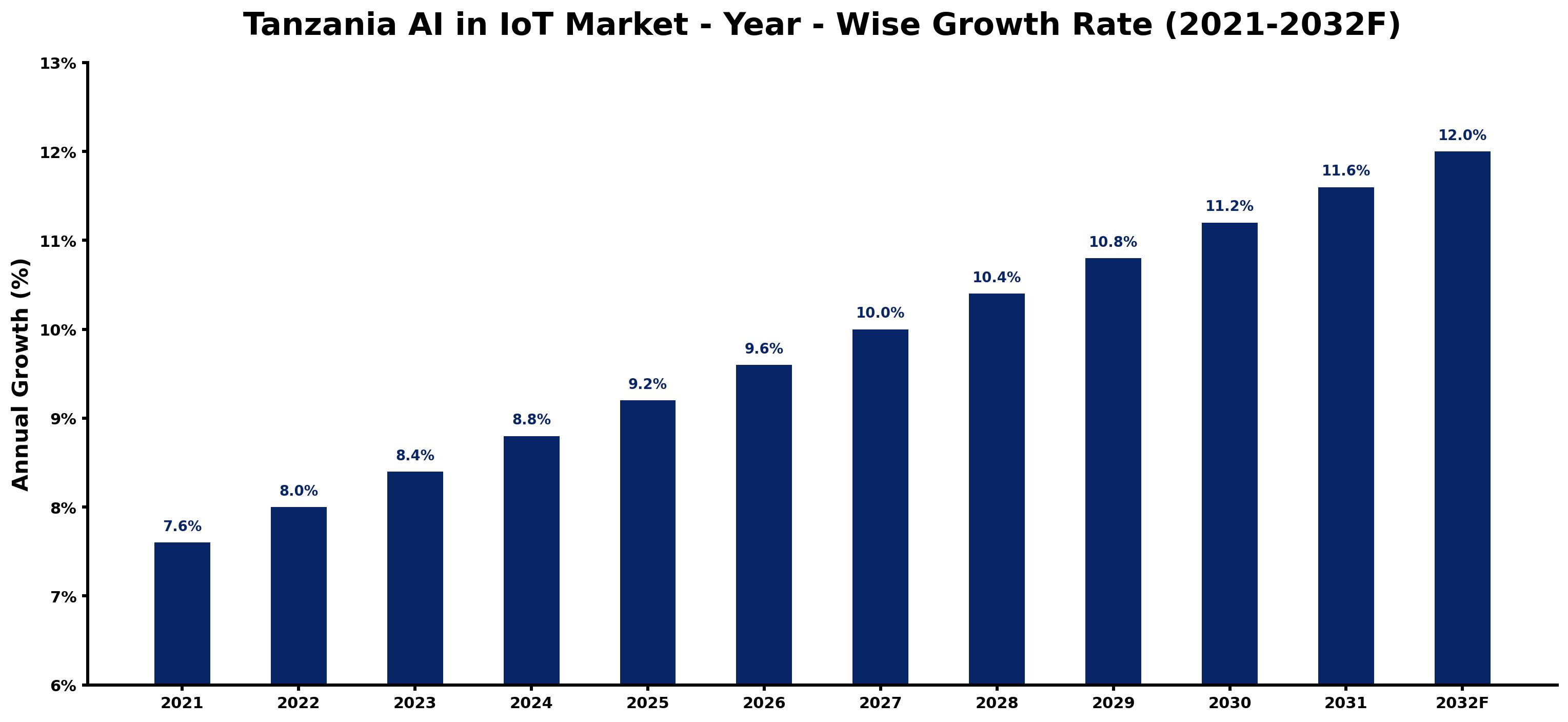
The table below presents the year‑wise growth rates along with the key drivers influencing the market
| Year | Growth Rate | Major Drivers |
| 2021 | 7.6% | Government's National ICT Policy promoting digital innovation. |
| 2022 | 8.0% | Increased funding for smart agriculture initiatives nationwide. |
| 2023 | 8.4% | Support from Tanzania Communication Regulatory Authority for IoT standards. |
| 2024 | 8.8% | Growing urbanization driving smart city IoT applications. |
| 2025 | 9.2% | Local tech startups focusing on AI-driven IoT solutions. |
| 2026 | 9.6% | Investments in renewable energy optimizing IoT resource management. |
| 2027 | 10.0% | Tanzanian youth embracing tech entrepreneurship in IoT. |
| 2028 | 10.4% | Adoption of AI in logistics enhancing supply chain efficiency. |
| 2029 | 10.8% | Government incentives for smart home technology adoption. |
| 2030 | 11.2% | Increasing smartphone penetration improving IoT accessibility. |
| 2031 | 11.6% | Partnerships with regional universities advancing IoT research. |
| 2032 | 12.0% | International collaborations boosting AI capabilities in IoT. |
Note: Market size estimations and growth projections presented in this report are based on 6Wresearch's proprietary forecasting methodology, utilizing the latest available industry data, government publications, and primary research inputs.
Tanzania AI in IoT Market Key Takeaways
Below are some of the specific key takeaways from the market, including:
- Growing implementation of AI-driven solutions to improve operational efficiency across sectors.
- Increased focus on real-time data analytics for better decision-making processes.
- Government initiatives are actively supporting the digital transformation agenda.
- Challenges such as data privacy concerns and infrastructure gaps still need addressing.
- Investment opportunities are emerging particularly in agriculture and smart city projects.
Evaluation of Restraints in Tanzania AI in IoT Market
The Tanzania AI in IoT market faces several hurdles that could impede its growth. Limited internet connectivity, especially in rural areas, restricts the full potential of IoT applications. on top of that, the high costs associated with deploying AI and IoT technologies deter smaller enterprises from investing. There’s also a persistent skills gap, making it challenging for organizations to find qualified professionals capable of managing these complex systems. Data privacy and security concerns further complicate the landscape, as businesses navigate regulatory uncertainties and the potential risks associated with adopting new technologies.
Tanzania AI in IoT Market Trends
Current trends in the Tanzania AI in IoT market indicate a growing integration of AI algorithms with IoT devices. Companies are increasingly focusing on automating processes to enhance operational efficiency. The healthcare sector, for example, is witnessing a surge in AI-powered tools for remote patient monitoring and predictive analytics.
There's also a marked shift towards developing solutions that offer real-time insights and user personalization. As more organizations recognize the transformative potential of connected devices, the market is likely to evolve rapidly, reflecting a blend of innovation and practical applications.
Tanzania AI in IoT Market Opportunities
The AI in IoT market in Tanzania presents numerous investment avenues, particularly in sectors like agriculture, healthcare, and smart cities. With ongoing government support for digital transformation, there's a rising demand for AI solutions that can sift through and analyze large datasets. Investors might consider developing AI algorithms tailored for predictive maintenance in agriculture, enhancing energy management systems, or establishing smart infrastructure solutions in urban areas.
The potential for AI-powered IoT platforms that facilitate seamless communication among devices also remains a lucrative prospect, aligning with the country's technological advancements and infrastructure improvements.
Government Initiatives in the Tanzania AI in IoT Market
The Tanzanian government is actively fostering the growth of the AI and IoT market through strategic policies and initiatives. With the National ICT Policy focused on creating an enabling environment for technological adoption, there is significant momentum towards enhancing digital infrastructure. These initiatives are critical in driving the digital transformation agenda that is vital for the AI and IoT sectors.
- A recently completed initiative to expand internet connectivity across rural areas aims to facilitate better access to IoT solutions.
- Currently underway is the Tanzania Smart Cities Project, which leverages AI and IoT to improve urban services and infrastructure.
- A planned national AI framework will guide the ethical and practical deployment of AI technologies across various industries.
- The government has initiated collaborations with educational institutions to enhance digital literacy and skills development in AI and IoT.
- Ongoing regulatory reforms are aimed at addressing data privacy and security concerns, creating a safer environment for technology adoption.
Future Insights of the Tanzania AI in IoT Market
Looking ahead to 2026-2032, the Tanzania AI in IoT market is likely to experience significant expansion. The increasing adoption of IoT devices will drive demand for AI solutions capable of processing and interpreting the data generated. With continued government support for digital initiatives, businesses will increasingly recognize the value of AI in enhancing operational efficiency and improving customer experiences.
As technology becomes more ingrained in business practices, organizations that embrace AI-powered IoT solutions will be better positioned to thrive in a competitive environment.
Tanzania AI in IoT Market Latest Developments
Recent activity in the Tanzania AI in IoT market has been characterized by a surge in innovation and investment. Companies are actively exploring new partnerships and technological advancements to stay ahead of the curve. With a focus on enhancing operational efficiencies, businesses are increasingly investing in AI-driven solutions.
- A major technology vendor launched an AI-powered analytics platform in early 2025, designed to support healthcare providers in remote patient monitoring.
- An initiative that began in mid-2025 is currently underway, aimed at integrating IoT devices with agricultural management systems to improve crop yields.
- Upcoming in 2026, a rollout is planned for a national AI training program targeting young professionals in the tech sector.
- In Q3 2025, a leading regional operator completed an upgrade of its IoT infrastructure, enhancing connectivity for smart city applications.
- A collaborative project between government and private sector is expected to kick off in early 2026, focusing on developing AI-driven solutions for urban planning.
Tanzania AI in IoT Market - Key Attractiveness of the Report
- 10 Years of Market Numbers
- Historical Data Starting from 2022 to 2025
- Base Year: 2025
- Forecast Data until 2032
- Key Performance Indicators Impacting the Market
- Major Upcoming Developments and Projects
Key Highlights of the Report:
- Tanzania AI in IoT Market Outlook
- Market Size of Tanzania AI in IoT Market, 2025
- Forecast of Tanzania AI in IoT Market, 2032
- Historical Data and Forecast of Tanzania AI in IoT Revenues & Volume for the Period 2022-2032F
- Tanzania AI in IoT Market Trend Evolution
- Tanzania AI in IoT Market Drivers and Challenges
- Tanzania AI in IoT Price Trends
- Tanzania AI in IoT Porter's Five Forces
- Tanzania AI in IoT Industry Life Cycle
- Historical Data and Forecast of Tanzania AI in IoT Market Revenues & Volume By Component for the Period 2022-2032F
- Historical Data and Forecast of Tanzania AI in IoT Market Revenues & Volume By Platforms for the Period 2022-2032F
- Historical Data and Forecast of Tanzania AI in IoT Market Revenues & Volume By Software Solutions for the Period 2022-2032F
- Historical Data and Forecast of Tanzania AI in IoT Market Revenues & Volume By Services for the Period 2022-2032F
- Historical Data and Forecast of Tanzania AI in IoT Market Revenues & Volume By Vertical for the Period 2022-2032F
- Historical Data and Forecast of Tanzania AI in IoT Market Revenues & Volume By Manufacturing for the Period 2022-2032F
- Historical Data and Forecast of Tanzania AI in IoT Market Revenues & Volume By Energy and Utilities for the Period 2022-2032F
- Historical Data and Forecast of Tanzania AI in IoT Market Revenues & Volume By Transportation and Mobility for the Period 2022-2032F
- Historical Data and Forecast of Tanzania AI in IoT Market Revenues & Volume By BFSI for the Period 2022-2032F
- Historical Data and Forecast of Tanzania AI in IoT Market Revenues & Volume By Government and Defense for the Period 2022-2032F
- Historical Data and Forecast of Tanzania AI in IoT Market Revenues & Volume By Retail for the Period 2022-2032F
- Historical Data and Forecast of Tanzania AI in IoT Market Revenues & Volume By Healthcare and Life Sciences for the Period 2022-2032F
- Historical Data and Forecast of Tanzania AI in IoT Market Revenues & Volume By Telecom for the Period 2022-2032F
- Historical Data and Forecast of Tanzania AI in IoT Market Revenues & Volume By Technology for the Period 2022-2032F
- Historical Data and Forecast of Tanzania AI in IoT Market Revenues & Volume By ML and Deep Learning for the Period 2022-2032F
- Historical Data and Forecast of Tanzania AI in IoT Market Revenues & Volume By NLP for the Period 2022-2032F
- Tanzania AI in IoT Import Export Trade Statistics
- Market Opportunity Assessment By Component
- Market Opportunity Assessment By Vertical
- Market Opportunity Assessment By Technology
- Tanzania AI in IoT Top Companies Market Share
- Tanzania AI in IoT Competitive Benchmarking By Technical and Operational Parameters
- Tanzania AI in IoT Company Profiles
- Tanzania AI in IoT Key Strategic Recommendations






































