Tanzania Amoxicillin Market Size, Share & Growth Rate
The Tanzania Amoxicillin Market was estimated at USD 430 Million in 2025 and is projected to reach USD 609 Million by 2032, growing at a CAGR of 5.1% from 2026 to 2032. This growth trajectory is primarily fueled by the increasing incidence of bacterial infections, which underscores the essential role that antibiotics like Amoxicillin play in healthcare. As healthcare access improves and public awareness about the effective use of antibiotics rises, the demand for Amoxicillin is expected to further intensify.
Tanzania Amoxicillin Market Year-wise Growth Rate and Key Drivers
This graph highlights how the Tanzania Amoxicillin Market has steadily grown over the years, supported by major growth factors.
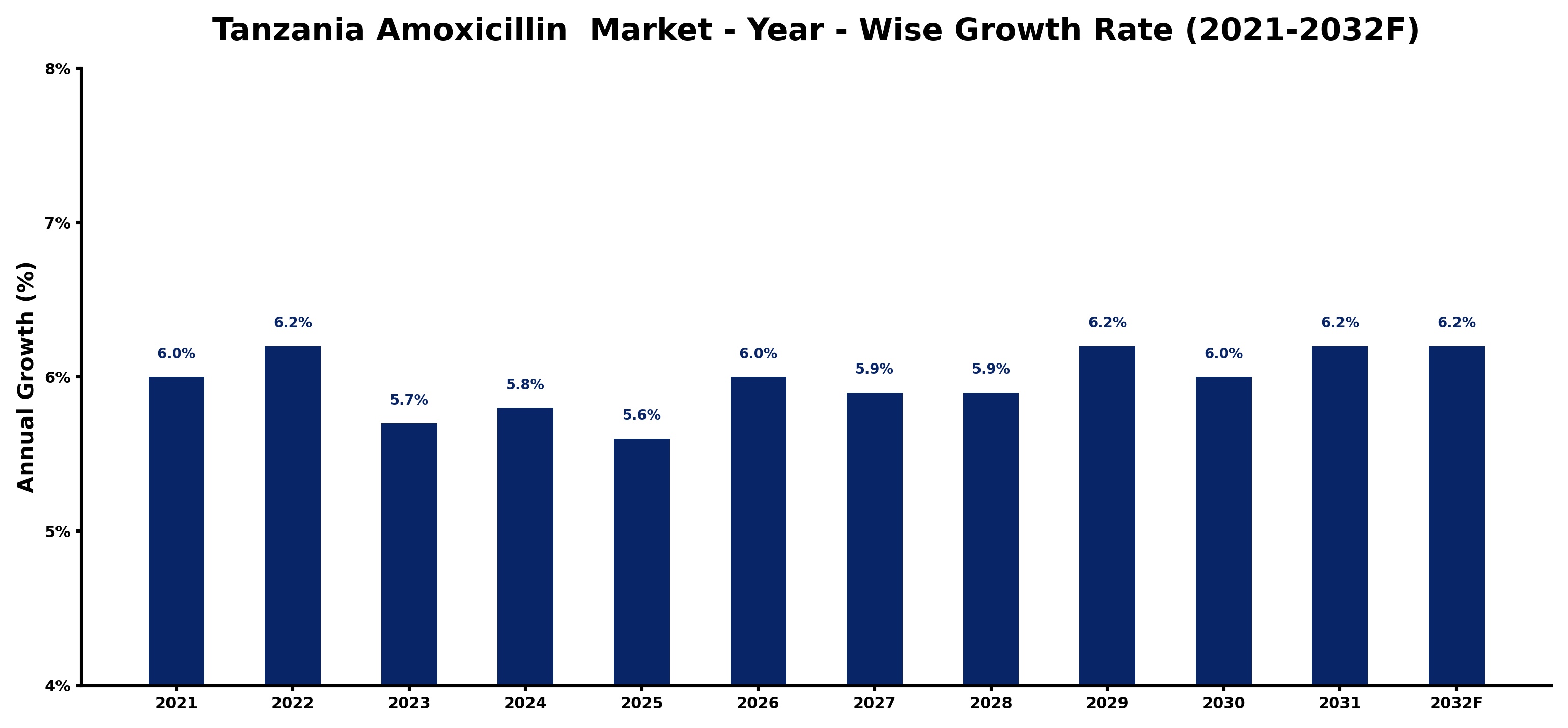
The table below presents the year‑wise growth rates along with the key drivers influencing the market
| Year | Growth Rate | Major Drivers |
| 2021 | 6.0% | Local pharmaceutical manufacturing investments boost Amoxicillin production capacity |
| 2022 | 6.2% | Domestic pharmaceutical firms invest in larger amoxicillin manufacturing facilities |
| 2023 | 5.7% | Local pharmaceutical manufacturing bolstered amoxicillin supply chain resilience |
| 2024 | 5.8% | Pharmaceutical companies invest in upgraded facilities for amoxicillin production |
| 2025 | 5.6% | Pharmaceutical manufacturers upgraded facilities to boost amoxicillin production capacity |
| 2026 | 6.0% | Improved laboratory automation boosts Amoxicillin production efficiency in Tanzania |
| 2027 | 5.9% | Pharmaceutical manufacturers upgrade facilities for increased amoxicillin production capacity |
| 2028 | 5.9% | Amoxicillin manufacturing capacity expansion boosted regional pharmaceutical supply stability |
| 2029 | 6.2% | Local pharmaceutical manufacturers enhance capacity through advanced production technologies |
| 2030 | 6.0% | Pharmaceutical partnerships boosted local amoxicillin production capacity growth |
| 2031 | 6.2% | Digitalization in manufacturing improved amoxicillin production efficiency |
| 2032 | 6.2% | Pharmaceutical manufacturing upgrades boosted amoxicillin production capabilities in Tanzania |
Note - Market size estimations and growth projections presented in this report are based on 6Wresearch’s advanced forecasting approach, validated with industry datasets as of June 2026.
Tanzania Amoxicillin Market Synopsis
Currently, the Tanzania Amoxicillin market is on a growth trajectory, propelled by a mix of rising bacterial infections and an expanding healthcare framework. With the effectiveness of Amoxicillin in treating various bacterial conditions, healthcare providers are increasingly reliant on this antibiotic to address public health needs.
Moreover, the emergence of affordable generic formulations has made Amoxicillin more accessible to a broader segment of the population. Government initiatives aimed at strengthening healthcare infrastructure and increasing the availability of essential medicines are also pivotal in driving market dynamics.
Tanzania Amoxicillin Market Key Takeaways
- The market is characterized by a competitive landscape with a variety of formulations available, including tablets and oral suspensions.
- Government programs aim to improve access to Amoxicillin, especially in rural and underserved areas.
- Increasing awareness regarding the appropriate use of antibiotics is reshaping healthcare practices.
- Investment opportunities abound in manufacturing high-quality generic Amoxicillin and in R&D for improved formulations.
- Challenges related to counterfeit drugs highlight the need for enhanced regulatory frameworks.
Evaluation of Restraints in Tanzania Amoxicillin Market
Despite the positive growth trajectory, the Tanzania Amoxicillin market faces significant restraints that impede its potential. The infiltration of counterfeit products poses a serious risk not only to patient safety but also to the credibility of legitimate suppliers. Additionally, inadequate healthcare facilities in rural areas hinder the effective distribution of Amoxicillin, creating disparities in access to essential medications. The regulatory environment, while improving, still struggles with enforcement challenges, allowing substandard products to reach the market, which further complicates public health efforts.
Tanzania Amoxicillin Market Trends
Current trends in the Tanzania Amoxicillin market highlight a shift towards the availability of generic versions, which are increasingly popular due to their lower cost. Furthermore, strategic partnerships among pharmaceutical companies are emerging to expand distribution networks, ensuring that Amoxicillin reaches both urban and rural populations more efficiently. There is also a growing focus on developing combination therapies that can enhance treatment outcomes, further driving the demand for Amoxicillin as a versatile treatment option.
Tanzania Amoxicillin Market Opportunities
The landscape for investment in the Tanzania Amoxicillin market is ripe with opportunities. As the demand for effective antibiotics grows, local and international investors can tap into the manufacturing and distribution of high-quality generics. There is a notable gap in research and development for innovative formulations and delivery methods, presenting a significant area for investment. Additionally, collaborations with healthcare providers and government initiatives to enhance medicine accessibility can lead to mutually beneficial outcomes that improve public health and yield profitable returns.
Government Initiatives in the Tanzania Amoxicillin Market
The Tanzanian government has enacted several policies to ensure that Amoxicillin remains accessible, affordable, and high-quality. The Tanzania Medicines and Medical Devices Authority (TMDA) plays a crucial role in regulating pharmaceutical products to protect public health. Moreover, initiatives like the Tanzania Pharmaceutical Industries Development Policy aim to bolster local manufacturing capabilities, reducing dependency on imported medicines. Collaborative efforts with international organizations are also underway to ensure that essential medicines, including Amoxicillin, reach remote and vulnerable populations through targeted public health campaigns.
Future Insights of the Tanzania Amoxicillin Market
Looking ahead to 2026-2032, the Tanzania Amoxicillin market is poised for continued growth. Enhanced healthcare infrastructure and rising awareness of antibiotic importance will contribute significantly to this upward trend. With infectious diseases remaining a pressing public health concern, the demand for Amoxicillin is expected to remain strong. Market players who prioritize innovation in product offerings and establish robust distribution networks will likely find themselves at the forefront of this evolving landscape.
Tanzania Amoxicillin Market Latest Developments (May 2025 - June 2026)
In recent months, there has been a notable push towards increasing the production of generic Amoxicillin to meet rising demand. Furthermore, various public health campaigns focusing on the safe and effective use of antibiotics are gaining traction, which is essential for combatting issues related to antibiotic resistance. Collaborations between government entities and pharmaceutical stakeholders are being intensified to enhance distribution frameworks, ensuring that Amoxicillin is more readily available across diverse regions of Tanzania.
Tanzania Amoxicillin Market - Key Attractiveness of the Report
- 10 Years of Market Numbers
- Historical Data Starting from 2022 to 2025
- Base Year: 2025
- Forecast Data until 2032
- Key Performance Indicators Impacting the Market
- Major Upcoming Developments and Projects
Key Highlights of the Report:
- Tanzania Amoxicillin Market Outlook
- Market Size of Tanzania Amoxicillin Market, 2025
- Forecast of Tanzania Amoxicillin Market, 2032
- Historical Data and Forecast of Tanzania Amoxicillin Revenues & Volume for the Period 2022-2032F
- Tanzania Amoxicillin Market Trend Evolution
- Tanzania Amoxicillin Market Drivers and Challenges
- Tanzania Amoxicillin Price Trends
- Tanzania Amoxicillin Porter's Five Forces
- Tanzania Amoxicillin Industry Life Cycle
- Historical Data and Forecast of Tanzania Amoxicillin Market Revenues & Volume By Infection Type for the Period 2022-2032F
- Historical Data and Forecast of Tanzania Amoxicillin Market Revenues & Volume By Skin Infections for the Period 2022-2032F
- Historical Data and Forecast of Tanzania Amoxicillin Market Revenues & Volume By ENT (Ear, Nose & Throat) Infections for the Period 2022-2032F
- Historical Data and Forecast of Tanzania Amoxicillin Market Revenues & Volume By Stomach Infections for the Period 2022-2032F
- Historical Data and Forecast of Tanzania Amoxicillin Market Revenues & Volume By Lungs Infections for the Period 2022-2032F
- Historical Data and Forecast of Tanzania Amoxicillin Market Revenues & Volume By Urinary tract infections (UTI) for the Period 2022-2032F
- Historical Data and Forecast of Tanzania Amoxicillin Market Revenues & Volume By Pneumonia for the Period 2022-2032F
- Historical Data and Forecast of Tanzania Amoxicillin Market Revenues & Volume By Bronchitis for the Period 2022-2032F
- Historical Data and Forecast of Tanzania Skin Infections Amoxicillin Market Revenues & Volume By Gonorrhea for the Period 2022-2032F
- Historical Data and Forecast of Tanzania Amoxicillin Market Revenues & Volume By Route of Administration for the Period 2022-2032F
- Historical Data and Forecast of Tanzania Amoxicillin Market Revenues & Volume By Oral for the Period 2022-2032F
- Historical Data and Forecast of Tanzania Amoxicillin Market Revenues & Volume By Intravenous for the Period 2022-2032F
- Historical Data and Forecast of Tanzania Amoxicillin Market Revenues & Volume By Form for the Period 2022-2032F
- Historical Data and Forecast of Tanzania Amoxicillin Market Revenues & Volume By Tablets for the Period 2022-2032F
- Historical Data and Forecast of Tanzania Amoxicillin Market Revenues & Volume By Capsule for the Period 2022-2032F
- Historical Data and Forecast of Tanzania Amoxicillin Market Revenues & Volume By Suspensions for the Period 2022-2032F
- Historical Data and Forecast of Tanzania Amoxicillin Market Revenues & Volume By Syrup for the Period 2022-2032F
- Historical Data and Forecast of Tanzania Amoxicillin Market Revenues & Volume By Powder for the Period 2022-2032F
- Historical Data and Forecast of Tanzania Amoxicillin Market Revenues & Volume By Distribution Channel for the Period 2022-2032F
- Historical Data and Forecast of Tanzania Amoxicillin Market Revenues & Volume By Hospitals Pharmacies for the Period 2022-2032F
- Historical Data and Forecast of Tanzania Amoxicillin Market Revenues & Volume By Retail Pharmacies for the Period 2022-2032F
- Historical Data and Forecast of Tanzania Amoxicillin Market Revenues & Volume By Online Pharmacies for the Period 2022-2032F
- Historical Data and Forecast of Tanzania Amoxicillin Market Revenues & Volume By Others for the Period 2022-2032F
- Tanzania Amoxicillin Import Export Trade Statistics
- Market Opportunity Assessment By Infection Type
- Market Opportunity Assessment By Route of Administration
- Market Opportunity Assessment By Form
- Market Opportunity Assessment By Distribution Channel
- Tanzania Amoxicillin Top Companies Market Share
- Tanzania Amoxicillin Competitive Benchmarking By Technical and Operational Parameters
- Tanzania Amoxicillin Company Profiles
- Tanzania Amoxicillin Key Strategic Recommendations






































