Tanzania Biocides Market: Top 5 Importing Countries and Market Competition (HHI) Analysis
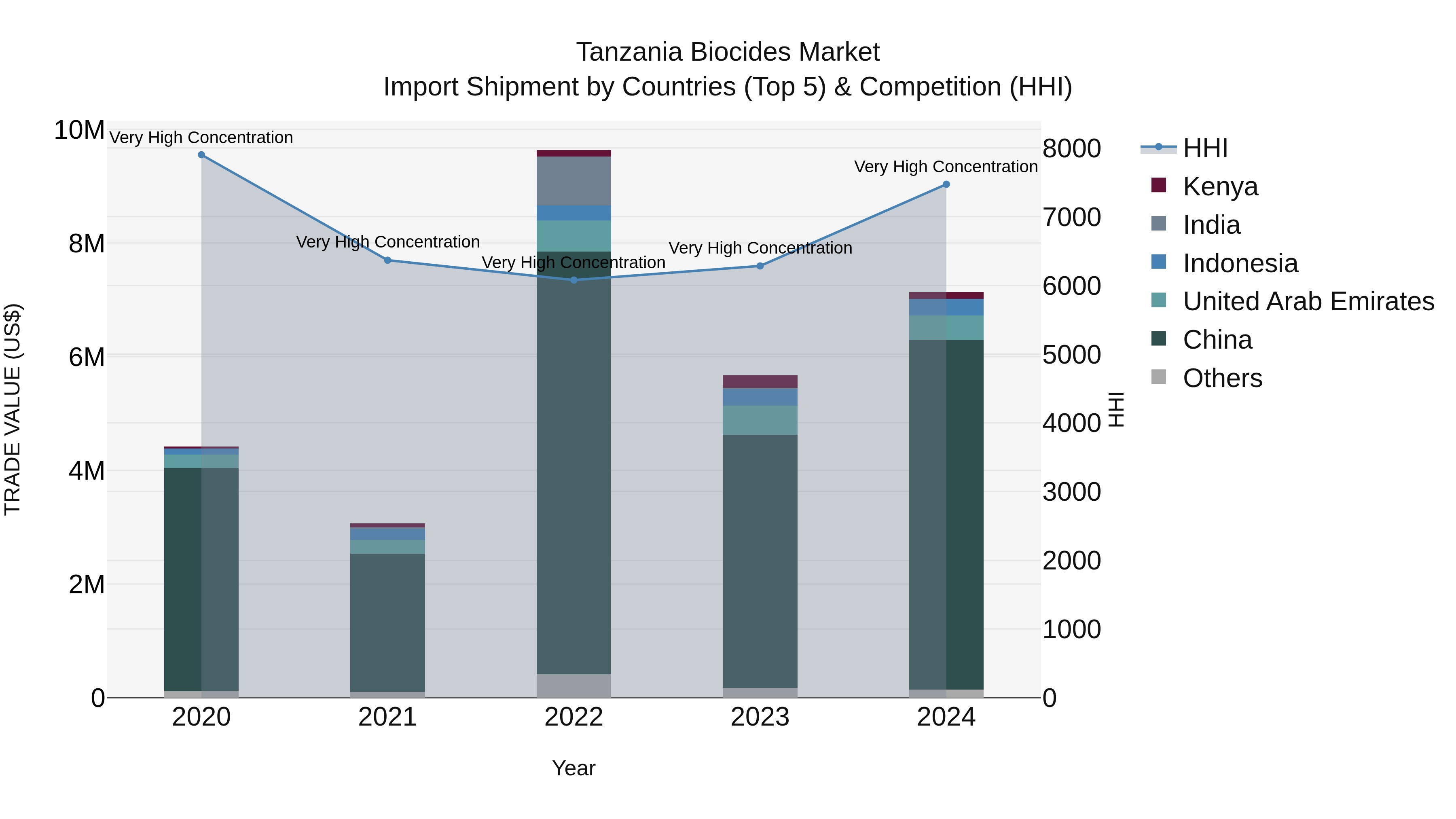
Tanzania`s biocides import market in 2024 continued to see significant concentration among top exporting countries, with China, UAE, Indonesia, Kenya, and Belgium leading the pack. The high Herfindahl-Hirschman Index (HHI) indicates a concentrated market structure. A strong compound annual growth rate (CAGR) of 12.75% from 2020 to 2024 illustrates sustained demand. Notably, the impressive 25.9% growth rate from 2023 to 2024 points to accelerating market expansion and opportunities for both local and international biocides suppliers.
Tanzania Biocides Market Overview
The Tanzania Biocides Market is characterized by steady growth driven by increasing awareness about the importance of hygiene and sanitation across various industries including agriculture, healthcare, and water treatment. The market is primarily dominated by key players offering a wide range of biocidal products such as disinfectants, pesticides, and preservatives to combat microbial growth. With a growing population and rising concerns regarding disease prevention, there is a growing demand for biocides in Tanzania. The government`s initiatives to promote sustainable development and improve public health standards also contribute to the market growth. However, challenges such as regulatory hurdles and environmental concerns regarding the use of certain biocidal products pose potential obstacles to market expansion in the region.
Tanzania Biocides Market Trends and Opportunities
The Tanzania Biocides Market is witnessing a growing demand due to increased awareness about hygiene and sanitation, especially in light of the ongoing global health crisis. The market is experiencing a shift towards more eco-friendly and sustainable biocide products, driven by regulatory pressure and consumer preferences for environmentally safe solutions. Opportunities exist for innovative biocide formulations that are effective against a wide range of pathogens while being non-toxic and safe for humans and the environment. With the government`s focus on improving healthcare infrastructure and sanitation practices, the biocides market in Tanzania is poised for growth, particularly in sectors such as healthcare, water treatment, and agriculture. Collaboration with local manufacturers and distributors can help international biocide companies establish a strong presence in the Tanzanian market.
Tanzania Biocides Market Challenges
In the Tanzania biocides market, some of the main challenges faced include limited awareness and understanding of the importance of biocides in various industries, such as agriculture and healthcare. There is also a lack of stringent regulations and enforcement mechanisms to ensure the safe and effective use of biocidal products. Additionally, the availability of counterfeit or substandard biocides in the market poses a significant threat to human health and the environment. Infrastructure limitations, such as inadequate storage facilities and transportation networks, further hinder the distribution and accessibility of biocides in remote or rural areas. Addressing these challenges will require collaborative efforts from government agencies, industry stakeholders, and regulatory bodies to promote education, improve regulatory frameworks, and enhance quality control measures in the Tanzania biocides market.
Tanzania Biocides Market Drivers
The Tanzania Biocides Market is primarily driven by factors such as increasing awareness about the importance of maintaining hygiene and sanitation in various industries, including healthcare, food processing, and agriculture. The rising incidences of infectious diseases and foodborne illnesses have led to a growing demand for biocides to control and prevent the spread of pathogens and pests. Additionally, stringent regulations imposed by government authorities to ensure public health and safety have also propelled the market growth. The expansion of key end-user industries such as water treatment, personal care, and construction further drives the demand for biocides in Tanzania. Moreover, technological advancements in biocide formulations and increasing investments in research and development activities are expected to fuel market growth in the coming years.
Tanzania Biocides Market Government Policies
The Tanzanian government regulates the biocides market through the Pest Control Products Board (PCPB) under the Ministry of Agriculture. The PCPB is responsible for registering and regulating the importation, distribution, sale, and use of biocidal products in the country. All biocides must be registered with the PCPB before they can be sold or used in Tanzania, and manufacturers and distributors must comply with the board`s licensing requirements. Additionally, the government has established maximum residue limits for biocides in food products to ensure consumer safety. The enforcement of these regulations is crucial to safeguard public health and the environment from the adverse effects of biocides.
Tanzania Biocides Market Future Outlook
The Tanzania Biocides Market is poised for steady growth in the foreseeable future, driven by increasing awareness about the importance of maintaining hygiene and preventing disease transmission. The market is expected to benefit from the growing demand for biocidal products across various industries such as healthcare, agriculture, and water treatment. Additionally, stringent regulations focusing on controlling microbial contamination and promoting environmental sustainability will further boost market growth. Companies operating in the Tanzania Biocides Market are likely to invest in research and development activities to introduce innovative and eco-friendly biocidal solutions. Overall, the market is anticipated to expand as businesses and consumers prioritize health and safety measures, creating opportunities for both local and international biocide manufacturers to penetrate the Tanzanian market.
Key Highlights of the Report:
- Tanzania Biocides Market Outlook
- Market Size of Tanzania Biocides Market, 2024
- Forecast of Tanzania Biocides Market, 2031
- Historical Data and Forecast of Tanzania Biocides Revenues & Volume for the Period 2021 - 2031
- Tanzania Biocides Market Trend Evolution
- Tanzania Biocides Market Drivers and Challenges
- Tanzania Biocides Price Trends
- Tanzania Biocides Porter's Five Forces
- Tanzania Biocides Industry Life Cycle
- Historical Data and Forecast of Tanzania Biocides Market Revenues & Volume By Type for the Period 2021 - 2031
- Historical Data and Forecast of Tanzania Biocides Market Revenues & Volume By Oxidizing Biocide for the Period 2021 - 2031
- Historical Data and Forecast of Tanzania Biocides Market Revenues & Volume By Non-Oxidizing Biocide for the Period 2021 - 2031
- Historical Data and Forecast of Tanzania Biocides Market Revenues & Volume By Others for the Period 2021 - 2031
- Historical Data and Forecast of Tanzania Biocides Market Revenues & Volume By Application for the Period 2021 - 2031
- Historical Data and Forecast of Tanzania Biocides Market Revenues & Volume By Water Treatment for the Period 2021 - 2031
- Historical Data and Forecast of Tanzania Biocides Market Revenues & Volume By Household for the Period 2021 - 2031
- Historical Data and Forecast of Tanzania Biocides Market Revenues & Volume By Industrial & Institutional Cleaning and Home Care for the Period 2021 - 2031
- Historical Data and Forecast of Tanzania Biocides Market Revenues & Volume By Paints & Coatings for the Period 2021 - 2031
- Historical Data and Forecast of Tanzania Biocides Market Revenues & Volume By Wood Preservatives for the Period 2021 - 2031
- Historical Data and Forecast of Tanzania Biocides Market Revenues & Volume By Others for the Period 2021 - 2031
- Tanzania Biocides Import Export Trade Statistics
- Market Opportunity Assessment By Type
- Market Opportunity Assessment By Application
- Tanzania Biocides Top Companies Market Share
- Tanzania Biocides Competitive Benchmarking By Technical and Operational Parameters
- Tanzania Biocides Company Profiles
- Tanzania Biocides Key Strategic Recommendations






































