Tanzania Bulletproof Glass Market Size, Share & Growth Rate
The Tanzania Bulletproof Glass Market was estimated at USD 217 Million in 2025 and is projected to reach USD 289 Million by 2032, growing at a CAGR of 4.2% from 2026 to 2032. This growth trajectory is primarily fueled by a surge in security concerns across key sectors including banking, retail, and government. Additionally, the adoption of advanced technology in bulletproof glass production is enhancing the overall product quality, making it more appealing to end-users looking for reliable and effective safety solutions.
Tanzania Bulletproof Glass Market Year-wise Growth Rate and Key Drivers
This graph highlights how the Tanzania Bulletproof Glass Market has steadily grown over the years, supported by major growth factors.
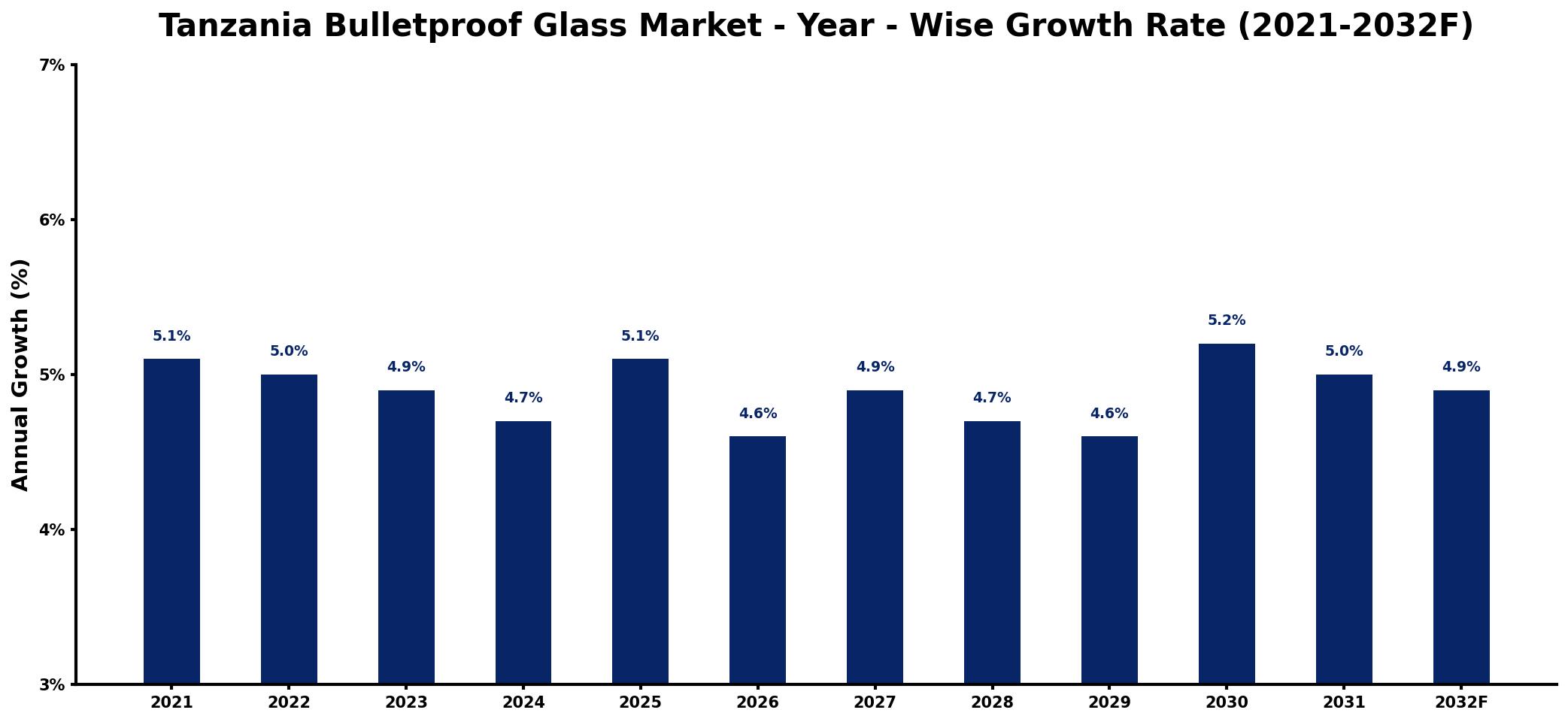
The table below presents the year‑wise growth rates along with the key drivers influencing the market
| Year | Growth Rate | Major Drivers |
| 2021 | 5.1% | increased capital investment inflows |
| 2022 | 5.0% | Increased investment in safety infrastructure |
| 2023 | 4.9% | Growing demand from residential sector |
| 2024 | 4.7% | Expansion of commercial property developments |
| 2025 | 5.1% | Surge in government security projects |
| 2026 | 4.6% | Heightened awareness of personal safety |
| 2027 | 4.9% | Adoption of advanced security technologies |
| 2028 | 4.7% | Increased insurance coverage for properties |
| 2029 | 4.6% | Rising crime rates prompting demand |
| 2030 | 5.2% | Growing exports to neighboring regions |
| 2031 | 5.0% | rising procurement volume requirements |
| 2032 | 4.9% | Increased regulatory safety standards |
Note: Market size estimations and growth projections presented in this report are based on 6Wresearch's proprietary forecasting methodology, utilizing the latest available industry data, government publications, and primary research inputs.
Tanzania Bulletproof Glass Market Synopsis
In recent years, the Tanzania bulletproof glass market has witnessed significant momentum, propelled by a heightened focus on security amid rising crime rates. As industries across the country recognize the necessity for enhanced protection, the market is moving towards a future characterized by innovative products and custom solutions tailored to various needs.
Looking ahead, the market is on an upward trajectory, with an increasing number of commercial enterprises and government institutions investing in bulletproof glass as a standard security measure. The integration of lighter and more transparent materials is not only revolutionizing the market but also appealing to environmentally-conscious consumers, signaling a shift in buyer preferences.
Tanzania Bulletproof Glass Market Key Takeaways
- The market is projected to grow significantly, with anticipated revenues reaching USD 289 Million by 2032.
- Heightened security concerns in the banking and automotive sectors are key demand drivers.
- Technological advancements are leading to lighter, more effective bulletproof glass options.
- Customization and tailored solutions are increasingly important to meet diverse consumer needs.
- Government regulations are expected to bolster industry standards and consumer confidence.
Evaluation of Restraints in Tanzania Bulletproof Glass Market
Despite its promising outlook, the Tanzania bulletproof glass market faces several restraints. The high costs associated with production and installation present a barrier for many potential customers. Moreover, limited awareness regarding the advantages of bulletproof glass can impede broader market adoption. The presence of counterfeit products poses additional risks, as it undermines trust in the industry. To overcome these challenges, stakeholders will need to focus on raising awareness, enhancing quality assurance measures, and developing competitive pricing strategies to increase accessibility.
Tanzania Bulletproof Glass Market Trends
Current trends indicate a strong demand for advanced technologies in bulletproof glass production, leading to innovations that prioritize strength without sacrificing transparency. Additionally, there is an increasing shift towards sustainable materials, aligning with global sustainability goals. Customization is also on the rise, as businesses seek unique solutions tailored to their specific security requirements. This focus on innovation and sustainability is expected to define the future of the Tanzania bulletproof glass market.
Tanzania Bulletproof Glass Market Opportunities
The potential for investment in the Tanzania bulletproof glass market is vast, given the increasing emphasis on security across various industries. As crime rates continue to rise, both businesses and individuals are actively seeking ways to enhance safety and protection. The development of lighter and more affordable bulletproof glass options presents a unique opportunity for manufacturers and investors alike. Collaborating with local partners to produce high-quality, tailored products can offer substantial returns, catering specifically to the Tanzanian market's needs.
Government Initiatives in the Tanzania Bulletproof Glass Market
The Tanzanian government is actively promoting policies that regulate the importation, sale, and installation of bulletproof glass. These initiatives aim to ensure compliance with safety standards, ultimately preventing misuse and fostering a secure environment. Proper licensing and adherence to quality control measures are emphasized to maintain product integrity in this burgeoning market. Furthermore, guidelines monitor the application of bulletproof glass in high-risk sectors such as government buildings and financial institutions, contributing to an overall increase in public safety.
Future Insights of the Tanzania Bulletproof Glass Market
The future outlook for the Tanzania bulletproof glass market is optimistic, driven by rising awareness of security threats and increasing demand across various sectors. As socio-political conditions evolve, the market is poised for steady growth. The continuing rise in affluence among the population and the construction industrys integration of bulletproof glass in new projects will further fuel demand. Technological advancements in material science will also likely lead to the emergence of stronger and more versatile products, solidifying the market's growth prospects.
Tanzania Bulletproof Glass Market Latest Developments (2025 - 2026)
In recent months, the bulletproof glass market in Tanzania has seen notable developments, with increased public and private investment aimed at enhancing security measures. Trends indicate that more businesses are adopting advanced security protocols, integrating bulletproof glass into their facilities. Additionally, local manufacturers are increasingly focusing on innovation to meet the specific needs of the Tanzanian market, driving competition and leading to improvements in product offerings.
Tanzania Bulletproof Glass Market - Key Attractiveness of the Report
- 10 Years of Market Numbers
- Historical Data Starting from 2022 to 2025
- Base Year: 2025
- Forecast Data until 2032
- Key Performance Indicators Impacting the Market
- Major Upcoming Developments and Projects
Key Highlights of the Report:
- Tanzania Bulletproof Glass Market Outlook
- Market Size of Tanzania Bulletproof Glass Market, 2025
- Forecast of Tanzania Bulletproof Glass Market, 2032
- Historical Data and Forecast of Tanzania Bulletproof Glass Revenues & Volume for the Period 2022-2032F
- Tanzania Bulletproof Glass Market Trend Evolution
- Tanzania Bulletproof Glass Market Drivers and Challenges
- Tanzania Bulletproof Glass Price Trends
- Tanzania Bulletproof Glass Porter's Five Forces
- Tanzania Bulletproof Glass Industry Life Cycle
- Historical Data and Forecast of Tanzania Bulletproof Glass Market Revenues & Volume By Type for the Period 2022-2032F
- Historical Data and Forecast of Tanzania Bulletproof Glass Market Revenues & Volume By Solid Acrylic for the Period 2022-2032F
- Historical Data and Forecast of Tanzania Bulletproof Glass Market Revenues & Volume By Traditional Laminated for the Period 2022-2032F
- Historical Data and Forecast of Tanzania Bulletproof Glass Market Revenues & Volume By Polycarbonate for the Period 2022-2032F
- Historical Data and Forecast of Tanzania Bulletproof Glass Market Revenues & Volume By Glass-clad Polycarbonate for the Period 2022-2032F
- Historical Data and Forecast of Tanzania Bulletproof Glass Market Revenues & Volume By Other Types for the Period 2022-2032F
- Historical Data and Forecast of Tanzania Bulletproof Glass Market Revenues & Volume By End-user Industry for the Period 2022-2032F
- Historical Data and Forecast of Tanzania Bulletproof Glass Market Revenues & Volume By Automotive for the Period 2022-2032F
- Historical Data and Forecast of Tanzania Bulletproof Glass Market Revenues & Volume By Buildings and Construction for the Period 2022-2032F
- Historical Data and Forecast of Tanzania Bulletproof Glass Market Revenues & Volume By Defense for the Period 2022-2032F
- Historical Data and Forecast of Tanzania Bulletproof Glass Market Revenues & Volume By Other End-user Industries for the Period 2022-2032F
- Tanzania Bulletproof Glass Import Export Trade Statistics
- Market Opportunity Assessment By Type
- Market Opportunity Assessment By End-user Industry
- Tanzania Bulletproof Glass Top Companies Market Share
- Tanzania Bulletproof Glass Competitive Benchmarking By Technical and Operational Parameters
- Tanzania Bulletproof Glass Company Profiles
- Tanzania Bulletproof Glass Key Strategic Recommendations






































