Tanzania Car Air Fresheners Market Size, Share & Growth Rate
The Tanzania Car Air Fresheners Market was estimated at USD 386 Million in 2025 and is projected to reach USD 718 Million by 2032, growing at a CAGR of 9.3% from 2026 to 2032. This growth is primarily fueled by a significant increase in vehicle ownership and the rising awareness among consumers about the necessity of maintaining a pleasant in-car environment. As more Tanzanians prioritize their driving experiences, the demand for diverse and innovative air freshener solutions continues to rise.
Tanzania Car Air Fresheners Market Year-wise Growth Rate and Key Drivers
This graph highlights how the Tanzania Car Air Fresheners Market has steadily grown over the years, supported by major growth factors.
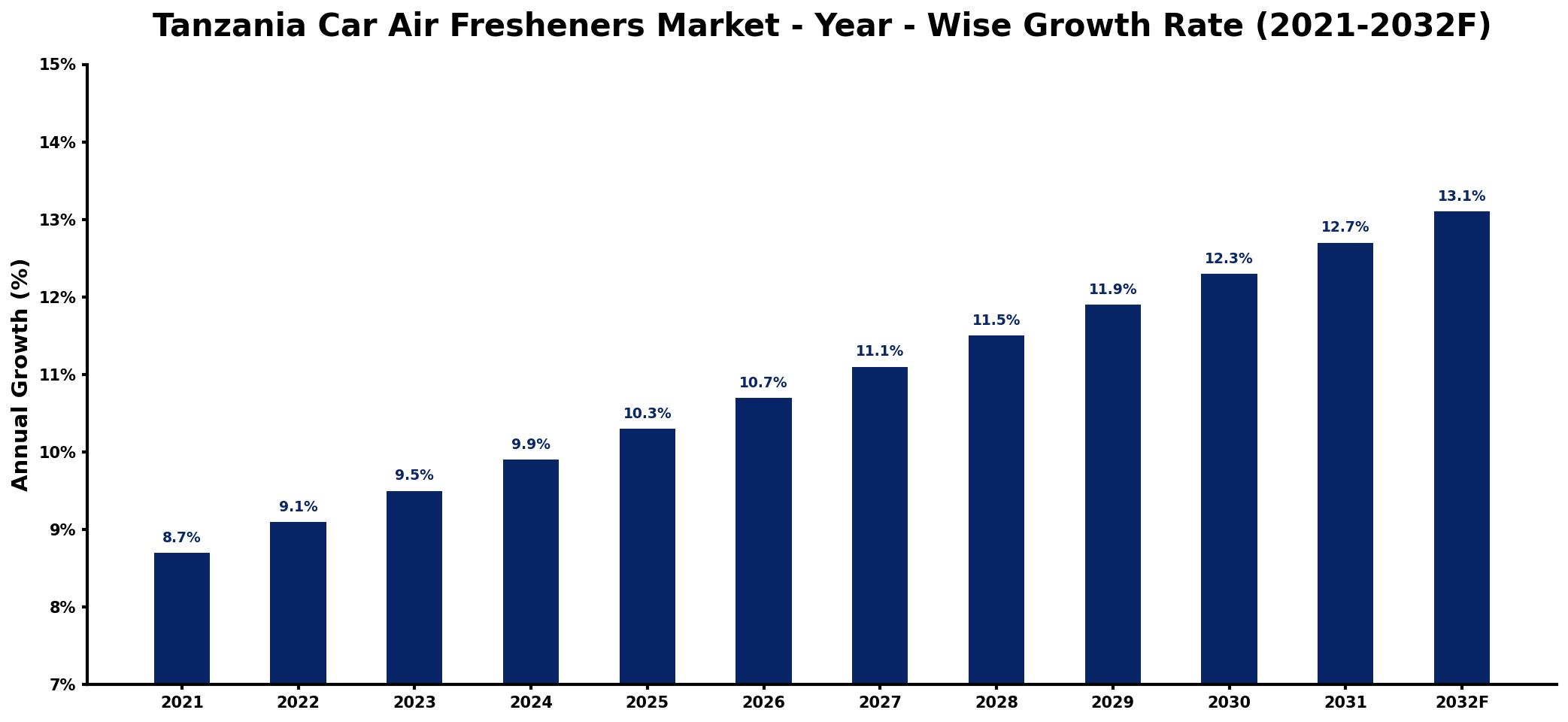
The table below presents the year‑wise growth rates along with the key drivers influencing the market
| Year | Growth Rate | Major Drivers |
| 2021 | 8.7% | Rising disposable income levels |
| 2022 | 9.1% | Increased consumer lifestyle awareness |
| 2023 | 9.5% | Growth in automotive sector demand |
| 2024 | 9.9% | Expansion of retail distribution channels |
| 2025 | 10.3% | Surge in online shopping trends |
| 2026 | 10.7% | Higher investment in advertising campaigns |
| 2027 | 11.1% | Emergence of eco-friendly alternatives |
| 2028 | 11.5% | Development of innovative fragrance options |
| 2029 | 11.9% | Growing popularity of gift products |
| 2030 | 12.3% | Rising tourism and travel activities |
| 2031 | 12.7% | Increase in urban population density |
| 2032 | 13.1% | Enhanced focus on personal wellness |
Note: Market size estimations and growth projections presented in this report are based on 6Wresearch's proprietary forecasting methodology, utilizing the latest available industry data, government publications, and primary research inputs.
Tanzania Car Air Fresheners Market Synopsis
The Tanzania Car Air Fresheners market has seen robust momentum recently, spurred by the growing automotive sector and a shift towards enhancing interior spaces. With consumers becoming more discerning about product quality and fragrance options, the market is poised for further expansion in the upcoming years.
As the focus on sustainability intensifies, there is a noticeable shift towards eco-friendly air fresheners. This includes a preference for natural ingredients and biodegradable materials, aligning with global trends towards environmental consciousness among consumers.
Tanzania Car Air Fresheners Market Key Takeaways
- The market exhibits a strong growth trajectory, driven by increasing car ownership and consumer preference for enhancing vehicle ambiance.
- Eco-friendly products are gaining traction, leading to demand for natural, organic air fresheners.
- Distribution channels are diversifying, with a notable rise in online retailing alongside traditional automotive stores and supermarkets.
- Customization and personalization are becoming key factors influencing consumer purchasing decisions.
- Investment in product innovation is essential for companies to maintain a competitive edge in this dynamic market.
Evaluation of Restraints in Tanzania Car Air Fresheners Market
Despite the positive growth indicators, the Tanzania Car Air Fresheners market faces several restraints. The competitive landscape is intense, with numerous local and international brands vying for consumer attention. Additionally, price sensitivity among consumers can hinder market penetration, especially in regions where disposable incomes are lower. Limited distribution networks in certain areas can also restrict product availability. Furthermore, counterfeit products pose a challenge, impacting brand trust and consumer confidence.
Tanzania Car Air Fresheners Market Trends
The market is increasingly influenced by trends favoring eco-friendly solutions, with consumers showing a preference for biodegradable and natural ingredient-based air fresheners. Essential oil-based products are becoming more popular, offering fragrance options that appeal to health-conscious consumers. The rise of smart air purifiers for cars also indicates a shift towards convenience and technology-driven solutions. Furthermore, personalized fragrance experiences and unique designs are on the rise as consumers seek distinct products that reflect their individual tastes.
Tanzania Car Air Fresheners Market Opportunities
There are several promising investment opportunities within the Tanzania Car Air Fresheners market. Companies can tap into the growing consumer demand for eco-friendly products by developing innovative air freshener solutions that prioritize sustainability. Collaborations with automotive dealerships and service centers to offer tailored air freshener experiences can enhance customer satisfaction and brand loyalty. Additionally, leveraging e-commerce platforms and digital marketing can expand market reach, especially among younger, tech-savvy consumers who are increasingly looking for unique fragrance offerings.
Government Initiatives in the Tanzania Car Air Fresheners Market
The Tanzanian government actively regulates the car air fresheners market to ensure consumer safety and product quality. The Tanzania Bureau of Standards (TBS) establishes regulations regarding labeling, packaging, and ingredients, ensuring that all products meet established quality benchmarks. Furthermore, the Tanzania Food and Drugs Authority (TFDA) supervises compliance with health and safety standards, requiring manufacturers and importers to register their products for approval prior to distribution. These initiatives work towards fostering a competitive and trustworthy market environment.
Future Insights of the Tanzania Car Air Fresheners Market
Looking ahead to 2026-2032, the Tanzania Car Air Fresheners Market is expected to maintain its upward trajectory. The growing automotive sector, paired with rising disposable incomes, is likely to drive demand for innovative car accessories. Consumers will increasingly seek products that not only enhance air quality but also contribute to a pleasant driving experience. With continuous advancements in product offerings and heightened focus on sustainability, the market is set for significant expansion, providing ample opportunities for both new entrants and established players to thrive.
Tanzania Car Air Fresheners Market Latest Developments (2025 - 2026)
In recent months, the Tanzania Car Air Fresheners market has seen a surge in innovation, with brands introducing a variety of eco-friendly and customizable air freshener options. Companies are increasingly adopting digital marketing strategies to better engage with consumers, especially through social media platforms. New collaborations among manufacturers and automotive dealerships are emerging, promoting co-branded air freshener products as part of customer care packages. These developments indicate a vibrant market, responding dynamically to consumer preferences and environmental considerations.
Tanzania Car Air Fresheners Market - Key Attractiveness of the Report
- 10 Years of Market Numbers
- Historical Data Starting from 2022 to 2025
- Base Year: 2025
- Forecast Data until 2032
- Key Performance Indicators Impacting the Market
- Major Upcoming Developments and Projects
Key Highlights of the Report:
- Tanzania Car Air Fresheners Market Outlook
- Market Size of Tanzania Car Air Fresheners Market, 2025
- Forecast of Tanzania Car Air Fresheners Market, 2032
- Historical Data and Forecast of Tanzania Car Air Fresheners Revenues & Volume for the Period 2022-2032F
- Tanzania Car Air Fresheners Market Trend Evolution
- Tanzania Car Air Fresheners Market Drivers and Challenges
- Tanzania Car Air Fresheners Price Trends
- Tanzania Car Air Fresheners Porter's Five Forces
- Tanzania Car Air Fresheners Industry Life Cycle
- Historical Data and Forecast of Tanzania Car Air Fresheners Market Revenues & Volume By Product for the Period 2022-2032F
- Historical Data and Forecast of Tanzania Car Air Fresheners Market Revenues & Volume By Gel & Cans for the Period 2022-2032F
- Historical Data and Forecast of Tanzania Car Air Fresheners Market Revenues & Volume By Spray/Aerosol for the Period 2022-2032F
- Historical Data and Forecast of Tanzania Car Air Fresheners Market Revenues & Volume By Paper Car Air Fresheners for the Period 2022-2032F
- Historical Data and Forecast of Tanzania Car Air Fresheners Market Revenues & Volume By Vents & Clips for the Period 2022-2032F
- Historical Data and Forecast of Tanzania Car Air Fresheners Market Revenues & Volume By End-User for the Period 2022-2032F
- Historical Data and Forecast of Tanzania Car Air Fresheners Market Revenues & Volume By Sports Car for the Period 2022-2032F
- Historical Data and Forecast of Tanzania Car Air Fresheners Market Revenues & Volume By Mid-range Car for the Period 2022-2032F
- Historical Data and Forecast of Tanzania Car Air Fresheners Market Revenues & Volume By SUV for the Period 2022-2032F
- Historical Data and Forecast of Tanzania Car Air Fresheners Market Revenues & Volume By Others for the Period 2022-2032F
- Historical Data and Forecast of Tanzania Car Air Fresheners Market Revenues & Volume By Fragrance for the Period 2022-2032F
- Historical Data and Forecast of Tanzania Car Air Fresheners Market Revenues & Volume By Scented for the Period 2022-2032F
- Historical Data and Forecast of Tanzania Car Air Fresheners Market Revenues & Volume By UnScented for the Period 2022-2032F
- Tanzania Car Air Fresheners Import Export Trade Statistics
- Market Opportunity Assessment By Product
- Market Opportunity Assessment By End-User
- Market Opportunity Assessment By Fragrance
- Tanzania Car Air Fresheners Top Companies Market Share
- Tanzania Car Air Fresheners Competitive Benchmarking By Technical and Operational Parameters
- Tanzania Car Air Fresheners Company Profiles
- Tanzania Car Air Fresheners Key Strategic Recommendations






































