Tanzania Cargo Shipping Market Size, Share & Growth Rate
The Tanzania Cargo Shipping Market was estimated at USD 485 Million in 2025 and is projected to reach USD 684 Million by 2032, growing at a CAGR of 5.0% from 2026 to 2032. This growth trajectory is primarily driven by an increase in trade activities and significant investments in port infrastructure. As Tanzania continues to modernize its ports and logistics processes, the demand for reliable and efficient shipping services is set to rise, bolstered by regional trade agreements and a growing economy.
Tanzania Cargo Shipping Market Year-wise Growth Rate and Key Drivers
This graph highlights how the Tanzania Cargo Shipping Market has steadily grown over the years, supported by major growth factors.
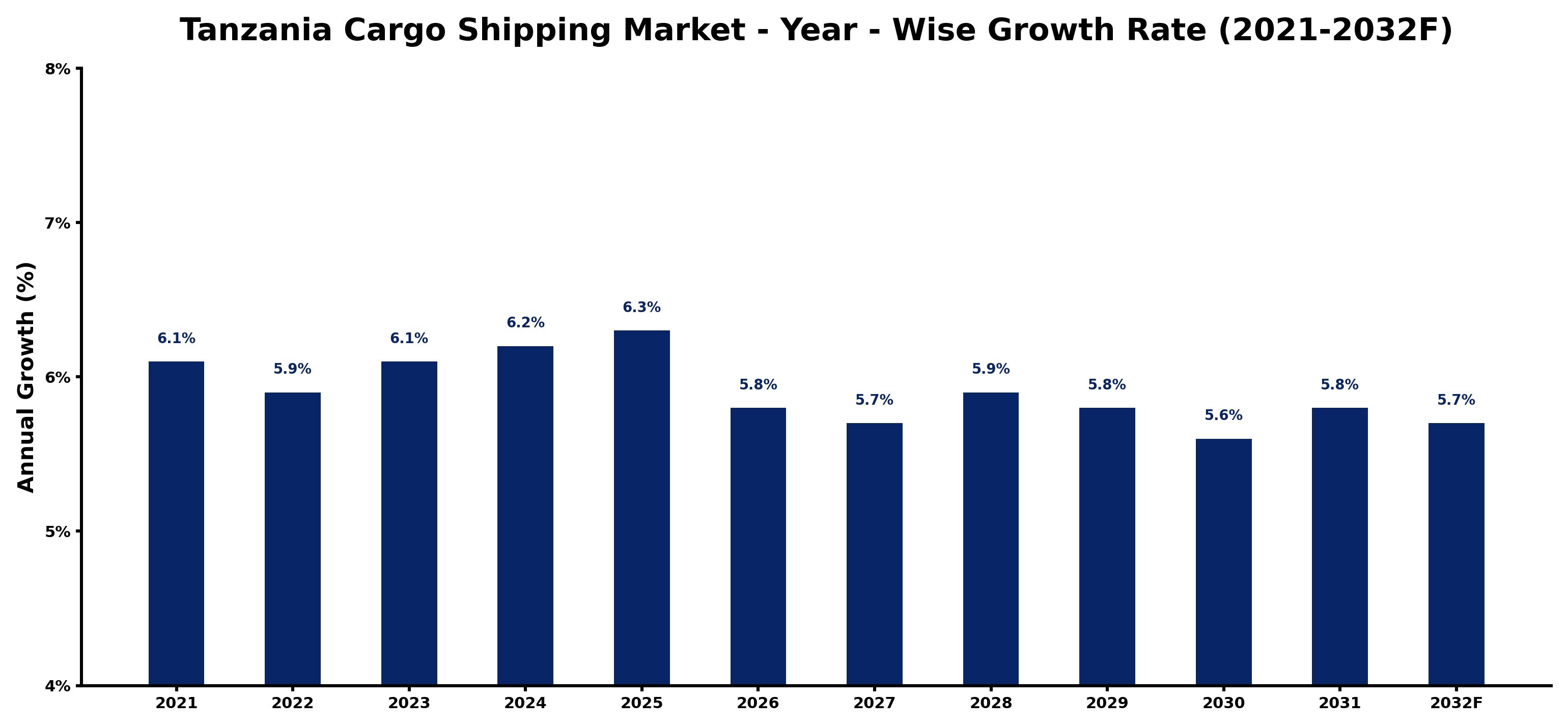
The table below presents the year‑wise growth rates along with the key drivers influencing the market
| Year | Growth Rate | Major Drivers |
| 2021 | 6.1% | Growing urbanization and commercial development |
| 2022 | 5.9% | Expansion of commercial construction activities |
| 2023 | 6.1% | Expansion of manufacturing activities |
| 2024 | 6.2% | Rapid growth in telecom and data center sectors |
| 2025 | 6.3% | Growing urbanization and commercial development |
| 2026 | 5.8% | Expansion of commercial construction activities |
| 2027 | 5.7% | Rapid growth in telecom and data center sectors |
| 2028 | 5.9% | Growing urbanization and commercial development |
| 2029 | 5.8% | Expansion of commercial construction activities |
| 2030 | 5.6% | Rapid growth in telecom and data center sectors |
| 2031 | 5.8% | Expansion of transportation and logistics networks |
| 2032 | 5.7% | Increasing adoption of advanced technologies |
Note - Market size estimations and growth projections presented in this report are based on 6Wresearch's advanced forecasting approach, validated with industry datasets as of June 2026.
Tanzania Cargo Shipping Market Synopsis
Recent developments in Tanzania's cargo shipping sector are indicative of a market on the rise, especially in the strategic ports of Dar es Salaam and Tanga. These ports are vital for facilitating both imports and exports, focusing heavily on containerized cargo and bulk commodities, which are essential for the country's economic growth.
With a diverse mix of international shipping lines and local carriers, the market is witnessing dynamic shifts toward more efficient operations. Ongoing investments aimed at overcoming existing challenges such as port congestion and infrastructure inefficiencies highlight the commitment to enhancing Tanzania's position as a regional shipping hub.
Tanzania Cargo Shipping Market Key Takeaways
- The market is growing due to increased trade volumes and a focus on modernizing port infrastructure.
- Digitalization and technological integration are becoming essential for improved operational efficiency.
- There is a shift towards sustainable shipping practices among operators in the region.
- Increased partnerships among shipping companies are enhancing service offerings and market reach.
- Government initiatives are critical in addressing infrastructure and regulatory challenges to facilitate growth.
Evaluation of Restraints in Tanzania Cargo Shipping Market
The Tanzania Cargo Shipping Market faces several significant restraints that could hinder its growth trajectory. Key among these is inadequate infrastructure, particularly concerning ports and roads, which can lead to increased shipping times and costs. Additionally, inconsistent regulatory frameworks and bureaucratic inefficiencies often obstruct operational fluidity. Limited access to financing options further compounds these issues, restricting investments in fleet modernization and technological upgrades. Competitors from neighboring countries with more advanced logistics systems add pressure on Tanzanian companies to elevate their service standards and operational capabilities to remain competitive.
Tanzania Cargo Shipping Market Trends
The Tanzania Cargo Shipping Market is experiencing several transformative trends that are reshaping the landscape. A notable demand for efficiency is driving shipping companies to adopt digital solutions that streamline operations and enhance customer experiences. There's a growing emphasis on environmentally sustainable practices, reflecting a global shift towards greener logistics. Collaborations and partnerships among carriers are becoming more prevalent, aiming to expand service capabilities and reach untapped markets. Additionally, investments in logistics infrastructure are crucial to managing the increasing volume of cargo traffic as trade within and outside the region expands.
Tanzania Cargo Shipping Market Opportunities
The market offers numerous investment opportunities driven by its strategic coastal location and burgeoning trade volumes. Modernizing port facilities and expanding fleet capacities are vital avenues for growth. Furthermore, leveraging advanced logistics technologies can significantly enhance operational efficiency. The government's focus on facilitating trade through improved transportation networks presents additional opportunities for stakeholders looking to capitalize on Tanzania's growing cargo shipping industry.
Government Initiatives in the Tanzania Cargo Shipping Market
The Tanzanian government plays a pivotal role in shaping the cargo shipping market through various policies and initiatives. The Tanzania Shipping Agencies Act and the Tanzania Ports Authority Act establish regulatory frameworks that aim to enhance operational standards within the industry. Additionally, the National Transport Policy underscores the government's commitment to improving transport infrastructure, which includes ongoing investments in ports and shipping facilities. Regional cooperation through the East African Community (EAC) further strengthens trade facilitation efforts, creating a more conducive environment for the shipping sector.
Future Insights of the Tanzania Cargo Shipping Market
Looking ahead to the period between 2026 and 2032, the Tanzania Cargo Shipping Market is expected to continue its upward trajectory. Increased trade activities, particularly within the African continent, coupled with ongoing infrastructure investments, will enhance the market's capabilities. The integration of digital technologies and a focus on sustainable practices will not only improve efficiency but also align with global trends. As the market evolves, stakeholders will need to adapt to the shifting landscape, with an eye towards innovation and enhanced customer service.
Tanzania Cargo Shipping Market Latest Developments (May 2025 - June 2026)
The cargo shipping industry in Tanzania is currently witnessing a phase of modernization aimed at addressing past inefficiencies. Significant upgrades in port facilities and logistics networks are in progress, reflecting a national commitment to supporting increased cargo traffic. Collaborative efforts among local shipping companies are fostering a more integrated approach to service delivery, ensuring that customer demands are met more effectively. Furthermore, developments in technology adoption are leading to more streamlined operational processes, enhancing the overall efficiency of the market.
Tanzania Cargo Shipping Market - Key Attractiveness of the Report
- 10 Years of Market Numbers
- Historical Data Starting from 2022 to 2025
- Base Year: 2025
- Forecast Data until 2032
- Key Performance Indicators Impacting the Market
- Major Upcoming Developments and Projects
Key Highlights of the Report:
- Tanzania Cargo Shipping Market Outlook
- Market Size of Tanzania Cargo Shipping Market, 2025
- Forecast of Tanzania Cargo Shipping Market, 2032
- Historical Data and Forecast of Tanzania Cargo Shipping Revenues & Volume for the Period 2022-2032F
- Tanzania Cargo Shipping Market Trend Evolution
- Tanzania Cargo Shipping Market Drivers and Challenges
- Tanzania Cargo Shipping Price Trends
- Tanzania Cargo Shipping Porter's Five Forces
- Tanzania Cargo Shipping Industry Life Cycle
- Historical Data and Forecast of Tanzania Cargo Shipping Market Revenues & Volume By Cargo Infrastructure for the Period 2022-2032F
- Historical Data and Forecast of Tanzania Cargo Shipping Market Revenues & Volume By Port Developments in Asia for the Period 2022-2032F
- Historical Data and Forecast of Tanzania Cargo Shipping Market Revenues & Volume By Port Developments in Europe for the Period 2022-2032F
- Historical Data and Forecast of Tanzania Cargo Shipping Market Revenues & Volume By Port Developments in North America for the Period 2022-2032F
- Historical Data and Forecast of Tanzania Cargo Shipping Market Revenues & Volume By Port Developments in South America for the Period 2022-2032F
- Historical Data and Forecast of Tanzania Cargo Shipping Market Revenues & Volume By Port Developments in Africa for the Period 2022-2032F
- Historical Data and Forecast of Tanzania Cargo Shipping Market Revenues & Volume By Cargo Type for the Period 2022-2032F
- Historical Data and Forecast of Tanzania Cargo Shipping Market Revenues & Volume By Container Cargo for the Period 2022-2032F
- Historical Data and Forecast of Tanzania Cargo Shipping Market Revenues & Volume By Bulk Cargo for the Period 2022-2032F
- Historical Data and Forecast of Tanzania Cargo Shipping Market Revenues & Volume By General Cargo for the Period 2022-2032F
- Historical Data and Forecast of Tanzania Cargo Shipping Market Revenues & Volume By Oil & Gas for the Period 2022-2032F
- Historical Data and Forecast of Tanzania Cargo Shipping Market Revenues & Volume By Industry Type for the Period 2022-2032F
- Historical Data and Forecast of Tanzania Cargo Shipping Market Revenues & Volume By Food, Manufacturing for the Period 2022-2032F
- Historical Data and Forecast of Tanzania Cargo Shipping Market Revenues & Volume By Oil & Ores for the Period 2022-2032F
- Historical Data and Forecast of Tanzania Cargo Shipping Market Revenues & Volume By Electrical & Electronics for the Period 2022-2032F
- Tanzania Cargo Shipping Import Export Trade Statistics
- Market Opportunity Assessment By Cargo Infrastructure
- Market Opportunity Assessment By Cargo Type
- Market Opportunity Assessment By Industry Type
- Tanzania Cargo Shipping Top Companies Market Share
- Tanzania Cargo Shipping Competitive Benchmarking By Technical and Operational Parameters
- Tanzania Cargo Shipping Company Profiles
- Tanzania Cargo Shipping Key Strategic Recommendations






































