Tanzania Cloud POS Market Size & Growth Rate (2026-2032)
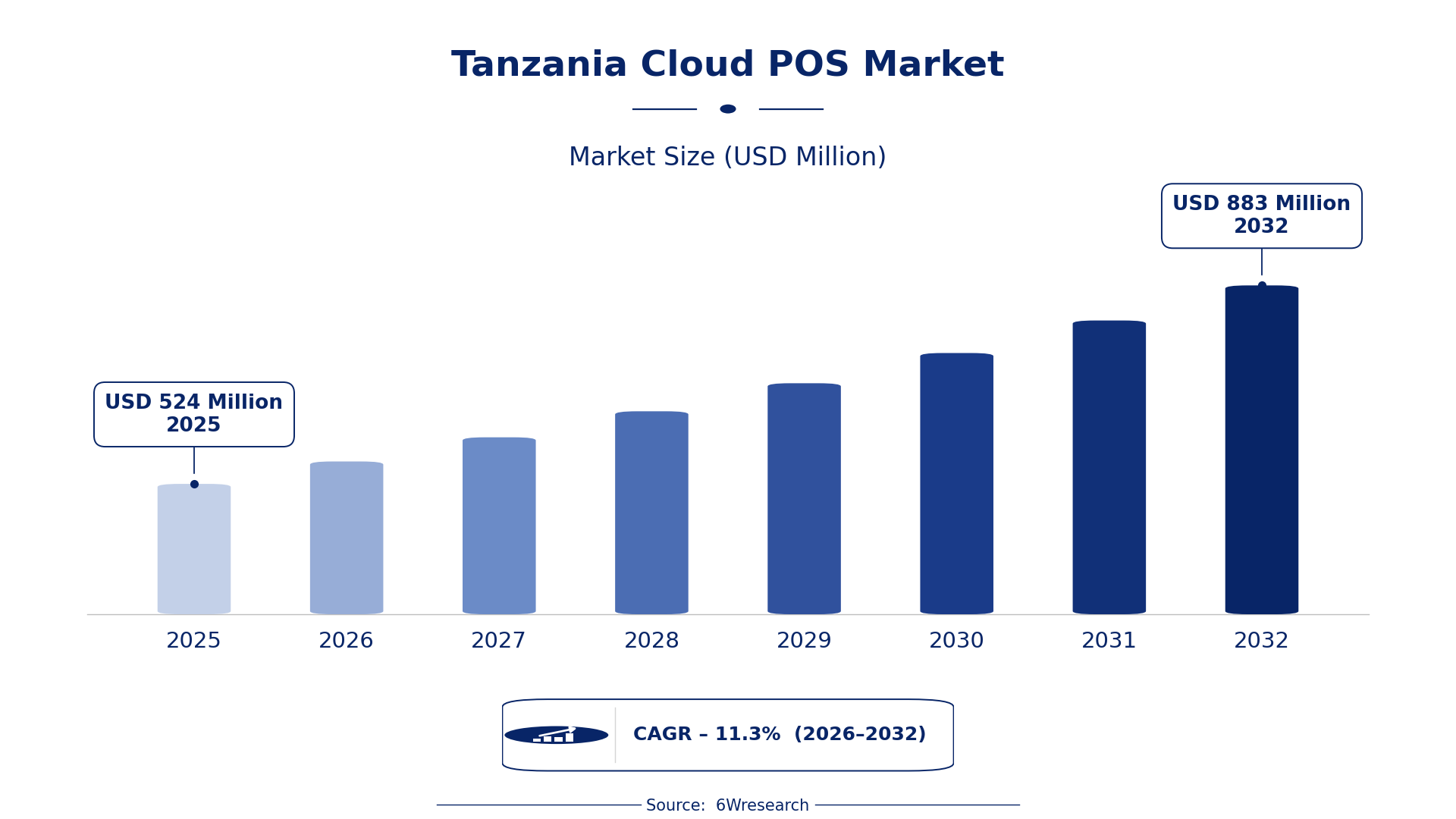
The Tanzania Cloud POS Market was estimated at USD 524 Million in 2025 and is projected to reach USD 883 Million by 2032, growing at a CAGR of 11.3% from 2026 to 2032.
Tanzania Cloud POS Market Synopsis
The demand for cloud-based point-of-sale systems in Tanzania is surging, driven by the retail and hospitality sectors’ increasing need for efficient transaction solutions. Businesses are turning to cloud POS systems to enhance their operational efficiency and customer engagement, capitalizing on real-time analytics and remote access features.
This shift is evident as more retailers and service providers embrace digital payment solutions, which not only improve operational capabilities but also provide a competitive edge. The tailored offerings from cloud POS providers are further stimulating market growth, ensuring that the solutions meet the unique requirements of Tanzanian businesses.
Tanzania Cloud POS Market Year-wise Growth Rate and Key Drivers
This graph illustrates the annual growth rates of the Tanzania Cloud POS Market from 2021 to 2032, highlighting a steady upward trajectory and projected expansion over the forecast period.
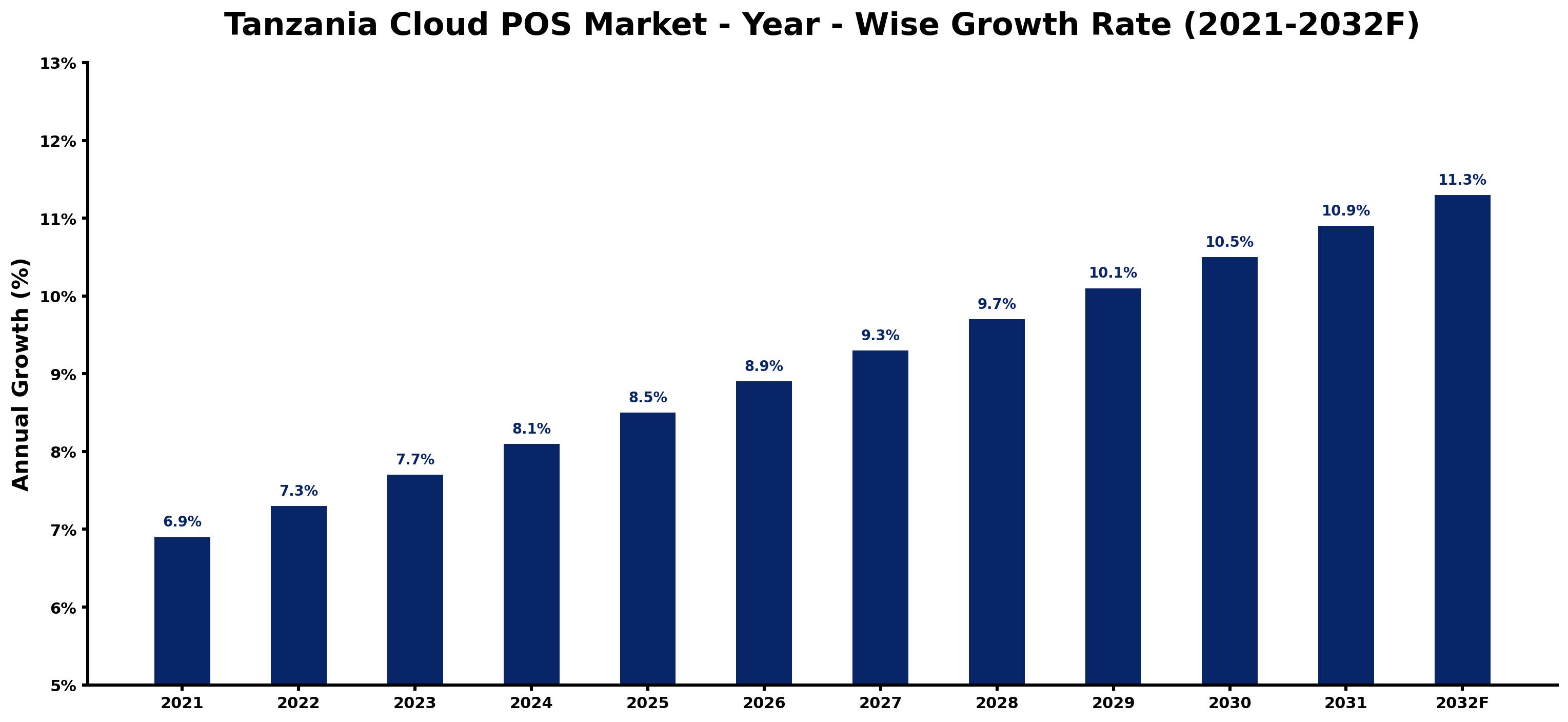
The table below presents the year‑wise growth rates along with the key drivers influencing the market
| Year | Growth Rate | Major Drivers |
| 2021 | 6.9% | Increased smartphone penetration driving cloud-based sales systems |
| 2022 | 7.3% | Tanzania's digital payment reforms boosting POS adoption rates |
| 2023 | 7.7% | Growth in local retailers adopting cloud solutions for efficiency |
| 2024 | 8.1% | Government initiatives enhancing digital infrastructure in urban areas |
| 2025 | 8.5% | Rising youth entrepreneurship fostering cloud POS usage |
| 2026 | 8.9% | Enhanced internet connectivity supporting remote POS functionalities |
| 2027 | 9.3% | Local partnerships improving access to Cloud POS technologies |
| 2028 | 9.7% | Increasing awareness of mobile payment platforms among merchants |
| 2029 | 10.1% | Supportive regulatory environment for technology startups emerging |
| 2030 | 10.5% | Growing trend towards cashless transactions in urban regions |
| 2031 | 10.9% | Tanzania's business formalization encouraging digital tool integration |
| 2032 | 11.3% | Increased foreign investments in Tanzanian tech sector advancements |
Note: Market size estimations and growth projections presented in this report are based on 6Wresearch's proprietary forecasting methodology, utilizing the latest available industry data, government publications, and primary research inputs.
Tanzania Cloud POS Market Key Takeaways
Below are some of the specific key takeaways from the market, including:
- The market is benefiting from the rise of digital payment methods and e-commerce integration.
- Cloud POS systems are increasingly recognized for their scalability and cost-effectiveness.
- Businesses are demanding advanced features such as inventory management and customer relationship tools.
- Challenges related to internet connectivity and data security are impacting adoption rates.
- Government initiatives are aimed at enhancing digital infrastructure and supporting technology integration.
Evaluation of Restraints in Tanzania Cloud POS Market
Despite the promising growth trajectory, several factors are impeding the broader adoption of cloud POS systems in Tanzania. Limited internet connectivity in rural areas hampers the full potential of real-time data processing, which is crucial for effective business operations. Additionally, concerns regarding data security and privacy are prevalent, particularly for small and medium-sized enterprises that may lack robust cybersecurity measures. The initial investment costs associated with implementing cloud POS solutions further complicate adoption, making it essential for providers to address these barriers to unlock market potential.
Tanzania Cloud POS Market Trends
A noticeable trend in the Tanzania Cloud POS market is the increasing integration of mobile payment solutions. As consumers become more comfortable with contactless payments, businesses are seeking cloud POS systems that can facilitate these transactions effectively. on top of that, the demand for real-time analytics is prompting providers to innovate, enabling businesses to make informed decisions based on customer behavior and inventory management.
Another emerging trend is the customization of cloud POS solutions tailored to specific industries such as healthcare, retail, and hospitality. This specialization not only enhances user experience but also drives loyalty among businesses seeking to improve operational efficiency.
Tanzania Cloud POS Market Opportunities
The Tanzania Cloud POS market presents numerous opportunities for growth, particularly for providers that can adapt their solutions to meet local needs. There's a strong potential for partnerships with e-commerce platforms to facilitate integrated online and offline payment systems. Additionally, as more businesses seek to enhance their customer experience, opportunities exist for cloud POS solutions that offer comprehensive CRM features and user-friendly interfaces.
Investment in educational initiatives aimed at small and medium-sized enterprises could further drive adoption, helping these businesses understand the benefits of cloud technology. As government support for digital infrastructure continues, the market is likely to see increased engagement from technology providers.
Government Initiatives in the Tanzania Cloud POS Market
The Tanzanian government is actively promoting digital transformation within the retail sector, fostering a conducive environment for cloud POS adoption. By prioritizing improvements in internet infrastructure and encouraging technology integration, the government is laying the groundwork for a more efficient payment ecosystem. These initiatives are essential for addressing existing barriers and facilitating the growth of cloud POS systems.
- A national digital infrastructure upgrade programme launched in early 2025 aims to enhance internet connectivity across urban and rural areas.
- Currently underway is a government initiative to provide training programs for small business owners on the benefits of digital payment systems.
- A regulatory framework introduced in 2025 encourages the adoption of transparent billing practices in digital transactions.
- Ongoing discussions regarding a public-private partnership to develop a nationwide mobile payment platform.
- Planned initiatives to enhance cybersecurity measures for businesses adopting cloud-based systems by 2026.
Future Insights of the Tanzania Cloud POS Market
Looking ahead to 2026-2032, the Tanzania Cloud POS market is expected to flourish as businesses increasingly recognize the value of digital transformation. The ongoing growth of e-commerce and mobile payment platforms will continue to create demand for sophisticated cloud POS solutions. As providers innovate to enhance their offerings, the market will likely see advancements in technology that cater to the unique needs of various industries, further driving adoption and customer satisfaction.
Tanzania Cloud POS Market Latest Developments
In the past year, the Tanzania Cloud POS market has witnessed a flurry of activity, with providers focusing on enhancing their offerings and expanding their reach. The push for digital transformation has spurred several initiatives aimed at improving customer engagement and operational efficiency across sectors.
- A leading regional operator launched a new cloud POS solution in Q1 2025, designed specifically for small retail businesses.
- An ongoing partnership between technology vendors aims to integrate AI-driven analytics into existing cloud POS systems, enhancing inventory management features.
- A major technology vendor is currently testing a mobile POS application that incorporates contactless payment options, expected to roll out in mid-2026.
- A recently completed pilot programme demonstrated the effectiveness of cloud POS solutions in streamlining operations for restaurants, generating positive feedback.
- Upcoming plans for a comprehensive cloud POS training initiative aimed at educating retailers about digital payment solutions are set for late 2026.
Tanzania Cloud POS Market - Key Attractiveness of the Report
- 10 Years of Market Numbers
- Historical Data Starting from 2022 to 2025
- Base Year: 2025
- Forecast Data until 2032
- Key Performance Indicators Impacting the Market
- Major Upcoming Developments and Projects
Key Highlights of the Report:
- Tanzania Cloud POS Market Outlook
- Market Size of Tanzania Cloud POS Market, 2025
- Forecast of Tanzania Cloud POS Market, 2032
- Historical Data and Forecast of Tanzania Cloud POS Revenues & Volume for the Period 2022-2032F
- Tanzania Cloud POS Market Trend Evolution
- Tanzania Cloud POS Market Drivers and Challenges
- Tanzania Cloud POS Price Trends
- Tanzania Cloud POS Porter's Five Forces
- Tanzania Cloud POS Industry Life Cycle
- Historical Data and Forecast of Tanzania Cloud POS Market Revenues & Volume By Application Areas for the Period 2022-2032F
- Historical Data and Forecast of Tanzania Cloud POS Market Revenues & Volume By Retail and Consumer Goods for the Period 2022-2032F
- Historical Data and Forecast of Tanzania Cloud POS Market Revenues & Volume By Travel and Hospitality for the Period 2022-2032F
- Historical Data and Forecast of Tanzania Cloud POS Market Revenues & Volume By Media and Entertainment for the Period 2022-2032F
- Historical Data and Forecast of Tanzania Cloud POS Market Revenues & Volume By Transport and Logistics for the Period 2022-2032F
- Historical Data and Forecast of Tanzania Cloud POS Market Revenues & Volume By Healthcare for the Period 2022-2032F
- Historical Data and Forecast of Tanzania Cloud POS Market Revenues & Volume By Component for the Period 2022-2032F
- Historical Data and Forecast of Tanzania Cloud POS Market Revenues & Volume By Solution for the Period 2022-2032F
- Historical Data and Forecast of Tanzania Cloud POS Market Revenues & Volume By Services for the Period 2022-2032F
- Historical Data and Forecast of Tanzania Cloud POS Market Revenues & Volume By Service for the Period 2022-2032F
- Historical Data and Forecast of Tanzania Cloud POS Market Revenues & Volume By Training, Consulting, and Integration for the Period 2022-2032F
- Historical Data and Forecast of Tanzania Cloud POS Market Revenues & Volume By Support and Maintenance for the Period 2022-2032F
- Historical Data and Forecast of Tanzania Cloud POS Market Revenues & Volume By Organization Size for the Period 2022-2032F
- Historical Data and Forecast of Tanzania Cloud POS Market Revenues & Volume By SMEs for the Period 2022-2032F
- Historical Data and Forecast of Tanzania Cloud POS Market Revenues & Volume By Large Enterprises for the Period 2022-2032F
- Tanzania Cloud POS Import Export Trade Statistics
- Market Opportunity Assessment By Application Areas
- Market Opportunity Assessment By Component
- Market Opportunity Assessment By Service
- Market Opportunity Assessment By Organization Size
- Tanzania Cloud POS Top Companies Market Share
- Tanzania Cloud POS Competitive Benchmarking By Technical and Operational Parameters
- Tanzania Cloud POS Company Profiles
- Tanzania Cloud POS Key Strategic Recommendations






































