Tanzania Coated Fabric Market Size, Share & Growth Rate
The Tanzania Coated Fabric Market was estimated at USD 490 Million in 2025 and is projected to reach USD 666 Million by 2032, growing at a CAGR of 4.5% from 2026 to 2032. This growth trajectory is largely attributed to the burgeoning automotive sector that increasingly demands coated fabrics for upholstery and interior applications. Additionally, the rising need for durable and water-resistant materials in industrial and protective clothing sectors significantly contributes to the market's expansion.
Tanzania Coated Fabric Market Year-wise Growth Rate and Key Drivers
This graph highlights how the Tanzania Coated Fabric Market has steadily grown over the years, supported by major growth factors.
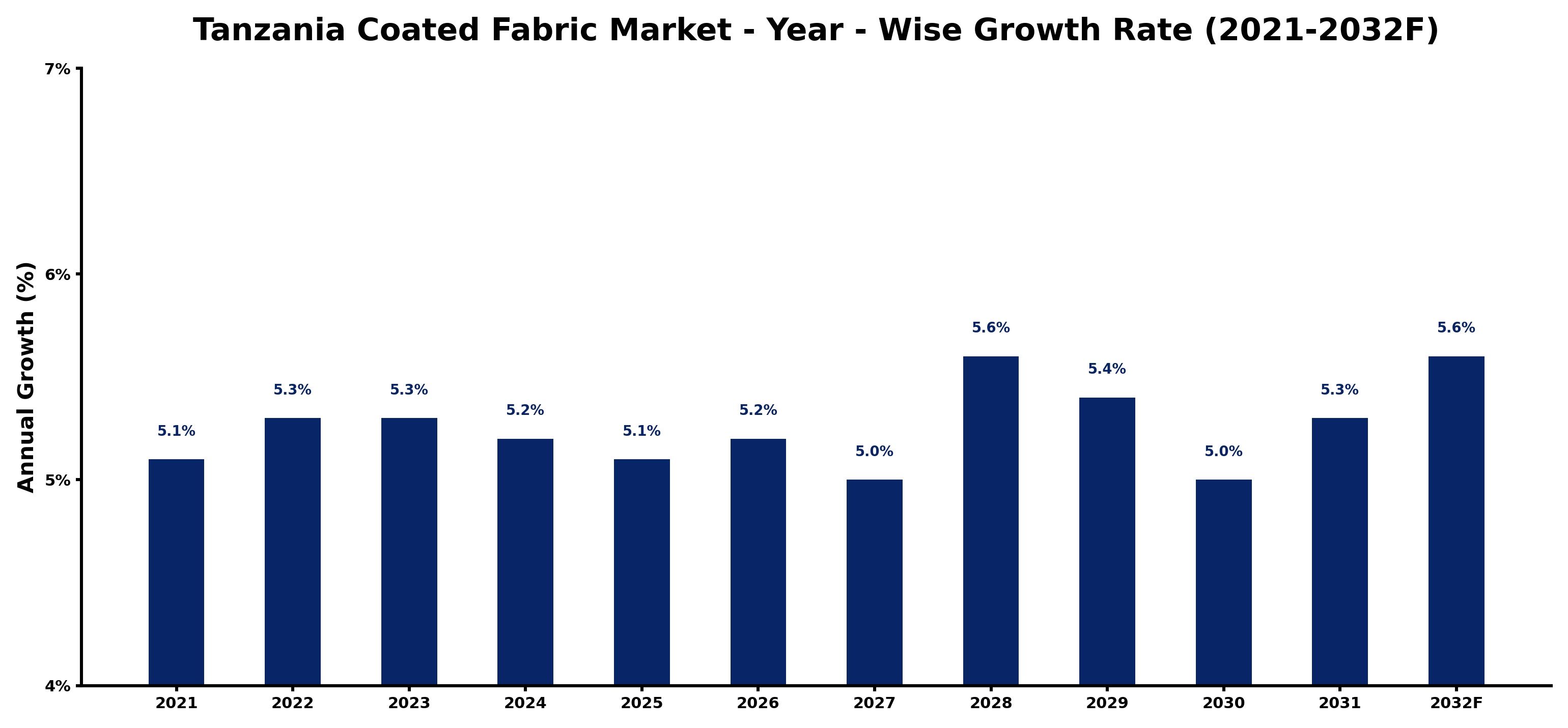
The table below presents the year‑wise growth rates along with the key drivers influencing the market
| Year | Growth Rate | Major Drivers |
| 2021 | 5.1% | Government infrastructure modernization initiatives |
| 2022 | 5.3% | Increasing smart city development projects |
| 2023 | 5.3% | Expansion of commercial construction activities |
| 2024 | 5.2% | Rising electricity demand across industries |
| 2025 | 5.1% | Increasing adoption of advanced technologies |
| 2026 | 5.2% | Government infrastructure modernization initiatives |
| 2027 | 5.0% | Growing urbanization and commercial development |
| 2028 | 5.6% | Increasing industrial infrastructure investments |
| 2029 | 5.4% | Growing urbanization and commercial development |
| 2030 | 5.0% | Expansion of manufacturing activities |
| 2031 | 5.3% | Expansion of commercial construction activities |
| 2032 | 5.6% | Government infrastructure modernization initiatives |
Note - Market size estimations and growth projections presented in this report are based on 6Wresearch's advanced forecasting approach, validated with industry datasets as of June 2026.
Tanzania Coated Fabric Market Synopsis
Recently, the Tanzania Coated Fabric Market has experienced a noticeable uptick in demand, thanks to innovative coating technologies and a stronger focus on multifunctional applications. Looking ahead, the market is set to evolve further, driven by continuous advancements and an expanding base of diverse applications, particularly in automotive and protective sectors.
However, while the current momentum is promising, the market must navigate challenges such as pricing pressures and stringent quality standards. These elements, combined with government initiatives aimed at bolstering the local textile industry, will shape the trajectory of the Tanzania Coated Fabric Market moving forward.
Tanzania Coated Fabric Market Key Takeaways
- The market is supported by the expanding automotive sector and increasing demand for protective clothing.
- Innovations in coating technologies are playing a crucial role in product differentiation.
- Government policies and incentives are fostering growth within the local textile industry.
- Competitive pricing and quality assurance remain critical challenges for manufacturers.
- The market's trajectory is poised for positive growth due to rising consumer demand for durable materials.
Evaluation of Restraints in Tanzania Coated Fabric Market
Despite the growth prospects, the Tanzania Coated Fabric Market is facing several restraints that could limit its potential. One major concern is the competitive pricing landscape, which is becoming increasingly intense as manufacturers grapple with rising raw material costs. This environment necessitates a careful balance between maintaining quality and controlling costs. Additionally, quality assurance remains paramount, especially as industries impose stringent standards regarding durability and performance. Environmental regulations surrounding the use of chemicals also compel manufacturers to invest in sustainable practices, adding further complexity to their operations. Finally, shifts in consumer preferences require agile strategies, making it imperative for companies to stay ahead of market dynamics.
Tanzania Coated Fabric Market Trends
In Tanzania, the coated fabric market is witnessing significant trends that are shaping its future. Key among these is the shift towards multifunctional coatings that provide enhanced durability, water resistance, and aesthetic appeal. This trend is particularly prevalent in automotive applications, where consumers are increasingly favoring materials that combine functionality with style. Moreover, advancements in eco-friendly coating technologies are gaining traction, reflecting a growing awareness and demand for sustainable manufacturing practices.
Another notable trend is the integration of smart fabrics into coated fabric applications. These innovative materials are designed to respond to environmental stimuli, offering unique features like temperature regulation and moisture management. As such advancements continue to emerge, they are expected to further elevate the capabilities of coated fabrics in various sectors.
Tanzania Coated Fabric Market Opportunities
The Tanzania Coated Fabric Market presents numerous growth and investment opportunities for stakeholders. Given the rising demand for automotive upholstery, manufacturers have the potential to innovate and introduce new, high-performance fabrics tailored for this sector. Furthermore, the increasing focus on protective clothing provides avenues for companies to explore specialized coatings that enhance safety and comfort for industrial applications. Additionally, leveraging advancements in sustainable production practices can not only address regulatory challenges but also appeal to environmentally conscious consumers, thereby opening up new market segments.
Government Initiatives in the Tanzania Coated Fabric Market
Government policies play a pivotal role in shaping the Tanzania Coated Fabric Market. Initiatives aimed at improving textile quality standards and ensuring the safe use of chemical coatings are key areas of focus. Moreover, the government's support for the local textile industry, through subsidies and various incentives, is fostering an environment conducive to growth and innovation. Such measures not only encourage investments but also aim to elevate the overall standards within the market.
Future Insights of the Tanzania Coated Fabric Market
Looking towards the future, the Tanzania Coated Fabric Market is poised for significant developments through 2026-2032. The ongoing advancements in coating technologies, coupled with strong governmental support, are likely to fuel further market growth. Additionally, as consumer preferences increasingly shift towards durable, multifunctional products, manufacturers will need to adapt their offerings accordingly. The intersection of sustainability and innovation will play a crucial role, positioning the market to capture new opportunities in both local and international arenas.
Tanzania Coated Fabric Market Latest Developments (May 2025 - June 2026)
In recent months, the Tanzania Coated Fabric Market has been trending towards innovations in environmentally friendly materials, with several manufacturers exploring new sustainable practices. There is also a visible shift in consumer preferences, as demand for versatile fabrics continues to rise across various industries. Furthermore, collaborations between governmental agencies and local manufacturers are being emphasized to promote quality standards and technological advancements, indicating a proactive approach towards market evolution.
Tanzania Coated Fabric Market - Key Attractiveness of the Report
- 10 Years of Market Numbers
- Historical Data Starting from 2022 to 2025
- Base Year: 2025
- Forecast Data until 2032
- Key Performance Indicators Impacting the Market
- Major Upcoming Developments and Projects
Key Highlights of the Report:
- Tanzania Coated Fabric Market Outlook
- Market Size of Tanzania Coated Fabric Market, 2025
- Forecast of Tanzania Coated Fabric Market, 2032
- Historical Data and Forecast of Tanzania Coated Fabric Revenues & Volume for the Period 2022-2032F
- Tanzania Coated Fabric Market Trend Evolution
- Tanzania Coated Fabric Market Drivers and Challenges
- Tanzania Coated Fabric Price Trends
- Tanzania Coated Fabric Porter's Five Forces
- Tanzania Coated Fabric Industry Life Cycle
- Historical Data and Forecast of Tanzania Coated Fabric Market Revenues & Volume By Product for the Period 2022-2032F
- Historical Data and Forecast of Tanzania Coated Fabric Market Revenues & Volume By Polymer-coated Fabric for the Period 2022-2032F
- Historical Data and Forecast of Tanzania Coated Fabric Market Revenues & Volume By Rubber-coated Fabric for the Period 2022-2032F
- Historical Data and Forecast of Tanzania Coated Fabric Market Revenues & Volume By Fabric-backed Wall Coverings for the Period 2022-2032F
- Historical Data and Forecast of Tanzania Coated Fabric Market Revenues & Volume By Application for the Period 2022-2032F
- Historical Data and Forecast of Tanzania Coated Fabric Market Revenues & Volume By Transportation for the Period 2022-2032F
- Historical Data and Forecast of Tanzania Coated Fabric Market Revenues & Volume By Protective Clothing for the Period 2022-2032F
- Historical Data and Forecast of Tanzania Coated Fabric Market Revenues & Volume By Industrial for the Period 2022-2032F
- Historical Data and Forecast of Tanzania Coated Fabric Market Revenues & Volume By Roofing, Awnings & Canopies for the Period 2022-2032F
- Historical Data and Forecast of Tanzania Coated Fabric Market Revenues & Volume By Furniture & Seating for the Period 2022-2032F
- Historical Data and Forecast of Tanzania Coated Fabric Market Revenues & Volume By Others for the Period 2022-2032F
- Tanzania Coated Fabric Import Export Trade Statistics
- Market Opportunity Assessment By Product
- Market Opportunity Assessment By Application
- Tanzania Coated Fabric Top Companies Market Share
- Tanzania Coated Fabric Competitive Benchmarking By Technical and Operational Parameters
- Tanzania Coated Fabric Company Profiles
- Tanzania Coated Fabric Key Strategic Recommendations






































